Top 10 Diamond Saw Blade Suppliers in Brazil for Granite Quarry and Slab Processing in 2026
Why Brazilian Granite Decides Which Supplier You Can Trust
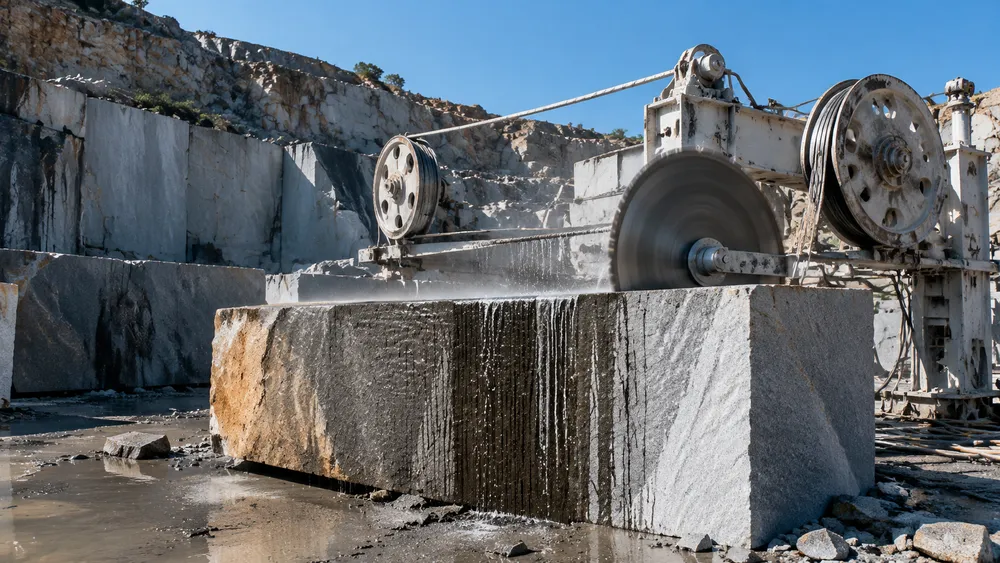
Brazil is one of the largest granite producers and exporters on the planet, which means the people sourcing blades here are rarely buying a single disc for a job. You are running a quarry face, a block-squaring yard, or a slab plant with gang saws that eat segments by the hundred. That scale changes what "a good supplier" means, and it is exactly why the search for diamond saw blade suppliers brazil turns up so little that is actually useful — most listings sell you a catalog, not a cutting result.
The stone itself is the reason. Brazilian granites out of Espírito Santo, Bahia, and Ceará tend to run hard and abrasive, and that combination punishes a mismatched blade in two opposite ways. Too hard a bond and the segment glazes over — the diamonds never expose, the blade polishes the stone instead of cutting it, and your operator watches the feed rate collapse while the motor heats up. Too soft a bond and the matrix wears away faster than the diamond can work, so blade life falls off a cliff and your cost-per-cut doubles. A granite diamond saw blade brazil buyers can actually rely on is one where the bond hardness was matched to the specific stone, not pulled off a shelf labeled "granite" as if all granite were the same.
Then there is the sourcing friction that has nothing to do with the blade and everything to do with getting it. Import lead time, port clearance timing at Santos or Vitória, duty landed on top of the unit price, and the very real risk that the spec you ordered was never tuned for your stone in the first place. Every one of those is a place where a wrong decision costs you either downtime or margin. So before any list of names is worth reading, it helps to be honest about what you are really screening for.
How Serious Buyers Should Evaluate a Diamond Blade Supplier
Before any name goes on a shortlist, decide what you are grading it against. A supplier can have a slick catalog and a warehouse in São Paulo and still be wrong for a slab plant, because the things that protect your margin sit underneath the marketing. Any diamond blade manufacturer brazil operators take seriously should stand up to the same set of questions:
| Criterion | What to actually ask | Why it moves your margin |
|---|---|---|
| Bond formula control | Does this supplier design and sinter its own segments, or resell someone else's blades? | If they own the formula, they can retune it for your granite. If they resell, "custom" means picking from a fixed menu. |
| Granite-matched spec | Can they adjust bond hardness and diamond concentration for hard versus abrasive stone? | A quarry block cutting blade supplier that treats all granite the same will cost you either speed or blade life. |
| Certifications | ISO 9001 for process control, CE and MPA where you resell into regulated markets, SGS on request | Pre-qualified paperwork keeps your compliance team out of the critical path. |
| MOQ flexibility | Can they support both a trial batch and a monthly container? | Low MOQ lets you test a formula before committing volume. |
| Reorder capacity | Do repeat orders wait behind other buyers, or is throughput deep enough to keep you stocked? | Stockouts on a running gang saw line are downtime, not an inconvenience. |
| Full size range | Everything from small fabrication discs to large gang saw and block segments under one roof | One supplier across the range means fewer POs and one QC standard. |
| Landed cost transparency | Ex-works price, plus freight, duty, and lead time to your port — not just a unit quote | The number that matters is delivered cost per blade, not the sticker price. |
The two that separate a real manufacturing partner from a box-mover are bond formula control and granite-matched spec. If a supplier cannot change what happens inside the segment, everything else is just logistics around a blade that may or may not suit your stone.
The Top 10 Diamond Saw Blade Suppliers Serving the Brazilian Granite Market
A quick note on how this list is built, because an honest framework helps you more than a fake scoreboard. These suppliers are grouped by supplier model — global full-line brands, European stone-tooling specialists, Asian export manufacturers, and Brazilian distributors — rather than ranked one through ten on a single made-up score. Granite operations differ too much for a universal winner: the right choice for a fabrication shop running edging discs is the wrong choice for a slab plant feeding gang saws. Names and market positions should be confirmed against each company's current official site before you commit a PO, since distribution arrangements and product lines shift year to year.
Global full-line brands (deep distribution, broad catalogs)
- Saint-Gobain Abrasives (Norton) — A long-established abrasives operation with a real footprint inside Brazil, covering stone and construction cutting tools. Best fit when you want an in-country brand name with local availability and are less focused on granite-specific bond tuning.
- Husqvarna Construction — A global diamond tool line (carrying the Diamant Boart heritage) with South American distribution, strong on standardized blades for construction and fabrication. Best fit for buyers who value a recognized brand and consistent stock across categories.
- Tyrolit — An Austrian manufacturer with a broad stone and construction range, including gang saw and stationary-machine blades. Best fit for slab plants that want a European engineering pedigree and can plan around import lead time.
- Robert Bosch — Broad diamond disc distribution across Brazil, strongest at the fabrication and edging tier rather than heavy quarry block work. Best fit for shops needing widely available small-to-mid discs through existing channels.
European stone-tooling specialists (slab and fabrication focus)
- ADI — An Italian stone-tooling specialist serving slab and fabrication plants, with tooling built specifically around stone processing. Best fit for finishing and profiling operations that want dedicated stone expertise.
- Diamut (Biesse Group) — Italian stone tooling under the Biesse machinery group, oriented toward slab processing lines. Best fit when your plant already runs Biesse equipment and wants matched tooling.
- Italdiamant — An Italian diamond tool maker producing for stone applications and exporting internationally. Best fit for buyers sourcing specialty stone tools who can absorb European lead times.
Asian export manufacturers (volume and export experience)
- Ehwa Diamond Industrial — A large Korean diamond tool manufacturer exporting stone blades worldwide, including into South American markets. Best fit for volume buyers who want a big-manufacturer supply base with export experience.
- Shinhan Diamond Industrial — An established Korean diamond tool exporter with a broad stone-cutting range. Best fit for distributors building a mid-to-premium import line.
Brazilian distributors and importers (in-country stock)
- In-country distributor-importers (for example, Cortag and similar regional suppliers) — This channel's real value is local stock, familiar communication in Portuguese, and fast replenishment when a line goes down. It tends to be strongest at the fabrication and edging tier; for heavy quarry block segments, confirm whether they stock or special-order. Best fit for urgent needs and smaller volumes where speed beats unit cost.
Local suppliers earn their place on this list. When a blade fails mid-shift and you need a replacement tomorrow, an importer with stock on the shelf is worth more than a lower ex-works price sitting in a container three weeks out. The question is not whether local supply is good — it is which of your orders it actually suits.
Matching Blade and Segment Type to Your Granite Operation
Screening suppliers only pays off if you know what to ask them for. A granite operation is really several different cutting jobs, and each one wants a different blade and a different bond. Getting the type right is where a quarry block cutting blade supplier proves whether they understand your work or just sell tools.
- Quarry block squaring — Large-diameter blades and segments (running up to 3200 mm on the biggest setups) do the heavy work of turning a rough block into a squared one. Here segment height and bond durability matter most; you are cutting deep into hard, abrasive stone and you need life, not just speed.
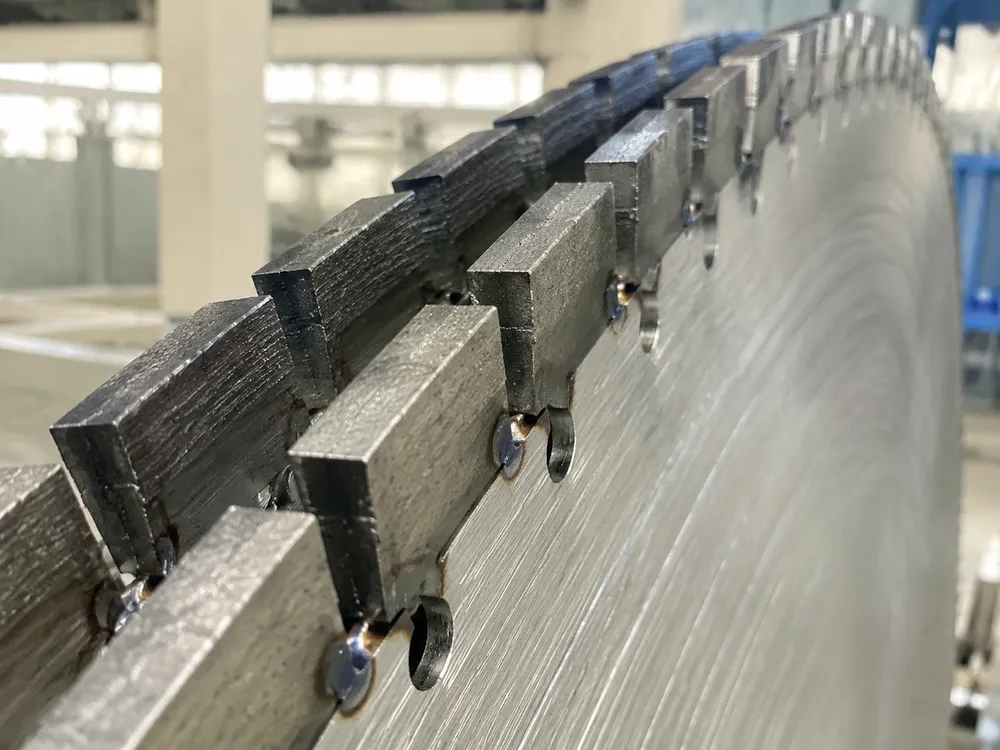
- Gang saw slab production — A gang saw blade brazil slab plants depend on carries many segments working in parallel across a block. Segment spacing, diamond concentration, and bond hardness have to be consistent blade-to-blade, because one soft outlier in the gang wears unevenly and throws off the whole cut. Diamond gang saw segments for granite slab processing are where uniform sintering quality shows up directly in your slab yield.
- Bridge saw and block cutting — Mid-to-large blades for cross-cutting and trimming slabs to size. Bond needs to balance a clean edge against reasonable life on hard granite.
- Edging and fabrication — Smaller discs from 105 mm up handle profiling, notching, and finishing. These move in high volume through fabrication shops and are the tier local distributors stock most reliably.
Underneath all of it is one rule: bond hardness has to match the stone. The right bond hardness cuts fast and lasts — everything else is compromise. Harder, more abrasive granite generally wants a bond tuned to keep exposing fresh diamond without wearing away prematurely, and the concentration has to suit both the stone and the machine's power and RPM. (In practice we see the same granite "type" behave differently between two quarries a hundred kilometers apart, which is why we ask for the specific origin, not just "Brazilian granite.")
So when you approach any supplier, have the real spec ready: granite origin and rough hardness, blade diameter and arbor, target feed rate, and whether you are cutting wet or dry. A supplier who can turn that into a bond recommendation is one who controls their formula. A supplier who just asks "which model?" is selling from a shelf.
The Real Cost of Convenience: Local Stock vs Factory-Direct Containers
There are orders where buying local is simply the right call, and it is worth saying so plainly. If a blade fails on a running line and every hour of downtime costs you more than the blade itself, the distributor with stock on the shelf wins — every time. Emergency replacements, one-off small quantities, a trial before you commit, a project where the delivery date is fixed and immovable: for all of these, in-country stock and Portuguese-speaking support are worth paying a premium for. The diamond saw blade suppliers brazil relies on for fast turnaround are doing exactly the job they are good at.
The trade-off shows up at volume. Local stock has to be imported, warehoused, financed, and carried, and every one of those steps adds a layer to the price before the blade reaches you. On a single urgent blade, that premium is invisible against the cost of downtime. On a monthly reorder of gang saw segments, it compounds — the same convenience that saved you once is now quietly compressing your margin on every container's worth of blades you buy.
Factory-direct changes the math in the other direction. Ordering by the container from the manufacturer removes the distribution markup and, just as importantly, gives you formula control — the ability to have segments tuned to your granite rather than picked from stock. What it asks in return is planning: a lead time measured in weeks and an MOQ commitment, instead of same-day pickup. There is no single tariff figure that settles this for everyone, because your landed cost is a function of order size, urgency, and how much quality control you need. The honest way to decide is to run your own numbers: delivered cost per blade for local stock versus factory-direct, across a real year of demand. For a gang saw blade brazil slab plants reorder every month, that comparison usually tells a very different story than it does for a shop buying a dozen discs at a time.
Where a Factory-Direct Manufacturer Fits: The CLSEG Route
Once the local landscape is clear, the factory-direct option is easier to place. We are not a Brazilian distributor and would not pretend to be one — you will not get a blade from us tomorrow afternoon. What we offer is the other half of the sourcing decision: the manufacturer at the source of the supply chain, for the repeat-volume and quality-critical orders where that matters most.
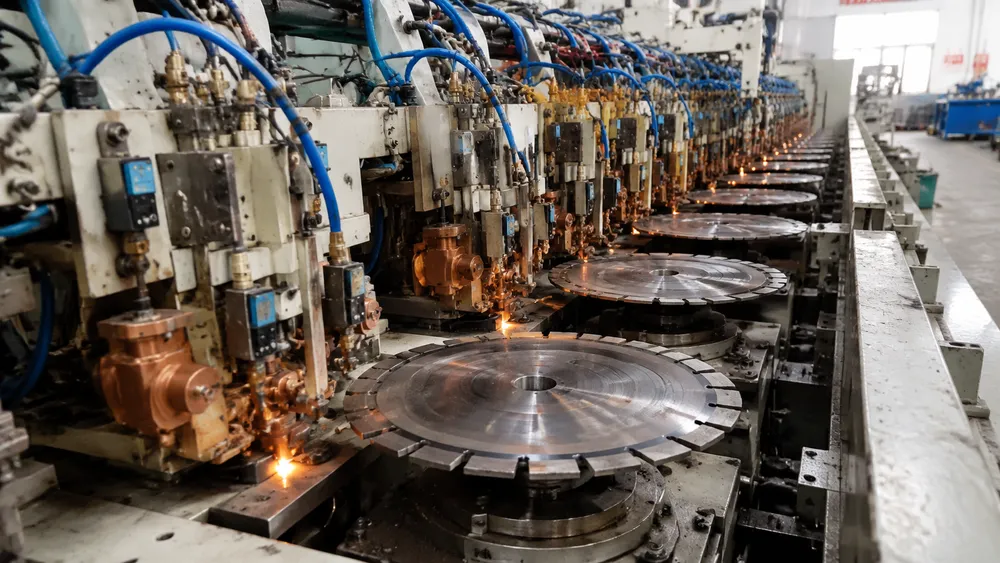
Here is what that means in practice. We have made diamond saw blades since 2003, and that is all we make — no sideline products, no trading-company layer between you and the people who control the formula. Our 14,100 m² facility runs 8 fully automated lines at an annual capacity of 3,000,000 pieces, so your monthly reorder of gang saw segments does not queue behind someone else's order. We produce the full range under one roof, from 105 mm fabrication discs to 3200 mm gang saw and quarry block segments, which means one supplier and one QC standard across every blade type your operation runs. You can see the full lineup on our Diamond Saw Blades category page.
The part that matters most for hard granite is formula control. Our in-house R&D center holds 60+ patents, and because we design and sinter our own bonds, "granite-tuned" is a real adjustment, not a menu choice — we set diamond concentration and bond hardness to your specific stone origin. For factory direct diamond blades for hard granite cutting, that is the whole point: the bond is matched before the blade ever ships. We hold ISO 9001:2015, CE, SGS, and MPA certifications, so if you are reselling into regulated markets, the compliance paperwork is already in hand. And because OEM and ODM are how we work rather than a special request, Brazilian resellers can order private-label packaging and brand-specific specs as a normal part of the process. If you want a specific bond recommendation for your granite, that starts with a conversation through our contact page.
Choosing Your Sourcing Route by Scenario
Strip away the supplier names and the decision comes down to matching the order to the route:
- Urgent, low-volume, or emergency replacement → Buy local. In-country distributor stock and same-language support are worth the premium when downtime is the real cost.
- Repeat-volume slab-plant procurement → Go factory-direct with a validated bond spec. Once you know the formula that works on your granite, ordering it by the container removes the markup and keeps your lines stocked.
- Cost-sensitive bidding → Run the landed-cost comparison. For a bulk diamond saw blade supplier for granite plants brazil scenario, delivered cost per blade across a year usually favors container-direct over carried local stock.
- Quality-critical or regulated resale → Prioritize formula control and documentation. A supplier who owns the bond and holds MPA and CE certifications keeps both your cutting results and your compliance predictable.
Most serious operations end up using both routes — local stock for the urgent gaps, factory-direct for the planned volume. The mistake is defaulting to one for everything and paying for it in either downtime or margin. Whichever way you lean, the specs that make any quote real are the same: granite type and origin, blade diameter and arbor, wet or dry cutting, and your annual volume. Bring those four things to any supplier and you will get a recommendation you can actually compare — and if you want ours, that is exactly where the contact page conversation starts.