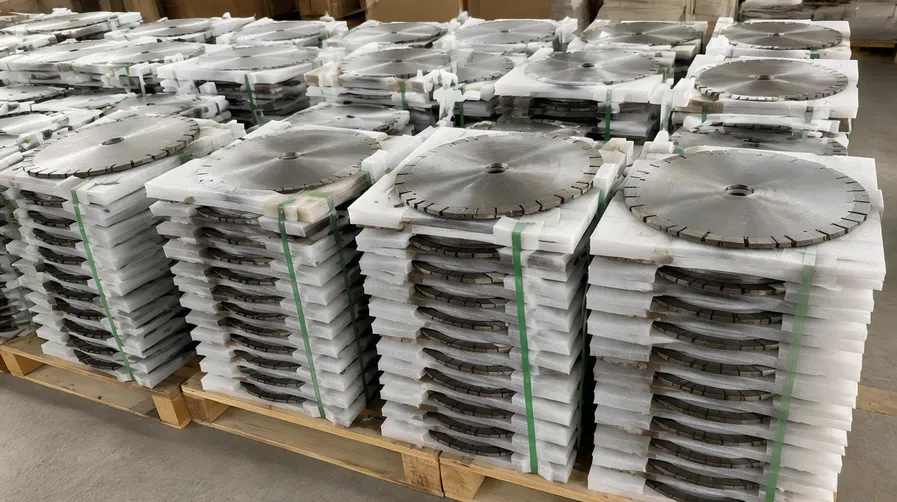
Concrete Diamond Cutting Discs Engineered for Aggregate, Rebar & Repeated Abuse
Segmented rim geometry with thermally stable bond formulas developed specifically for concrete's dual challenge: hard aggregate plus incidental rebar contact. Available 105–230 mm for angle grinders and handheld cut-off saws.
- Laser-welded option available for dry-cut / high-RPM
- OEM / private label from 500 pcs
- 20–25% higher diamond concentration than standard construction blades
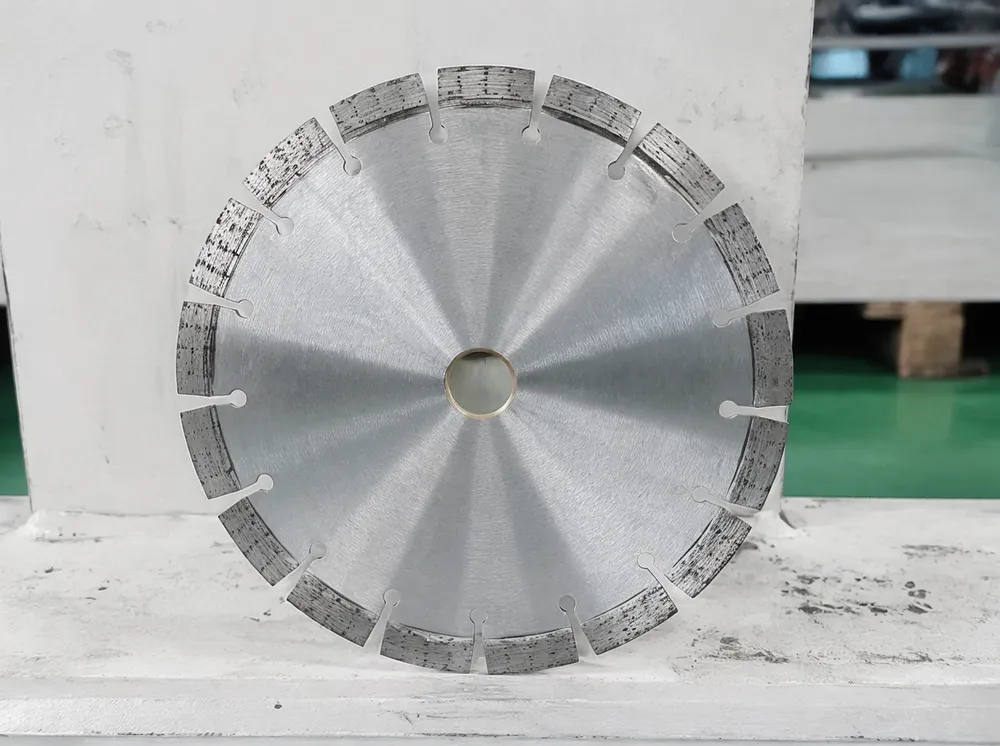
What Makes Concrete Different from Every Other Material These Blades Cut
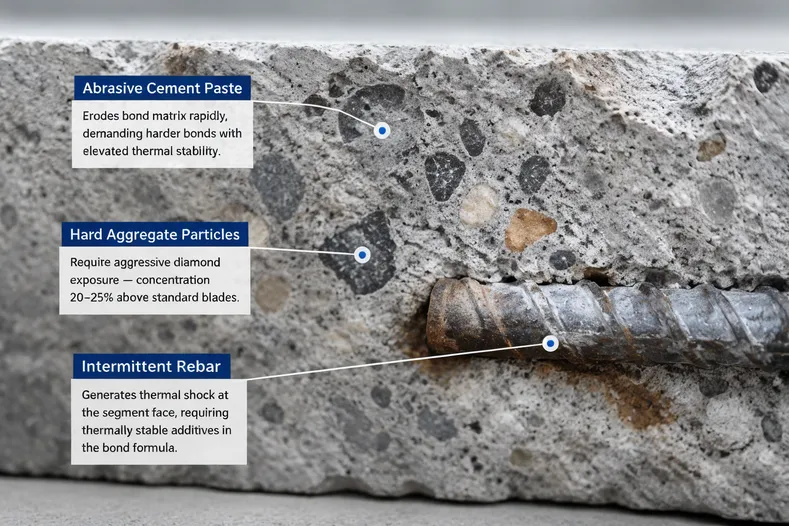
Concrete is not stone. A granite cutting disc formula will fail on concrete within minutes, and the reason comes down to material composition: concrete is a composite of cement paste, sand, gravel aggregate (varying hardness depending on regional quarry source), and frequently embedded steel reinforcement. The blade encounters three distinct material behaviors in a single cut — abrasive paste that erodes the bond, hard aggregate particles that demand aggressive diamond exposure, and intermittent rebar that generates thermal shock at the segment face.
We develop concrete-specific diamond cutting disc formulas around this reality. The bond matrix is harder than what we use for granite or marble, with elevated thermal stability additives to survive the heat cycling when diamonds contact steel. Diamond concentration runs 20–25% higher than our standard construction blades because concrete's abrasiveness strips segments faster. The segment geometry uses wider gullets for debris clearance — concrete dust packs dense and will choke a blade that doesn't clear fast enough.
If you're stocking diamond cutting discs for the construction and renovation market, concrete blades are your highest-turnover SKU. Every job site pours or cuts concrete. Your customers go through these faster than any other blade type in the range.
Three Material Behaviors in One Cut
Abrasive Cement Paste
Erodes bond matrix rapidly, demanding harder bonds with elevated thermal stability.
Hard Aggregate Particles
Require aggressive diamond exposure — concentration 20–25% above standard blades.
Intermittent Rebar
Generates thermal shock at the segment face, requiring thermally stable additives in the bond formula.
Technical Specifications for This Product
Specifications shown are standard production values. Contact us for detailed data sheets or custom configurations.
| Parameter | Standard Value |
|---|---|
| Diameter options | 105, 110, 115, 125, 150, 180, 200, 230 mm |
| Arbor bore | 20 mm, 22.23 mm, 25.4 mm (others on request) |
| Segment height | 10–12 mm (standard), 7–8 mm (economy) |
| Segment thickness | 2.0–2.8 mm |
| Blade body thickness | 1.6–2.4 mm |
| Segment count (115 mm) | 8 segments |
| Segment count (230 mm) | 16 segments |
| Rim type | Segmented (std), turbo segmented (premium) |
| Segment attachment | HF welded (std), laser welded (dry/high-RPM) |
| Maximum RPM | 13,300 (115 mm) / 6,600 (230 mm) |
| Cutting method | Dry or wet (config dependent) |
| Compatible tools | 4"–9" angle grinders, cut-off machines, masonry saws |
Most Popular Configuration
- 115 mm diameter, 22.23 mm arbor, 10 mm segment, laser-welded, 8-segment — covers European & Middle Eastern markets
- 105 mm / 20 mm arbor — Southeast Asian market standard
- 125 mm / 22.23 mm — South American distributor standard
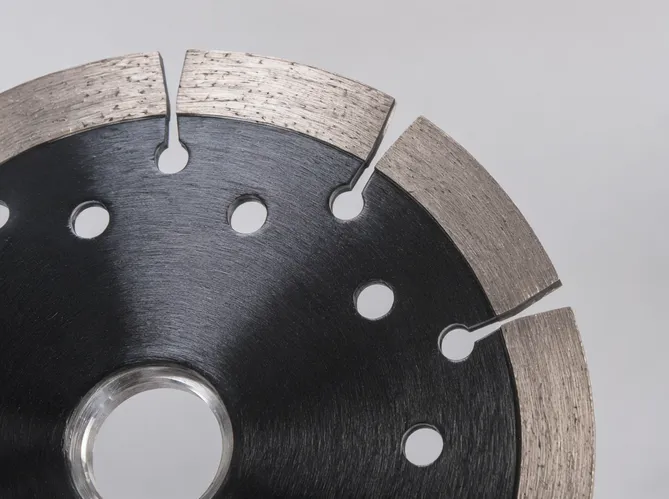
The Bond Formula That Separates a Concrete Blade from a Generic Disc
This is where we spend the most engineering time for this product line — and where the performance gap between our blades and commodity imports becomes obvious to your end users within the first ten cuts.
Concrete cutting demands a hard bond matrix. The cement paste and sand are highly abrasive, meaning a soft bond (the type used for hard granite) would erode within minutes. But the bond can't be too hard either — if aggregate chunks break loose and expose fresh, non-abrasive cement paste surface, the diamonds need to self-sharpen by controlled bond wear. We formulate concrete blades in the medium-hard to hard range on our internal bond scale, with iron-cobalt-bronze matrix and specific tungsten carbide additives for thermal shock resistance.
We maintain three concrete formula tiers:
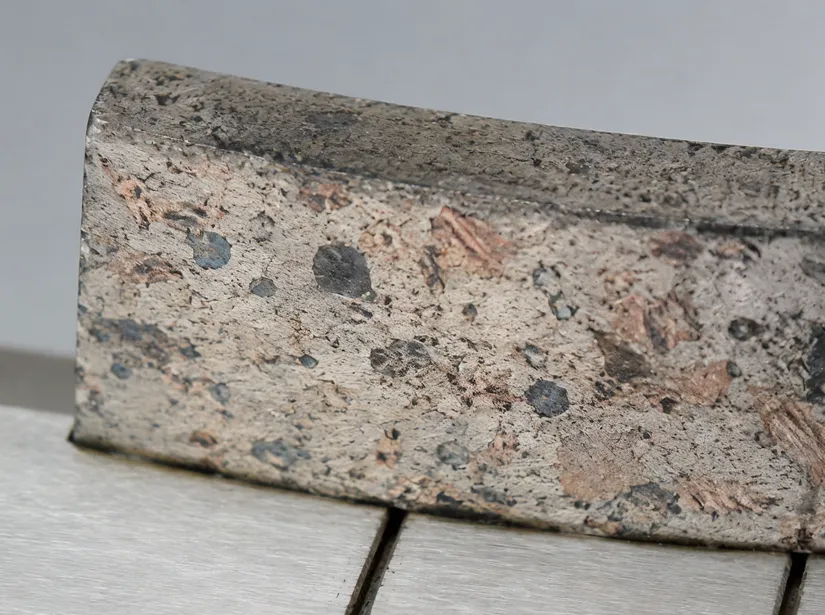
Bond matrix microstructure — iron-cobalt-bronze with tungsten carbide additives
Standard Concrete
For C20–C35 grade cured concrete, unreinforced or lightly reinforced. Medium-hard bond, 30/40 mesh diamond grit for aggressive stock removal.
- C20–C35 grade cured concrete
- Medium-hard bond formulation
- 30/40 mesh diamond grit
- Volume SKU for general construction
Reinforced Concrete
For C35+ slabs with heavy rebar density. Hard bond with elevated cobalt content for thermal stability at the rebar contact point.
- C35+ with heavy rebar density
- Elevated cobalt for thermal stability
- 40/50 mesh — blocky crystal morphology
- Impact-resistant shape for steel contact
Green/Fresh Concrete
For early-age cutting within 24–72 hours of pour (joint cutting, road construction). Extremely abrasive because cement hasn't fully cured.
- 24–72 hours post-pour
- Hardest bond in concrete range
- Reduced diamond concentration
- Joint cutting & road construction
When you tell us what your market cuts most — residential slabs, highway joints, renovation demo, precast plant processing — we match the formula tier. This isn't marketing differentiation; it's the difference between a blade that delivers 50+ cuts at rated depth and one that's done in 20.
We've had buyers switch from a "universal" blade to our reinforced concrete formula and see segment life increase 40% on the same job. The formula is invisible on the shelf — two blades look identical — but the downstream complaint rate tells the real story.
Construction Market Segments Where Concrete Blades Generate Repeat Orders
Your buyers work in specific verticals. Here's where concrete diamond cutting discs move volume and how the commercial logic plays out:
Residential & Commercial Renovation
High-velocity · Price-aware · Quality-dependentDemolition and remodeling contractors cut through existing concrete floors, walls, and structural elements daily. They consume blades at 3–5 per week per crew and buy through local distributors or hardware chains.
Quality matters: a blade that stalls mid-cut on reinforced concrete costs the crew downtime and the contractor credibility with the project owner.
Road & Infrastructure Construction
Project-driven · Large orders · Contract-basedJoint cutting in fresh concrete pavement, trench cutting for utilities, highway repair patches. Contractors run handheld cut-off saws (230 mm blades primarily) and consume blades in larger quantities per project — 20–50 blades per road section.
Orders are project-driven and lumpy but large. If you distribute into government infrastructure supply chains, this segment offers contract-based predictable volume.
Precast Concrete Manufacturing
Steady consumption · Predictable · Highest loyaltyFactories producing precast walls, pipes, culverts, and modular building elements cut cured concrete daily as part of their production line. Blade consumption is steady and predictable: X blades per shift, Y shifts per week, 50 weeks per year.
They want consistent blade life so their production planning holds. Precast buyers are the most loyal once you match their consumption rate — they hate changing suppliers mid-production.
Electrical & Plumbing Contractors
Lower per-buyer volume · Massive total segmentChasing conduit channels in concrete walls and floors. Overlaps with our wall chaser blade line, but many contractors simply use standard concrete cutting discs on their angle grinders for this work.
Volume per contractor is lower, but the segment is massive in total — every building gets wired.
Landscaping & Hardscaping
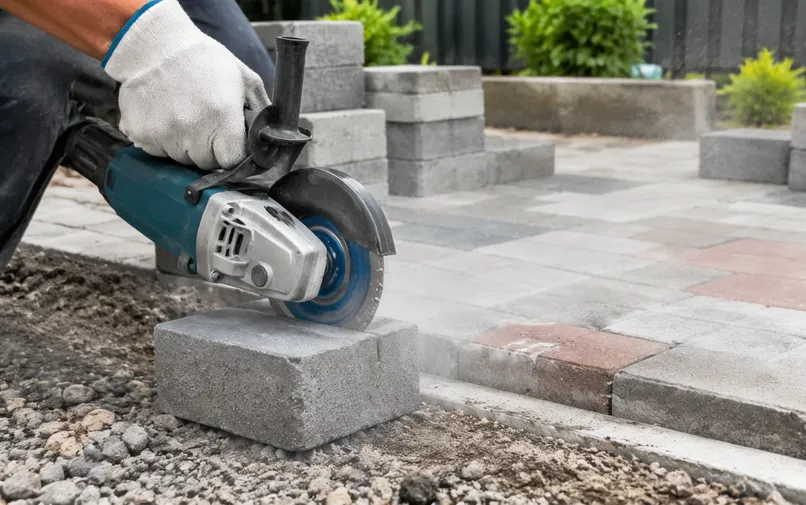
Retail hardware channel · Entry-level SKUCutting concrete pavers, curbs, decorative blocks. Smaller diameter blades (105–125 mm) at moderate volume per buyer, but widespread across the retail hardware channel.
Good entry-level SKU for distributors building out a diamond blade section.
Build a concrete blade line matched to your market
Each segment has different pricing sensitivity, order patterns, and formula requirements. We can help you build a concrete blade product line that covers the three or four most relevant segments for your market without carrying dead stock in formulas that don't move.
Laser-Welded vs. High-Frequency Welded — Choosing the Right Joint for Your Market
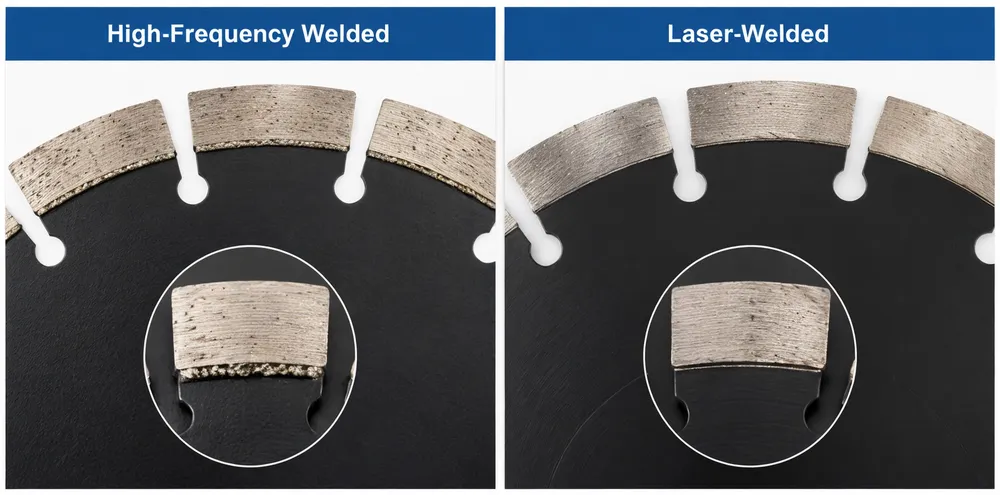
The segment attachment method affects product positioning, price point, and the end-use scenarios your buyers can safely cover. We offer both for concrete cutting discs, and most distributors stock both.
High-Frequency Welded
Adequate for wet cutting and moderate dry cutting with periodic cooling breaks. Bond strength exceeds operational forces under normal use conditions.
Positioning: "Contractor Grade" line
Laser-Welded
Weld joint is 30–40% stronger under thermal stress, making it safe for sustained dry cutting at full RPM without water. No segment loss risk during aggressive feed rates in reinforced concrete.
Positioning: "Professional" / "Safety-Rated" line
Price Differential & Product Line Strategy
15–25%
Price premium per blade (diameter-dependent)
30–40%
Stronger weld joint under thermal stress
~60%
Of our EU concrete blade volume now laser-welded
The price differential is enough to create a distinct tier in your product line without cannibalizing volume from the standard range. Many distributors use high-frequency welded as their "contractor grade" line and laser-welded as their "professional" or "safety-rated" line, with corresponding margin on the premium tier.
MPA Certification & EU Market Shift
We've shifted about 60% of our European concrete blade volume to laser-welded over the past three years. MPA certification, which we hold, specifically tests segment retention under dry-cut thermal stress — and EU distributors increasingly require it for their professional-grade listings.
Customization Scope for Concrete Diamond Cutting Discs
You're sourcing these to build a product line — not buying retail. Here's what we adjust for your requirements.
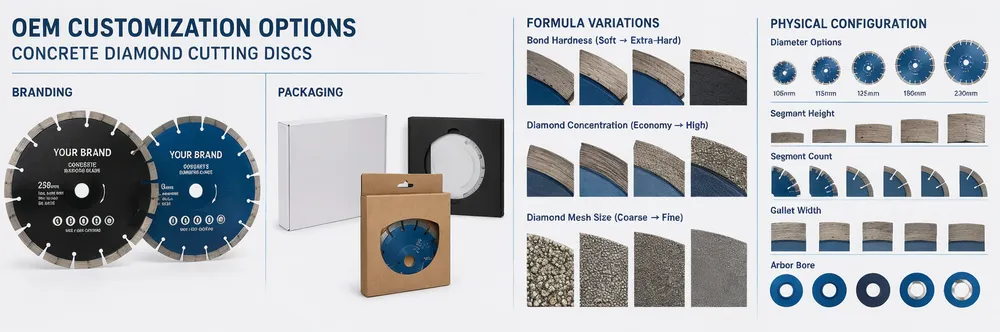
Formula Customization
- Bond hardness grade (soft through extra-hard on our internal scale)
- Diamond mesh size (30/40 through 50/60 for concrete applications)
- Diamond concentration (standard, high-concentration, economy)
- Target material specification (tell us the concrete type and rebar density)
Physical Configuration
- Any standard diameter from 105–230 mm
- Arbor bore to match your market's tool standard
- Segment height (determines blade life — taller segments = longer life but higher cost per blade)
- Segment count and gullet width (affects cut speed vs. life balance)
- Laser-welded or high-frequency welded
Branding & Packaging
- Private-label blade printing (your brand, safety text, RPM rating, barcode)
- Custom core color (painted steel — any RAL color available on runs over 1,000 pcs)
- Packaging: blister pack, paper card, tin box, bulk carton, custom sleeve
- Your artwork, your UPC/EAN codes, your regulatory text
MOQ & Lead Time
Formula change on standard packaging: 500 pcs per SKU
Full custom (packaging + formula + branding): 2,000 pcs per SKU
Standard orders: 25–35 days
Full custom with new packaging approval: 35–45 days
Repeat orders on established specs: 15–20 days
No Separate Engineering Fees
We don't charge separately for formula development or packaging design review — it's built into our standard OEM workflow. You tell us the target application, the price point you need to hit, and the packaging format. We handle the engineering and production planning.
We'll quote within 24 hours
Manufacturing Decisions Specific to Our Concrete Blade Line
We make different production choices for concrete blades than we do for granite or tile blades coming off the adjacent lines in the same factory. These choices protect your margin by reducing the two failure modes that generate the most warranty claims in concrete applications: premature segment loss and thermal cracking.
Segment Sintering Profile
Concrete blade segments run a longer sintering cycle at slightly lower peak temperature than our stone blade segments. The extended dwell time produces a denser, more homogeneous bond matrix that resists the micro-cracking caused by thermal cycling when diamonds hit rebar.
We validated this profile change in 2019 after tracing a batch of field complaints in the Middle Eastern market back to micro-fractures forming at the segment-bond interface during dry cutting of heavily reinforced slab.
Pre-Weld Core Preparation
Before welding, steel cores receive automated shot-blasting on the rim zone plus chemical activation. Concrete blades take more abuse from impact and vibration than stone blades (concrete is rougher material, and contractors tend to push harder), so weld integrity matters more.
We measure actual weld shear strength on destructive pull-test samples every shift — our internal threshold for concrete blades is 15% higher than for general stone blades.
Stress-Relief Slot Geometry
Our concrete cutting discs use laser-cut stress-relief slots (the narrow cuts you see in the blade body radiating from the gullets). The slot pattern is specific to concrete application: wider slots positioned to maximize thermal dissipation during dry cutting, with radius-end geometry that prevents crack propagation from the slot tip.
We've iterated on this pattern across six design revisions since 2015.
Final Balance and Runout
Concrete cutting at high feed generates more vibration than stone cutting. Core flatness tolerance on our concrete blades is ≤0.2 mm runout at the rim (tighter than our standard ≤0.3 mm for general cutting discs).
CNC tensioning after welding ensures the blade runs true even under the lateral loads common in freehand angle grinder use.
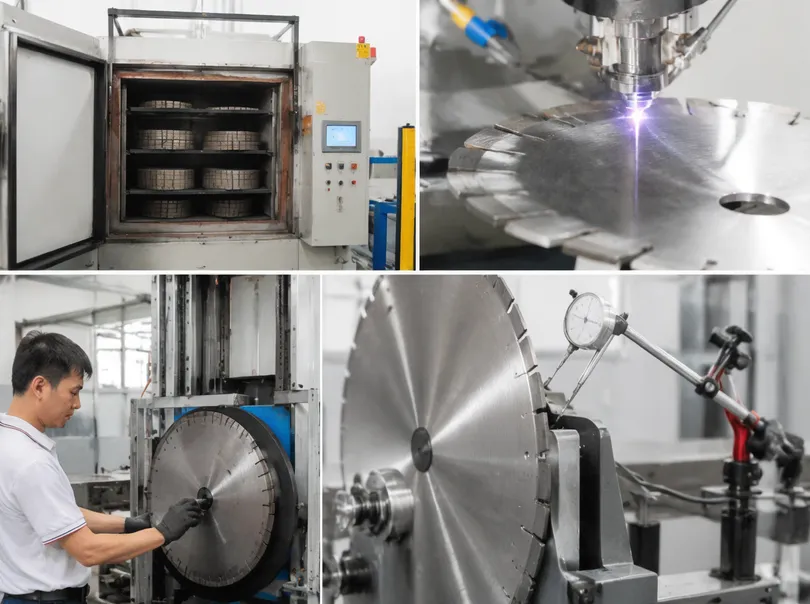
These are production details your end users never see — but they feel them in blade life, cut quality, and the absence of complaints. When you evaluate concrete diamond cutting disc suppliers, the manufacturing discipline behind the scenes determines whether your quarterly reorder rate is 90% or 50%.
Differentiation from Sibling Products — Selecting the Right Blade for Your Buyer
Concrete cutting discs occupy a specific position in our diamond cutting disc range. Here's how they compare to adjacent products, so you stock the right blades for the right buyers.
| Your Buyer's Application | Recommended Product | Why Not Concrete Disc? |
|---|---|---|
| Cured concrete, reinforced concrete, CMU block | Concrete Cutting Discs This page | — |
| Hard natural stone (granite, quartzite, engineered quartz) | Granite Cutting Discs | Granite needs softer bond to expose diamonds against non-abrasive material; concrete bond is too hard for granite |
| General natural stone (marble, sandstone, limestone) | Stone Cutting Discs | Stone discs use finer grit and softer matrix; concrete disc would cut but leave rough finish |
| Porcelain and ceramic tile | Ceramic Tile Cutting Discs | Tile requires continuous rim and fine grit for chip-free cuts; segmented concrete disc will chip tile edges |
| Dry cutting across mixed materials (concrete + stone) | Dry Cut Diamond Blades | Dry-cut blades are optimized for thermal management across multiple materials; concrete disc is optimized for concrete specifically |
| Fast aggressive cutting, demolition | Segmented Cutting Discs | General segmented discs work across materials; concrete disc is formula-optimized for concrete specifically |
Concrete Construction Markets
If your market is primarily concrete construction, stock concrete cutting discs as your core SKU and supplement with granite or stone discs for buyers who also serve the stone industry.
Diversified Markets
If your market is more diversified, consider our turbo diamond cutting discs as an all-rounder alongside dedicated concrete blades for the heavy-use construction segment.
Frequently Asked Questions
What diamond concentration is appropriate for cutting reinforced concrete versus plain concrete?
For plain concrete (C20–C35, unreinforced), standard concentration around 25–30% provides adequate life without over-costing the blade. For reinforced concrete with moderate to heavy rebar, increase to 35–40% concentration with blocky crystal morphology — the diamonds encounter both abrasive paste and impact from steel, so you need more crystals and tougher crystal shapes that resist fracturing on rebar contact.
We set concentration per formula tier; you don't need to specify the percentage — just tell us the concrete type and rebar density your market encounters.
Can I use a concrete diamond cutting disc on asphalt?
Technically yes for short-duration cuts, but it's not ideal. Asphalt is softer and stickier than concrete — the bitumen binder tends to clog segment gullets and coat diamond surfaces, reducing cutting efficiency. We offer dedicated asphalt cutting blades in larger diameters for road work.
If your buyer occasionally crosses between concrete and asphalt on the same job, a concrete disc will handle brief asphalt cuts without damage, but dedicated blades perform significantly better for sustained asphalt cutting.
How many linear meters can a concrete cutting disc cut before replacement?
This depends on blade diameter, segment height, concrete hardness, rebar content, and operator technique. As a general benchmark for our standard 115 mm concrete disc with 10 mm segment height: approximately 80–120 linear meters of cutting in C30 unreinforced concrete at 30 mm depth.
Reinforced concrete reduces this by 30–50% depending on rebar density. We can provide application-specific life estimates once you describe the concrete type and cutting conditions your end users face.
What's the minimum order for concrete cutting disc wholesale with custom branding?
500 pieces per SKU for custom labeling on standard blades. If you need custom packaging (new blister mold or printed sleeve), 2,000 pieces per SKU covers the tooling cost within the unit price.
For initial market testing, we supply 200–500 pieces in neutral packaging — you test the performance, confirm the formula match, then commit to branded production.
Do I need laser-welded concrete blades if my market primarily cuts wet?
For consistent wet cutting with adequate water flow, high-frequency welded blades provide sufficient joint strength and are more cost-effective. Laser welding becomes important when blades are used dry, at aggressive feed rates, or in markets with strict safety certification requirements (MPA, for instance, tests segment retention under dry thermal stress).
If your buyer base splits between wet and dry use, stock both — price the laser-welded line 15–25% higher and market it as the professional/safety tier.
What causes concrete cutting discs to lose segments, and how do I avoid warranty claims?
Segment loss comes from three sources:
- 1. Weld failure (manufacturing defect) — prevented by proper pre-weld preparation and controlled weld parameters.
- 2. Operator abuse — cutting at angles that apply lateral force beyond design limits.
- 3. Material mismatch — using a disc rated for wet cutting in sustained dry applications.
On our end, automated welding with destructive batch testing prevents the first cause. On your end, clear product labeling (dry-rated vs. wet-only) and matching the blade to the application prevents the third. Operator abuse is harder to control, but laser-welded blades have more margin for misuse before failure.
Start Stocking Concrete Diamond Cutting Discs
You know what your market cuts. We know how to formulate the blade that survives it. Here's what makes our first conversation productive:
- What concrete types dominate in your region? (Residential slabs, highway work, precast, demolition?)
- What diameters and arbor sizes are standard for your market's power tools?
- Do your end users cut wet, dry, or both?
- Approximate annual volume or trial order quantity?
- OEM packaging needed, or starting with CLSEG-branded stock?
Send these to sales@clseg.com or WhatsApp: +86 13177381650. We'll respond with a formula recommendation, FOB pricing structure, and sample arrangement within 24 hours on business days.
Typical New-Buyer Path
Trial Order
Start with 500–1,000 pieces across two or three configurations (standard concrete + reinforced concrete, in your two most common diameters).
Field Testing
You field-test with your contractor customers, confirm the cut life meets expectations.
Branded Production
Move into branded production on the repeat order — custom labels, packaging, and optimized formulas locked to your market.