

Dry Cut Diamond Blades Engineered for Waterless Cutting
Laser-welded joints, thermally stable bonds, and airflow-optimized segment geometry — so your customers cut hard without a water supply and your warranty claims stay at zero.
Designed from the segment formula outward to survive high-temperature, no-water jobsite conditions. OEM/private label from 500 pcs · 20+ years manufacturing.
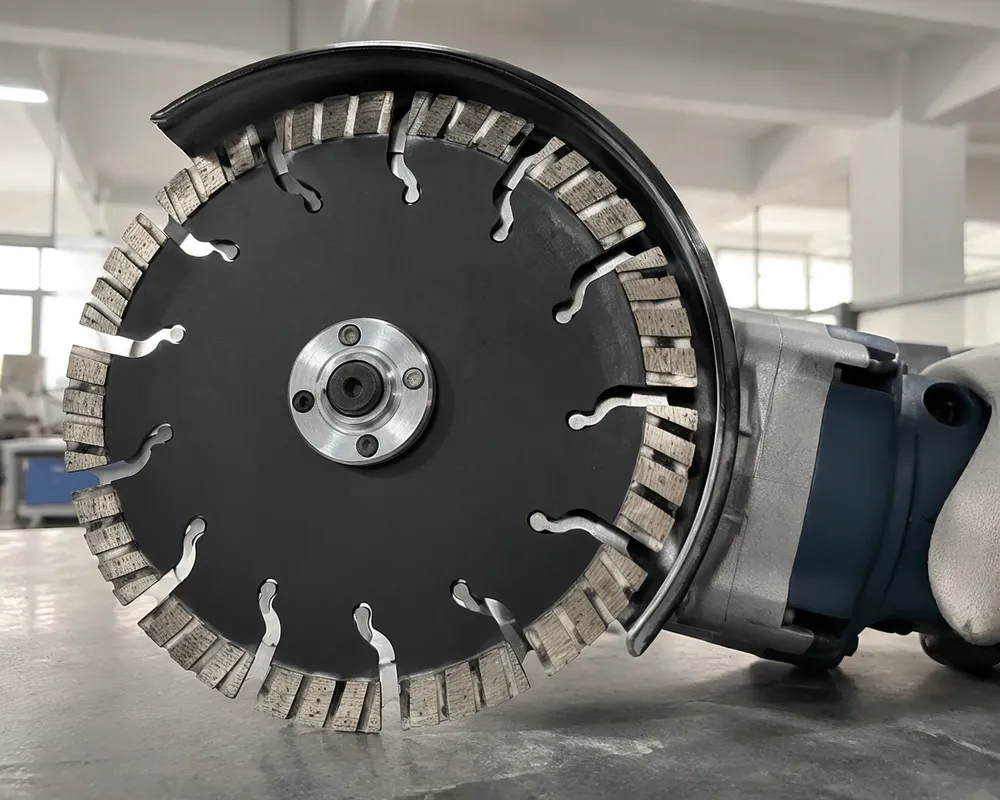
What Makes a Dry Cut Diamond Blade a Distinct Product — Not Just a Label
A dry cut diamond blade isn't a standard blade with "dry" printed on the box. It's a fundamentally different engineering package — designed from the bond formula through the segment geometry to the weld joint specifically for the thermal load of cutting without water coolant.
When a blade cuts dry, segment temperatures spike above 600°C on aggressive passes. At that temperature, three things fail on a standard blade: the bond matrix softens and releases diamonds prematurely, the weld joint fatigues under thermal cycling, and the steel core warps from uneven heat distribution. A properly engineered dry cutting diamond blade prevents all three failure modes simultaneously — through material choices, not through hoping the operator goes slowly.
We manufacture dry cut diamond blades across the full small-blade diameter range (105–230 mm), optimized for angle grinders, handheld cut-off machines, and masonry saws operating where water supply is impractical or impossible. Every blade ships with laser-welded segments as standard — not as an upgrade option.
(The category page covers our full diamond cutting disc range — 12 product lines including wet-cutting, turbo, and specialty blades. This page focuses specifically on the dry-cutting configuration and what differentiates it from everything else we make.)
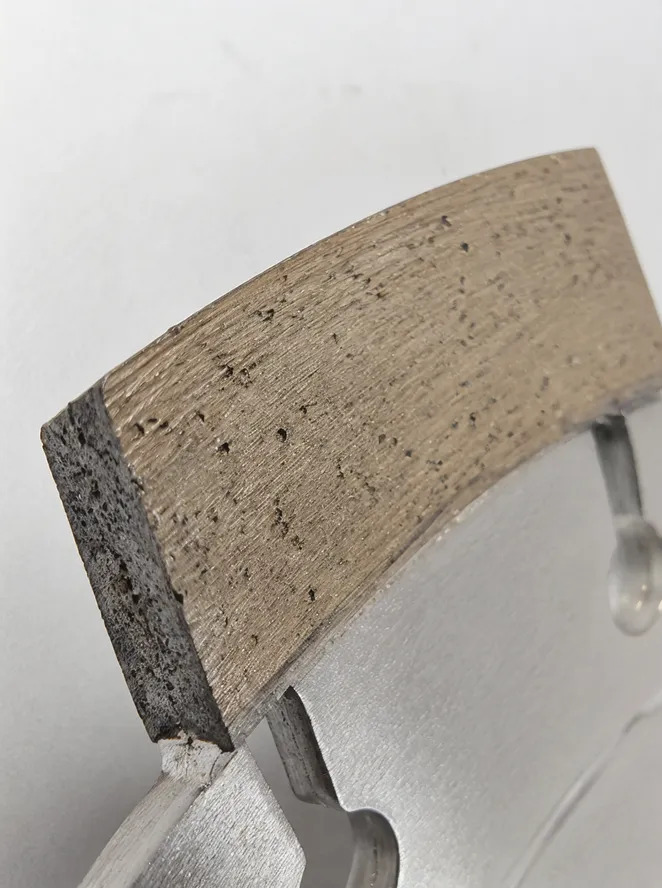
Three failure modes a standard blade hits at 600°C — and what our dry-cut engineering prevents:
Bond matrix softens and releases diamonds prematurely — solved by high iron/cobalt thermal-stable bond formulation.
Weld joint fatigues under rapid thermal cycling — solved by laser welding with 25+ MPa shear strength.
Steel core warps from uneven heat distribution — solved by airflow-optimized segment geometry and keyhole slots.
The Heat Problem and How We Solve It in Production
Dry cutting generates concentrated heat at the segment-material interface with no water to carry it away. The entire blade design has to manage that thermal load passively — through geometry, materials, and joint engineering. Here's what we do differently on our dry cut diamond blade line versus our wet-cutting products:
Thermally Stable Bond Matrix
650°C+ retentionWe formulate dry-cutting bonds with higher iron and cobalt content relative to our wet-cutting formulas. The bond retains its structural integrity above 650°C, holding diamonds in place through repeated thermal cycles rather than releasing them prematurely.
We've tested bond failure temperatures across our formula library — our standard dry-cutting bond maintains diamond retention at temperatures where our general-purpose bond has already begun to degrade.
For your end users, this translates to consistent cut speed throughout the blade's life, not a blade that "feels fast" for the first ten cuts and then glazes.
Segment Geometry with Built-in Airflow
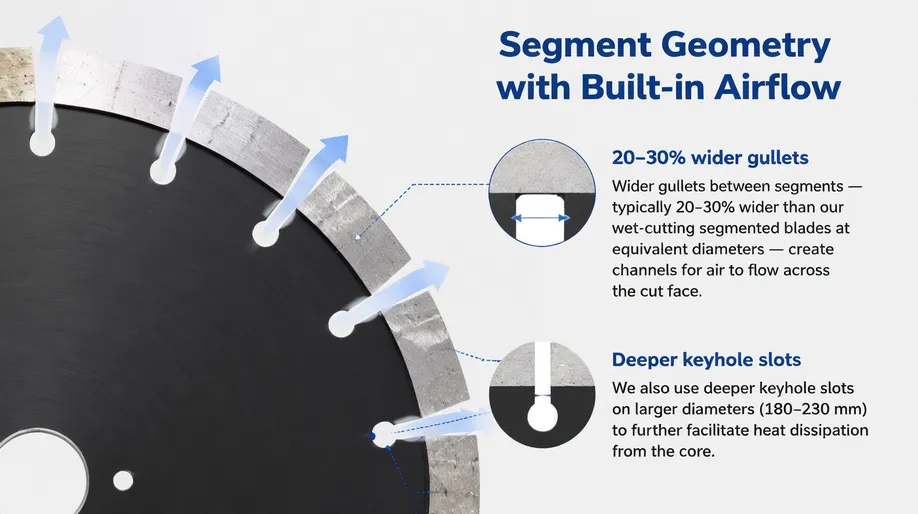
20–30% wider gulletsWider gullets between segments — typically 20–30% wider than our wet-cutting segmented blades at equivalent diameters — create channels for air to flow across the cut face.
This isn't marketing theory: air convection is the primary cooling mechanism when water isn't present. We also use deeper keyhole slots on larger diameters (180–230 mm) to further facilitate heat dissipation from the core.
Laser Welding as Standard
25+ MPa shear strengthEvery dry cut diamond blade we manufacture uses laser-welded segment attachment. High-frequency welding is sufficient for wet-cutting applications where thermal stress on the joint stays moderate. But dry cutting subjects the weld zone to rapid heat-cool cycles that fatigue brazed and HF-welded joints over time.
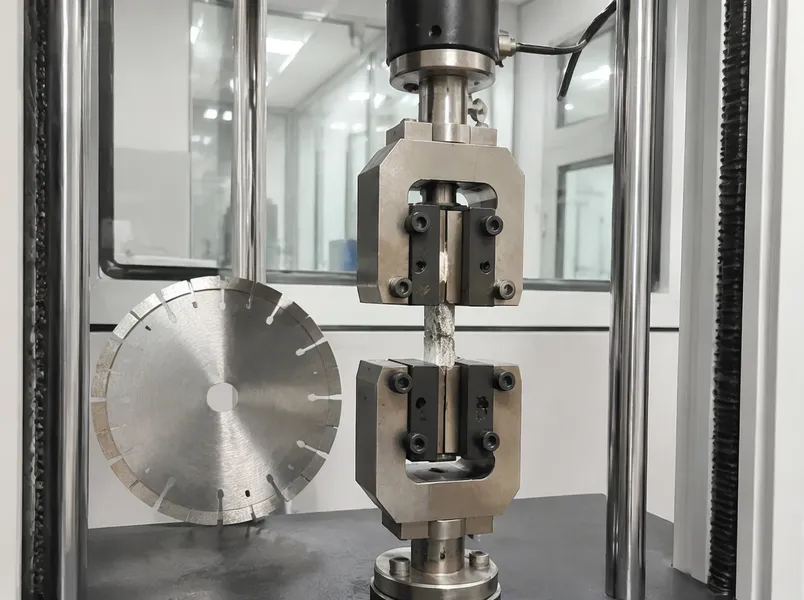
Laser welding produces a deeper fusion bond between the segment and core — shear strength tested at over 25 MPa on our destructive pull test fixtures. This is the engineering reason we don't offer dry-cutting blades in an HF-welded "economy" version: the risk of segment detachment under dry thermal cycling isn't worth the cost savings.
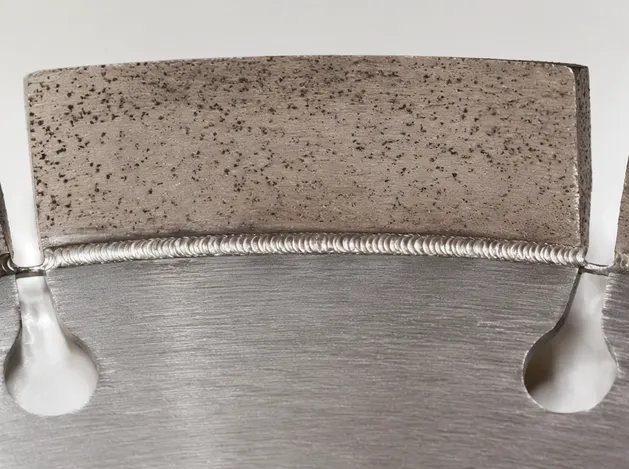
Why we eliminated HF welding from our dry-cut line:
We switched to laser-welding-only for our dry-cut line in 2016 after tracking warranty claims across both weld types over three years. The data was clear — HF-welded dry-cut blades had 4–5× the segment-loss incident rate. We absorbed the cost difference and eliminated the problem entirely.
Technical Specifications — Dry Cut Diamond Blade Range
Standard production values across our dry-cut line. Exact parameters vary by SKU configuration and customization.
| Parameter | Specification |
|---|---|
| Diameter range | 105 mm, 110 mm, 115 mm, 125 mm, 150 mm, 180 mm, 200 mm, 230 mm |
| Arbor bore | 16 mm, 20 mm, 22.23 mm, 25.4 mm (others on request) |
| Segment height | 8–12 mm (varies by diameter and target material) |
| Segment thickness | 1.8–3.2 mm |
| Blade body thickness | 1.4–2.6 mm |
| Segment attachment | Laser welded (standard, no HF option for dry-cut) |
| Maximum RPM | 10,000–14,000 RPM (diameter dependent) |
| Cutting method | Dry only / Dry-wet dual-use (configurable per SKU) |
| Rim configuration | Segmented with wide gullets, turbo with cooling slots, or protected continuous |
| Compatible tools | 4"–9" angle grinders, handheld cut-off saws, masonry saws, tile saws (dry mode) |
| Target materials | Concrete, granite, masonry, brick, sandstone, limestone, general stone |
| Bond type | Iron-cobalt based, thermally stable formulation (adjustable per material) |
115 mm / 22.23 mm arbor / segmented rim / 10 mm segment
For European and Middle Eastern contractors running 4.5" angle grinders on job sites.
125 mm diameter
South American and European markets. Standard arbor configurations.
105 mm diameter
Southeast Asian markets. Compact grinder compatibility.
Contact us for detailed product data sheets per SKU.
Where Dry Cut Diamond Blades Generate Volume — Your Market Segments
Every market segment below represents a commercial opportunity with specific order patterns. We've shipped dry-cutting blades into all of these and can tell you what moves.

General Construction and Renovation
Largest volume segmentAngle grinders are on every construction site, and water supply often isn't. Contractors cut concrete, masonry, brick, and cured mortar dry because running a hose to the fifth floor of a renovation or across an active road isn't practical. They need blades that cut aggressively without water and survive the thermal abuse.
Order Pattern
Distributors serving this segment typically stock 115 mm and 125 mm segmented-rim dry-cut blades in cases of 10-25 pieces. Reorder cycles run monthly for active distributors. Price sensitivity is moderate — contractors will pay 15-20% more for a blade that doesn't stall or lose segments, because downtime costs them more than the blade difference.

Hardscape and Landscape Installation
Premium retail marginPatio pavers, natural stone cladding, retaining wall blocks, garden edging — all cut on-site with handheld tools. Water makes a mess on finished landscapes and isn't always accessible in garden settings. Dry-cut blades in 115–150 mm serve this segment perfectly. Landscapers consume fewer blades per job than general contractors but buy premium willingly because the cut quality shows on the finished installation.
Order Pattern
Hardware retailers and landscape supply stores stock 5-10 piece packs. Seasonal demand peaks in spring/summer in temperate markets. A good SKU for shelf stock with healthy retail margin.

Concrete Repair and Utility Work
Safety-critical segmentCutting access holes in floors, sawing curbs for utility access, removing damaged concrete sections. These are quick, aggressive cuts where setting up a wet-cutting rig wastes more time than it saves. Municipal contractors and utility crews carry dry-cut blades as standard consumables in their truck inventory.
Order Pattern
Sold through industrial tool distributors. Buyers value blade life and segment retention above all — a blade that sheds a segment near a worker's face creates a safety incident, paperwork, and potential contract loss. This is the segment where your MPA certification and laser-weld quality documentation carry direct sales weight.

Indoor Renovation and Fit-Out
Year-round demandCutting openings in existing walls, adjusting floor tile layouts, installing HVAC penetrations in concrete — all indoor applications where water creates flooding risk, slip hazards, and cleanup costs. Dry-cut blades are mandatory, not optional, for indoor concrete and masonry work.
Order Pattern
Building supply stores and renovation tool retailers. Mixed with wall chaser blades and general-purpose discs in the "indoor cutting" product section. If you carry wall chaser blades already, dry-cut discs are the natural companion SKU.
(We've seen indoor renovation drive growth in Southeast Asian and Middle Eastern markets particularly — rapid construction cycles with constant building fit-out means steady blade consumption year-round, no seasonal dip.)
Know your target segment?
Tell us which markets you serve and we'll recommend a starter SKU mix with volume pricing.
How Dry-Cut Differs From Our Other Small Blade Lines
If you already source from our diamond cutting disc range, here's where dry-cut blades sit relative to sibling products — and how to decide which SKUs your inventory needs.
| Decision Factor | Dry Cut Diamond Blade | Segmented Cutting Disc | Turbo Diamond Disc |
|---|---|---|---|
| Primary use case | Waterless jobsite cutting | General-purpose (wet or moderate dry) | Multi-material all-rounder |
| Weld type | Laser welded (standard) | HF welded or laser welded | HF welded |
| Heat tolerance | Designed for sustained dry use | Tolerates intermittent dry cutting | Moderate dry tolerance |
| Segment spacing | Wider gullets for airflow | Standard gullet width | Continuous serrated rim |
| Price tier | Mid-premium | Standard | Standard |
| Ideal buyer | Contractors who cut dry daily | General hardware/construction | Distributors wanting fewer SKUs |
Selection Guidance for Your Inventory
If your customers work outdoors on construction sites without water — stock dry-cut blades as your dedicated SKU.
If they work in workshops with water available — standard segmented discs at a lower price point serve them better.
If you want a single SKU to cover multiple scenarios without specialization — turbo discs are the compromise blade.
Most distributors who carry the full range stock all three and let the application guide the sale.
Customization for Your Dry-Cut Blade Orders
We handle dry-cut blade customization the same way as our broader range — as standard workflow, not a special project. Here's what's adjustable specifically on the dry-cut line.
Bond Formula Tuning
Tell us what your market cuts dry — granite? concrete with rebar? sandstone? brick? — and we match the bond hardness and diamond concentration. A dry-cut blade for Middle Eastern limestone is a different formula than one for European reinforced concrete.
We maintain a formula library of tested dry-cutting bonds for over a dozen material classes.
Segment Geometry Options
- Standard segmented rim (wide gullets)
- Turbo rim with cooling slots
- "Protected" continuous rim for edge quality without water
Segment height adjustable from 8 mm (shorter life, lower price point) to 12 mm (longer life, premium tier) — you choose the position for your market.
Diameter and Arbor
All standard diameters from 105–230 mm. Any standard arbor bore, plus non-standard on custom tooling runs.
Branding and Packaging
- Your brand on the core (laser-etched or printed)
- Your packaging design (blister pack, paper card, tin, or retail sleeve)
- Your safety markings and regional compliance text
- Artwork files produced to your specifications
MOQ for Dry-Cut Blades
Lead Time
Note on formula development: If you need a dry-cut bond for a stone type we haven't previously optimized for, the first sample round may take an extra 7–10 days for our lab to run cutting tests and iterate. After that, it's locked into our formula library and reorders are fast.
Quality Assurance on the Dry-Cut Line — What We Check and Why
Dry-cut blades face harsher operating conditions than wet-cut products. Our QC process reflects that with additional checkpoints specific to this line.
Laser Weld Integrity Testing
Every production batch undergoes destructive shear testing on random samples — we physically break the segment off the core and measure the force required.
Our pass threshold for dry-cut blades is set higher than for our wet-cut HF-welded products because the thermal cycling during dry use puts more stress on the joint over time.
Blades that don't meet threshold get the entire batch re-inspected.
Thermal Cycling Simulation
We run sample blades through accelerated dry-cutting tests on our in-house test bench — instrumented granite and concrete blocks cut at aggressive feed rates without water.
We measure segment temperature, cut speed degradation, and segment wear uniformity throughout the cycle.
A blade that performs well for the first 20 cuts but deteriorates rapidly won't pass our thermal cycling protocol.
Core Flatness and Runout
Standard CNC tensioning and concentricity verification — dry-cut blades run at high RPM on handheld tools where vibration is both a safety issue and a user experience issue.
Diamond Distribution Verification
We section segments from each formula batch to verify diamond distribution under magnification.
Uneven diamond distribution causes hot spots during dry cutting — areas with fewer diamonds work harder, overheat, and cause premature local failure.
Consistent distribution = consistent thermal load across the segment face.
Certifications Relevant to Dry-Cut Blade Distribution
The MPA certification is particularly relevant if you distribute dry-cut blades in Europe: it validates that the blade meets safety requirements for RPM rating and segment retention under operational stress — exactly where dry-cutting conditions push the hardest.
Learn more about our manufacturing capabilitiesPackaging and Freight for Dry-Cut Blade Shipments
Dry-cut blades pack and ship identically to our other small blade products — the shipping considerations are the same across the category.
Standard Export Packaging
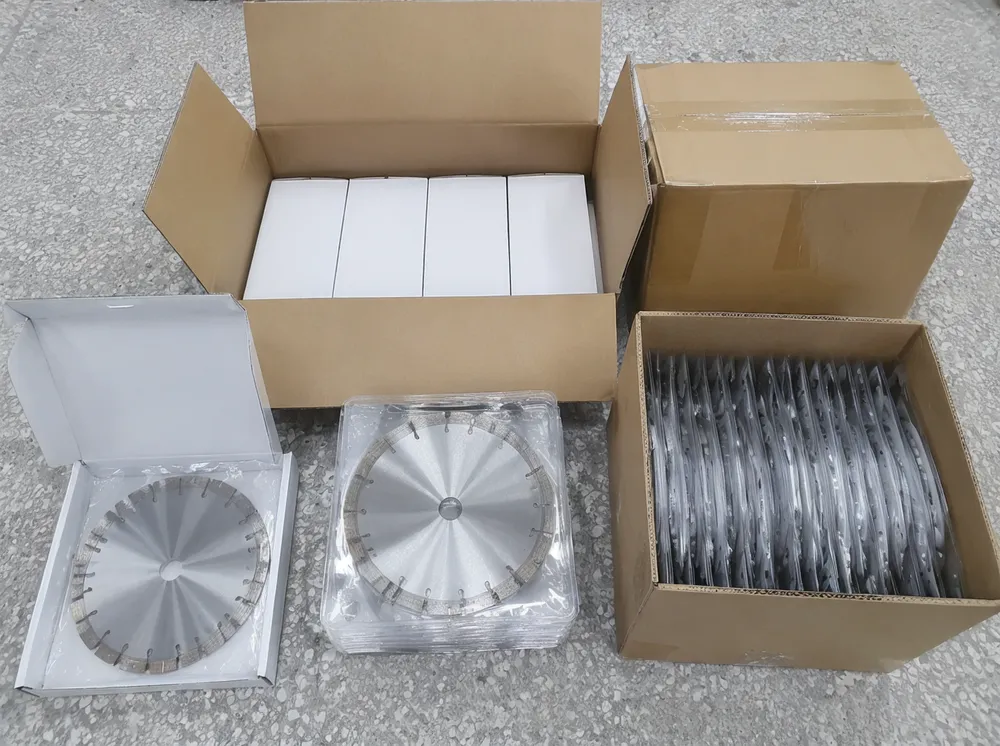
Custom retail packaging (blister packs, display cards) increases per-piece volume — we calculate exact loading plans with your order confirmation so your freight forwarder can book accurately.
Container Loading Reference for Dry-Cut Blades
Loading quantities are approximate and vary with packaging format.
| Diameter | Approx. pcs / 20GP | Approx. pcs / 40HQ |
|---|---|---|
| 105 mm | ~80,000 | ~160,000 |
| 115 mm | ~65,000 | ~130,000 |
| 125 mm | ~50,000 | ~100,000 |
| 230 mm | ~20,000 | ~40,000 |
Mixed Loading Is Standard
Most buyers ship dry-cut blades alongside other SKUs from our range — wet-cutting discs, turbo blades, wall chaser blades — in a single container to optimize freight cost per unit across their product catalog.
Frequently Asked Questions
Can dry cut diamond blades also be used with water (dual-use)?
Yes — we offer both dry-only and dry/wet dual-use configurations. A blade engineered for dry cutting performs perfectly with water; it simply doesn't require it. The reverse isn't true: a wet-only blade should never be used dry.
If you want maximum flexibility for your customers, specify dual-use on your order and we'll mark it accordingly on packaging and blade printing. The formula and geometry are the same as dry-only; the certification and labeling are the difference.
What is the typical lifespan difference between dry-cut and wet-cut diamond blades on the same material?
Expect 20–40% shorter life from a dry-cut blade versus a wet-cut blade on the same material, because higher operating temperatures accelerate both diamond degradation and bond erosion. This is physics, not a quality issue — every manufacturer's dry-cut blades show similar relative life reduction.
The trade-off is accepted because the alternative (not cutting at all without water) is worse. For your pricing strategy: dry-cut blades command a 15–25% price premium over standard blades at retail because of the laser welding and thermal bond engineering.
How do I prevent customers from complaining that dry-cut blades wear faster?
Set expectations at the point of sale. We can print recommended usage guidelines directly on the blade or packaging — maximum continuous cut duration (typically 30–60 seconds before allowing a 10-second cooling pause), appropriate feed pressure, and RPM recommendations.
We also provide technical data sheets you can share downstream. Educated end users generate fewer complaints and more reorders because they use the blade within its designed parameters.
What segment rim type works best for dry cutting concrete versus dry cutting granite?
Concrete (Abrasive Aggregate, Sometimes Rebar)
Segmented rim with wide gullets. The gullets clear the heavy debris that concrete produces and allow maximum airflow cooling.
Granite (Hard, Low Debris)
Turbo rim or protected continuous rim with cooling slots. Granite cuts generate fine dust rather than heavy chips, so debris clearance is less critical — thermal management and edge quality matter more.
We configure the rim type per your target material during specification.
What certifications matter for selling dry-cut blades in Europe?
MPA (German safety certification for rotating abrasive tools) is the key one — many EU distributors and retailers require it as a condition of listing. It validates segment retention under operational RPM, which is the primary safety concern with dry-cut blades where thermal stress is highest.
We hold MPA certification across our dry-cut product range. CE marking covers general European conformity.
If you distribute in Germany specifically, MPA is essentially mandatory for professional tool channels.
Start Your Dry-Cut Blade Order
You've read the engineering. You understand the product. Here's what to send us to get a specific quote back:
- What materials will your customers cut dry? (concrete, granite, masonry, mixed?)
- Which diameters and arbor sizes fit your market? (we'll confirm if unsure)
- Estimated order volume — either trial quantity or annual forecast
- OEM branding needed, or starting with neutral/CLSEG-labeled stock?
We'll respond with a formula recommendation matched to your target material, pricing by quantity tier, and sample logistics — typically within 24 hours.
How Most New Buyers Start
Sample Order
200–500 piece test across two configurations (e.g., one for concrete, one for stone)
Field Testing
Your team or end users validate cutting performance, life, and thermal behavior on target materials
Branded Production
Scale into OEM-branded orders with your logo, packaging design, and volume pricing locked in