

Diamond Grinding Wheels Sintered to Spec
Metal-bonded diamond grinding wheels engineered for stone calibration, edge profiling, and surface prep — manufactured in-house at CLSEG's Ezhou facility.
Diameter range 100–350 mm, bond hardness matched per stone type, available in standard and segmented profiles. OEM/private-label runs from 200 pieces.
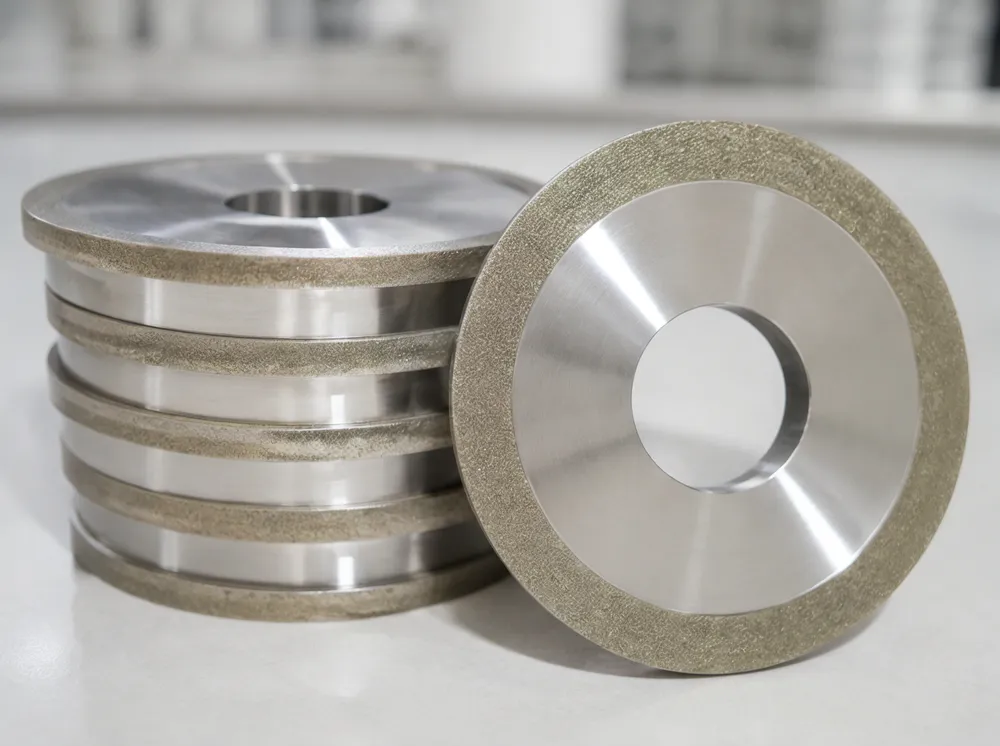
What Diamond Grinding Wheels Do — and Where This Product Sits
A diamond grinding wheel is the tool that takes over after the saw blade finishes. Once a slab has been cut to rough dimension, a calibration grinding wheel brings it to uniform thickness — typically within ±0.1 mm across the full surface — so the downstream fabricator can work from a flat, predictable starting point. Edge profiling wheels shape the perimeter: straight, beveled, bullnose, ogee. Surface prep wheels remove saw marks and bring the stone to the grit stage before polishing begins.
This product page covers our standard and segmented diamond grinding wheels: flat-face and profiled wheels designed for bench grinders, bridge saw calibration heads, and CNC stone processing centers. These are distinct from our cup grinding wheels (which are angled-flange tools for hand-held grinders and floor machines) and our grinding discs (flat disc tools for surface preparation and grit progression).
If your application is floor grinding or aggressive concrete leveling, our cup grinding wheel range is likely the better starting point. If you need fine surface finishing after the calibration stage, see our stone surface grinding tools.
Within this product, the core choice is bond hardness and segment geometry — which is where the real performance difference lives between a wheel that runs for 200 hours and one that glazes over at 40.
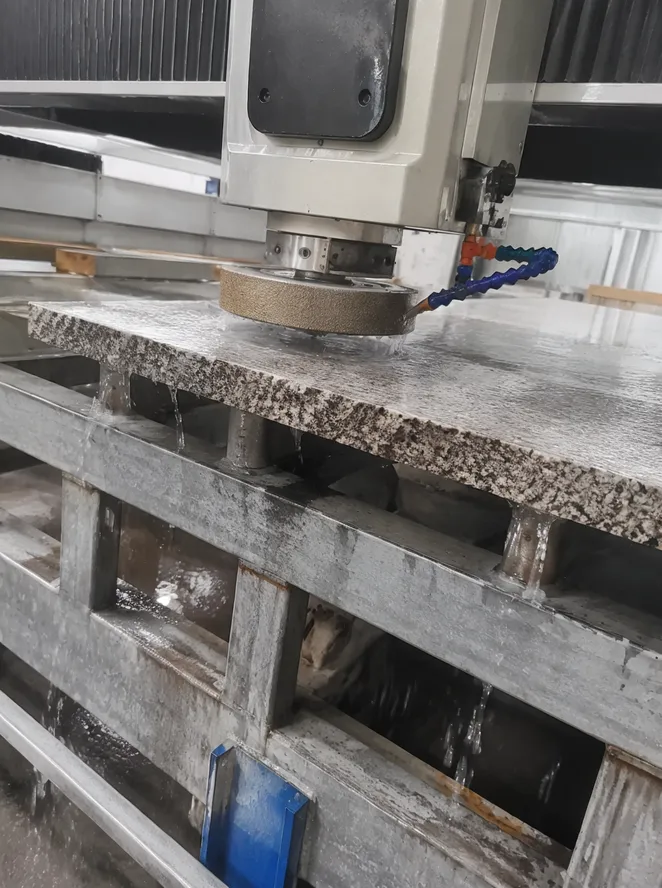
Three Core Functions
- Calibration — uniform thickness within ±0.1 mm across full slab surface
- Edge Profiling — straight, beveled, bullnose, ogee perimeter shaping
- Surface Prep — saw mark removal, grit stage preparation before polish
Technical Specifications
Industry-standard values for this product type and our current production range
| Parameter | Specification |
|---|---|
| Diameter | 100 mm – 350 mm (stock: 150, 200, 250, 300 mm) |
| Bore / Arbor | 20 mm, 25.4 mm, 32 mm; custom bores available |
| Segment Height | 8 mm – 15 mm (standard 10 mm) |
| Segment Width | 10 mm – 25 mm (varies by diameter & application) |
| Diamond Grit Size | 30/40 · 60/80 · 120/180 · 220/320 |
| Bond Type | Sintered metal bond (Cu-Sn-Fe alloy matrix) |
| Bond Hardness | Soft (S) / Medium (M) / Hard (H) |
| Segment Profile | Flat · Stepped · Segmented (chip clearance slots) |
| Attachment Method | Flanged bore (direct mount) · M14 thread |
| Max Operating Speed | 35 m/s (confirm with tool body & machine) |
| Compatible Equipment | Bridge saw calibration heads, bench grinders, CNC stone centers |
| Application Materials | Granite, marble, limestone, engineered quartz, ceramic, terrazzo |
Specifications shown are industry-standard values for this product type and our current production range. Contact us for exact data sheets on specific configurations.
Grit Progression
A typical stone calibration line runs through these stages, each removing the scratch pattern left by the previous wheel:
Bond Hardness Guide
- S Soft bond — hard materials (granite, engineered quartz). Wears faster to expose fresh diamonds.
- M Medium bond — general purpose (marble, limestone, terrazzo). Balanced wear rate.
- H Hard bond — soft/abrasive materials (sandstone, soft marble). Resists premature wear.
Performance & Application Guide
Matching wheel configuration to stone type and production demands
Material Compatibility
Granite & Engineered Quartz
Soft BondHigh-quartz-content stones demand a soft bond matrix that self-sharpens under load. Segment geometry with chip clearance slots prevents loading on these dense, non-porous surfaces.
Marble & Limestone
Medium BondCalcium-carbonate stones are softer but can be abrasive. A medium bond provides enough diamond retention without glazing. Lower peripheral speed recommended to prevent thermal micro-cracking.
Ceramic & Porcelain Slabs
Soft–Medium BondSintered ceramic panels are extremely hard and brittle. Consistent water flow and reduced feed rate are critical. Finer grit sequences (starting at 60/80) help avoid chipping on glaze layers.
Terrazzo & Concrete
Hard BondHighly abrasive aggregates wear through bonds quickly. Hard bond formulations with increased diamond concentration extend usable life in high-volume floor-prep and slab-calibration work.
Operating Parameters
| Parameter | Recommended Range |
|---|---|
| Peripheral Speed | 20–35 m/s |
| Feed Rate (calibration) | 1.5–4.0 m/min |
| Depth of Cut | 0.3–2.0 mm per pass |
| Coolant Flow | 15–30 L/min (continuous) |
| Spindle Power | 5.5–15 kW (per head) |
Maximizing Wheel Life
- Dress with an abrasive stick before first use and whenever glazing occurs
- Maintain consistent water coverage — dry spots cause segment burn-out
- Reduce feed rate rather than increasing spindle pressure when cutting slows
- Inspect segment height monthly; replace below 2 mm remaining to protect the core
- Match bond hardness to stone — mismatches are the #1 cause of premature failure
Not sure which configuration fits your line? Send us your stone type, machine model, and daily throughput — we'll recommend the right bond, grit sequence, and segment geometry. Get a recommendation →
Why Choose Our Diamond Grinding Wheels
Manufacturing decisions that affect your cost-per-square-meter
Tuned Bond Formulations
Our metal bond matrices are developed and tested against specific stone families — not generic one-size-fits-all recipes. Each alloy ratio (Cu, Sn, Fe, Co) is adjusted to match the abrasiveness and hardness of the target material.
Premium Diamond Selection
We use blocky, high-impact-strength synthetic diamonds with controlled friability. This ensures consistent self-sharpening rather than catastrophic fracture — maintaining cut rate throughout segment life.
Hot-Press Sintering
Segments are sintered under controlled temperature and pressure profiles to achieve uniform density and diamond distribution. No cold spots, no voids — consistent performance across every segment on the wheel.
Precision Runout Tolerance
Each wheel is machined and balanced to less than 0.05 mm runout. This matters for calibration work where the wheel must remove material uniformly across a 3-meter slab width without leaving ridges.
Replaceable Segment Design
Our wheel bodies are designed for segment replacement — when segments wear out, the core can be re-tipped rather than scrapped. This reduces long-term tooling cost by 30–40% compared to disposable wheels.
Application Engineering Support
We don't just ship tools — we help configure them for your specific line. Stone type, machine brand, daily throughput, and surface finish target all factor into our recommendation. Free technical consultation on every order.
Bond Hardness Is the Decision That Determines Your Cost Per Square Meter
Most suppliers list a single grinding wheel SKU and leave bond selection out of the conversation. We don't, because getting it wrong is expensive — either in premature tool wear or in glazing that kills your throughput.
The Core Rule
Soft stone needs hard bond. Hard stone needs soft bond.
The rule is counterintuitive until you understand the mechanism. Here's why it matters commercially:
Hard Stone → Soft Bond
When you run a grinding wheel on hard granite, the diamond crystals experience high cutting forces and blunt quickly. The metal bond matrix needs to erode away at the right rate to expose fresh crystal below.
If the bond is too hard:
- Blunted diamonds stay locked in place
- The wheel stops cutting
- Operators press harder to compensate
- Heat buildup accelerates tool degradation
With correct soft bond:
- Bond erodes at the right rate
- Self-sharpens continuously
- Consistent material removal across full tool life
- Cost per square meter stays predictable
Soft Stone → Hard Bond
On soft marble, the abrasive action is gentler on the diamond but more aggressive on the bond.
If the bond is too soft:
- Bond erodes too quickly
- Diamond concentration drops ahead of schedule
- Tool life collapses
- Replacement interval breaks planning assumptions
With correct hard bond:
- Matrix holds together under gentle abrasion
- Tool wears at the expected rate
- Replacement interval matches planning assumptions
- Total cost of ownership stays controlled
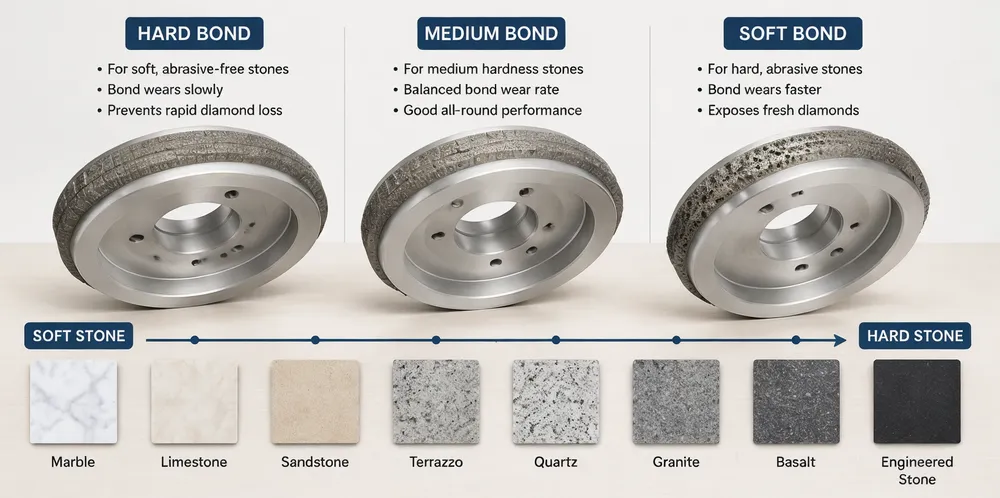
Three Calibrated Bond Hardness Grades
Soft Bond
Optimized for hard granite and engineered quartz. Self-sharpens under high cutting force.
Medium Bond
General purpose — suits mid-hardness stones and mixed-material processing lines.
Hard Bond
Designed for soft marble, limestone, and terrazzo. Holds matrix integrity under low-force abrasion.
Sintering Quality Control
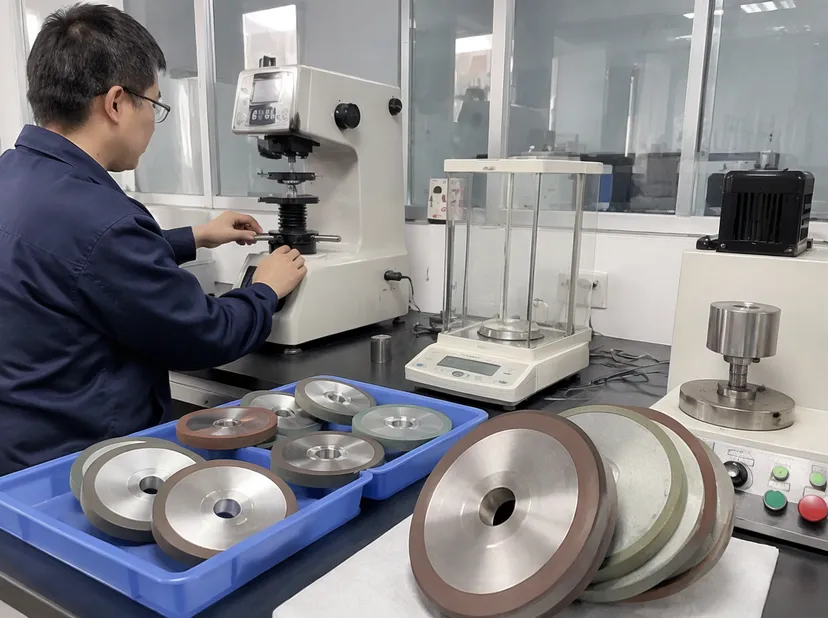
Sintering parameters are adjusted per grade to achieve consistent Rockwell B hardness readings with a batch variance of ±2 HRB. When you place an order, we ask for the stone type and the processing stage.
If we've supplied tools to comparable operations, we'll quote you the same formula that's working for them.
Formula Library Coverage
In most cases, our formula library already covers the stone variety. We've been running grinding formulas since we expanded the grinding line in 2009:
- Granite (all major quarry origins)
- Marble
- Engineered quartz
- Limestone
- Terrazzo
Segmented vs. Continuous Face: Which Geometry Ships Better Margin
Standard flat-face grinding wheels work well on medium-density stones in continuous operation. Segmented wheels are the better choice for intermittent contact, large diameter, or stones that load easily.
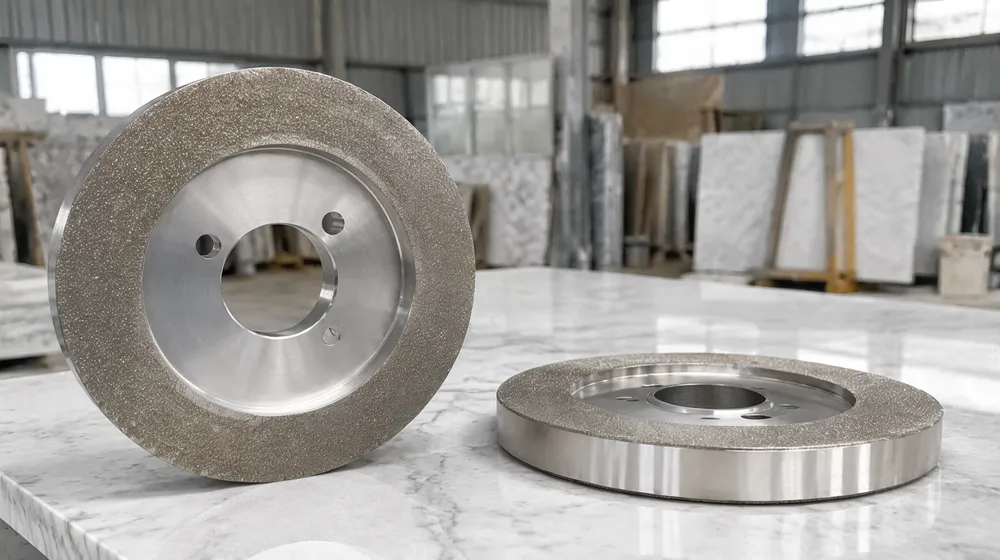
Continuous Face
Uninterrupted diamond face delivers consistent surface contact for medium-density stones in continuous operation.
Best for:
- Medium-density stones
- Continuous operation cycles
- Standard diameter applications
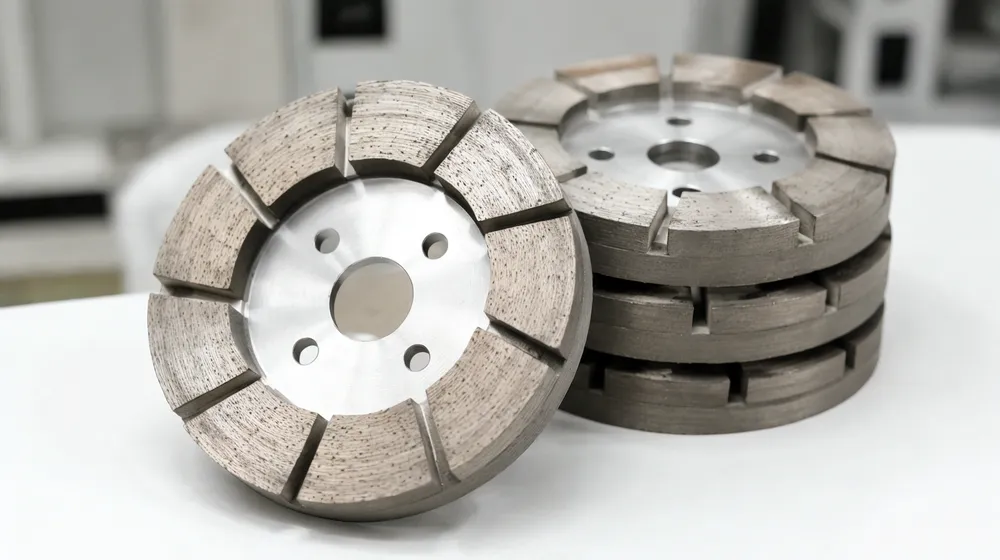
Segmented Face
Divided face with slots clears chips and slurry, reduces heat buildup, and prevents bond loading on easily-clogged stones.
Best for:
- Intermittent contact operations
- Large diameter wheels
- Soft limestone, engineered quartz
- Stones that load easily
The Commercial Argument for Stocking Both
Segmented wheels command a 15–25% price premium in most markets — the geometry is more complex to press and sinter. Buyers who understand the performance difference will ask for them specifically.
If you're supplying stone fabrication shops processing a variety of stone types, segmented and continuous-face wheels serve different jobs on the same shop floor — your distributor or dealer benefits from stocking both.
Price premium for
segmented geometry
Pre-Formed Slot Geometry — Not Post-Sintered Cuts
We press segmented segments with pre-formed slots in the tooling, not post-sintered cuts. Post-sintering cutting weakens the segment at the slot edges and shortens tool life.
Ours are formed in the pressing mold, so the slot geometry is integral to the sintered body — the edges hold up under load.
It's a detail most buyers never ask about, but it shows up in the field when a cheaper wheel starts chipping at the slot corners after 30 hours.
Where These Wheels Earn Your Buyers' Repeat Orders
Each segment consumes grinding wheels at different rates, buys through different channels, and evaluates suppliers on different criteria. Understanding the commercial logic behind each lets you position stock and pricing correctly.
Stone Countertop Fabricators
30–50 countertops/week typical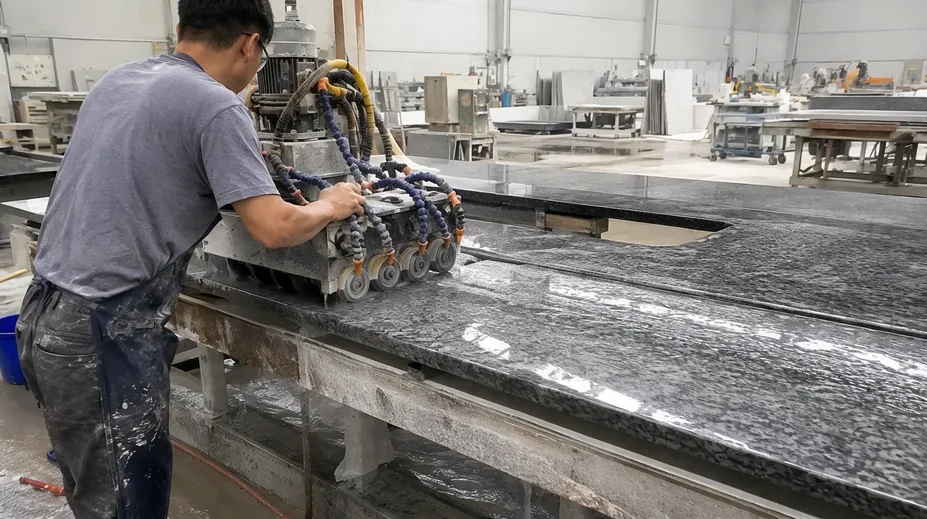
Fabrication shops cutting granite and engineered quartz slabs into countertops, vanity tops, and commercial surfaces. A shop processing 30–50 countertops per week runs through calibration wheels at a predictable rate — typically 4–8 coarse grinding wheels per month depending on stone hardness.
They buy from local distributors who can supply within 2–3 days. Consistent quality matters more than lowest price: a wheel that glazes mid-job causes delays, scratch patterns that require rework, and customer complaints that come back to the fabricator.
If your grinding wheels perform reliably, you retain the account. If they don't, you lose it to whoever the fabricator finds next.
Slab Processing & Calibration Lines
High-volume continuous operation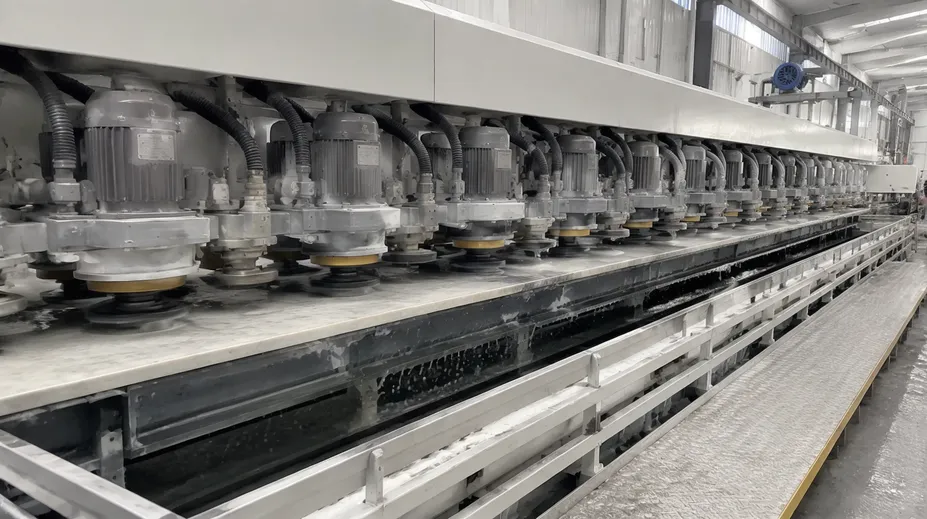
Marble and granite importers or distributors running calibration lines are high-volume grinding wheel consumers. A calibration line running 8 hours daily processes several hundred square meters of stone per shift. Coarse wheels on this type of line may last 3–5 days before replacement.
These buyers run 12–24 calibration wheel positions simultaneously on a fully loaded line and order in batches of 50–200 pieces at a time.
Once you're the specified supplier for a production line, the reorder cadence is predictable and the relationship is sticky — changing grinding wheel suppliers means re-validating feed rates, machine settings, and surface finish results.
Monument & Architectural Stone Shops
CNC + bench grinder operations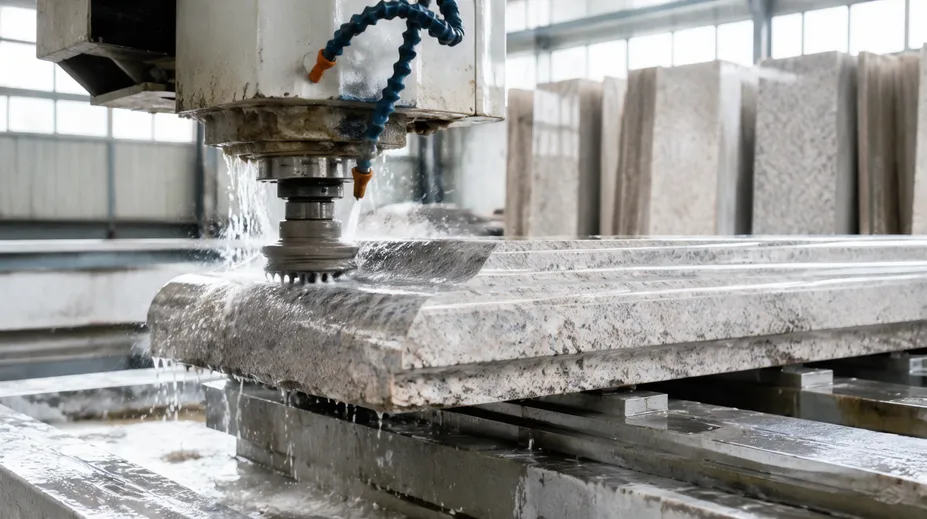
These operations profile edges, rout lettering, and shape complex stone profiles using CNC centers and bench grinders. They use profiled grinding wheels (bullnose, ogee, pencil-edge) in smaller volumes but at higher unit margins.
The customization requirement — specific profile radius, specific bond hardness for the stone being worked — is a sourcing hurdle that filters out suppliers who only carry standard SKUs.
If you can offer custom profiles sourced from us, you're competing in a segment that most distributors can't serve.
Tile & Ceramic Production Lines
Continuous high-volume consumable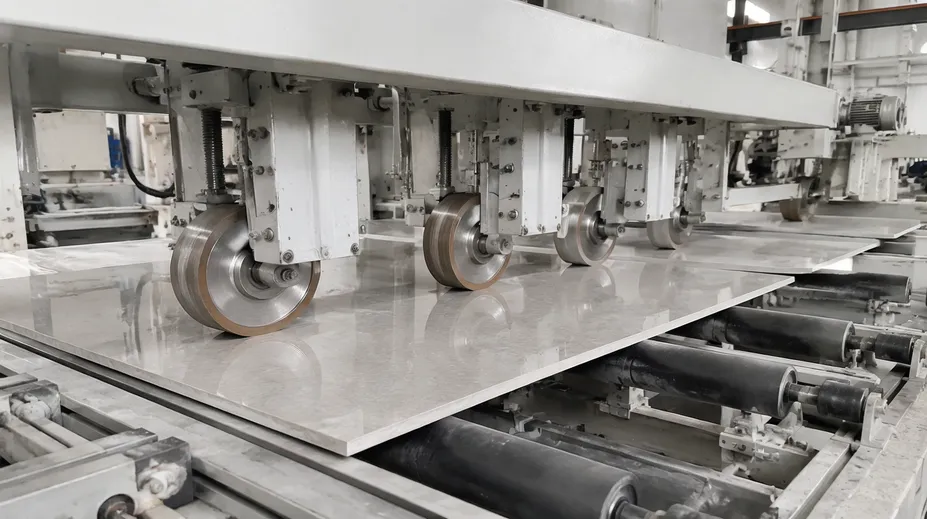
Diamond grinding wheels for edge calibration and thickness correction on large-format ceramic and porcelain slabs — before pressing or after firing. The volumes here are high: large format tile lines run continuously and consume grinding wheels as a production consumable.
Bond selection for ceramics differs from natural stone (typically softer bonds to avoid surface cracking on brittle substrates), and buyers in this segment evaluate suppliers on formula consistency batch over batch, not on unit price alone.
OEM Formula Matching: When You Need to Source from a Specific Starting Point
If you're already supplying grinding wheels under your own brand and need a manufacturing partner, the starting point is what you're already running — not what we have in catalog.
Private-Label Packaging
Your brand name, logo, and SKU codes printed on the wheel face and outer carton — standard on OEM runs. We ship container-ready, with packing lists formatted for your import documentation workflow.
How Formula Matching Works
Send Your Current Wheel
One or two pieces, plus the stone type being processed and your performance benchmark (expected life in m², surface finish at specific grit stage, operating speed).
We Analyze & Measure
We measure the existing wheel's diamond concentration and grit size, test the bond hardness, and examine the segment geometry.
Matched Sample Produced
Matched sample within 15–20 working days. If adjustment is needed after your field test, one iteration typically resolves it — our R&D team has been doing this since before formula matching was a standard service offering.
Custom Profile Tooling
Profiled wheels for edge work — bullnose, ogee, beveled — require profile-specific tooling.
Runs over 500 pcs
Tooling cost absorbed — no separate charge.
Runs below 500 pcs
One-time tooling charge quoted separately.
For standard flat and segmented wheels — no tooling charge applies.
OEM Program at a Glance
- MOQ 200–500 pieces per SKU (diameter/complexity dependent)
- Private-label: your brand, logo, SKU codes on wheel face + carton
- Matched sample turnaround: 15–20 working days
- One iteration typically resolves field-test adjustments
- Packing lists formatted for your import documentation workflow
- Tooling absorbed on profile wheel runs > 500 pcs
Certifications That Prequalify Your Import
Our diamond grinding wheels are manufactured under CLSEG's full certification umbrella — the same documentation stack that clears product through customs and satisfies regulatory requirements in our major export markets.
ISO 9001:2015
Third-party audited quality management system, covering the full production process from raw material incoming inspection through final product release.
CE Marking
Conformity with EU Machinery Directive and applicable EN safety standards for abrasive tools.
MPA Certification
Safety certification from the German Materials Testing Institute, one of the most recognized abrasive tool certifications for European distribution.
SGS Testing
Independent lab verification covering dimensional accuracy, rotational burst testing, and material composition.
MPA — The Certification European Distributors Ask About
MPA certification is the one that most European distributors ask about specifically — it's required by some buyers' insurance policies and satisfies the documentation requirements under German occupational safety regulations. If you're importing into the EU or UK, you likely won't need to arrange separate third-party testing on arrival.
View full certification documentation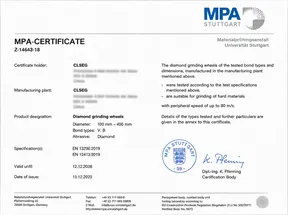
Frequently Asked Questions
Technical buying decisions answered directly — bond selection, tool life, product differences, MOQs, and packaging logistics.
How do I choose between soft, medium, and hard bond for my grinding wheel application?
Match bond softness to stone hardness. Hard stones like granite and engineered quartz need a soft bond — the matrix wears away at the rate needed to continuously expose fresh diamond and maintain cutting action. Soft stones like marble and limestone need a medium or hard bond — otherwise the matrix erodes faster than the diamond and your tool life collapses.
For mixed-stone operations where the same wheel cuts multiple materials, a medium bond is usually the best compromise, though you'll see shorter life on the hard-stone stages.
If you tell us your primary stone type and the machine's feed rate, we'll specify the right grade directly.
What's the typical tool life for a diamond grinding wheel on granite calibration?
On a calibration line processing medium-hard granite at standard feed rates and water cooling, a properly specified coarse grinding wheel (30/40 grit, soft bond) runs 50–150 running meters of slab edge — or roughly 80–200 m² of slab surface per wheel on a flat calibration head.
Variables that compress life
Harder granite, insufficient water cooling, excessive feed rate pressure, or a bond that's too hard for the stone (glazing)
Variables that extend life
Softer granite, consistent coolant flow, optimized machine parameters
For any specific application, give us your stone type and machine setup — we can bracket the expected life much more precisely.
Diamond grinding wheel vs. diamond cup grinding wheel — which do I need?
Grinding wheels (this page) mount on bench grinders, bridge saw calibration heads, and CNC stone centers on a flanged arbor. They're designed for controlled flat or profiled passes where the machine holds the geometry.
Cup wheels mount on angle grinders with an M14 thread or 5/8"-11 arbor — they're handheld tools for aggressive surface removal, concrete prep, and edge shaping without CNC guidance.
Buyer runs bench machine / automated line
→ Grinding wheel
Buyer works handheld on floors / site prep
→ Cup wheel
Many stone fabrication shops stock both. See our cup grinding wheel range →
Can you produce grinding wheels with custom profiles for edge work?
Yes — bullnose, ogee, pencil-edge, beveled, and custom radii. Profile-specific tooling is required, which we quote separately on runs under 500 pieces and absorb on larger runs.
For custom profiles, send us a drawing or a cross-section of the edge profile you need, along with the stone type and machine type. We'll confirm feasibility and quote tooling plus production.
Lead time on new profiles (including tooling production) is typically 25–35 working days for the first sample.
What's your MOQ for diamond grinding wheels, and can you do mixed-grit orders?
Standard MOQ is 200–500 pieces per SKU depending on diameter. Mixed-grit orders within the same diameter and bond type count toward the MOQ — if you need 100 pieces of 60/80 grit and 100 pieces of 120/180 grit in the same 200 mm diameter, that's one MOQ met. Mixing diameters counts separately.
For distributors building an initial grinding wheel inventory, we can suggest a grit mix based on what's selling for our existing distributors in your target market — most fabrication shop customers need coarse and medium grit in the highest quantities, with fine grit at roughly 30% of the coarse volume.
How are diamond grinding wheels packaged for ocean freight?
Each wheel ships in a rigid individual tray or foam-padded cardboard sleeve, then packed 5–20 pieces per master carton depending on diameter. Moisture-barrier inner bags are standard on all export orders — steel arbor bores and wheel bodies will rust if exposed to container condensation during long voyages.
Master cartons are labeled with diameter, grit, bond hardness, and our batch code for traceability. If you need private-label carton printing, we print in-house; send artwork and we'll confirm print setup at no additional charge on orders over 500 pieces.
Other Products in Our Diamond Grinding Tool Range
All four product lines ship from the same facility under the same certification umbrella. If you're consolidating multiple grinding tool SKUs under a single supplier, explore the full range below.
Diamond Grinding Discs
Flat surface prep, grit progression, coating removal on handheld and floor machines.
View Diamond Grinding DiscsCup Grinding Wheels
Handheld angle grinder work — concrete leveling, stone edge shaping, surface removal.
View Cup Grinding WheelsStone Surface Grinding Tools
Frankfurt abrasives, fickert blocks, resin polish tools for automated production lines.
View Stone Surface Grinding ToolsSend Us Your Stone Type and We'll Spec the Wheel
The fastest path to a productive quote: tell us the stone you're grinding, the processing stage (calibration, edge profiling, surface prep), your machine type, and an approximate monthly volume.
We'll recommend the diameter, grit, and bond hardness — and if it's an unusual stone or a demanding tolerance requirement, we'll confirm with a sample run before you commit to production volume.
New to Our Grinding Wheel Line?
Most buyers start with a mixed sample order of 20–50 pieces across two or three grit stages. We can ship samples within 7–10 working days.
Ready to Get Started?
Tell us your stone type, processing stage, and volume. We'll handle the rest.
- Formula-matched to your stone type
- Sample run for demanding tolerances
- Mixed sample orders: 20–50 pcs
- Sample shipping: 7–10 working days