

Sintered Stone Saw Blades Precision Cutting for Engineered Surfaces
Purpose-built for large porcelain slabs, microcrystalline stone, and nano glass — the brittle, vitrified surfaces that standard stone blades destroy. Ultra-thin segments, controlled diamond exposure, low vibration cores that protect your downstream customers' finished panels.
- ISO 9001:2015 Certified
- CE, SGS, MPA Certified
- OEM/ODM Available
- Factory-Direct Export
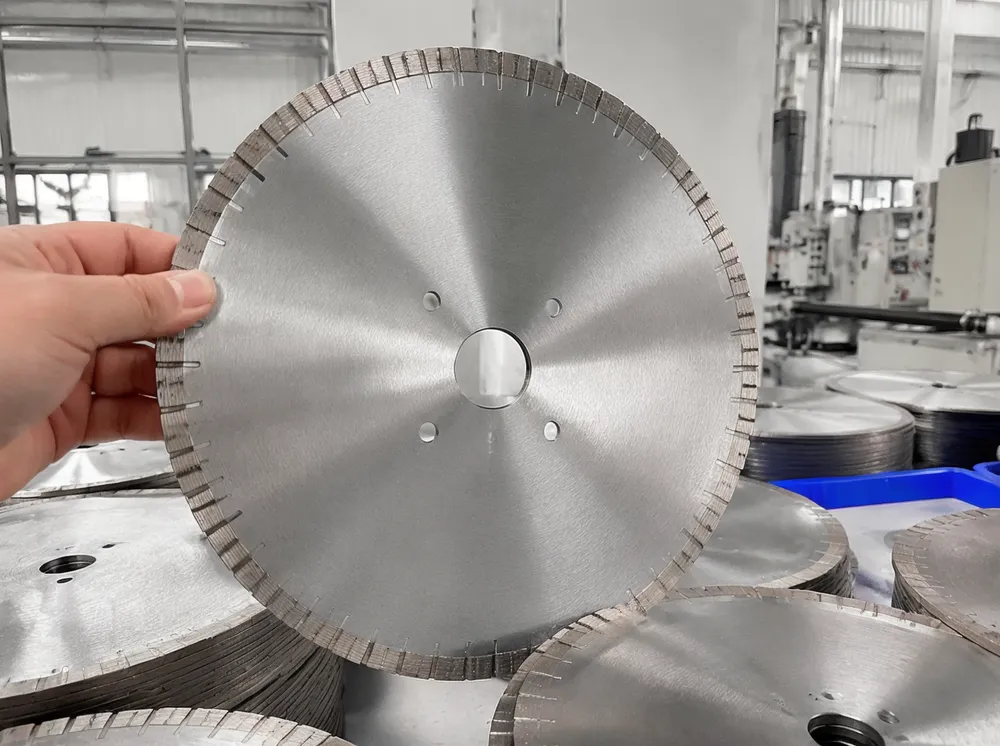
What Makes Sintered Stone Different to Cut — and Why It Matters for Your Business
Sintered stone, large-format porcelain slabs, microcrystalline stone, and nano glass are structurally different from natural stone. They're fired or pressed at extreme temperatures to near-zero porosity, which gives them exceptional hardness and surface density — but also makes them brittle in ways that punish imprecise tooling.
The failure mode you hear about from fabricators: edge chipping and micro-cracking that only shows up after the piece is installed and illuminated. A 3200 × 1600 mm sintered stone slab that chips at the cut edge isn't a blade problem — it's a $600–$1,200 panel loss, plus the labor to remove and replace it. Your downstream customer absorbs that cost, and you lose the reorder.
What these materials actually need is a blade with a tightly controlled segment geometry, a bond formula soft enough to cut without dragging, and a steel core that suppresses vibration at the frequencies generated by dense vitrified surfaces. A standard granite blade has the wrong bond hardness and too much lateral play — it cuts, but it micro-fractures the edge. A standard ceramic blade for tile (105–230 mm) doesn't scale to the 300–600 mm diameters required for slab processing on bridge saws.
This is the gap our sintered stone saw blade line fills. We developed these formulas from the ground up for engineered slab materials — not repurposed from natural stone formulas with minor adjustments.
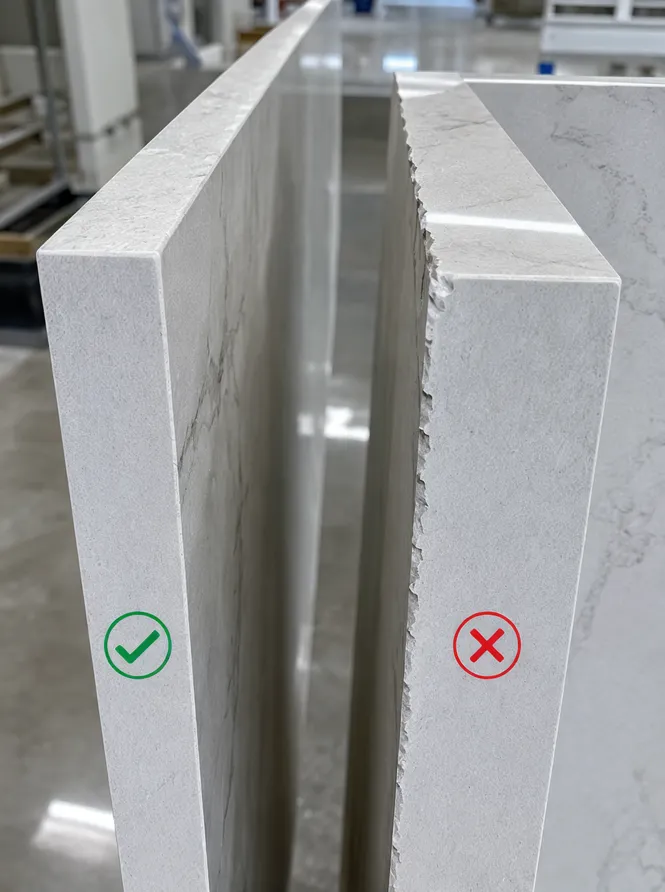
Near-Zero Porosity
Fired at extreme temperatures, these materials have exceptional hardness and surface density — but chip catastrophically with the wrong blade geometry.
$600–$1,200 Per Panel Loss
A chipped edge on a large-format slab means full panel replacement plus labor. Your downstream customer absorbs the cost — and you lose the reorder.
300–600 mm Diameter Gap
Standard ceramic tile blades (105–230 mm) don't scale for bridge saw slab processing. Standard granite blades have the wrong bond hardness and lateral play.
Technical Specifications
Specifications shown are industry-standard values for this product type. Actual specifications may vary by order configuration. Contact us for detailed product data sheets and machine compatibility confirmation.
| Parameter | Specification |
|---|---|
| Diameter range | 300 mm – 600 mm (custom up to 800 mm on request) |
| Segment height | 10 mm – 15 mm |
| Segment width (kerf) | 1.8 mm – 3.2 mm (varies by core thickness) |
| Core thickness | 1.6 mm – 2.8 mm |
| Arbor bore | 25.4 mm, 50 mm, 60 mm (custom bore available) |
| Segment type | Continuous rim, close-segment, and turbo-continuous hybrid |
| Diamond grit | 50/60, 60/80 mesh — finer grit for cleaner cut edges |
| Bond type | Soft-to-medium composite bond, proprietary low-stress formula |
| Core construction | Standard steel core and silent-core (vibration-dampening sandwich) options |
| Welding method | High-frequency welding (standard); laser welding available |
| Operating speed | 35 – 55 m/s (RPM charts provided with order) |
| Certifications | ISO 9001:2015, CE, MPA |
| Cutting mode | Wet cut (recommended); some configurations support semi-dry |
Key Decision Factors
Two dimensions worth examining before you quote against a competitor:
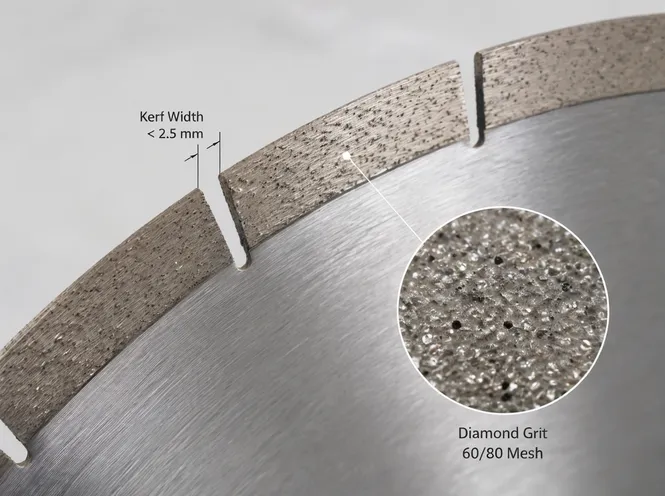
Segment Kerf Width
Narrow kerf (under 2.5 mm) reduces material loss on expensive slabs. This matters commercially when the slab costs $800 per sheet.
Diamond Grit Mesh
Finer diamond grit (60/80 mesh) produces cleaner edges but cuts slower. The right balance depends on your customers' machine power and whether they're optimizing for throughput or finish quality.
We specify both at the quote stage based on your application.
Bond Formula — The Technical Reason These Blades Work on Sintered Stone
The parent category page covers our formula development process in detail — the short version is that we own our formulas, run an in-house R&D center with 60+ patents, and match bond chemistry to material characteristics rather than selling a general-purpose blade at a lower price. See how our formula development works
Why Sintered Stone Is Different
For sintered stone specifically, the challenge is different from natural granite or marble. Natural stone has micro-porosity and crystal structure that gives diamonds something to bite into. Sintered stone is vitrified — the surface is essentially a dense glass-ceramic matrix.
Won't allow diamond exposure. Blade glazes immediately — no cutting action.
Allows too-aggressive diamond protrusion. Catches and chips the brittle surface instead of shearing cleanly.
Our Sintered Stone Formula Approach
- Formulas run at the softer end of our bond spectrum with controlled diamond protrusion depths — roughly 20–30% shallower exposure than we'd specify for granite.
- Segment geometry uses a finer diamond grit size (50/60 or 60/80 mesh) to distribute cutting load across more contact points.
- Result: a shearing action rather than a chipping action at the cut edge.
Lab Note: We tested this against a standard ceramic tile formula early in development — the tile blade formula glazed on sintered stone within 20 minutes of cutting because the bond was designed for a different abrasion mechanism.
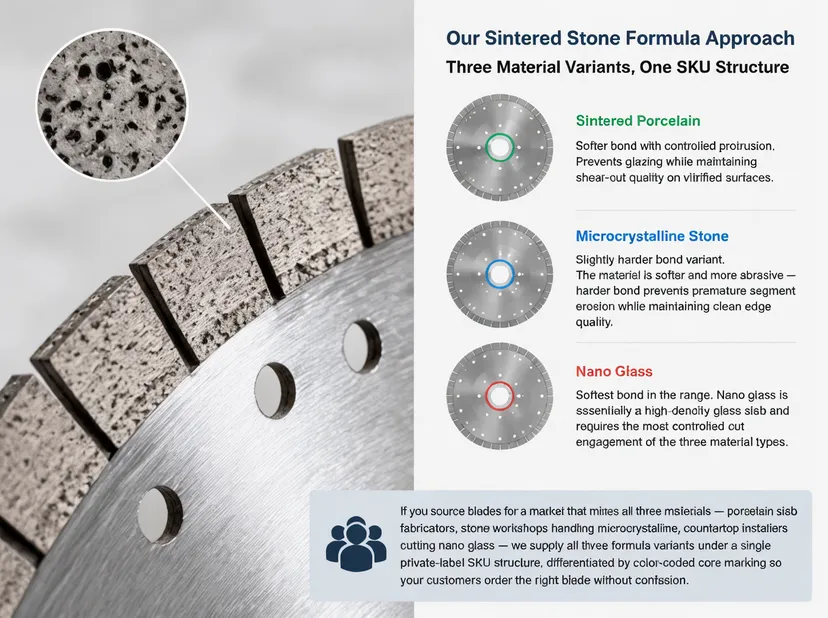
Three Material Variants, One SKU Structure
Sintered Porcelain
Softer bond with controlled protrusion. Prevents glazing while maintaining shear-cut quality on vitrified surfaces.
Microcrystalline Stone
Slightly harder bond variant. The material is softer and more abrasive — harder bond prevents premature segment erosion while maintaining clean edge quality.
Nano Glass
Softest bond in the range. Nano glass is essentially a high-density glass slab and requires the most controlled cut engagement of the three material types.
Private-label ready: If you source blades for a market that mixes all three materials — porcelain slab fabricators, stone workshops handling microcrystalline, countertop installers cutting nano glass — we supply all three formula variants under a single private-label SKU structure, differentiated by color-coded core marking so your customers order the right blade without confusion.
Application Segments — Markets Where These Blades Generate Reorders
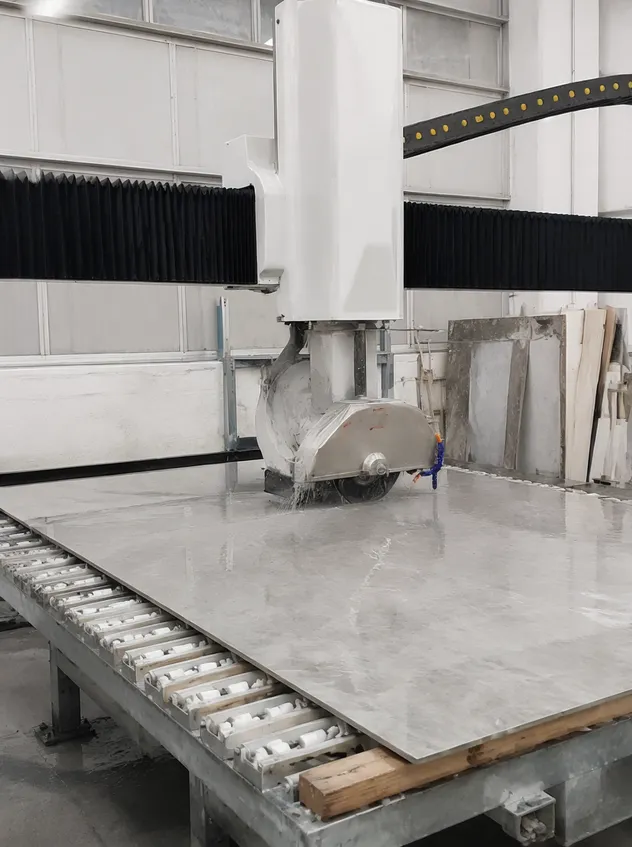
Large-Format Porcelain Slab Fabrication
Fastest GrowingThe fastest-growing application in this product line. Large-format porcelain slabs — 1200 × 2400 mm to 3200 × 1600 mm in 6 mm, 12 mm, and 20 mm thicknesses — are replacing natural stone in commercial interior projects globally. Kitchen countertops, vanity tops, flooring for commercial spaces, exterior cladding. Fabricators cutting these slabs on bridge saws run 300–400 mm blades continuously, and they experience significant blade failures when using standard granite or ceramic blades.
The Commercial Opportunity
Fabricators doing slab work at volume — say 50–100 slabs per week — go through 3–6 blades per week depending on slab thickness and machine parameters. That's a predictable, recurring order cycle.
A distributor who supplies the right blade (no edge chipping, predictable life) earns a sole-supplier relationship within 2–3 months, because a fabricator who finds a blade that works doesn't experiment. We've seen this pattern repeatedly with our existing distribution partners in Southeast Asia — new accounts start with a trial order and convert to blanket monthly orders within one quarter.
Microcrystalline Stone Processing
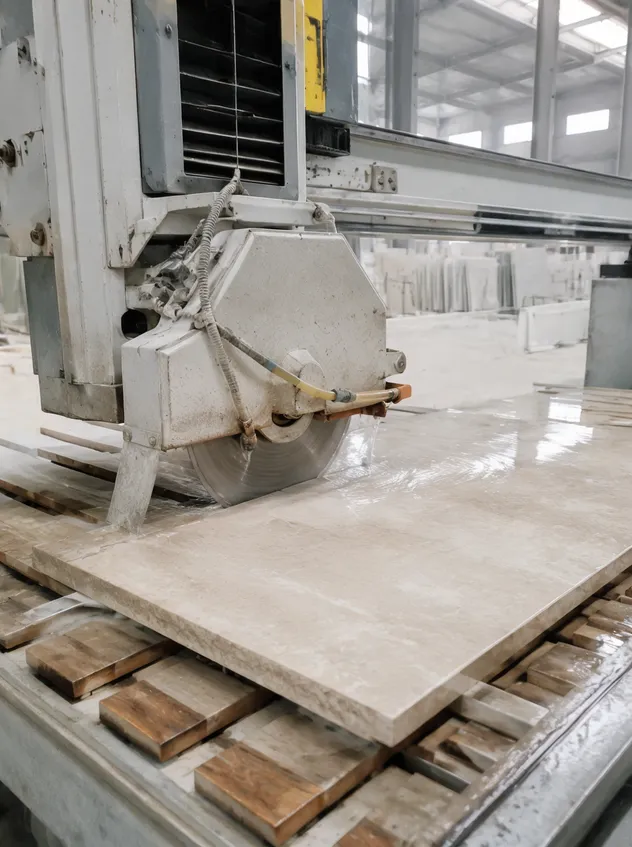
Microcrystalline stone (also called crystallized glass stone or glass ceramics) is widely used in flooring and wall cladding for high-specification commercial interiors — hotel lobbies, airports, shopping centers. It's harder than standard ceramic but more brittle than sintered porcelain, and its crystalline structure means cut edges are visible on finished surfaces.
Distribution Opportunity
For distributors supplying commercial interior contractors or stone wholesale markets in regions with active hospitality and commercial construction — Southeast Asia, the Middle East, Eastern Europe — microcrystalline stone saw blades move volume during project procurement cycles.
Order Pattern
Large hotel or airport projects source materials in bulk, which means blade orders follow the same pattern: large upfront purchase, then replacement orders as the project runs.
- Hotel lobbies & luxury hospitality
- Airport terminal flooring
- Shopping center wall cladding
- High-spec commercial interiors
Nano Glass Panel Cutting
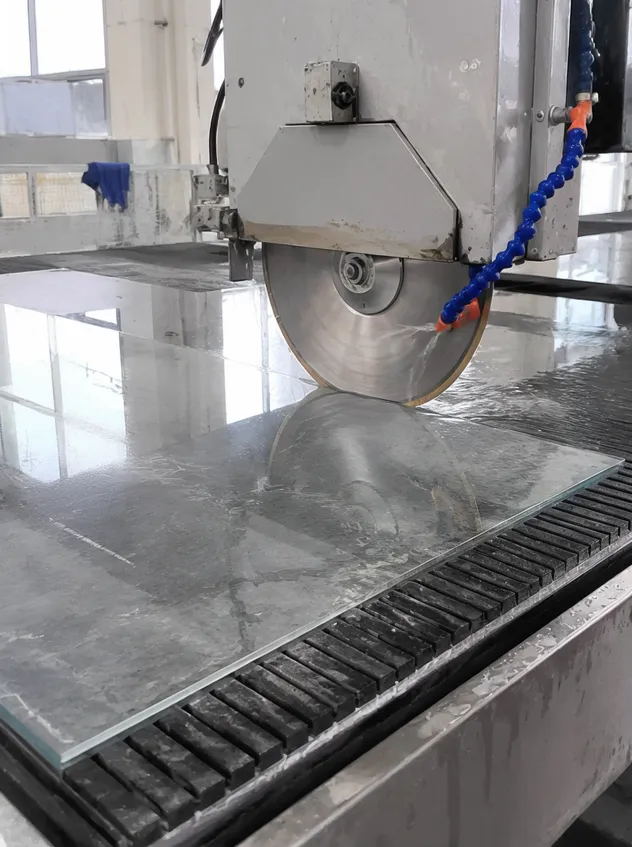
Premium SegmentNano glass (sometimes marketed as "nano crystallized glass") is increasingly specified for premium residential interiors and luxury commercial applications — feature walls, luxury bathroom surfaces, high-end reception areas. The material is visually striking but exceptionally unforgiving to cut: it's essentially a dense glass panel, and any blade vibration or bond mismatch produces visible surface damage.
Buyer Profile & Pricing Logic
The buyers sourcing nano glass blades are typically premium stone fabricators or interior stone suppliers serving the high-end residential market. Unit pricing tolerance is higher — your customers accept a price premium for blades that reliably protect $1,500/m² panels.
This is a margin-protective segment: the blade cost is trivial relative to the material cost, which means your customer cares about performance, not price.
- Feature walls & luxury bathroom surfaces
- High-end reception areas
- Premium residential interiors
Countertop Fabrication for Engineered Surface Brands
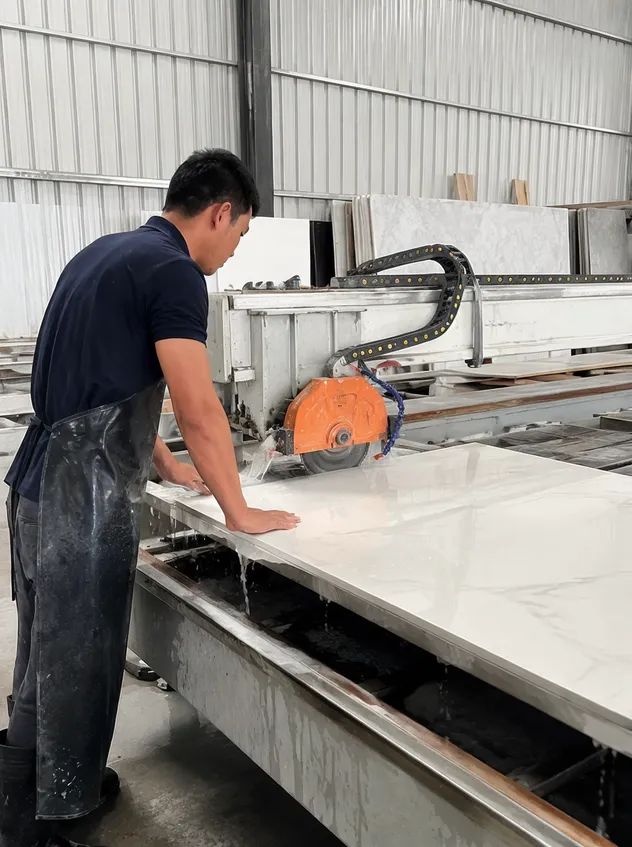
Widest DistributionThis is the widest-distribution application. Globally branded engineered surfaces — sintered stone brands sold through design showrooms and kitchen studios — require fabricators to cut panels on-site or at workshop level. These fabricators are often smaller operations (5–20 employees) buying through local stone tool distributors.
Why This Matters for Wholesale Distributors
For wholesale distributors targeting the kitchen and bath trade: these fabricators represent a high-touch, reorder-friendly customer base. They buy blades frequently, they rely on their tool distributor for product recommendations, and they pay attention to blade performance because their material costs are high.
Stocking the right sintered stone saw blade is a category anchor — it drives traffic from fabricators who need a reliable source.
Customization: What We Can Adjust and What It Affects
Sintered stone applications vary more than most stone categories because the material itself varies — different brands use different raw material compositions and firing temperatures, which affects how the blade should cut. We accommodate this through formula-level customization, not just dimensional changes.
Formula Tuning by Material Brand
If your customers consistently cut one brand of sintered stone (some brands have significantly harder surfaces than others), we can tune the bond hardness and diamond concentration to that specific material.
Process:
- We provide test blades; you cut sample pieces and report on edge quality and cutting speed
- Typical formula iteration: 1–2 rounds, 3–4 weeks total
- Once locked, your formula is on file for identical reorders
Diameter & Arbor Customization
Standard range is 300–600 mm. We can produce up to 800 mm for specialized large-format machines.
- Custom arbor bores for non-standard machine spindles
- European CNC stone machines: 80 mm or 100 mm arbor bores supported
- MOQ is lower than buyers expect for custom arbor sizes
Segment Geometry Options
The choice depends on your customers' machine power and slab thickness mix. We'll recommend geometry based on your application description.
Continuous Rim
Maximum chip protection on delicate materials
Turbo-Continuous Hybrid
Faster cutting with better debris clearance
Close-Segmented
Heavier stock removal on thicker slabs
Silent Core Upgrade
For fabricators cutting in enclosed workshops or showroom environments where occupational noise is regulated.
- Vibration-dampening sandwich steel core
- Reduces operating noise 3–5 dB
- EU & Australia occupational noise regulations make this a specification requirement, not optional
Also available: Silent Core Diamond Blades product line
Private Label Packaging
Your brand on the blade core, your logo on packaging, your color-coded SKU system.
- MOQ for private-label runs: starts at 100 pieces
- Blade core printing, custom box design, SKU labeling
If you're building a private-label tool brand for the stone fabrication trade, sintered stone blades are a natural anchor product: the category is specialized enough that your brand's presence signals expertise.
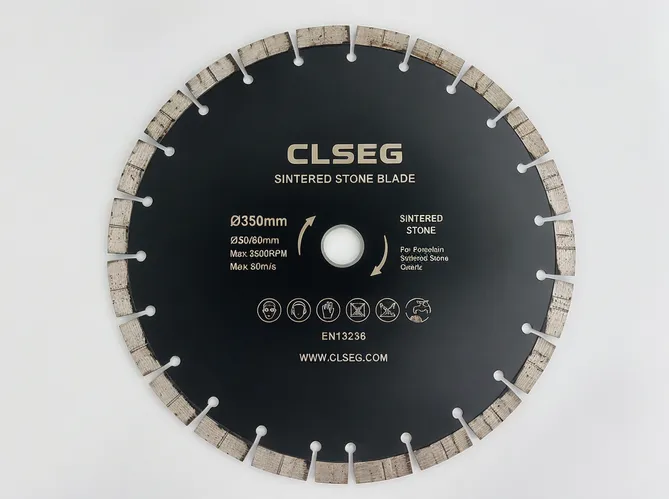
Custom segment geometries, silent cores, and private-label blade printing — configured per order to match your market's machine standards and regulatory requirements.
Ready to discuss customization?
Describe your application and we'll recommend the right formula, geometry, and packaging configuration.
Cut Quality vs. Cutting Speed — The Trade-Off Your Customers Will Ask About
This comes up in almost every conversation about sintered stone blades, so it's worth addressing directly.
Faster Cutting Speed
Requires more aggressive diamond exposure and a higher-concentration segment.
Trade-off: Increases the risk of micro-chipping on brittle vitrified surfaces.
Cleaner Edge Quality
Requires controlled exposure and finer grit for chip-free edges.
Trade-off: Slows down the cut. No formula fully optimizes both simultaneously.
How We Navigate This in Practice
We ask what material thickness and machine power your customers are working with. The answer determines which formula variant fits best:
Thin Sintered Stone Panels
6 mm, 9 mm thickness — cuts quickly regardless of formula because there's little material to remove.
Here you can run the edge-quality formula without meaningful throughput penalty. Clean edges at acceptable speed.
Thick Slabs — High Production
20 mm, 30 mm thickness — takes longer per cut, and high-production fabricators feel the speed difference.
Slightly more aggressive variant accepts marginally more edge roughness (still within commercial tolerance) in exchange for 20–30% faster feed rates.
The honest position:
For most fabricators running standard sintered stone panel thicknesses on water-cooled bridge saws, our standard formula produces clean edges at acceptable cut speeds. The high-speed variant is for production environments where the fabricator is cutting 100+ panels per day and the time-per-cut directly impacts labor cost.
We'll recommend which variant fits your customers' operations once you describe the use case.
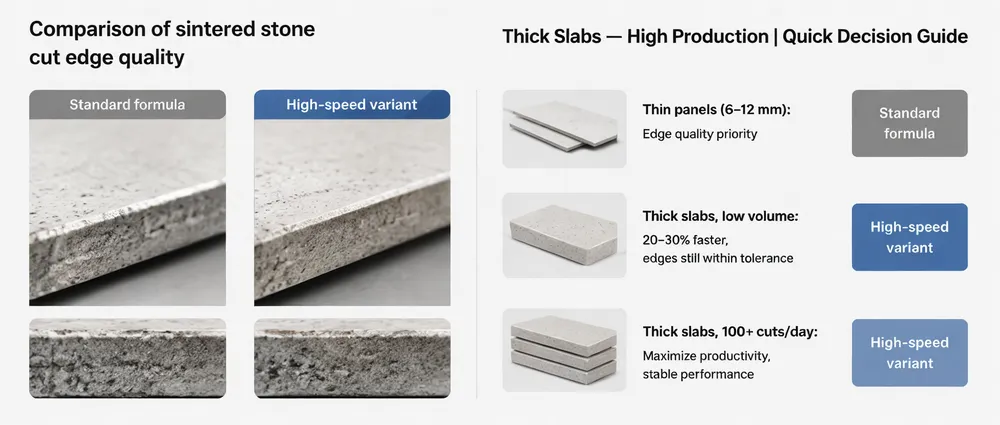
Quick Decision Guide
- Thin panels (6–12 mm): Standard formula — no speed penalty
- Thick slabs, low volume: Standard formula — edge quality priority
- Thick slabs, 100+ cuts/day: High-speed variant — 20–30% faster, edges still within tolerance
Quality Control — What We Check Before This Blade Ships
The failure modes on sintered stone blades are different from standard stone blades. Segment detachment risk is lower on this blade type because operating loads are lower — these blades cut with controlled engagement, not aggressive bite. The actual quality risks are: segment flatness (a warped segment produces an inconsistent kerf that chips the edge), diamond distribution uniformity (clustering creates high-pressure points that fracture brittle surfaces), and core concentricity (runout causes vibration, which is fatal on nano glass).
Segment Flatness Inspection
Every segment is checked for flatness before welding. Tolerance is tighter for sintered stone segments than for our granite blade range because the consequences of a non-flat segment are more visible on smooth engineered surfaces.
Diamond Distribution Verification
We pull segments from each batch for cross-section analysis. Diamond density variation across the segment cross-section must stay within our internal tolerance:
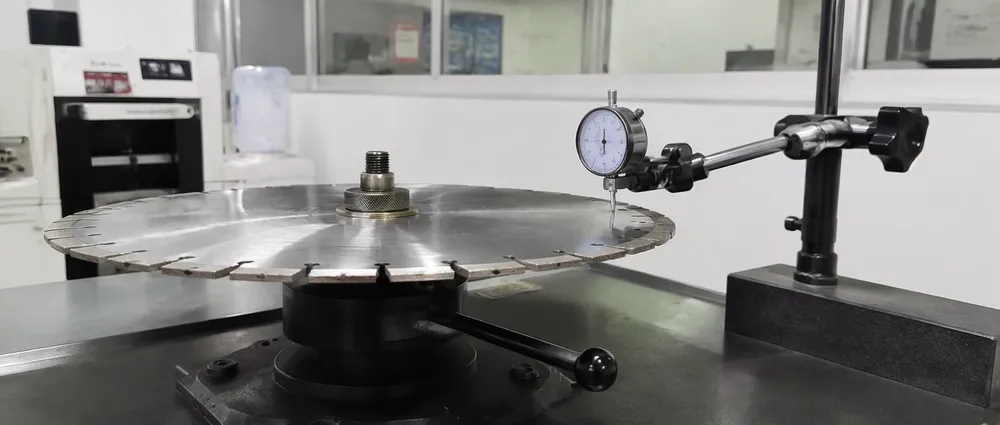
Core Runout Measurement
Finished blades are checked for concentricity on a dedicated runout bench. Blades that exceed our runout threshold get re-tensioned or rejected.
| Blade Type | TIR Threshold |
|---|---|
| Sintered Stone Blades | 0.10 mm |
| Standard Stone Blades | 0.15 mm |
Weld Inspection
Visual and random destructive pull testing on welded joints. Same protocol as our full blade range, documented in our ISO 9001:2015 quality management system.
Full Batch Traceability
Every production batch carries a batch record linking powder lot, sintering furnace parameters, and welding line data. If you ever have a quality issue in the field, we can pull the production data within 24 hours. That's the conversation your customers don't typically have with trading-company suppliers.
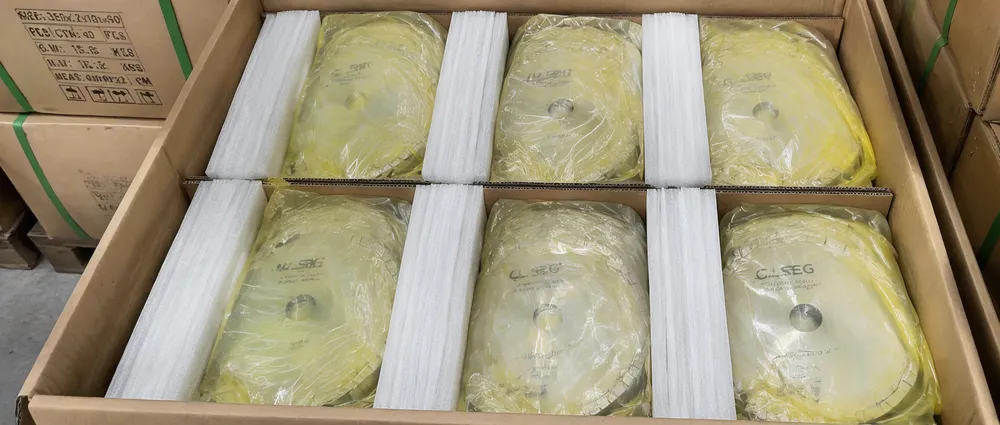
Packaging and Export Logistics
Sintered stone blades ship with edge-specific protection — the segments on these blades use finer diamond grit that is more vulnerable to lateral impact than coarser-grit segments on heavy-duty blades. Each blade is wrapped individually in VCI film, then packed in rigid-wall cartons with segment-face foam inserts that keep the rim from contacting the carton wall during transit.
Packing Density (350–450 mm)
- 60–80 pieces per carton (weight-limited rather than volume-limited at this diameter)
- Standard 20GP container carries 8,000–10,000 pieces of this diameter range
- LCL (Less-than-Container-Load) available for initial inventory builds — experienced with consolidation freight from Hubei
Lead Times
Standard Orders (Existing Formulas)
25–35 days from order confirmation
Custom Formula Orders
+3–4 weeks for sampling & buyer sign-off before production begins
Repeat Orders (Locked Formulas)
Faster — production parameters maintained; starts at order confirmation
Export Documentation
For buyers in markets requiring specific material declarations or RoHS compliance documentation, advise at the time of inquiry — we prepare it with the order.
Frequently Asked Questions
What's the difference between a sintered stone saw blade and a standard porcelain tile blade?
The standard porcelain tile blade (105–230 mm) is designed for wall tiles and floor tiles on wet tile saws — smaller format, lower machine power, slower feed rate. A sintered stone saw blade runs on bridge saws and large-format cutting machines at 300–600 mm diameter, handling slabs up to 3200 × 1600 mm in thicknesses from 6 to 20+ mm.
The formula requirements are also different: large-format sintered slabs often have different densities and surface characteristics than standard floor tiles, and the longer cut path means thermal management across the blade becomes important in a way it isn't on a 200 mm tile cut.
Key takeaway: They're different products for different machines and different material formats — not interchangeable.
| Parameter | Standard Porcelain Tile Blade | Sintered Stone Saw Blade |
|---|---|---|
| Diameter | 105–230 mm | 300–600 mm |
| Machine Type | Wet tile saws | Bridge saws, large-format cutters |
| Slab Size | Standard tile format | Up to 3200 × 1600 mm |
| Material Thickness | Standard wall/floor tile | 6 to 20+ mm |
| Thermal Management | Less critical (short cut path) | Critical (long cut path) |
Can one sintered stone blade formula cut large porcelain, microcrystalline stone, and nano glass?
A mid-range formula will cut all three at acceptable (not optimal) performance. If your customers process primarily one material type, a formula matched to that material will give 20–40% longer segment life and cleaner edges compared to a generalist formula.
For distributors stocking for mixed-material markets, we recommend a two-SKU structure:
Similar hardness profile. One formula handles both materials with optimal segment life and edge quality.
Softer bond, finer engagement. Prevents overheating and micro-chipping on glass-composite surfaces.
Private label tip: We can supply both under your brand and differentiate by core color so your customers self-select the right blade without needing technical training.
What causes chipping on sintered stone when cutting?
Four common causes:
- 1 Wrong bond hardness — too hard for the material density, causes the blade to drag and fracture rather than shear.
- 2 Excessive feed rate — the blade can't clear material fast enough, builds heat and vibration.
- 3 Inadequate water flow — thermal stress on brittle surfaces causes micro-cracking.
- 4 Worn blade run past its service life — diamond exposure decreases, the blade starts rubbing rather than cutting.
The most common single cause we see when buyers switch to us from another supplier is bond mismatch — the previous supplier's blade was designed for a different material type and was never correctly specified for sintered stone.
What is the MOQ for sintered stone saw blades?
50 pcs
Standard stock formulas
per specification
100 pcs
Private-label packaging
minimum
10–20 pcs
Custom formula development
sample batch
Custom formula development: we produce a sample batch of 10–20 pieces for cut testing and sign-off before full production. For market-test quantities prior to committing to a full order, we supply 5–10 piece samples at production pricing — enough to run trials with your key accounts and confirm blade performance before ordering container quantities.
How do I know which segment type — continuous rim, close-segmented, or turbo hybrid — is right for my customers?
Continuous Rim
For materials where zero chipping is non-negotiable: nano glass, ultra-premium sintered stone, any material where edge finish is visible in the final application.
Close-Segmented
For standard porcelain slabs where you want slightly faster debris clearance and can accept occasional minor edge texture (acceptable in most commercial flooring and countertop applications).
Turbo-Continuous Hybrid
For thicker slabs (15 mm+) where cooling and debris clearance on a longer cut path affects blade temperature.
If you describe the slab thickness range and material type your customers work with, we'll make the specific recommendation — this isn't a decision you should have to make by reading a spec sheet.
Can these blades run dry, or do they require water cooling?
Wet cutting is required for sintered stone, large porcelain, and nano glass. Dry cutting generates surface temperatures that micro-crack vitrified materials before the blade even completes the cut — you'd lose both the blade and the panel.
Standard high-frequency welded cores are sufficient for wet-cut sintered stone applications.
Limited water situations: If your customers encounter situations where water supply is limited (on-site installation cuts in finished spaces), we can supply a semi-dry configuration with laser-welded joints and a modified bond — but this is the exception. The standard wet-cut configuration handles 95% of sintered stone cutting work.
Related Products in the Diamond Saw Blade Range
If sintered stone blades don't match your specific application, these sibling products may be a better fit:
Ceramic Saw Blades
Designed for standard porcelain tile and ceramic wall and floor tiles at smaller format (105–300 mm). Lower machine power requirement; optimized for tile saws and wet bench saws rather than bridge saws.
View rangeBridge Saw Blades
General-purpose bridge saw blades for natural stone (granite, marble, mixed slab) on the same machine type as sintered stone. If your customers process both natural stone and engineered panels, we can specify both formulas and help you build a two-SKU inventory that covers the full material range.
View rangeSilent Core Diamond Blades
Vibration-dampening silent cores are available within this sintered stone product line, but if noise reduction is the primary requirement across your full blade inventory, the dedicated silent core range covers a wider diameter and application set.
View rangeContinuous Rim Diamond Blades
If your customer's primary concern is chip-free edges on any ceramic or stone material (not just sintered stone), the continuous rim range covers a broader set of applications at standard formula pricing.
View rangeStart With Your Material, Not Our Catalog
The fastest path to the right blade and a usable quote: tell us what your customers are cutting.
What We Need From You
- Sintered stone brand name (or material description)
- Slab thickness
- Machine type and power
- Approximate monthly volume
What You Get Back
Formula recommendation, segment geometry selection, and FOB pricing — typically within 48 hours for standard configurations.
New to Sintered Stone Blades?
If you want to test the category before committing to volume, we ship sample orders of 5–10 pieces at production pricing.
Most buyers in this segment start with a sample run across two or three key accounts, confirm the edge quality with their customers, then move to regular monthly or quarterly orders.
We've set up distribution partnerships this way in Southeast Asia, the Middle East, and Europe — it's a low-risk way to add a high-margin SKU to your stone tool line.
Get in Touch
Include the material type, slab thickness, machine specs, and target quantity. The more specific you are, the faster we turn around an actionable quote.