

Diamond Segments Sintered In-House, Shipped Factory-Direct
Granite, marble, and gang saw segments produced from raw powder to finished product under one roof — no third-party segment sourcing, no formula guesswork.
- 20+ years sintering experience
- 60+ formula patents
- Exported to 30+ countries
- ISO 9001, CE, SGS, MPA certified
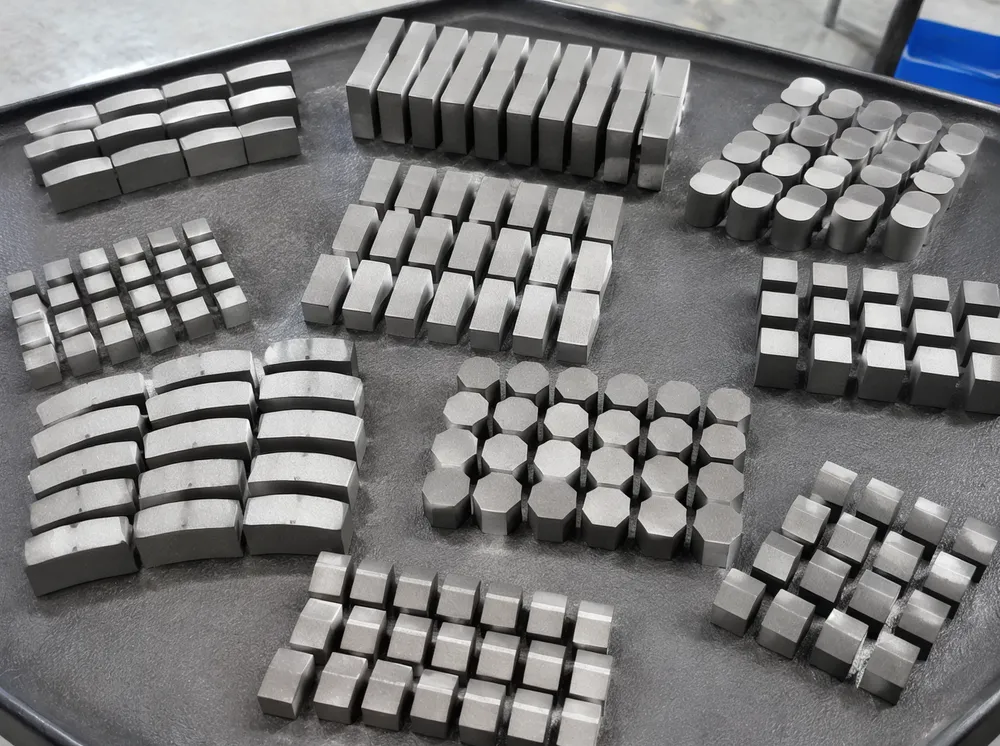
What You're Actually Buying When You Buy a Diamond Segment
A diamond segment is where your blade's cutting performance lives or dies. The steel core is just the delivery vehicle — the segment does the work. And the segment's performance is entirely determined by two things: the diamond grit specification and the metal bond formula that holds it together.
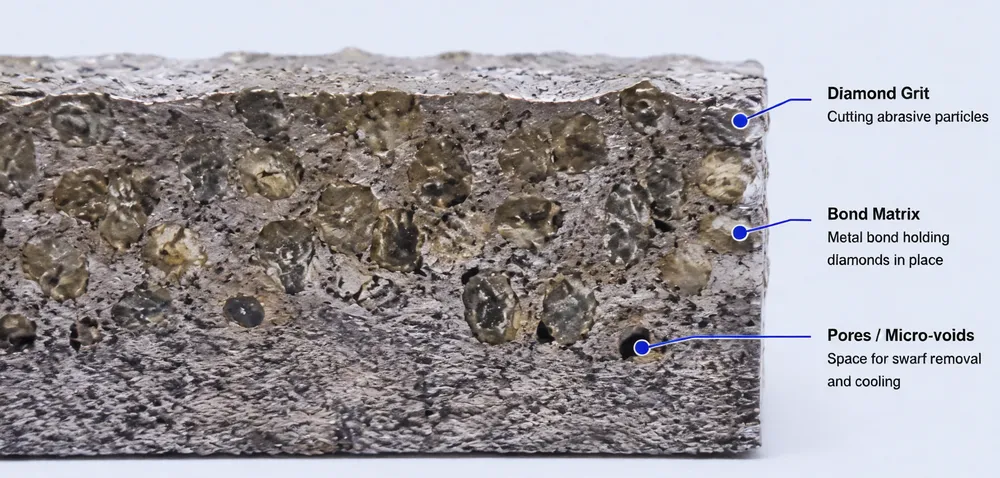
We sinter every segment ourselves. We don't buy pre-made segments from third-party powder metallurgy shops and weld them onto cores — which is what a surprising number of "blade manufacturers" actually do. Our diamond segment factory starts at the powder mixing stage: selecting diamond grit grades, blending metal bond powders (cobalt, iron, copper, tin, and proprietary additives), cold-pressing segment blanks, and sintering them under fully automated temperature and pressure profiles. When you source segments from us, you're dealing with the people who control the formula — not a factory that assembles someone else's components.
Why this matters commercially: when a segment underperforms in the field — eating through too fast on abrasive stone or glazing over on hard granite — the fix lives in the bond formula and diamond concentration. If your supplier doesn't control their own sintering, they can't troubleshoot. They send your complaint upstream and hope for the best. We adjust the formula directly, re-sinter test batches, and validate performance in-house before shipping corrections. Your after-sales problem resolution is a conversation, not a supply chain relay.
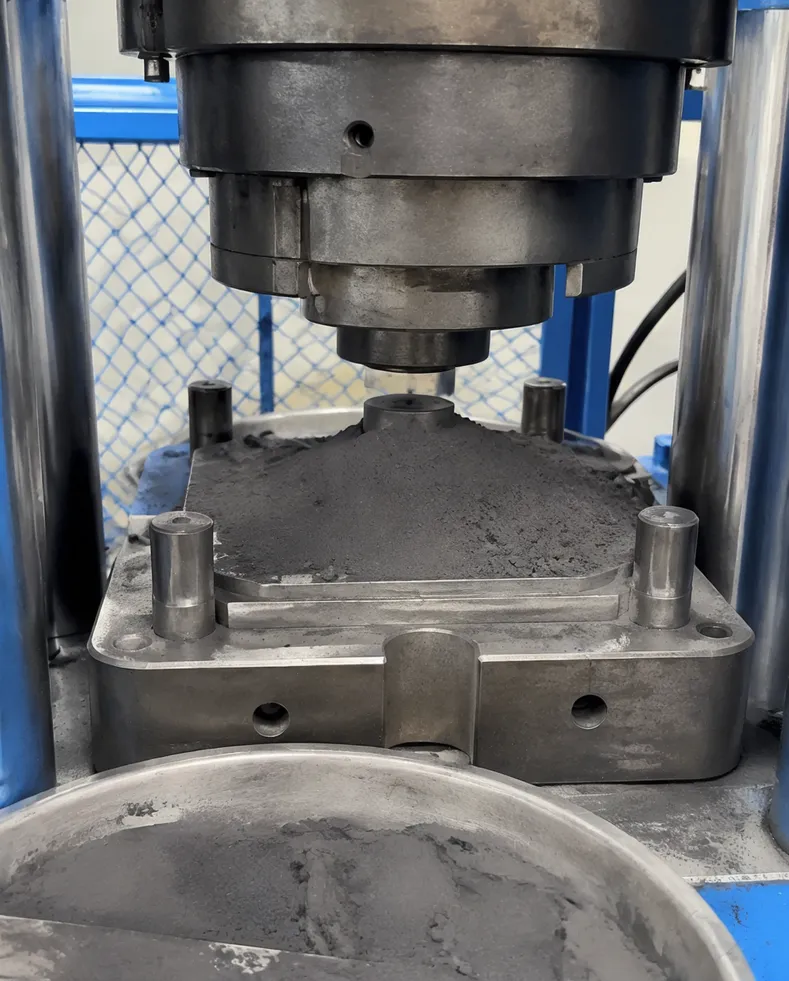
In-House Sintering Advantage
- Full formula control — powder mixing through final sintering
- Direct formula adjustments when field performance needs tuning
- After-sales is a conversation, not a supply chain relay
- Re-sinter test batches and validate in-house before shipping corrections
Segment Product Line by Application
We produce diamond segments across four primary categories, each with dedicated formula libraries tuned over two decades of real-world cutting data.
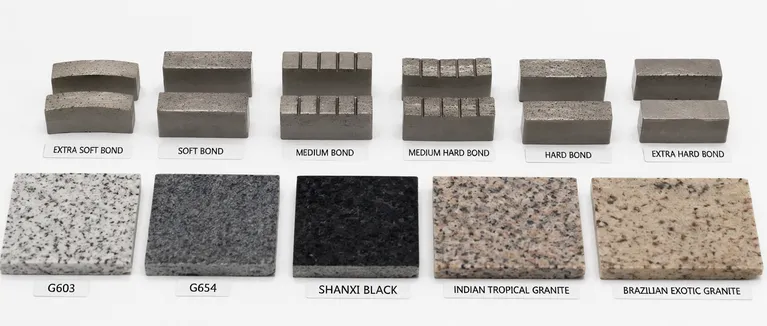
Granite Diamond Segments
Segments engineered for the full range of granites — from soft-to-medium varieties (G603, G654, Shanxi Black) up to extremely hard and abrasive types (Indian tropical granites, Brazilian exotic slabs). We adjust diamond concentration and bond hardness per granite type. Soft bond formulas for hard, non-abrasive granite ensure diamonds expose quickly. Hard bond formulas for abrasive granites prevent premature matrix erosion.
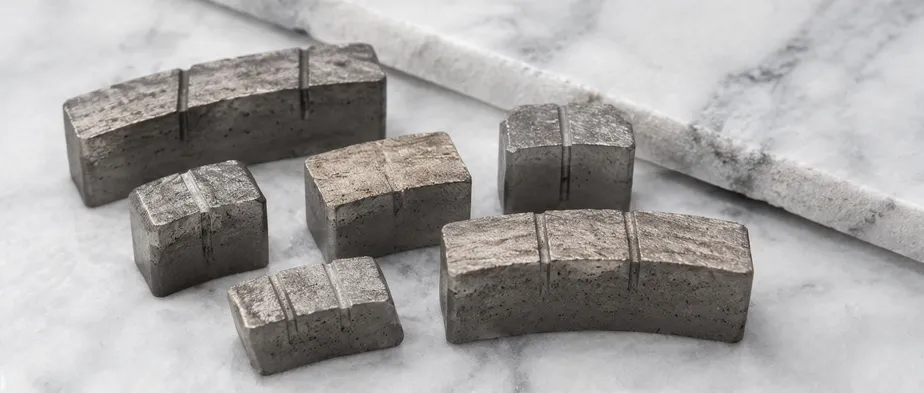
Marble Diamond Segments
Marble requires a different approach — it's softer and less abrasive than granite, so the bond matrix must wear fast enough to keep fresh diamonds exposed without over-cutting (which causes segment wobble and rough surface finish). Our marble segments use cobalt-dominant bonds with controlled porosity, optimized for clean cuts that reduce downstream polishing time. Suitable for block cutting, slab trimming, and fabrication work.
Gang Saw Diamond Segments
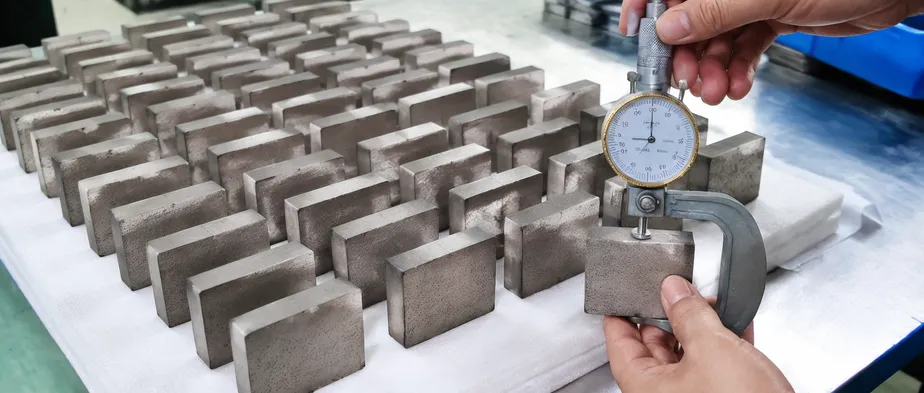
Gang saw segments are the high-volume workhorses of quarry and slab processing. These segments run continuously for days on multi-blade frames, cutting entire stone blocks into slabs. The operational demands are completely different from circular saw segments — slower feed rates, massive coolant flow, and the need for extreme uniformity across dozens of segments mounted on the same frame. We produce gang saw segments with consistent density tolerances batch-to-batch, so every blade on your frame wears at the same rate.
Custom Diamond Segments
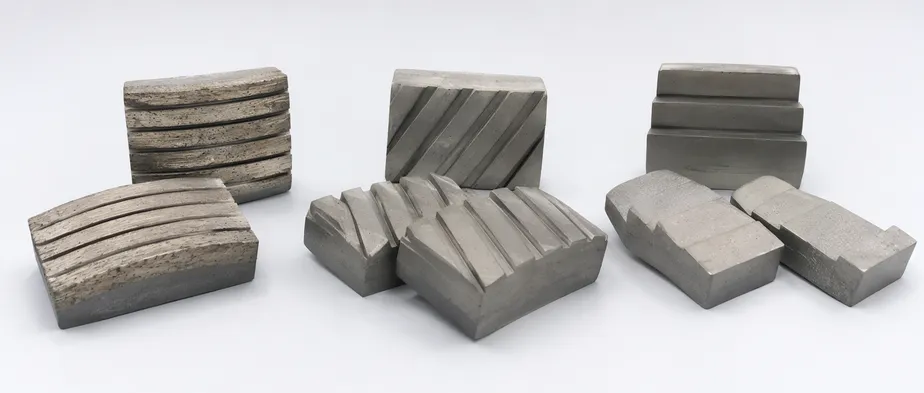
When your application falls outside standard configurations — unusual stone types, non-standard blade diameters, specific segment geometries (Arix layered, turbo profile, stepped-face) — our R&D team develops custom formulas. We hold 60+ formula and process patents, and our engineering team runs dedicated test-cutting rigs in-house. Custom segment development typically takes 2–4 weeks from initial spec discussion to sample delivery. OEM packaging, private labeling, and modified dimensions are standard workflow for us.
Why Gang Saw Batch Uniformity Matters
Uneven wear across a gang saw set is one of the fastestways to destroy slab quality and increase downtime. If segments on the same frame have even small density or hardness variations, some blades cut faster than others — creating uneven slab thickness, blade deflection, and premature failure of the weaker segments. Our QC process measures every segment in a batch for weight, dimensions, and hardness before shipping.
Technical Capabilities & Specs
Manufacturing parameters that define segment performance. These are the numbers we control in production — and the tolerances we guarantee on delivery.
Diamond Grit Sizes
We stock and blend diamond grits from 30/40 mesh (aggressive cutting, fast material removal) through 60/80 mesh (balance of speed and finish) down to 120/140 mesh (fine finish, reduced chipping).
Diamond Concentration
Concentration ranges from 15% to 40% by volume depending on application. Higher concentration extends segment life at the cost of cutting speed. We optimize concentration against your feed rate and daily output targets.
Bond Matrix Systems
Cobalt-based, iron-based, and hybrid bond systems. Bond hardness adjustable from HRC 15 (very soft, for hard non-abrasive stone) to HRC 45 (very hard, for highly abrasive material). Each bond system is paired with diamond type for optimal retention.
Sintering Process
Hot-press sintering at 680°C–900°C under controlled atmosphere. Pressure profiles are programmed per formula to achieve target density. We monitor real-time temperature curves and reject segments outside ±5°C of profile targets.
Dimensional Range
Segment heights from 8 mm to 25 mm. Widths from 2.5 mm to 15 mm. Lengths from 20 mm to 120 mm. Custom geometries (tapered, stepped, V-slot roof) produced to drawing specifications with ±0.1 mm tolerance.
Production Capacity
Monthly capacity of 200,000+ segments across all product lines. Four dedicated sintering lines with independent climate control. Batch traceability from raw powder weigh-in through final QC stamp.
Quality Control Protocol
Every production batch goes through a multi-point inspection: powder composition verification (XRF analysis), density measurement post-sinter (Archimedes method), hardness testing (Rockwell C), dimensional check (digital calipers + optical comparator), and destructive bend-strength testing on statistical samples. We ship test reports with every order.
How Diamond Segment Formula Controls Your Margin
The relationship between segment formula and your commercial outcome is direct: a well-matched segment cuts faster, lasts longer, and produces a cleaner finish — which means your downstream customer complains less, reorders more, and doesn't shop around for a "better" blade.
Here's how the formula variables translate to business results:
Diamond Concentration
Measured in ct/segment or concentration %Higher isn't always better. Over-concentrated segments in soft stone waste expensive diamond grit without improving cut speed. Under-concentrated segments in hard stone mean premature segment failure and blade returns.
We calibrate concentration to the specific stone hardness and abrasiveness your market demands.
Bond Hardness
Measured in HRC (Rockwell C scale)This controls how quickly the metal matrix erodes to expose fresh diamond cutting points.
Too hard a bond in soft stone = glazing, slow cutting, overheated blades, customer complaints.
Too soft a bond in abrasive stone = rapid segment loss, short blade life, eroded margins.
We maintain formula libraries for 50+ stone types, refined over 20 years of field feedback from buyers across 30 countries.
Diamond Grit Size & Quality
Industrial synthetic diamondWe use industrial synthetic diamond from established suppliers, graded by particle size distribution, crystal morphology (blocky vs. irregular shapes), and thermal stability.
Every incoming batch gets tested before it enters production — because grit inconsistency is the single most common root cause of segment performance variation.
We've rejected supplier shipments that passed their own QC because our particle size tolerance is tighter than industry standard.
Segment Geometry
Application-specific profilesBeyond the standard flat-top rectangle, we produce multiple geometry profiles optimized for specific cutting conditions:
Layered diamond placement for aggressive cutting in hard stone
Angled slots for improved debris clearance
Alternating layers for balanced cutting in mixed-hardness materials
Sintering Process and What It Means for Batch Consistency
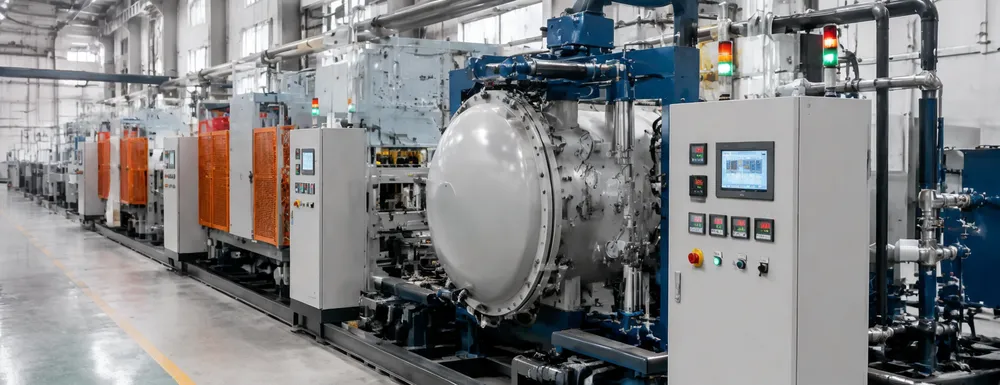
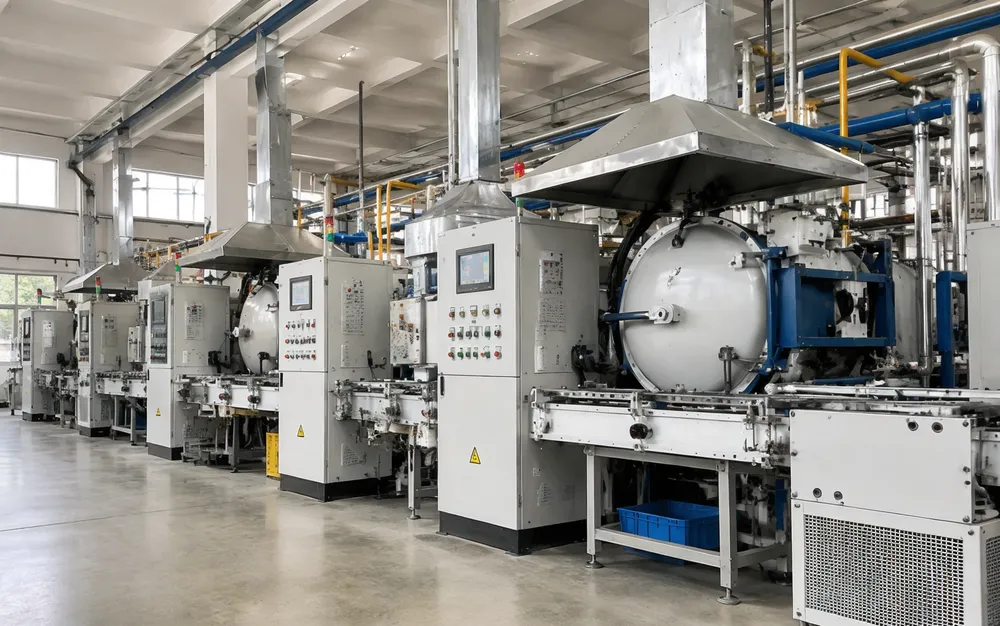
We run fully automated sintering lines — programmed temperature ramps, controlled atmosphere, consistent pressure profiles across every furnace cycle. This isn't a talking point; it's the reason your second order performs identically to your first.
Automated Sintering (CLSEG)
- Parameters locked into programmable controllers — no operator-dependent variation
- Defined sintering profile per formula: temperature curve (750–950°C depending on bond composition), hold time, pressure ramp, controlled cooling rate
- System logs every cycle — reorder six months later, same profile, same parameters, same result
- Density consistency within ±0.1 g/cm³ across batch samples
- Hardness testing (Rockwell C scale) confirms target working hardness before warehouse release
Manual Sintering Shops (Lower Price Points)
- Operator-dependent variation: furnace door timing, pressure gauge readings, cooling speed
- One operator's batch at HRC 28, another's at HRC 32 — same nominal formula, different results
- Inconsistent blade life within the same shipment — some blades last 20% longer than others
- Your customer notices, even if they can't articulate why
Density Check
Segment density after sintering measured on sample pieces from each batch — consistency within ±0.1 g/cm³.
Hardness Verification
Rockwell C scale testing confirms bond reached target working hardness. Only then do segments move to warehouse for welding or standalone shipment.
Lead Time
Because we sinter in-house and maintain raw material inventory.
Technical Specifications — Category Overview
Segment Geometry
- Height
- 8 mm – 25 mm
- Length
- 20 mm – 180 mm
- Width (kerf)
- 2.5 mm – 7.2 mm
- Compatible blade ∅
- 105 mm – 3500 mm
Diamond Formula
- Grit size
- 30/35 – 60/80 mesh
- Concentration
- 15% – 40%
- Bond hardness
- HRC 15 – HRC 35
Welding & Materials
- Welding compatibility
- High-frequency welding, laser welding, silver brazing
- Application materials
- Granite, marble, limestone, sandstone, concrete, engineered quartz, ceramic
Complete Parameter Reference
Category-wide ranges — each product page contains exact specs for that segment type.
| Parameter | Range Across Product Line |
|---|---|
| Segment height | 8 mm – 25 mm (application-dependent) |
| Segment length | 20 mm – 180 mm |
| Segment width (kerf) | 2.5 mm – 7.2 mm |
| Diamond grit size | 30/35 mesh – 60/80 mesh |
| Diamond concentration | 15% – 40% (by formula) |
| Bond hardness | HRC 15 – HRC 35 |
| Compatible blade diameter | 105 mm – 3500 mm |
| Welding compatibility | HF welding, laser welding, silver brazing |
| Application materials | Granite, marble, limestone, sandstone, concrete, engineered quartz, ceramic |
These are category-wide ranges. Each product page contains exact specifications for that segment type. If you have a specific stone type and blade diameter in mind — send us the details and we'll recommend the segment specification and formula match.
Matching Segments to Stone: A Sourcing Decision Framework
Choosing the wrong segment formula for your market's stone types is the most expensive mistake in this business — not because the segments cost much per piece, but because mismatched segments destroy blade reputation, generate returns, and lose end customers. Here's how we think about segment selection, and how we guide buyers through it:

Hard, Non-Abrasive Stone
Most granites from India, Brazil, Scandinavia
High quartz content, tight crystal structure
Soft-bond segments with higher diamond concentration
Why: The bond must wear away quickly to keep fresh diamonds exposed against stone that resists cutting. If you're stocking blades for these markets, ask us about our soft-bond granite formula series.

Soft, Abrasive Stone
Sandstone, some limestones, low-density marble
Naturally abrasive — rapidly wears bond matrix
Hard-bond segments with moderate diamond concentration
Why: The abrasive stone naturally wears the bond, so you need a matrix that resists erosion. Over-concentrating diamond in this application wastes money — the abrasive action exposes diamonds rapidly regardless.

Medium-Hard, Mixed-Abrasion Stone
Standard commercial granites, engineered quartz, some concrete
Where most market volume sits — formula precision matters most
Mid-range bonds with carefully balanced diamond concentration and grit size
Why: Small adjustments here make meaningful differences in segment life — a 5% shift in cobalt content can add 15–20% more cutting meters. This is where our formula engineering delivers the most measurable ROI for blade manufacturers.

Multi-Material Environments
Contractors cutting granite one day and concrete the next
Varied substrates, unpredictable job-to-job conditions
General-purpose segments — balanced trade-off formulas
Why: A general-purpose formula will never outperform a stone-specific formula on any single material — but it won't fail catastrophically on any material either. If your market is construction contractors rather than stone fabrication shops, this is likely what you should stock.
Not sure which category fits your market?
Most buyers serve mixed stone markets. Tell us your primary stone types, blade diameters, and whether your end-users are fabrication shops or construction contractors — we'll map the right segment formulas to your product line and recommend stocking ratios.
What Goes Wrong With Segments — And How Formula Engineering Prevents It
We've spent 20 years troubleshooting segment failures from markets across Southeast Asia, the Middle East, Europe, South America, and Africa. The failure modes repeat, and they're almost always formula-related:
Premature Segment Loss
Symptom: Segments falling off the blade during operation.
Root cause: Usually a welding issue, not a segment issue — but it can also trace back to segment density inconsistency. If the segment base surface isn't flat and dense, the welding joint doesn't form properly.
Our Prevention:
We grind segment bases to flatness specification before shipping, and maintain density consistency through automated sintering. For your inventory, this means zero field failures from segment detachment.
Glazing
Symptom: Segments become smooth, blade stops cutting.
Root cause: The bond matrix is too hard for the stone being cut. Diamonds can't re-expose because the metal isn't wearing away. This is the single most common complaint we hear from buyers who previously sourced from factories that use one-formula-fits-all approaches.
Our Prevention:
Stone-specific bond formulas. When you tell us what stone types dominate your market, we match the bond hardness accordingly.
Undercutting
Symptom: Excessive wear on one side of the segment.
Root cause: Caused by uneven diamond distribution within the segment or inconsistent bond density.
Our Prevention:
Our automated cold pressing and sintering prevent this by ensuring uniform powder distribution and consistent densification across the full segment cross-section.
Short Segment Life
Symptom: Cutting meters significantly below expectation.
Root cause: Usually a mismatch between diamond concentration and stone abrasiveness — too few diamonds for the cutting demand, or diamonds that fracture prematurely because the grit quality was inconsistent.
Our Prevention:
We control both variables: concentration is precisely measured during powder mixing, and diamond grit quality is tested on every incoming batch.
We track failure reports from our export markets and feed them back into formula refinement. A complaint about glazing in the Saudi Arabian market five years ago led to a complete bond redesign for our Middle East granite formula — now one of our highest-reorder SKUs.
OEM Segment Supply: Your Brand, Our Sintering
A significant portion of our diamond segment output ships as OEM — branded under our customers' labels, welded onto their steel cores at their facilities, or supplied as replacement segments for their installed blade base.
What OEM segment supply looks like with us:
Formula customization: You specify the target stone, desired cutting speed and life balance, and we develop or select from our formula library. Your formula is locked to your account — we don't share it with other customers in your market.
Geometry flexibility: Standard rectangular, Arix layered, turbo slot, sandwich construction, fan-shaped, trapezoidal. Specify the geometry or send a sample and we'll match it.
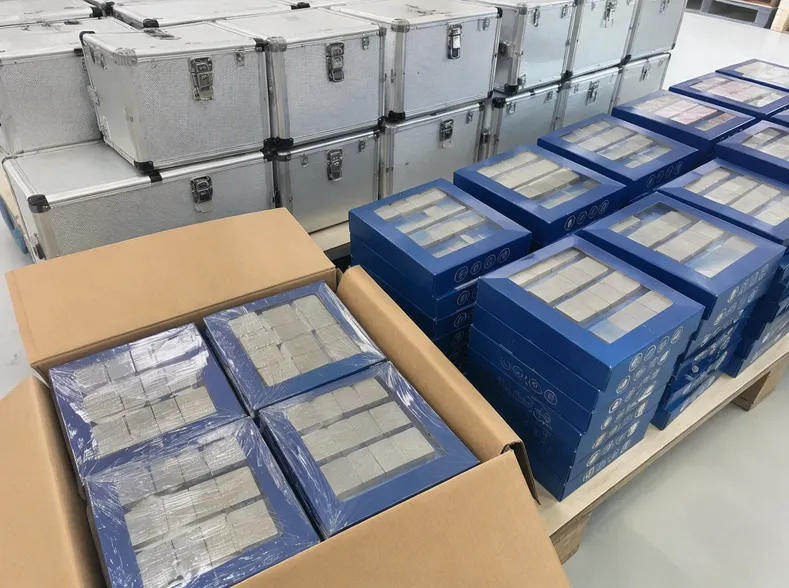
Packaging and labeling: Segments ship in your branded packaging, with your part numbers, your QC stickers. No CLSEG branding appears unless you want it.
Minimum order quantity: Flexible based on segment type and formula complexity. Standard formulas: 500 segments minimum. Custom formulas: 1,000 segments minimum on first order (to justify the formula development and testing investment), with reorders flexible down to 500.
Quality documentation: We provide batch test reports (hardness, density, dimensional inspection) with each shipment, formatted to your specs if needed.
MOQ Quick Reference
Available Geometries
Currently buying segments from a trader who sources from unknown factories?
Consider what you're missing: formula traceability, batch consistency data, and the ability to request adjustments when your market conditions change.
Capacity and Supply Chain Reliability
Our 8 automated production lines produce over 3,000,000 pieces annually — that figure covers all diamond tool products, including finished blades and standalone segments. The segment sintering lines specifically run dedicated furnace cycles daily.
What This Means for Your Ordering
No Allocation Conflicts
Your segment order doesn't compete against blade orders for furnace time. Sintering lines are dedicated by product type.
Consistent Reorder Lead Time
Standard segments at 15–25 days from order confirmation. We maintain raw material inventory (diamond grit, bond powders, cobalt) to prevent supply chain disruptions from flowing downstream to your delivery schedule.
Scale Flexibility
Whether you need 2,000 segments for a trial market entry or 200,000 segments for annual distribution volume, we have the throughput.
Certifications Already in Hand
Our factory holds ISO 9001:2015 certification, CE marking, SGS verification, and MPA safety certification. MPA is particularly relevant if you're selling into European markets — it's a safety certification for abrasive and cutting tools that your distributors may require. These certifications are already in hand, so your procurement team doesn't spend months chasing qualification paperwork.
Learn more about our facility and certificationsFrequently Asked Questions
Technical and ordering questions we hear most from stone tool distributors and OEM buyers.
How do I determine the right diamond segment formula for my market's stone types?
Send us the stone type names or — even better — photos and hardness data of the stone your end customers are cutting. We'll match from our 50+ formula library or develop a new formula if your stone profile is unusual. Most buyers start with 2–3 dominant stone types in their market. We spec a formula for each and ship sample segments for field testing before you commit to production quantities. The testing-to-production cycle takes about 4–6 weeks total.
What causes diamond segments to lose cutting speed mid-slab, and how does bond selection prevent it?
Mid-slab slowdown is almost always glazing — the bond surface has sealed over and diamonds aren't re-exposing. This happens when the bond is too hard for the stone being cut.
In hard, non-abrasive granites (Absolute Black, Blue Pearl, Tan Brown), you need a soft-bond formula — one with a lower cobalt percentage and higher porosity — so the stone's cutting action erodes the matrix and exposes fresh diamond layers continuously.
If you're getting reports of "the blade works great for the first 20 cm then slows down," it's a bond hardness mismatch, not a blade defect. We can adjust the formula and send test segments within 2–3 weeks.
What is the difference between Arix-pattern and standard flat-top diamond segments?
Arix segments arrange diamonds in a deliberate layered pattern within the metal bond, rather than random distribution. The practical effect: more consistent diamond exposure throughout the segment's life, slightly more aggressive initial cutting, and more predictable wear patterns.
For hard stone applications and high-RPM bridge saw work, Arix segments typically deliver 15–25% longer life than equivalent random-distribution segments at comparable cutting speed.
The trade-off is cost — Arix segments require more precise manufacturing and cost more per piece. For soft stone or general-purpose use, the performance advantage rarely justifies the price premium.
Can you supply segments compatible with blades from other manufacturers?
Yes. We regularly supply replacement segments to buyers who weld their own blades or need compatible segments for existing steel cores. Provide us with:
- The segment dimensions (length, width, height)
- The blade diameter and segment count
- The welding method (high-frequency or laser)
- The target stone type
We'll match the geometry and recommend an appropriate formula. If you can send a sample of your current segment, we can also analyze it and offer an equivalent or improved alternative.
What is your minimum order for custom-formula diamond segments?
First orders on a new custom formula: 1,000 segments minimum. This covers the formula development, test sintering, and in-house cutting validation we perform before shipment.
Reorders on an established formula: 500 segments minimum. For standard catalog formulas (granite, marble, concrete), the minimum is 500 segments from the first order.
Sample quantities (10–50 segments) are available for field testing before committing to production volumes — we encourage this approach for new buyer relationships.
How do you ensure batch-to-batch consistency across large segment orders?
Automated sintering with programmable temperature/pressure profiles eliminates operator-dependent variation. Each formula has a locked sintering recipe — same curve every cycle.
We pull sample segments from each batch for:
- Density measurement (±0.1 g/cm³ tolerance)
- Rockwell hardness testing (±0.5 HRC)
- Dimensional inspection against your specification
Batch records are retained and traceable, so if a consistency question arises six months later, we can pull the production data for your specific shipment.
Start With Your Stone Type — We'll Handle the Formula
Most new segment buyers start the same way: tell us what stone your market is cutting, what blade sizes are in use, and what performance issue (if any) you're trying to solve. We'll recommend a formula, provide sample segments for field testing, and move to production quantities once you're satisfied with the cut.
If you're currently sourcing segments from a supplier who can't explain their formula composition or troubleshoot field failures, you're carrying risk that shows up as customer complaints and lost reorders.
Tell Us Your Stone & Blade Size
Share your stone type, blade diameters in use, and approximate annual volume.
Receive a Specific Formula Recommendation
We respond with a tailored formula recommendation and pricing — not a generic catalog.
Field Test & Scale to Production
Sample segments for field testing first, then move to production quantities once you're satisfied with the cut.
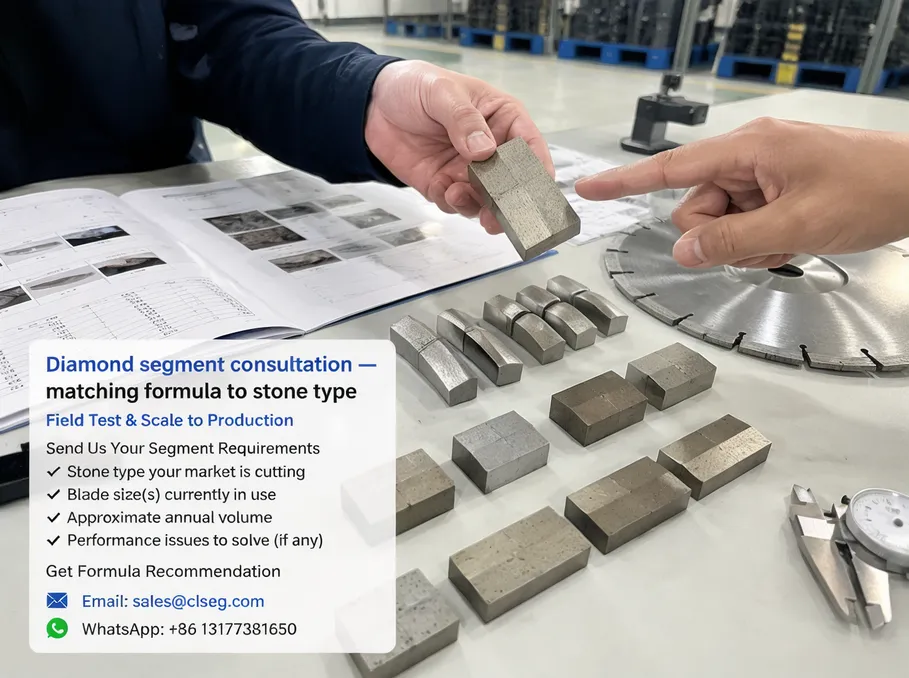
Send Us Your Segment Requirements
- Stone type your market is cutting
- Blade size(s) currently in use
- Approximate annual volume
- Performance issues to solve (if any)