

Ceramic Saw Blade Chip-Control Formula
Continuous rim diamond blades built around chip control — not cut speed — for porcelain tile, full-body ceramic, and brittle engineered panels.
Where other blades treat ceramics as a secondary application, ours start from the material's failure mode: brittle fracture from the cut edge inward. Bond hardness, rim geometry, and core flatness are all dialed to suppress that failure, so your downstream customers aren't filing warranty claims on chipped tile.
- ISO 9001:2015 Certified
- CE, SGS, MPA Certified
- 20+ Years Since 2003
- Factory-Direct Export
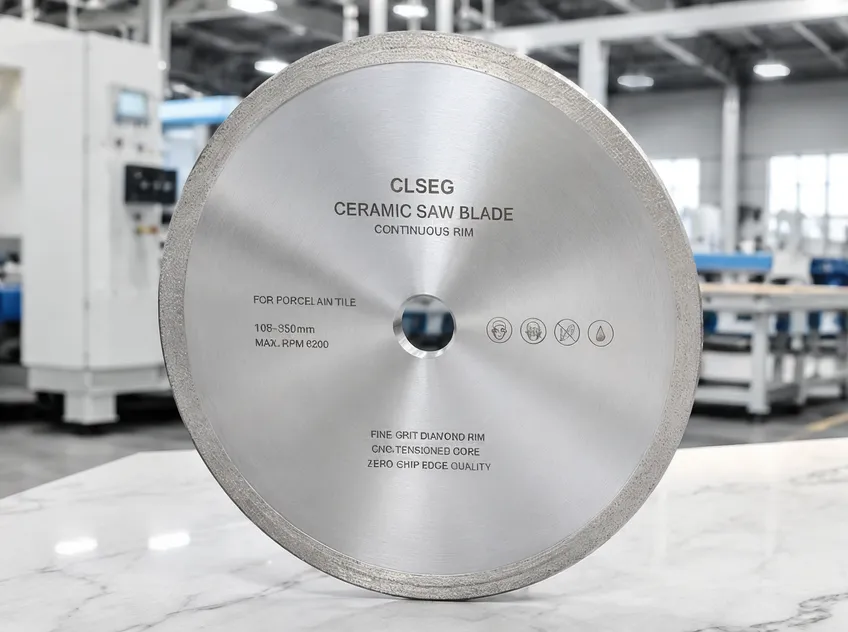
Why Ceramic Cuts Differently — and Why Your Blade Spec Has to Match
Porcelain and ceramic tile occupy a specific, frustrating corner of the cutting materials world. The material is hard but extremely brittle — Mohs hardness 6–7 on dense porcelain, but essentially no ductility. A blade that's even slightly too aggressive, slightly too coarse on the rim, or running a core that vibrates at operating speed will leave micro-fractures at the cut edge. Those fractures don't always appear immediately — sometimes they show up three hours after installation when a tile cracks along the cut line. Your customer doesn't trace it back to the blade. They trace it back to whoever supplied the tile.
The Commercial Risk in a Cheap Ceramic Blade
The defect isn't visible in the blade or even in the cut right after it's made — it's deferred, and the liability travels with the tile. This is the commercial risk buried in a cheap ceramic blade.
We formulate our ceramic saw blades from the opposite direction: start with the failure mode, engineer away from it. That means a continuous rim with fine-grit diamonds distributed densely across the cutting surface — no gullets to create impact points, no interrupted edge to induce lateral stress. The bond is tuned to a medium-hard formulation that prevents the rim from glazing on dense porcelain (a softer bond would erode too fast; a harder bond won't self-sharpen on a non-abrasive material). Core flatness is held to tight tolerances and each blade is CNC-tensioned to minimize runout at operating RPM — because on ceramic, rim wobble translates directly to edge chipping.
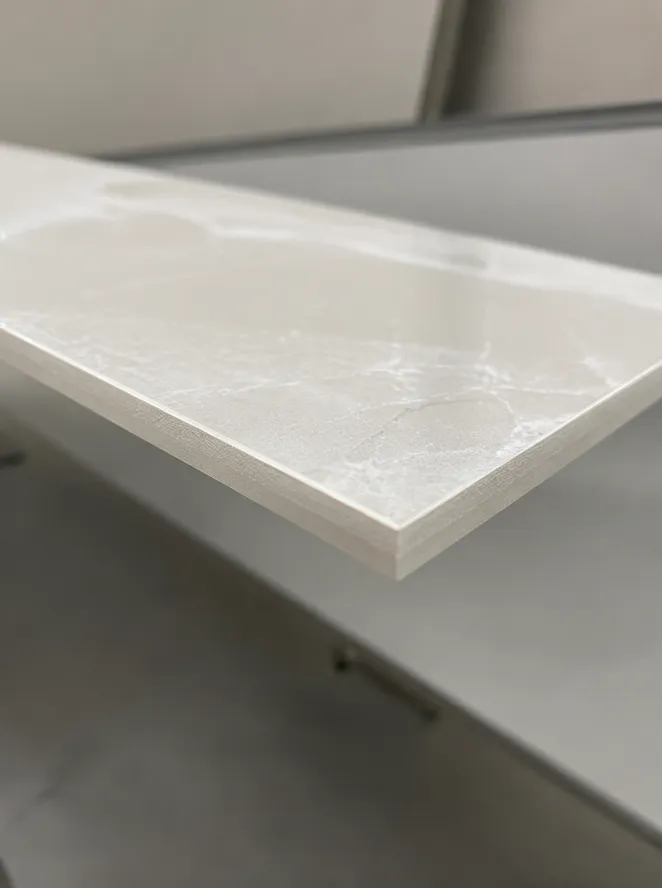
Key Engineering Decisions
- Continuous rim — no gullets, no impact points
- Fine-grit diamond, dense distribution
- Medium-hard bond — won't glaze or erode
- CNC-tensioned core — minimal runout at RPM
Back-to-Back Test Results
We've run both formulations back-to-back on 600×600 mm full-body porcelain. The under-tensioned core variant showed visible chipping at the exit edge above 8 cuts. Properly tensioned, the same material, zero visible edge fracture through the test run.
Technical Specifications
Specifications shown are industry-standard values for this product type. Actual specifications may vary by diameter and application. Contact us for detailed product data sheets and custom specifications.
| Parameter | Specification |
|---|---|
| Diameter range | 105 mm – 350 mm (standard stocked range) |
| Rim type | Continuous (no gullets) |
| Segment / rim height | 7 mm – 10 mm |
| Core thickness | 1.6 mm – 2.0 mm |
| Kerf width | 1.8 mm – 2.4 mm (varies by diameter) |
| Diamond grit size | 120/140 mesh – 170/200 mesh (fine to ultra-fine) |
| Bond type | Medium-hard cobalt-based composite bond |
| Arbor bore | 20 mm, 22.23 mm, 25.4 mm (custom bore available) |
| Operating speed | 35–80 m/s (wet); 25–45 m/s (dry, laser-welded cores only) |
| Welding method | High-frequency welding (wet cut); laser welding (dry cut capable) |
| Certifications | ISO 9001:2015, CE, SGS, MPA |
| Compatible machines | Wet tile saws, bridge saws, angle grinders (size-dependent) |
Key Comparison Parameters
Two parameters are worth your attention when comparing quotes:
Diamond Grit Size
Grit in the 120/140–170/200 range delivers the fine cutting action ceramic needs — coarser grit (40/50 or 50/60, typical for granite blades) leaves a torn rather than sliced edge on brittle materials.
Core Thickness
Core thickness at 1.6–2.0 mm keeps the kerf narrow, which matters for large-format tile work where material waste compounds across a project.
Operating Notes
- Always use water cooling on high-frequency welded blades
- Feed rate: steady, moderate pressure — let the blade cut
- Support tile fully on both sides of the cut line
- Check arbor bore compatibility before mounting
Material Compatibility
Continuous rim ceramic blades are engineered for hard, brittle, chip-prone materials. Here's how they perform across the range of ceramics you'll encounter on site or in a fabrication shop.
Porcelain Tile
The primary target material. Full-body and glazed porcelain, including large-format panels up to 1200×2400 mm. Chip-free cuts with proper feed rate and water flow.
Optimal MatchCeramic Wall Tile
Softer than porcelain but still benefits from the continuous rim's smooth action. Faster cut speed due to lower hardness. No glaze cracking when diamond grit is fine enough.
ExcellentVitrified Tile
Dense, low-porosity body very similar to porcelain in cutting behavior. The medium-hard bond self-sharpens properly on this material without glazing.
ExcellentGlass Mosaic
Workable with reduced feed rate and plenty of water. The continuous rim avoids shock fractures that segmented blades would cause. Thin glass requires support.
Good — Reduced SpeedTerracotta / Clay Tile
Softer, more abrasive material. The blade cuts well but wears faster than on porcelain. A softer-bonded blade may be more economical for high-volume terracotta work.
Good — Higher WearGranite / Hard Stone
Not recommended. Granite's abrasive quartz content erodes the fine diamond too quickly. A segmented blade with coarser grit and a harder bond is the correct tool for natural stone.
Not RecommendedMatching rule of thumb: If the material is hard, brittle, and non-abrasive (porcelain, vitrified, glass), the continuous rim ceramic blade is correct. If the material is abrasive (granite, sandstone, concrete), you need a segmented blade with coarser diamond and different bond chemistry. See our granite blade page for those applications.
Applications & Use Cases
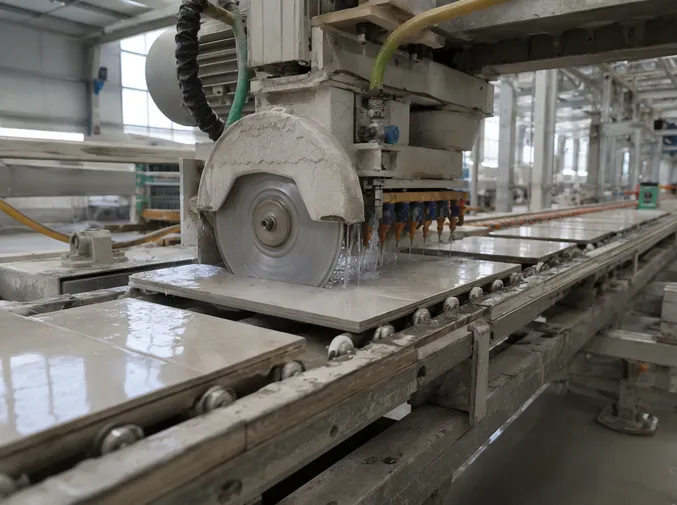
Where these blades end up working — from residential bathroom renovations to industrial tile production lines.
Residential Tiling
Bathrooms, kitchens, entryways. Clean cuts on porcelain and ceramic tile with hand-held wet saws. The blade's fine kerf reduces waste on expensive designer tile.
Commercial Fit-Out
Retail spaces, lobbies, office buildings. Large-format porcelain panels require precision cuts with zero chipping on exposed edges. Bridge saws with 300–350 mm blades.
Tile Manufacturing
Production-line trimming and sizing of fired ceramic and porcelain. High-volume, continuous operation where blade life and consistent cut quality directly affect yield.
Renovation & Repair
Cutting replacement tiles to fit existing layouts. Precision matters — you're matching edges against installed tiles where any chip is visible.
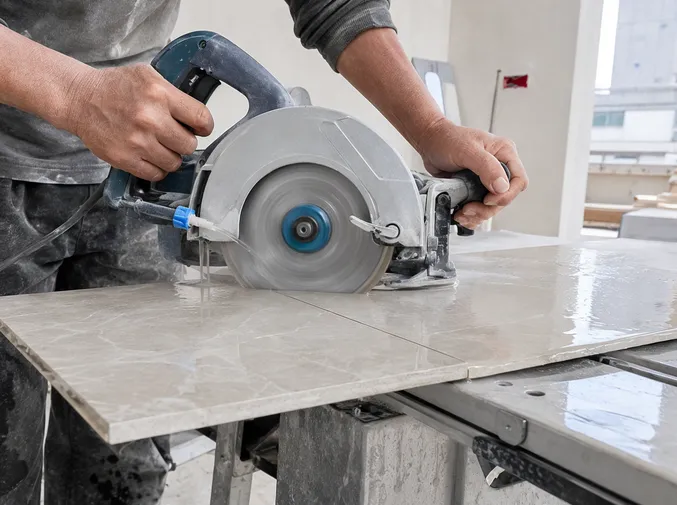
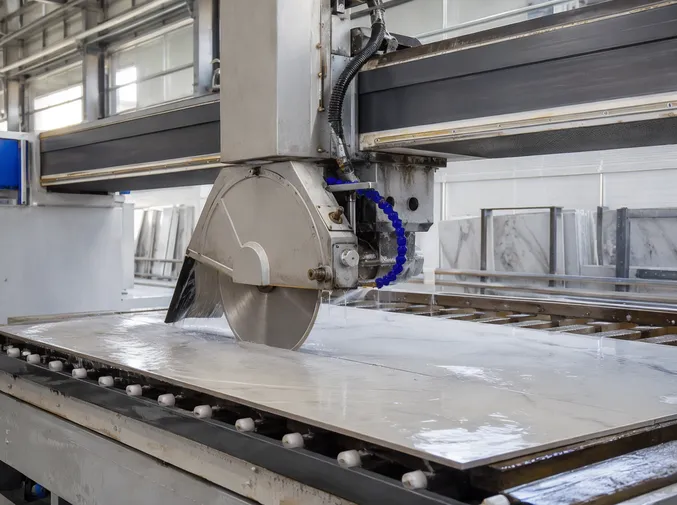
Wet vs Dry Cutting: What Actually Works on Ceramic
Short answer: wet cutting is always better for ceramics. But dry cutting is sometimes necessary, and the blade needs to be built for it.
Wet Cutting
Recommended- Water cools the rim and flushes swarf — extends life 3–5× over dry
- Eliminates airborne silica dust (health hazard on porcelain)
- Cleanest possible edge — thermal stress is removed from the equation
- High-frequency welded rims are standard (lower cost)
- Operating speed up to 80 m/s with adequate water flow
Best for: all ceramic cutting where a water source is available. Tile saws, bridge saws, production lines.
Dry Cutting
Use With Caution- Requires laser-welded rim (sintered won't survive thermal shock)
- Reduced operating speed (25–45 m/s) to manage heat buildup
- Shorter blade life — heat accelerates bond erosion and diamond degradation
- Silica dust generated — respiratory protection and dust extraction required
- Useful for quick cuts with angle grinder where water isn't practical
Best for: short cuts on site where no water supply exists. Keep cuts brief, allow cooling between passes.
The Practical Verdict
If you're doing more than a handful of cuts, set up wet cutting. The blade lasts longer, the cuts are cleaner, and you're not breathing silica. Dry cutting is a compromise for convenience, not a preferred method. When ordering, specify whether you need wet-only (high-frequency weld, lower cost) or wet/dry capable (laser weld, slightly higher cost).
Buyer's Guide: How to Spec a Ceramic Blade
Whether you're a distributor stocking a product line or a contractor buying for a specific job, here's what to look at beyond brand name.
Match Diameter to Machine
This sounds obvious but gets overlooked. A 250 mm blade on a saw rated for 200 mm means the RPM is wrong, the guard doesn't cover it, and you're running over rated peripheral speed. Check your saw's max blade diameter and arbor bore size before ordering.
Specify the Tile Type
"Ceramic blade" covers a range. A blade optimized for soft wall tile will wear fast on full-body porcelain. Tell your supplier the specific material — glazed porcelain, through-body, vitrified — so they can match the bond hardness correctly.
Wet or Dry Capability
Wet-only blades use high-frequency welding (cheaper, sufficient when water is guaranteed). If any chance of dry use, specify laser-welded. The price difference is small; the safety difference is significant.
Volume vs. Quality Tradeoff
Higher diamond concentration = longer life but higher cost per blade. For production lines cutting thousands of meters, invest in premium concentration. For a 20-tile bathroom job, standard concentration is fine — you won't wear through the rim.
Ask for Test Data
Any serious manufacturer can provide linear meters cut per blade on a specific material at a specific feed rate. This is the real comparison metric — not price per blade. A blade that costs 20% more but lasts 50% longer is cheaper per cut.
Check Certifications
CE marking is the minimum for European markets. MPA testing confirms the blade has been speed-tested beyond its rated RPM. ISO 9001 covers the manufacturing process. These aren't marketing — they're engineering validation.
OEM & Custom Manufacturing
Need blades branded to your company, or a specification that doesn't exist in any catalog? We manufacture to order with full customization of diameter, segment profile, bond matrix, and packaging.
-
Private Label / White Label Your brand, your packaging, our manufacturing. MOQ as low as 100 pieces per SKU for established partners.
-
Custom Specifications Non-standard diameters, specific arbor bores, tailored diamond concentration, or unusual segment heights — all engineered to your requirements.
-
Application Engineering Send us the material you're cutting and the machine you're using. We'll formulate the bond matrix and segment geometry to match.
-
Production Lead Times Standard orders ship within 15–25 days. Rush production available for critical needs at premium rate.
Typical OEM Process
Frequently Asked Questions
Direct answers to the questions we get most from buyers, distributors, and tile installers.
Can I use a ceramic blade to cut glass or stone?
Technically yes, but it's not ideal. Ceramic blades have a softer bond matrix tuned for hard, brittle materials that produce fine powder. Natural stone (granite, marble) produces coarser swarf and benefits from a harder bond. Glass requires very specific feed rates and a fine-grit continuous rim. You'll get through the material with a ceramic blade, but you'll burn through the blade life faster than a purpose-built one. Use the right tool for the job.
Why is my blade glazing over and not cutting?
The bond is too hard for the material you're cutting. The diamonds are getting polished flat instead of fracturing to expose new cutting edges. This happens when a blade designed for soft ceramics is used on very hard porcelain, or when feed pressure is too light. Solution: make a few cuts in abrasive material (a concrete block or dressing stick) to expose fresh diamonds, then increase your feed rate. If it keeps happening, you need a softer bond specification.
What's the difference between continuous rim and segmented?
Continuous rim (no gaps) gives the cleanest cut with minimal chipping — ideal for glazed surfaces where aesthetics matter. Segmented rims (with gullets) cut faster because the gaps help clear debris and improve cooling, but leave a slightly rougher edge. For ceramic tile where chip-free edges matter, continuous rim is standard. Segmented designs are more common in general construction blades for concrete and masonry.
How many linear meters can I expect from one blade?
It depends on the material hardness, blade quality, feed rate, and whether you're using water. As a rough guide: on standard glazed porcelain (Mohs 6–7) with wet cutting, a quality 250 mm continuous rim blade should deliver 80–150 linear meters. On harder full-body porcelain, expect 40–80 meters. Cheap blades may give 20–30 meters on the same material. Always compare cost-per-meter, not cost-per-blade.
What RPM should I run my blade at?
Never exceed the max RPM printed on the blade — this is a safety limit, not a suggestion. The optimal peripheral speed for ceramic cutting is typically 30–50 m/s wet, 25–35 m/s dry. To calculate: RPM = (peripheral speed × 60,000) ÷ (π × diameter in mm). For a 200 mm blade at 40 m/s, that's approximately 3,820 RPM. Most tile saws are already calibrated correctly for their blade size.
Do you ship internationally?
Yes. We export to over 50 countries across Europe, the Middle East, Southeast Asia, and the Americas. Standard shipping is by sea (20–35 days depending on destination), with air freight available for urgent orders. We handle export documentation and can ship DDP (delivered duty paid) or FOB/CIF depending on your preference. Contact us for a landed-cost quote to your port.
Ready to Source Ceramic Blades That Perform?
Whether you need 10 blades for a project or 10,000 for distribution, we'll match the right specification to your application. No middlemen, direct from the factory floor.
Typical response within 24 hours. Sample orders welcome.
What This Blade Cuts — and the Market Segments Behind Each Application
Standard Ceramic and Porcelain Tile (Residential & Commercial Construction)
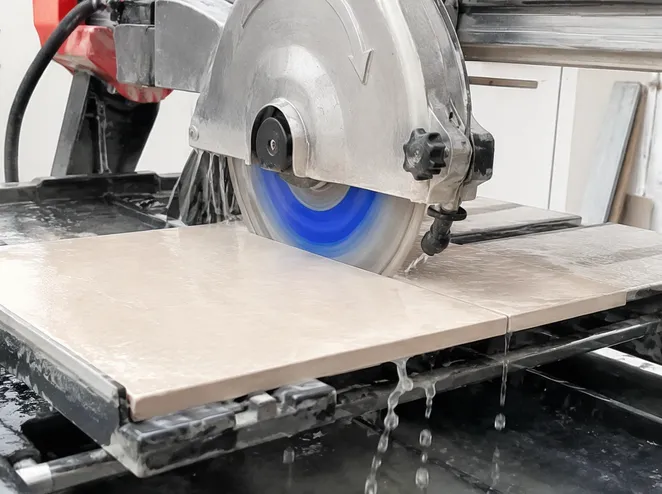
The volume segment. 300×300 mm to 600×600 mm glazed ceramic and full-body porcelain tiles account for the majority of ceramic blade consumption globally. Tile contractors and fabricators run wet saws — Rubi, Dewalt, MK Diamond, and equivalent brands — and consume blades as a recurring operational expense. A tile contractor running 40–60 m² of floor tile per day burns through a blade roughly every 5–8 working days. For distributors serving tile installation contractors, this is a predictable reorder cycle with high loyalty once they find a blade that doesn't chip.
The key buying criterion in this segment is consistent edge quality across the blade's full life — not just the first fifty cuts when the rim is sharp, but cut 400 when it's halfway worn. Our bond formulation is calibrated so the rim self-sharpens progressively on porcelain rather than glazing, so your customers aren't adjusting feed rates as the blade ages.
Segment Snapshot
- Tile size: 300×300 mm to 600×600 mm (glazed ceramic & full-body porcelain)
- Typical consumption: 1 blade every 5–8 working days at 40–60 m²/day
- Key criterion: consistent edge quality from cut 1 through cut 400+
- Self-sharpening bond prevents glazing — no feed-rate adjustment needed
Large-Format Porcelain Slabs (1200×2400 mm and Above)
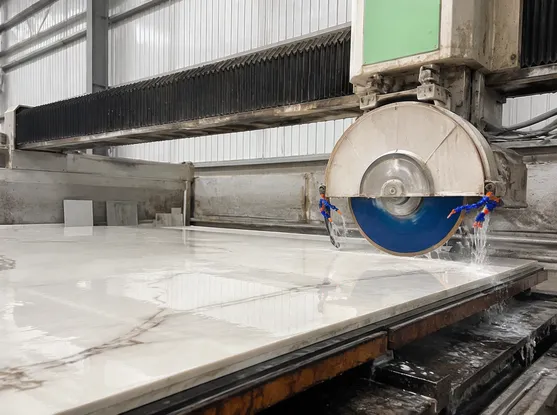
The fastest-growing application in the ceramic segment over the last decade, and commercially the most demanding. Ultra-compact sintered porcelain surfaces — Dekton, Laminam, Neolith, and their Asian equivalents — are 12–20 mm thick, up to 3200×1600 mm, and absolutely unforgiving on cutting equipment. A chip on a slab that retails for $200–400/m² is a warranty conversation nobody wants to have.
Fabricators cutting large-format slabs typically run 350 mm blades on bridge saws with full water flood cooling. Our ceramic saw blades in the 300–350 mm range are configured for exactly this: ultra-fine grit, high diamond concentration, and cores with tighter flatness tolerances than our standard stone blades — because the combination of large cutting diameter and brittle material amplifies any core eccentricity into edge damage.
Sintered Surfaces — Bond Formula Note
Sintered surfaces like Dekton have a silica content significantly higher than standard porcelain — typically 40–60% crystalline silica by composition — which means our bond formula for this sub-segment is tuned harder than for standard ceramic. If your customers cut both, ask us about stocking two SKUs: one for standard porcelain, one for sintered panels.
Mosaic and Decorative Tile Cutting (Specialty Fabrication)
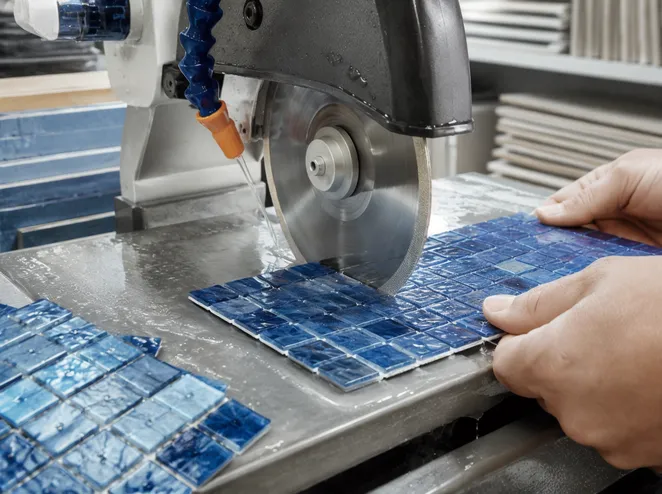
Glass-mosaic tiles, hand-painted decorative ceramics, and thin glazed panels — diameters under 200 mm, typically on bench-mounted wet saws or angle grinder setups. Volume per account is lower, but margin per blade is higher and the quality requirement is absolute: a chipped mosaic tile isn't salvageable.
The segment is concentrated in specialty tile shops, interior finishing contractors, and hotel/hospitality project fabricators. If you supply the tile sector at the premium end of the market, this is a natural add-on to a ceramic blade SKU list.
Segment Characteristics
- Blade diameters under 200 mm
- Lower volume per account, higher margin per blade
- Zero-chip tolerance — damaged mosaic tiles are not salvageable
- End users: specialty tile shops, interior finishing, hotel/hospitality projects

Tile Manufacturing Plants (OEM Industrial Supply)
Ceramic and porcelain tile manufacturers use diamond blades on-site for trimming, calibrating, and quality-check cuts during production. Unlike a construction contractor who cuts finished tile on a jobsite, a tile plant running trimming saws operates at production speed — 8–12 hours per shift, high feed rate, consistent material. For this application, blade life is the primary metric.
We supply tile manufacturing plants in Southeast Asia and the Middle East directly, with volume pricing structured for monthly replenishment orders.
Shift Duration
8–12 hrs
Feed Rate
Production Speed
Reorder Cycle
Monthly
Key Metric
Blade Life
How We Build the Rim — Process Details That Drive Edge Quality
The continuous rim on a ceramic saw blade is not simply a steel core with diamonds pressed onto the edge. What happens at the rim-to-core interface, and how the diamonds are distributed through the rim depth, determines whether the blade delivers clean edges on cut 1 and cut 500 identically.
Powder Mixing & Formulation
Our ceramic blade rims start with powder mixing in our climate-controlled formulation room: synthetic diamond grit in the 120/200 mesh range gets blended with cobalt-based metal bond powder at precise ratios we've refined since 2003.
The ratio shifts slightly depending on whether the blade is destined for standard glazed tile, full-body porcelain, or sintered surfaces — the bond softness has to match the material's abrasiveness, which for non-abrasive dense ceramics means a medium-hard matrix that allows controlled self-sharpening without rapid erosion.
Cold Pressing
Cold pressing forms the rim blank at calibrated tonnage. We use a die profile specific to continuous rim geometry — not adapted from a segmented blade die — because the compaction pressure distribution across a continuous rim profile differs from a segmented one, and getting it wrong leaves density gradients that cause uneven wear.
Why dedicated dies matter: Density gradients from incorrect compaction cause uneven wear patterns — visible as inconsistent cut quality over the blade's working life.
Programmable Sintering
After pressing, the blanks go through our programmable sintering furnaces on a fully automatic temperature and pressure cycle. We pull test specimens from each sintering batch and check hardness and density. If either drifts, that batch is set aside; it doesn't get welded.
High-Frequency Welding
High-frequency welding attaches the sintered rim to the steel core. This creates the permanent bond between diamond segment and blade body that must withstand centrifugal forces at full operating speed without separation or deformation.
CNC Tensioning Critical Step
After welding, every blade goes through CNC tensioning — this is the step most budget manufacturers skip or do manually, and it's where the difference shows up on ceramic.
A steel core that's not properly tensioned develops runout under centrifugal force at operating speed. On granite or concrete that runout is tolerable. On ceramic tile it translates directly to microfractures at the cut edge.
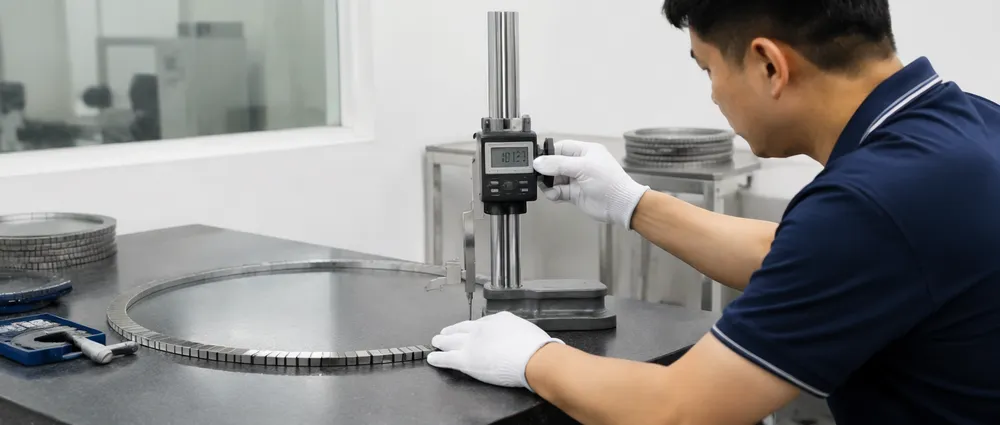
Final Dimensional Check
Final dimensional check: diameter, core flatness, rim runout at operating-speed simulation. Blades outside tolerance don't ship.
2–4%
Internal rejection rate
Our internal rejection rate runs 2–4% across the blade range; for ceramic blades specifically it runs slightly higher because our tolerances for this product are tighter.
That 2–4% is material cost we absorb, not a problem that travels to your customer. Blades outside tolerance don't ship.
Ceramic vs. Continuous Rim vs. Tile Saw Blades — Positioning Within Our Range
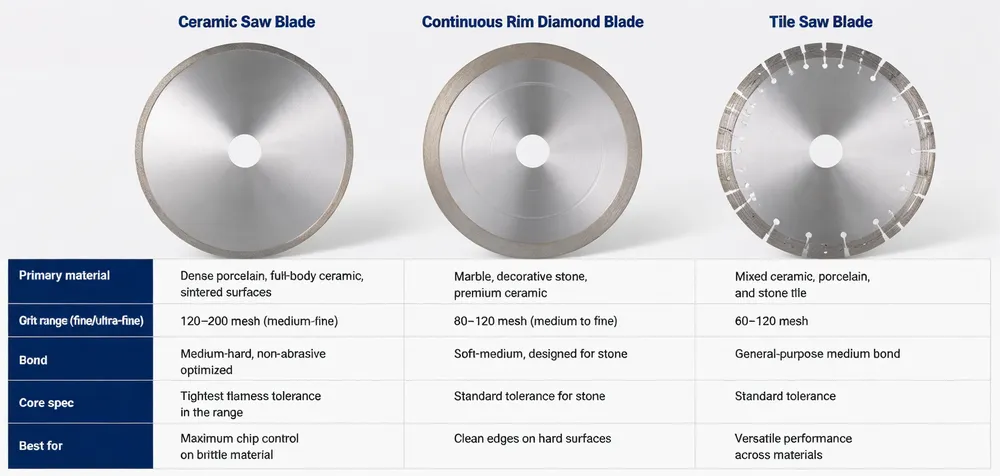
Buyers occasionally ask how our ceramic saw blade relates to our continuous rim diamond blades and tile saw blades in the same category. The short answer: these products address overlapping but distinct application profiles.
| Ceramic Saw Blade | Continuous Rim Diamond Blade | Tile Saw Blade | |
|---|---|---|---|
| Primary material | Dense porcelain, full-body ceramic, sintered surfaces | Marble, decorative stone, premium ceramic | Mixed ceramic, porcelain, and stone tile |
| Grit range | 120–200 mesh (fine/ultra-fine) | 80–120 mesh (medium-fine) | 60–120 mesh (medium to fine) |
| Bond | Medium-hard, non-abrasive optimized | Soft-medium, designed for stone | General-purpose medium bond |
| Core spec | Tightest flatness tolerance in the range | Standard tolerance for stone | Standard tolerance |
| Best for | Maximum chip control on brittle material | Clean edges on soft stone and mixed use | Contractors cutting a mix of tile and stone |
Full-Body Porcelain Focus
If your market cuts predominantly full-body porcelain and sintered surfaces, the ceramic saw blade is the right SKU. Maximum chip control and tightest flatness tolerance.
Mixed Stone & Tile Work
If your customers mix stone and tile work, the tile saw blade or continuous rim blade gives them more versatility across material types.
Not Sure?
We'll help you spec based on what materials your market actually cuts — tell us the tile types and we'll point you to the right product.
Customization Options for OEM and Private-Label Programs
Our ceramic saw blades are available for OEM customization across several parameters. This isn't a special service — it's how most of our volume business with international distributors works.
Diameter & Arbor Configuration
Standard: 105–350 mmWe produce custom diameters outside this range on request — if your market uses wet saw platforms with non-standard arbor sizes (common in parts of Southeast Asia and South America), we machine to fit.
Grit & Bond Adjustment
Custom formula sampling availableIf your market cuts a specific ceramic type that requires a bond modification — for example, if you supply a large tile manufacturer who runs an unusual synthetic ceramic compound — we adjust the formula and send test samples before committing to production.
We've done this for buyers supplying glass-ceramic hybrid tile plants in Southeast Asia where standard formulas glazed too quickly.
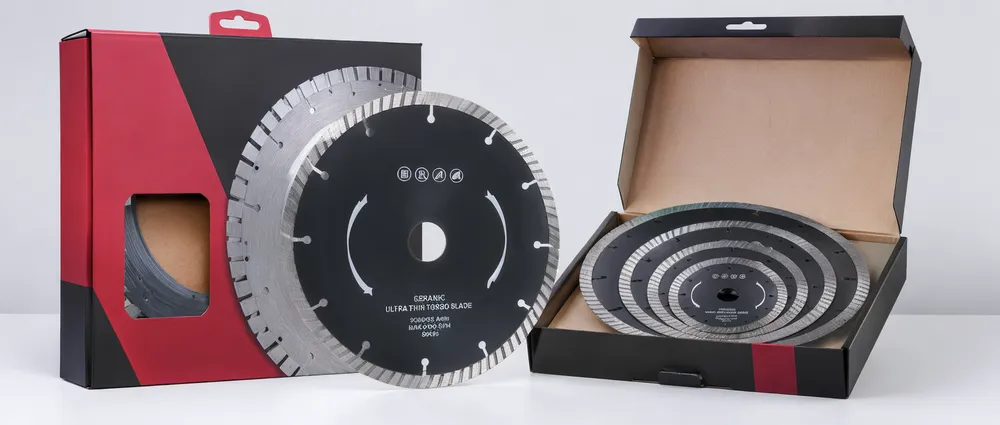
Private-Label Packaging
MOQ: 200 pcs per specYour brand name, logo, and color specification on the blade core and retail box.
- MOQ starts at 200 pieces per diameter and specification
- Low enough for a market test, high enough to justify the packaging setup
- Custom blade core print + retail box branding
Mixed-Diameter Bundle Packs
Single container, full rangeIf you're entering a new tile market and want to cover the full range in one shipment, we package mixed-spec orders in a single container to simplify your logistics.
Example starter range:
We can propose a starter SKU mix based on what's moving for our existing distributors in your region.
Tell us your tile types, target diameters, and annual volume — we'll spec and quote within 48 hours.
Certifications and Compliance for Your Export Markets
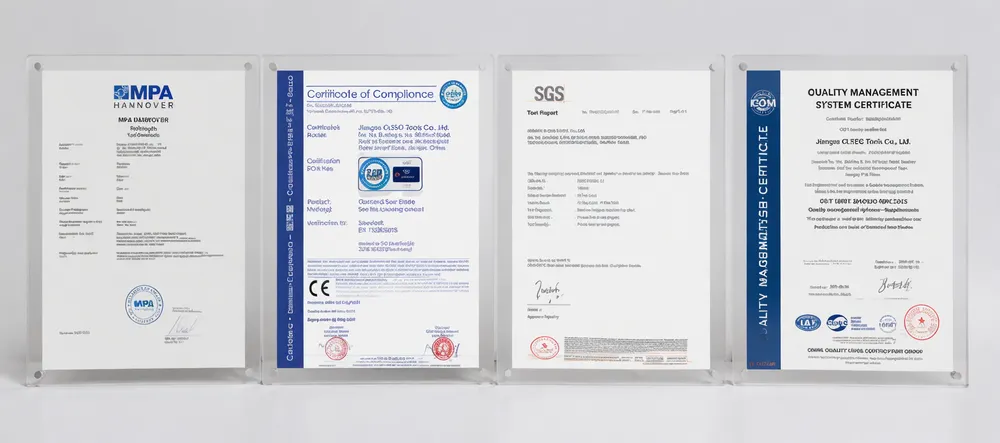
Our ceramic saw blades ship with the same certification stack as our full diamond saw blade range: ISO 9001:2015, CE, SGS, and MPA.
MPA
Materialprüfungsamt
German safety certification for abrasive and cutting tools. Tests segment retention under stress, dimensional conformance, and operating speed limits. European tool distributors and safety-conscious industrial buyers often require MPA as a pre-condition for stocking a blade.
Having MPA means your compliance team doesn't need to run a separate qualification process before listing our product.
CE Marking
EU Machinery Safety
Covers the EU's machinery safety directive requirements. Required for tools sold to professional users in European markets. Our CE documentation is current and available on request.
SGS
Third-Party Audit
Third-party audit reports available for buyers who require independent verification beyond our own QC documentation — common in Middle East government procurement and some Southeast Asian distributor qualification processes.
ISO 9001:2015
Quality Management
Certified quality management system governing our entire production process from raw material inspection through final product verification and shipment.
Additional Market Requirements
For buyers in markets with additional requirements — SABER in Saudi Arabia, SNI in Indonesia, or specific national standards in other export markets — contact us with your compliance checklist.
We've navigated these requirements for buyers in most of our active export markets and can advise on documentation pathways.
Packaging, Container Loading, and Lead Times
Packaging
Ceramic saw blades ship in individual rigid plastic cases or reinforced cardboard sleeves, depending on diameter.
The continuous rim is more vulnerable to edge impact than a segmented blade — a hard knock during port handling can deform the rim locally and ruin concentricity.
Our packaging spec reflects this: each blade has a center hub protector and the box is corner-reinforced to absorb lateral impact.
300 mm+ blades
Ship in foam-lined cardboard with additional edge protection.
Container Loading
A 20GP container handles the following approximate capacities:
15,000–25,000 pieces
6,000–8,000 pieces
We can provide exact loading calculations and a container diagram with your quote — useful if you're optimizing freight cost per unit.
Lead Times
Stocked formulas ship within 25–30 days from order confirmation.
Add 2–3 weeks for sampling and approval before production begins.
We hold your formula parameters on file — production can start without a re-qualification cycle. Faster turnaround on confirmed formulas.

Frequently Asked Questions
What's the difference between a ceramic saw blade and a tile saw blade?
In practice, a ceramic saw blade is formulated specifically for dense, non-abrasive brittle materials — full-body porcelain, sintered surfaces, and high-density ceramics where edge fracture is the primary failure mode. The grit is finer (120/200 mesh versus 60/80 for a general tile blade) and the bond is calibrated to self-sharpen on a material that doesn't abrade the matrix.
A tile saw blade typically uses a broader bond range and coarser grit to handle both ceramic and softer stone tile in mixed applications.
Decision guide: If your customers cut predominantly porcelain and sintered surfaces, a ceramic-specific blade delivers better edge quality and longer life on those materials. If they cut a mix of ceramic and stone, a tile saw blade or continuous rim blade may give better versatility.
Can a ceramic saw blade cut large-format sintered porcelain slabs (Dekton, Neolith, etc.)?
Yes, but the blade specification matters. Sintered porcelain surfaces like Dekton and Neolith have high crystalline silica content and exceptional hardness — they're closer in cutting behavior to engineered quartz than to standard ceramic tile.
We configure ceramic blades for large-format sintered cutting with:
- A slightly harder bond formulation than our standard ceramic range
- Higher diamond concentration
- Tighter core flatness tolerances for the larger diameters (300–350 mm) used on bridge saws
Note for distributors: If you're supplying fabricators who specialize in sintered surface work, tell us — we'll spec the blade correctly for that material rather than sending you a standard ceramic blade.
Should ceramic saw blades be run wet or dry? Wet cutting is strongly preferred for ceramic and porcelain work…
Wet cutting is strongly preferred for ceramic and porcelain work. Water flood cooling accomplishes two things simultaneously: it removes heat that would otherwise accelerate rim erosion, and it suppresses the fine silica dust that dense porcelain generates.
Dry cutting is possible on our laser-welded ceramic blade variants (laser welding handles the thermal cycling that HF-welded joints can't tolerate without water), but edge quality on brittle ceramic degrades at higher dry-cut speeds.
For professional tile work — especially large-format or high-value material — wet cutting is the right choice, and our standard HF-welded ceramic blades are optimized for it.
What causes chipping on ceramic tile cuts, and how do I diagnose the source? Three main causes: blade-side, machine-side, and material-side…
Three main causes to investigate systematically:
Blade-Side Causes
- A glazed rim — bond too hard for the material, diamonds can't expose
- A coarse-grit blade mismatched to brittle tile
- A blade with inadequate core tensioning creating runout
Machine-Side Causes
- A worn spindle bearing creating vibration
- Insufficient water flow allowing heat buildup
- Feed rate too aggressive for the blade diameter and material hardness
Material-Side Causes
- Tile with internal stress from firing inconsistencies — cuts on one tile chip; the same blade on a different tile from the same box does not
Diagnostic Logic
Chipping is consistent across all tiles and starts from the first cut → suspect blade spec or glazing
It's intermittent and tile-dependent → check material quality
It starts clean and gets progressively worse mid-session → check water flow and machine vibration
What is the minimum order quantity for ceramic saw blades, and can I test before committing?
MOQ for standard ceramic saw blades is 50 pieces per diameter specification. For private-label packaging, MOQ is 200 pieces.
For market testing before committing to a larger order, we offer sample quantities of 5–10 pieces at production pricing — enough to put blades in front of your tile contractor customers and get real performance feedback before you build inventory.
Recommended onboarding sequence:
- 1 Start with a sample run of 5–10 pieces
- 2 Get validation from 2–3 contractor accounts
- 3 Move to a stocking order with confidence
Most of our new distribution partners in this category follow this sequence. That's the approach we'd suggest.
Wet tile saw blade vs. continuous rim ceramic blade: when does the continuous rim design matter?
The continuous rim is what makes chip-free cutting achievable on brittle materials. A blade with gullets — even narrow ones — creates interrupted cutting action: each time a gullet passes through the cut zone, there's a micro-impact on the material edge.
On granite or marble, that impact is absorbed. On dense porcelain, it creates micro-fractures that propagate from the edge. The continuous rim eliminates those interruptions entirely.
- Cut edge quality is the performance criterion
- Tile with visible cut edges
- Decorative ceramic applications
- Large-format slabs
- Cut speed matters more than edge quality
- Rough cutting operations
- Trim waste cuts
Related Products in the Tile and Stone Cutting Range
Depending on what your market actually cuts, one of these may be a better fit — or a complementary SKU alongside the ceramic blade.
Tile Saw Blades
Mixed ceramic, porcelain, and stone tile work. Broader grit range for versatility across material types.
View rangeContinuous Rim Diamond Blades
When your customers cut a mix of soft stone and premium ceramic. Continuous rim design in a medium-fine formulation for mixed applications.
View rangeSintered Stone Saw Blades
Large-format sintered porcelain and microcrystalline stone. If your market has moved heavily into ultra-compact surface fabrication, this is the blade built specifically for that material.
View rangeBridge Saw Blades
If your customers run bridge saws and cut a mix of stone and large-format tile, bridge saw blades cover the stone side of their work.
View rangeGet a Quote for Ceramic Saw Blades
The fastest path to an actionable quote: tell us the tile type your market cuts (standard glazed, full-body porcelain, sintered surface, or a mix), the diameters you need, and your approximate monthly or quarterly volume. We'll come back with formula recommendations, exact specifications, and FOB pricing — typically within 48 hours.
If you're new to sourcing ceramic blades from a direct manufacturer, we can suggest a starter SKU mix based on what's working for our existing distributors in your region. Most new partners start with two diameters — a 115 mm for hand-held and bench work, and a 300–350 mm for bridge saw work — test with their contractor accounts, and expand from there.
Submit a Detailed Inquiry
Include tile types, target diameters, and any private-label requirements. The more specific your request, the faster we return an actionable quote.
- Tile type your market cuts
- Required diameters (e.g. 115 mm, 300–350 mm)
- Monthly or quarterly volume estimate
- Private-label or custom packaging needs
- Target market / certification requirements
Typical response time: within 48 hours with full specifications and FOB pricing.