

ARIX Diamond Blades Geometrically Arranged Segments for Hard Stone
Controlled diamond placement delivers consistent cutting speed throughout segment life and typically 20–30% longer total lifespan than random-distribution segments. Your customers cut more slabs per shift without blade changes.
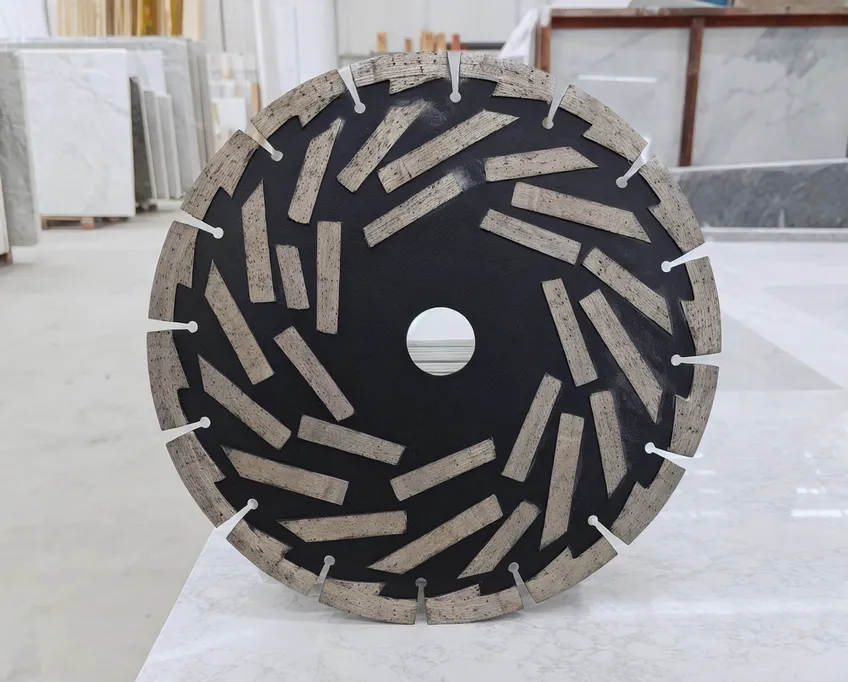
What an ARIX Diamond Blade Actually Delivers — and Who Profits from It
The Core Difference: Deliberate Geometric Array
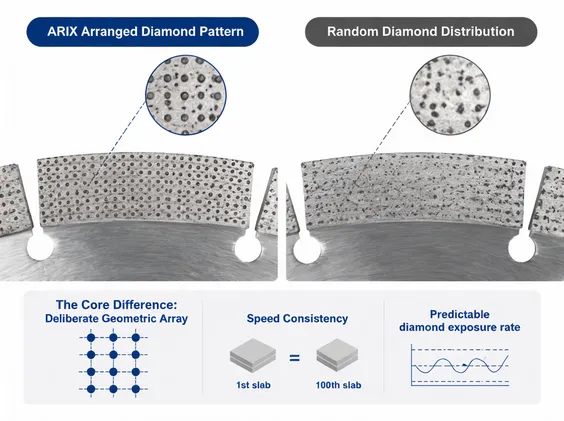
An ARIX diamond blade uses a segment where diamonds are placed in a deliberate geometric array — layer by layer, position by position — rather than mixed randomly into the metal bond powder before pressing. The difference is not cosmetic.
In a standard segment, diamond particles cluster in some areas and gap in others. When a cluster wears through, the blade speeds up briefly; when it hits a gap, cutting slows and the operator either pushes harder (risking blade deflection) or accepts lost time. Over the segment's life, cutting speed decays unevenly.
ARIX segment diamond blades eliminate that inconsistency. Every layer exposes diamonds at a predictable rate. The cutting speed you measure on the first slab is functionally the same speed you'll measure on the hundredth.
For Your Fabrication Customers
This translates directly: your fabrication customers maintain consistent throughput without compensating for blade degradation mid-shift. Their labor cost per square meter stays flat instead of climbing as the blade ages.
For Your Business (The Distributor)
The commercial positioning is straightforward — this is a premium blade. The arranged diamond pattern costs more to manufacture, which means it sells at a 15–25% premium over standard segments at your price point. Your margin in absolute dollars per blade is higher.
Defensible Upsell Story
The performance advantage gives you a defensible upsell story for any customer running hard granite, engineered quartz, or other materials where cutting speed directly impacts shop profitability. When your customer runs a side-by-side test — and serious fabricators always test — the consistent speed and longer life justify the premium. That's a product they reorder without shopping around.
How Arranged Diamond Placement Changes Manufacturing Economics
The Manufacturing Process
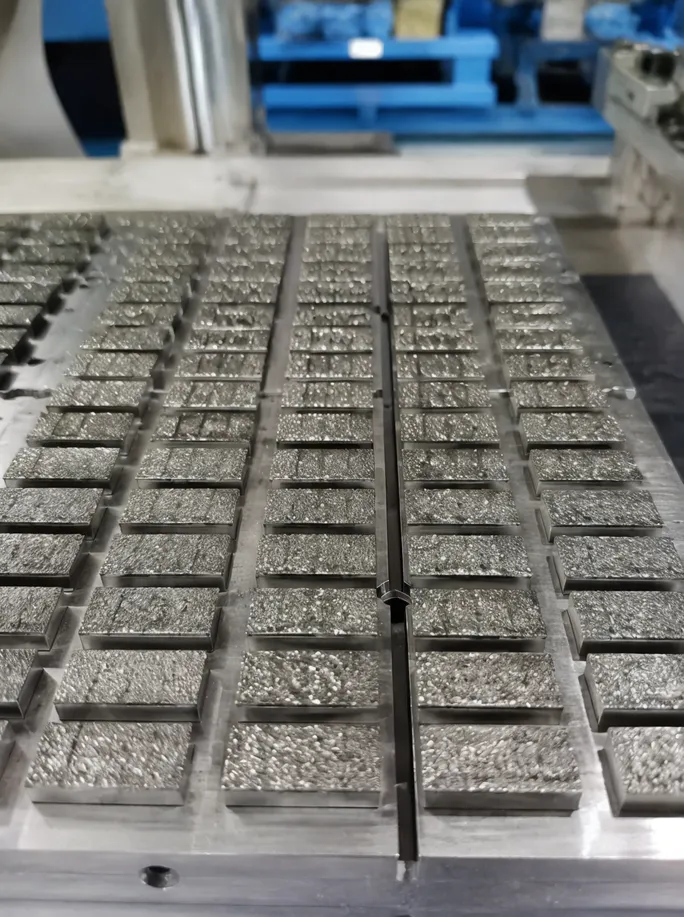
We sinter ARIX segments on dedicated tooling that positions each diamond layer in a controlled geometric grid. Standard segment production blends diamonds into metal powder at a target concentration (say, 20–25% by volume) and presses the mixture — the distribution is statistical, not deterministic.
ARIX production adds a step: each layer of the segment gets diamonds placed at specific coordinates within the cross-section before the next powder layer goes in. This is slower per segment, requires precision fixturing, and demands tighter process control on layer thickness.
Standard vs. ARIX Production
- Diamonds blended into metal powder
- Statistical distribution, not deterministic
- Faster production cycle
- Diamonds placed at specific coordinates
- Layer-by-layer precision fixturing
- Tighter process control on layer thickness
Hard to Commoditize
Many small factories skip ARIX because the tooling investment and slower production rate don't fit their batch economics. You carry a product your competitors can't easily replicate.
Side-by-Side Test Ready
When your customer runs a side-by-side test — and serious fabricators always test — the consistent speed and longer life justify the premium. That's a product they reorder without shopping around.
Global Supply Consistency
Dedicated production line means stable lead times regardless of demand spikes on standard products. Your supply chain planning stays predictable quarter over quarter.
The Bottom Line for Distributors
ARIX isn't just a technical story — it's a commercial moat. You stock a product with demonstrable performance differences that your end-users can verify in their own shops. That verification loop creates reorder loyalty, reduces price sensitivity, and protects your margin from the race-to-the-bottom on commodity blades.
Application Matrix — Where ARIX Blades Outperform Standard Segments
Not every cut justifies the ARIX premium. Here's a practical guide for matching the right blade to the right application — so you can advise your customers with confidence.
| Material | Application | ARIX Advantage | Why |
|---|---|---|---|
| Hard Granite | Bridge saw slabs | High | Consistent diamond exposure prevents speed drop-off in abrasive material |
| Engineered Quartz | Countertop fabrication | High | Resin-bonded materials wear segments unevenly; arranged pattern compensates |
| Porcelain / Sintered Stone | Large-format panels | High | Extreme hardness demands maximum diamond utilization per pass |
| Marble | Slab cutting | Moderate | Softer material — standard blades perform well; ARIX adds life but less speed gain |
| Concrete | Wall/floor sawing | High | Extended life reduces blade changes on deep cuts; consistent speed in rebar encounters |
| Reinforced Concrete | Demolition / core drilling | High | Alternating hard/soft layers stress random segments; arranged pattern handles transitions |
| Soft Limestone | Block cutting | Low | Standard blades already cut fast; ARIX premium not justified by performance gap |
Stock Strategy Recommendation
Lead with ARIX for hard granite, engineered quartz, porcelain, and reinforced concrete applications. These are the use cases where your customers will see — and measure — the difference. For softer materials, keep standard blades as the volume play and position ARIX only for customers who prioritize blade life over upfront cost.
Product Range Available for Distribution
Our ARIX line covers the diameter and application ranges most distributors need. All blades ship with laser-welded segments for wet cutting applications.
Bridge Saw Blades
- 350mm – 625mm diameters
- Granite, engineered stone, porcelain
- Silent core options available
Wall Saw Blades
- 600mm – 1600mm diameters
- Reinforced concrete, heavy construction
- High segment height for extended life
Floor Saw Blades
- 350mm – 900mm diameters
- Asphalt, green concrete, cured concrete
- Early-entry and deep-cut configurations
Core Drill Bits
- 25mm – 500mm diameters
- Wet drilling in reinforced concrete
- Roof segment and turbo segment options
CNC Machine Blades
- Optimized for automated cutting lines
- Consistent cut quality reduces waste
- Extended intervals between blade changes
Custom / OEM Specs
- Private label with your branding
- Custom segment formulations per market
- MOQ as low as 50 blades per SKU
Full Technical Specifications
Detailed spec sheets with segment dimensions, diamond concentration, bond hardness, and recommended operating parameters are available on request. We provide these in your language and can white-label them for your sales team's use.
Technical Specifications — ARIX Diamond Blade Range
Standard production parameters across the ARIX range. Exact values are adjusted per your target stone type and machine specifications.
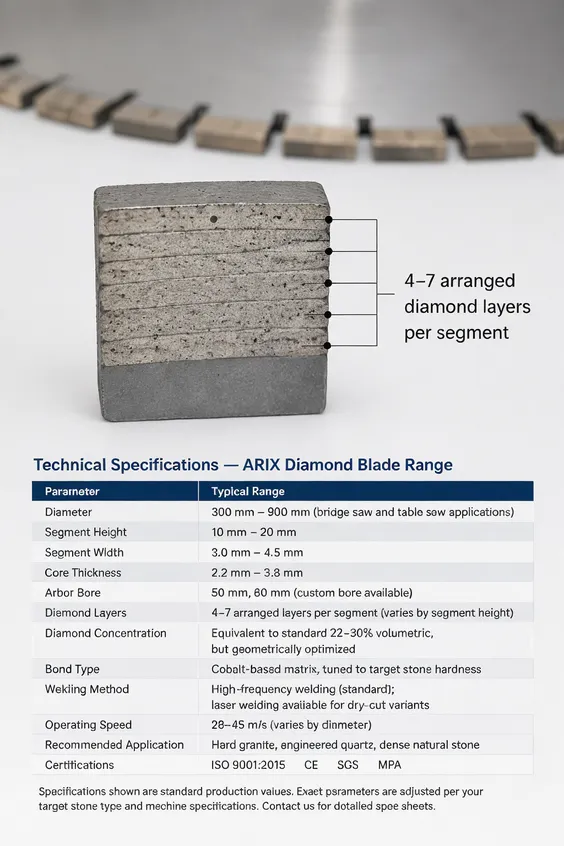
| Parameter | Typical Range |
|---|---|
| Diameter | 300 mm – 900 mm (bridge saw and table saw applications) |
| Segment Height | 10 mm – 20 mm |
| Segment Width | 3.0 mm – 4.5 mm |
| Core Thickness | 2.2 mm – 3.8 mm |
| Arbor Bore | 50 mm, 60 mm (custom bore available) |
| Diamond Layers | 4–7 arranged layers per segment (varies by segment height) |
| Diamond Concentration | Equivalent to standard 22–30% volumetric, but geometrically optimized |
| Bond Type | Cobalt-based matrix, tuned to target stone hardness |
| Welding Method | High-frequency welding (standard); laser welding available for dry-cut variants |
| Operating Speed | 28–45 m/s (varies by diameter) |
| Recommended Application | Hard granite, engineered quartz, dense natural stone |
| Certifications | ISO 9001:2015 CE SGS MPA |
Specifications shown are standard production values. Exact parameters are adjusted per your target stone type and machine specifications. Contact us for detailed spec sheets.
Where Your Customer Sees the Value
The segment height is where your customer sees the value — a 15 mm Arix segment on hard granite typically outlasts a 15 mm standard segment by 20–30% in linear meters cut. That's not because it contains more diamond; it's because fewer diamonds are wasted in suboptimal positions where they get plucked out before doing useful work.
Where ARIX Blades Generate Repeat Revenue for Your Business
Countertop Fabrication — Hard Granite and Engineered Quartz
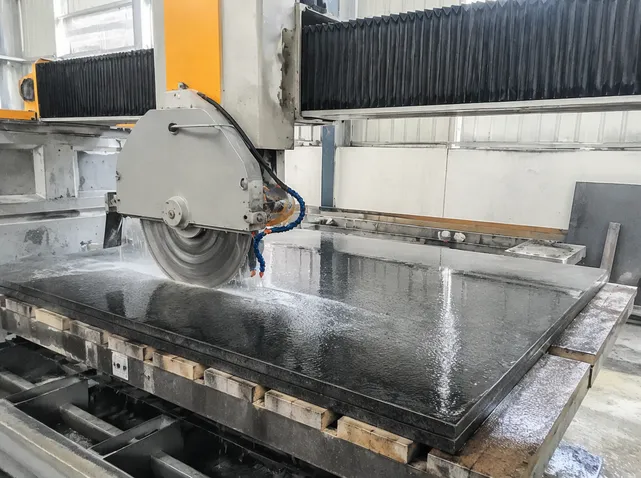
This is the primary market. Fabrication shops running bridge saws 8–12 hours daily on materials like Black Galaxy, Absolute Black, or premium engineered quartz surfaces experience the Arix advantage most acutely. These are hard, non-abrasive materials that cause standard segments to glaze between randomly-placed diamond clusters. The Arix pattern prevents glazing by ensuring continuous diamond exposure at every stage of wear.
Commercially: countertop fabricators are volume blade consumers. A shop running two bridge saws through hard granite may consume 8–12 blades per month. If your arix diamond blade delivers 25% more life per blade, that customer's annual blade spend drops — but your per-blade margin is higher, and they stop testing alternatives because the performance is proven. Sticky customers, predictable reorders.
Large-Format Slab Processing — Automated Lines
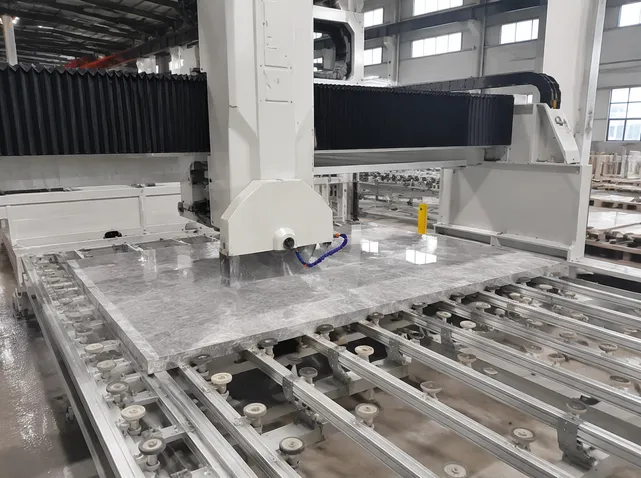
Production facilities running automated bridge saws or CNC cutting centers need blades that maintain consistent kerf width throughout their life. Random-distribution segments create subtle kerf variation as diamond clusters and gaps cycle through — imperceptible on a single cut, but measurable over a production day where slab thickness tolerance matters. Arix segments maintain dimensional stability across their entire wear life, so your customer's downstream polishing and finishing processes receive consistent material.
This segment tends to order in larger quantities (20–50 blades per specification per order) and is less price-sensitive because downtime for blade changes costs more than the blade itself.
Premium Stone Processing — Exotic Granite and Quartzite
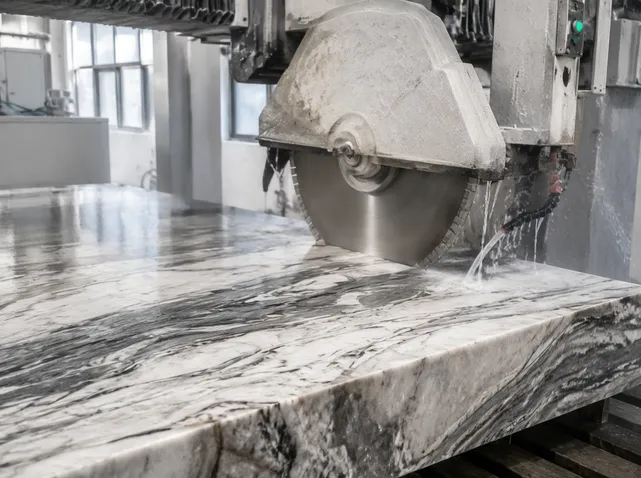
Quartzite and exotic hard granites (Brazilian Super White, Patagonia, Taj Mahal) are among the most expensive raw materials in stone fabrication. A blade that wobbles or produces inconsistent kerf on a $300/m² slab creates expensive waste. Arix blades' dimensional stability and smooth cutting action reduce material waste on high-value stone, so the blade premium is trivial compared to the slab value it protects.
Your customers processing premium materials are the easiest Arix upsell — the risk of ruining expensive stone with an inconsistent blade is their daily concern.
Tell us your target market and stone types
We'll recommend the right Arix configuration for your customer base.
Customization: Formula, Dimensions, and Private Label
Our Arix blade customization follows the same workflow as our full diamond saw blade range, with one additional parameter: diamond layer geometry.
Bond Formula Adjustment
We tune the cobalt-based matrix hardness to your target stone. Hard, dense granite (Mohs 6.5+) gets a softer bond so the Arix pattern's diamonds expose cleanly. Moderately hard stone gets a harder bond for extended wear.
If you're serving markets with specific local granite varieties, send us the stone name or a sample — we'll match the formula from our library or develop a new one.
Arix Pattern Configuration
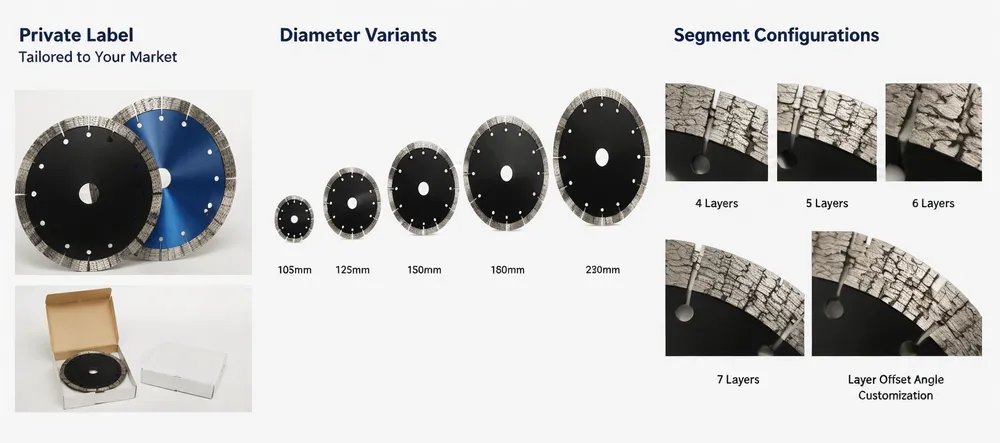
Layer count (4–7 per segment), diamond spacing within each layer, and layer offset angle are adjustable.
- Higher layer count suits taller segments for heavy-production use
- Tighter diamond spacing within layers suits extremely hard stone where you need more cutting points per revolution
Diameter and Arbor
Standard production covers 300–900 mm. Non-standard arbor bores for regional machine types are routine.
Some Turkish and Italian bridge saws use bore sizes that differ from the 50/60 mm standard — we stock the tooling for common variants.
Private Label
Your brand on the blade, your color coding, your packaging design.
What We Can't Customize
Transparency saves everyone time: Arix segment technology is optimized for hard, non-abrasive materials. We don't recommend Arix for soft, abrasive stone (sandstone, abrasive limestone) or concrete — the random-distribution standard segment is actually better suited there because the abrasive material erodes the bond quickly enough that diamond distribution pattern matters less.
If your market primarily cuts soft stone, we'll steer you toward our standard segmented blades instead.
How We Build ARIX Segments — Process Details That Protect Your Margin
Standard diamond saw blade segments are produced in high volume on automated cold-press lines — fast, efficient, and well-suited for general applications. Arix segments require a fundamentally different approach at the pressing stage.
Layer Preparation
Metal bond powder (the same cobalt-iron-copper matrix we use for standard segments, formula-adjusted for stone type) is weighed and staged per layer.
Diamond grit for each layer is pre-sorted by particle size within a tighter tolerance band than standard segments require — because positional placement amplifies any size inconsistency.
Positioned Placement
Each layer gets diamonds set into a fixture that establishes the geometric array. The spacing is determined by the target stone type and desired cutting aggressiveness.
Sequential Pressing
Rather than filling a die cavity with pre-mixed powder-and-diamond blend (standard process), we build the segment layer by layer: powder, positioned diamonds, powder, positioned diamonds.
Each layer is lightly pre-compacted before the next goes in. Final pressing brings the full segment to target density.
Sintering
Same programmable furnace profiles as standard segments, but with tighter temperature control tolerance because the geometric pattern is more sensitive to differential thermal expansion during sintering.
Post-Sinter QC
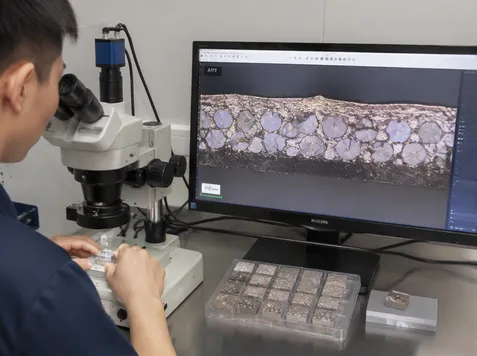
We cross-section sample segments from each Arix batch and inspect under magnification to verify diamond positions haven't shifted during sintering.
If pattern integrity degrades beyond our internal threshold, the batch is rejected.
Why This Matters for Your Business
This process is why Arix commands a premium — and why many competitors don't offer it. The layer-by-layer approach is roughly 3× slower per segment than standard pressing.
We offset this with dedicated tooling that runs Arix continuously rather than switching between standard and Arix on the same line.
The performance advantage your customers experience isn't marketing — it's embedded in a manufacturing process that's genuinely different from standard production.
vs standard pressing
ARIX vs. Standard Segments — Helping Your Customers Choose
Your customers will ask "is the Arix blade worth the extra cost?" Here's the decision framework we share with our distribution partners:
| Factor | Standard Segment | ARIX Segment |
|---|---|---|
| Cutting speed consistency | Varies ±15–20% over segment life | Consistent ±5% over segment life |
| Total segment life (hard granite) | Baseline | +20–30% typical |
| Unit cost | Baseline | +15–25% |
| Best application | Mixed materials, softer stone, price-sensitive markets | Hard granite, engineered quartz, high-production shops |
| Speed priority vs. life priority | Balanced | Speed AND life — doesn't force the trade-off |
| Recommended for | Distributors serving diverse, cost-conscious markets | Distributors serving fabricators who track cost-per-cut |
The Simplest Sales Pitch for Your Customers
"If you're cutting hard stone 6+ hours per day, the Arix blade pays for itself in the first week through fewer blade changes and consistent output."
When Standard Segments Win
If your market is primarily soft stone or occasional-use customers, standard segments are the better value. They deliver reliable performance at a lower unit cost for price-sensitive markets.
- Mixed material applications
- Softer stone cutting
- Volume base for your product line
When ARIX Justifies the Premium
For fabricators tracking cost-per-cut on hard granite and engineered quartz, the ARIX premium disappears in the first week of consistent, high-production cutting.
- Hard granite & engineered quartz
- High-production shops (6+ hrs/day)
- Premium tier for your distribution line
Product Line Strategy
We produce both — you can build a product line with standard blades as your volume base and Arix as the premium tier. Most of our distribution partners stock both and let customer application drive the recommendation.
Packaging, Logistics, and Container Loading
ARIX diamond blades ship under the same export infrastructure we use for our full 3,000,000-piece annual production — independent export rights, year-round container shipments, full documentation.
Individual Packaging
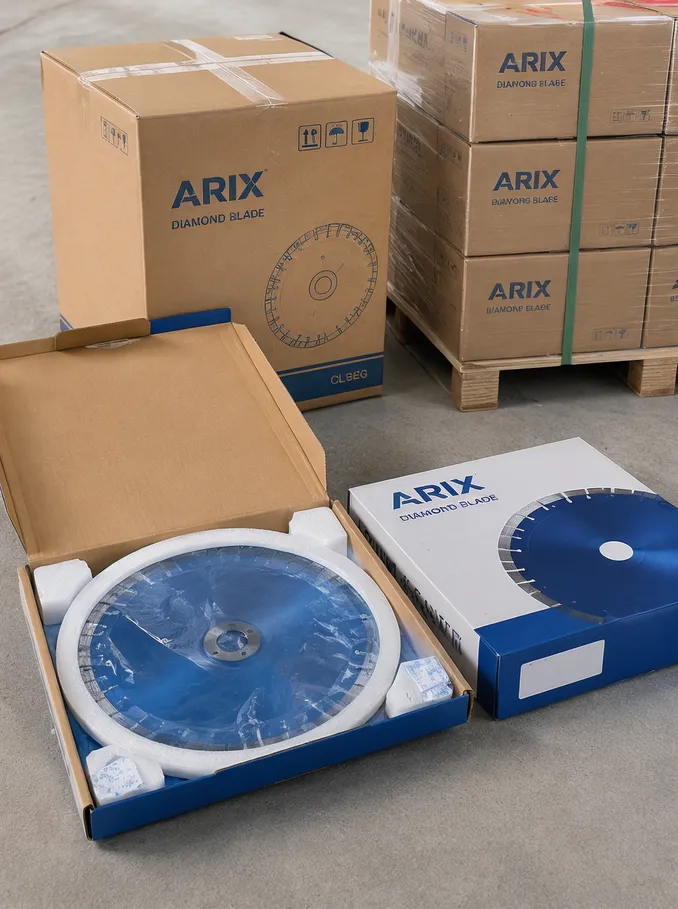
Each blade is wrapped in VCI anti-corrosion film with a foam edge guard over the segment tips. Blades are placed in individual printed cartons (private-label packaging if you've specified it) with a moisture-absorbing packet inside.
Carton Loading
For standard 350–500 mm Arix blades, master cartons hold 5–10 blades depending on diameter. Master cartons are palletized with corner reinforcement.
Container Capacity
A 20GP container holds approximately 2,000–4,000 Arix blades in the 350–500 mm diameter range (lower density than standard blades because Arix blades are typically ordered in specific sizes rather than bulk-mixed diameters).
For 600–900 mm diameters, wooden crate packaging applies — approximately 500–1,000 pieces per 20GP depending on specific dimensions.
Lead Time
Standard Arix orders on existing formulas: 30–40 days from order confirmation. The slightly longer lead time versus standard blades reflects the layer-by-layer production process.
Repeat orders on recorded formulas are faster — we maintain your formula parameters and Arix pattern specifications on file.
Documentation
- Commercial invoice
- Packing list
- Certificate of origin
- CE / MPA / SGS certificates
- Fumigation certificate for wooden crating
We coordinate with your freight forwarder or arrange through our logistics partners.
Frequently Asked Questions
Direct answers to the questions distributors and fabricators ask most about ARIX diamond blade technology, performance, and ordering.
What is the minimum order quantity for ARIX diamond blades?
50 pieces per specification for stock Arix formulas. For custom formula development (new stone type matching), we start with a 10-piece sample batch for your testing before committing to production quantities.
Private-label Arix orders start at 50 pieces per spec — same threshold as unlabeled because the labeling setup cost is minimal relative to the segment production cost.
How much longer do ARIX segments last compared to standard segments on granite?
On hard, non-abrasive granite (the material where Arix performs best), typical life improvement is 20–30% in linear meters cut per segment height. The range depends on specific stone hardness and machine operating parameters.
On moderately hard stone, the improvement narrows to 10–15% — still meaningful but less dramatic.
On soft or highly abrasive materials, Arix offers minimal life advantage over standard segments because the bond erosion rate, not diamond placement, becomes the limiting factor.
Can ARIX blades run on any bridge saw, or do they require specific machines?
Any bridge saw or table saw that accepts standard diamond blades in the same diameter and arbor will run an Arix blade. There are no machine modifications needed — the Arix technology is entirely in the segment, not the core geometry.
RPM, water flow, and feed rate recommendations are the same as standard blades of equivalent diameter. Your customers swap directly from standard to Arix without machine adjustment.
ARIX segments vs. turbo segments for granite — which should I stock?
Different cutting mechanisms. Turbo rims use a continuous serrated profile for cooling and debris clearance — they cut faster initially but on larger saw blades the speed advantage diminishes and they're typically limited to smaller diameters (under 350 mm).
Arix uses arranged diamond placement within a standard segmented configuration, optimized for 300–900 mm saw blades on bridge and table saws.
For your granite fabrication customers running bridge saws, Arix is the correct choice. For handheld and small-diameter applications, look at our turbo diamond saw blades instead.
What stone types should I NOT recommend ARIX blades for?
Soft, highly abrasive materials — sandstone, abrasive limestone, most concrete. The Arix advantage comes from controlling diamond exposure rate in hard materials where the bond erodes slowly.
In abrasive materials, the bond matrix erodes so quickly that diamond placement pattern becomes irrelevant — the diamonds expose regardless of position. For these materials, standard segments perform equally well at lower cost.
We'll tell you directly if your stone type doesn't justify the Arix premium — we'd rather sell you the right blade than create a disappointed end user.
How do I verify that a blade actually uses genuine ARIX segment technology?
Cross-section a used segment and examine under 10–20× magnification. Genuine Arix segments show a visible geometric grid pattern in the diamond distribution. Random-distribution segments show scattered placement with no repeating pattern.
If you're comparing suppliers and want verification, request a sample blade and section one segment after partial use — the pattern becomes clearly visible once a few millimeters of wear expose the internal structure.
We provide cross-section photos of our Arix segments on request.
Get Started — Sample or Volume Quote
Most new Arix partners start with a sample order of 5–10 blades to test against their current supply on actual customer stone. We match the formula to your target material, ship samples at production pricing, and include a recommended test protocol so your customer's comparison is controlled.
Tell us:
- What stone types do your customers cut?
- What bridge saw models are common in your market?
- What blade diameter/arbor combination do you need?
We'll send back an Arix specification recommendation, FOB pricing, and a test-cutting protocol within 48 hours.
Contact Us Directly
Include the stone type, diameter, and approximate monthly volume. The more specific you are, the faster we turn around an actionable quote with matched formula recommendations.