

Bridge Saw Blades Formula-Matched to Your Market
Your customers cut a rotating mix of materials on one machine. These blades deliver consistent performance across stone types without blade changes between jobs, so your accounts keep reordering instead of shopping around.
Granite, marble, quartz, and engineered slabs from a single manufacturer — 300–900 mm diameter range with custom formula development.
- ISO 9001 Certified
- CE & SGS & MPA
- 300–900 mm Diameter
- Ships to 30+ Countries
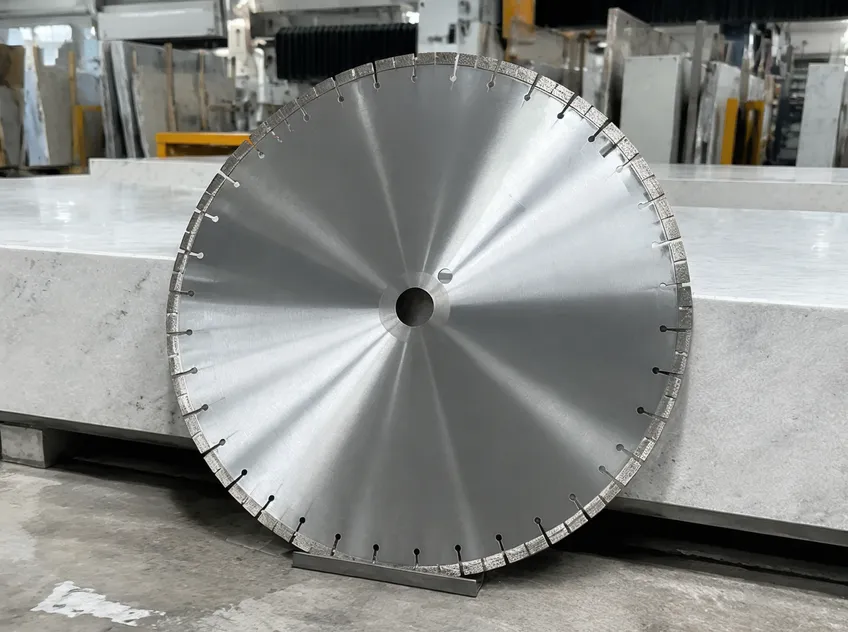
What This Blade Is — and When It Earns Its Place in Your Product Line
A bridge saw blade is a general-purpose diamond blade designed to run on bridge saw machines — the CNC or manual overhead gantry saws that dominate stone fabrication. Diameters typically run 300 mm to 900 mm, with 350 mm, 400 mm, and 500 mm being the highest-volume sizes worldwide.
Here's the positioning that matters for your inventory decisions: bridge saw blades sit between stone-specific blades and truly universal blades. A fabrication shop cutting 90% granite should be on a dedicated granite bridge saw blade. A shop cutting 40% granite, 30% marble, 20% engineered quartz, and 10% exotic materials — they need a bridge saw blade with a mid-range bond formula that handles the variety without being optimized for none of it.
We tune the bond hardness, diamond concentration, and segment geometry for multi-material performance. The trade-off is honest: a general bridge saw blade won't match the speed of a granite-specific blade on hard granite alone, or the edge quality of a marble-specific blade on soft calcite. But it eliminates blade changes between jobs, reduces your customer's SKU complexity, and handles 80% of what walks through their door. For most fabricators, that trade-off saves them more money than the 10–15% performance difference costs them.
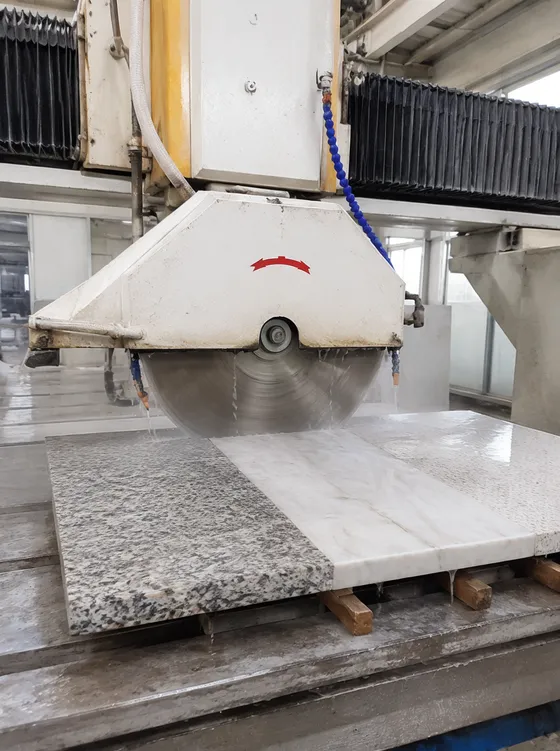
Inventory Positioning for Distributors
This is the blade your distributor accounts order first when they're building a stone fabrication line. Once they know their customers' material mix, you upsell into stone-specific blades. The bridge saw blade stays in rotation as the default — the one they reach for when an unfamiliar slab arrives.
Eliminates Blade Changes
One blade handles granite, marble, engineered quartz, and exotic materials without swapping between jobs.
Reduces SKU Complexity
Your customers stock fewer blade variants. Less inventory cost, fewer wrong-blade mistakes on the shop floor.
Honest Trade-Off: 10–15%
A general blade won't match stone-specific speed on any single material — but the cost savings from versatility outweigh that gap for most fabricators.
Technical Specifications
Standard production values for multi-stone bridge saw blades. Custom segment heights, diamond concentrations, and arbor sizes available on request.
| Parameter | Specification |
|---|---|
| Diameter range | 300 mm, 350 mm, 400 mm, 450 mm, 500 mm, 600 mm, 700 mm, 900 mm |
| Segment height | 10 mm – 15 mm (standard 10 mm and 12 mm; 15 mm for extended life) |
| Segment width | 3.0 mm – 4.2 mm (kerf width; standard 3.4 mm and 3.6 mm) |
| Core thickness | 2.2 mm – 3.2 mm (varies with diameter) |
| Number of segments | 18–54 segments (increases with diameter) |
| Arbor bore | 50 mm (standard) / 60 mm / 25.4 mm (custom bore available) |
| Welding method | High-frequency welding (standard) / Laser welding (available for dry-cut versions) |
| Diamond grit | 35/40 mesh and 40/50 mesh (balanced for multi-material cutting) |
| Bond type | Cobalt-iron composite bond (mid-range hardness for multi-stone versatility) |
| Operating speed | 28–35 m/s linear speed (varies by diameter) |
| Cutting method | Wet cutting (standard); dry-cut version available with laser-welded segments |
| Compatible materials | Granite, marble, limestone, travertine, engineered quartz, sintered stone, quartzite |
| Certifications | ISO 9001:2015, CE, SGS, MPA |
Comparison Note for Quote Evaluation
When you line up quotes from multiple suppliers, check segment height and diamond grit mesh together. A blade quoted 20% cheaper with 8 mm segments vs. our 12 mm will give your customer roughly 30% less cutting life — that "savings" becomes a faster reorder cycle at a higher per-meter cutting cost for the end user. We see this cause account losses for distributors more often than actual blade quality issues.
Segment Design & Bond Engineering
The segment is where performance lives or dies. Here's what we control in our multi-stone bridge saw blade segments and why each variable matters to your end users' cutting results.
Diamond Concentration & Distribution
We use a controlled random distribution pattern rather than layered placement. In a multi-material blade, layered diamonds create uneven wear when switching between hard and soft stones — the layers designed for soft material erode too fast on granite, leaving gaps. Random distribution keeps fresh cutting points exposed regardless of what material comes next.
- Standard concentration: 20–25 vol% for balanced life and speed
- High-concentration option: 28–32 vol% for accounts prioritizing blade life over cutting speed
- Diamond quality: SSD90+ synthetic diamonds with controlled fracture toughness
Bond Hardness Selection
The bond matrix erodes to expose fresh diamonds. Too hard and the blade glazes on soft stone; too soft and it wears out on granite. For multi-material blades, we target the middle of the Rockwell C scale range — HRC 25–35 — which sacrifices peak performance on either extreme but avoids failure on both.
Segment Geometry Options
Segment shape affects slurry clearance, cooling efficiency, and noise. We offer three geometries for bridge saw blades, each suited to different distributor markets:
Flat Segment (Standard)
Proven geometry. Consistent wear pattern. Best for shops running at steady feed rates. Lowest manufacturing cost — passes savings to your price-sensitive accounts.
V-Slot Segment
Channels in the segment face improve slurry evacuation and reduce heat buildup. 8–12% faster cutting on thick slabs (40 mm+). Slight premium in tooling cost but worth it for high-volume fabricators.
Turbo Segment
Continuous rim with serrated edges. Aggressive cutting action for shops that prioritize speed over edge finish. Good for rough-cutting before polishing — not ideal for exposed countertop edges.
Core Steel Quality
We use 65Mn spring steel for cores up to 500 mm and 30CrMo alloy steel for larger diameters. The core needs to absorb vibration without warping — a warped core causes segment loss, which causes blade failure, which causes your distributor's customer to call with a complaint. We tension-test every core before segment welding. Tensioning is the difference between a blade that runs true at 3,000 RPM and one that wobbles at 2,400.
Custom Formulation for Volume Orders
If you're ordering 200+ blades per quarter, we can formulate a bond matrix specific to your market's dominant stone types. A distributor selling primarily into a region with 60% engineered quartz work gets a slightly different bond balance than one selling into a granite-heavy market. The adjustment is in the sintering temperature and cobalt-to-iron ratio — subtle changes that add 15–20% performance against the dominant material without sacrificing versatility on others. Contact our engineering team to discuss your volume and material mix.
Material-Specific Performance Guide
How our multi-stone bridge saw blade performs on each material type — and what your customers should expect in terms of feed rate, edge quality, and blade life.
Granite
Mohs 6–7 | AbrasiveThe cobalt-iron bond erodes at the right pace on granite's abrasive quartz crystals. Performance gap versus a dedicated granite blade is modest — your customers won't notice it on standard 20 mm and 30 mm slabs.
Marble & Limestone
Mohs 3–4 | Non-abrasiveSoft stone extends blade life significantly. The slight finish gap versus a marble-specific blade shows up only under close inspection on polished edges — not visible on honed or leather finishes.
Engineered Quartz
Mohs 7 | Resin-boundEngineered quartz runs hot due to resin content. Adequate water flow (5+ L/min per side) is critical. The multi-stone bond handles it, but dedicated quartz blades with thermal-resistant segments last longer on pure quartz loads.
Sintered Stone / Porcelain
Mohs 7–8 | Dense & brittleWorks for occasional sintered stone cuts. Shops cutting 50%+ sintered material should switch to a dedicated porcelain blade — the chip risk on thin panels (6–12 mm) is higher with multi-stone geometry.
Quartzite
Mohs 7–8 | Extremely hardNatural quartzite is harder than granite and wears segments faster. The multi-stone bond handles it well — most fabricators cutting quartzite intermittently won't justify a separate blade SKU.
Travertine
Mohs 3–4 | PorousThe porosity of travertine makes it forgiving. Multi-stone blades perform nearly identically to dedicated marble blades on this material. No reason to stock a separate SKU for travertine-focused accounts.
Performance Summary for Distributor Sales Teams
The pitch to your accounts is straightforward: this blade handles everything they'll encounter in a typical week without blade changes. It gives up 10–15% versus dedicated blades on any single material, but saves 20–30 minutes per material switch (blade change + break-in cuts + speed adjustment). For a shop running 3+ material types per day, the multi-stone blade pays for itself in labor savings within the first week.
OEM & Private Label Bridge Saw Blades
Build your brand on our manufacturing infrastructure. We produce bridge saw blades under your label with the same tooling, diamond quality, and quality control as our own branded products.
What We Customize
-
Blade printing & packaging
Your logo, brand colors, and product codes laser-printed on blade cores. Custom retail or industrial packaging.
-
Segment formulation
Bond hardness, diamond concentration, and grit size tuned to your target market's dominant materials.
-
Size & arbor configuration
Non-standard diameters, segment counts, and arbor bores for regional machine preferences.
-
Color coding & SKU system
Core paint colors and segment markings matched to your existing product line hierarchy.
-
Certification documentation
CE, ISO, and regional safety certifications issued under your brand or co-branded with our facility credentials.
MOQ & Lead Times
Why Distributors Choose Private Label
- Protect your accounts from competitor brands entering through your supply chain
- Control pricing without manufacturer brand comparison shopping
- Build brand equity that travels with you if you change suppliers
- Tailor product specs to your regional market without R&D investment
Private Label Process
Consultation
Share your market focus, target materials, and branding requirements.
Sample Production
We produce 3–5 sample blades for your field testing and approval.
Design Approval
Finalize printing artwork, packaging layout, and documentation.
Production & Shipping
Batch production with QC photos shared before dispatch.
Technical Specifications
Full specification table for our multi-stone bridge saw blade range. Use this data for quoting, machine setup guidance, and technical support with your accounts.
| Diameter | Segment Height | Segment Width | Segment Count | Arbor | RPM (max) | Application |
|---|---|---|---|---|---|---|
| 350 mm (14") | 15 mm | 3.2 mm | 24 | 60 mm | 2,800 | Small bridge saws, countertop shops |
| 400 mm (16") | 15 mm | 3.4 mm | 28 | 60 mm | 2,500 | Mid-size bridge saws |
| 450 mm (18") | 15 mm | 3.6 mm | 32 | 60 mm | 2,200 | Standard production bridge saws |
| 500 mm (20") | 15 mm | 3.8 mm | 36 | 60 mm | 1,900 | High-production, thick slab cutting |
| 600 mm (24") | 20 mm | 4.0 mm | 42 | 60 mm | 1,600 | Large format slabs, block trimming |
| 700 mm (28") | 20 mm | 4.2 mm | 48 | 60 mm | 1,400 | Heavy-duty production, quarry trimming |
| 800 mm (32") | 20 mm | 4.5 mm | 54 | 60 mm | 1,200 | Industrial bridge saws, gang saws |
Core Material
65Mn spring steel, laser-cut and tensioned. Heat-treated for flatness stability at operating temperature.
Diamond Quality
Industrial-grade synthetic diamond, 40/50 mesh primary with 50/60 mesh secondary layer. Concentration: 25–30 vol%.
Segment Bonding
Silver-brazed or laser-welded depending on diameter. Laser weld standard on 450 mm and above for safety at high peripheral speeds.
Ordering & Distributor Support
We structure everything around making your purchasing and reselling process as simple as possible. Here's what working with us looks like.
Shipping & Logistics
- FOB Xiamen or CIF to your port — your choice
- Standard lead time: 15–20 days after payment
- Express available: 7–10 days (surcharge applies)
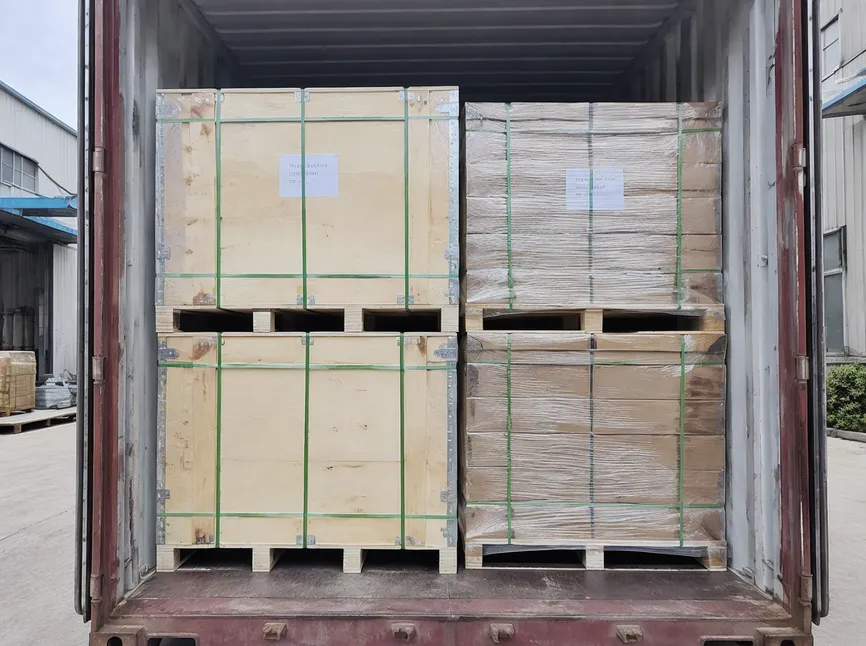
- Wooden crate packaging, fumigation certificate included
Pricing Structure
- Tiered pricing: better rates at 50, 100, and 500+ units
- Annual volume agreements available
- Payment: T/T 30% deposit, 70% before shipment
- L/C at sight accepted for orders over $10,000
Technical Support
- Dedicated account manager for each distributor
- WhatsApp/WeChat support during CN business hours
- Cut parameter sheets for your end users (PDF, branded)
- Troubleshooting assistance for blade performance issues
Request Samples or a Quote
Tell us your target materials, preferred diameters, and monthly volume. We'll send pricing and arrange test blades for your top accounts.
Get StartedFrequently Asked Questions
Common questions from distributors evaluating multi-stone bridge saw blades for their product lines.
What's the real performance difference between a multi-stone blade and a dedicated granite blade?
Can this blade handle engineered quartz (Silestone, Caesarstone, etc.)?
What's the minimum order for private label blades?
How do I know which segment formulation to choose for my market?
Do you provide warranty or blade life guarantees?
Can I get blades with silent cores or vibration-dampening slots?
How Bond Formula Drives Multi-Stone Performance
The category page covers our formula development process in depth. For bridge saw blades specifically, here's what we optimize differently than single-stone blades.
The Core Challenge
We use a cobalt-iron composite bond at a hardness level we calibrate between granite-hard and marble-soft. The concept is straightforward — the bond needs to wear fast enough that diamonds expose properly in hard granite (where there's minimal abrasion to erode the matrix naturally), but not so fast that it erodes prematurely when the operator switches to abrasive limestone or sandstone-backed engineered slabs.
Three Control Variables
In practice, we arrive at this by controlling three variables:
Cobalt-to-Iron Ratio
Higher cobalt = more wear-resistant matrix. Higher iron = softer matrix.
Diamond Concentration
Measured in carats per segment, tuned to the bond wear rate.
Sintering Temperature
Temperature profile controls final matrix density and diamond retention.
For our standard multi-stone bridge saw blade formula, we run a mid-range ratio that handles the material rotation without dramatic performance shifts.
Diamond Grit Selection
The diamond grit selection reinforces the formula bias:
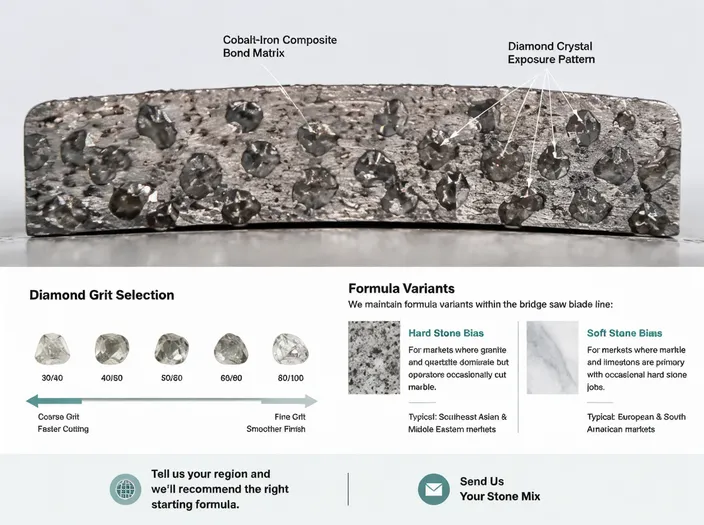
Formula Variants
We maintain formula variants within the bridge saw blade line:
For markets where granite and quartzite dominate but operators occasionally cut marble.
Typical: Southeast Asian & Middle Eastern markets
For markets where marble and limestone are primary with occasional hard stone jobs.
Typical: European & South American markets
Tell us your region and we'll recommend the right starting formula.
Segment Geometry and Welding: What Affects Your Customer's Cut Quality
We produce bridge saw blade segments in two standard profiles for this product line:
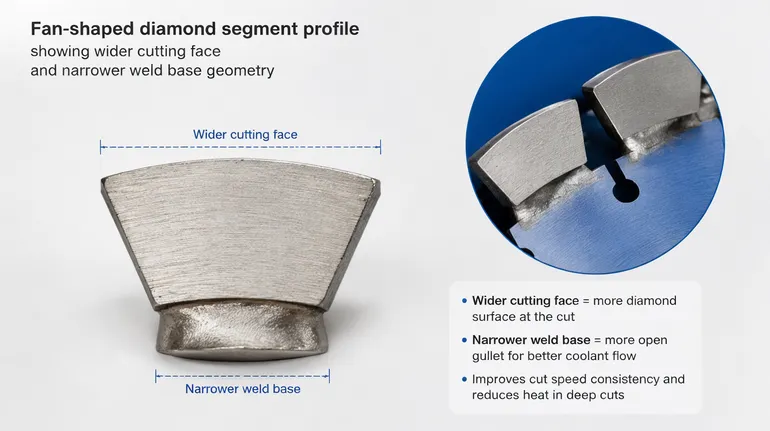
Fan-Shaped Segments
Wider at the cutting face, narrower at the weld base. This geometry improves coolant flow through the gullets and provides more diamond surface area at the point of contact.
Why we default to fan segments for 400 mm+: The increased water flow reduces heat buildup during deep cuts on thick slabs.
What your customers notice: Consistent cut speed even in the bottom third of a 3 cm granite slab — where standard flat segments start to bind.
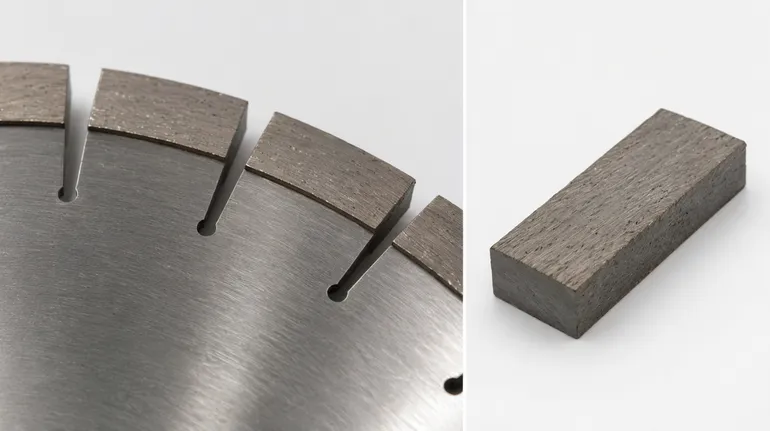
Flat / Rectangular Segments
Uniform width from base to tip. Simpler geometry, lower segment manufacturing cost, and predictable wear pattern.
Used on 300–350 mm blades: Where cut depth is shallower and thermal management is less critical.
Why not fan-shape here: On smaller diameters, the fan-shape advantage diminishes because the gullets are already proportionally deeper relative to the cut.
Welding: High-Frequency as Standard
The bridge saw environment — wet cutting at moderate RPM — produces minimal thermal stress on the segment joint. High-frequency welding delivers adequate joint strength at a lower manufacturing cost than laser, so your per-blade landed cost stays competitive.
When to upgrade to laser welding
Laser welding is available and recommended only if your customers run these blades dry — which happens in some retrofit or portable bridge saw setups where water supply isn't plumbed.
For standard wet-cut bridge saw use: high-frequency welding delivers the joint strength you need at the right cost. Laser welding adds cost with no performance benefit in normal operating conditions.
Our Non-Negotiable Weld Prep
We grind every core seating area before welding to bare steel — surface oxide or mill scale under the weld joint is the single most common cause of premature segment detachment in this product category.
It's a step some factories skip because it adds handling time, but we've traced enough field failures back to contaminated weld interfaces that it's non-negotiable in our process.
Market Segments That Move Bridge Saw Blades in Volume
Understanding where blades move in volume helps you allocate inventory, set pricing tiers, and prioritize account development. Three segments dominate bridge saw blade consumption globally.
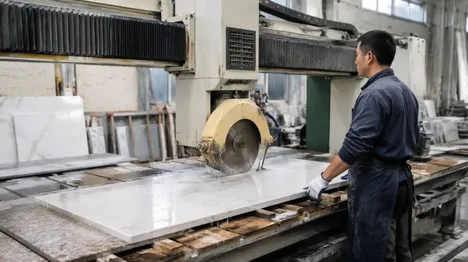
Countertop Fabrication — Your Highest-Reorder Segment
Stone fabrication shops producing kitchen and bathroom countertops are the primary consumers of bridge saw blades. A busy shop runs its bridge saw 8–12 hours daily and burns through 2–4 blades per month depending on volume and stone hardness. At 400–500 mm diameter, these blades are the bread-and-butter SKU for any distributor serving the fabrication industry.
The Commercial Logic
Fabricators budget blades as operational consumables, not capital purchases. They reorder on a predictable cycle. Your margin per blade is moderate, but the lifetime value of a fabrication account — reordering monthly for years — makes this the segment where supply reliability matters more than the lowest possible price.
Fabricators switch suppliers when a blade arrives inconsistent or late, not because they found a slightly cheaper option.
We ship bridge saw blades to fabrication distributors in Southeast Asia, the Middle East, and South America who serve exactly this segment.
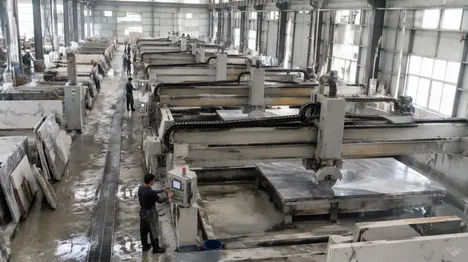
Stone Processing Centers — Multi-Machine Facilities
Large processing centers running 3–10 bridge saws simultaneously consume blades at industrial scale. These buyers typically standardize on one blade specification across all machines to simplify inventory and operator training. Orders tend to be quarterly in bulk — 500–2,000 blades per purchase — with negotiated annual pricing.
Account Value
Landing one processing center account can represent the same volume as 20 individual fabrication shops. The qualification process is longer (they'll test 10–20 blades before committing), but the payoff is a multi-year contract-volume relationship.
Standardized specification across all machines simplifies your inventory management and their operator training.
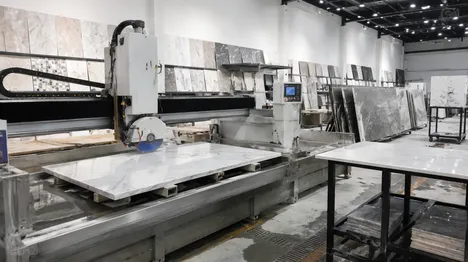
Tile and Slab Showrooms with In-House Cutting
A growing segment: stone and tile showrooms that offer custom cutting for retail customers. They run lighter bridge saws (10–15 HP vs. fabrication-grade 20–30 HP machines) and cut perhaps 20–40 pieces per day across a wide variety of materials.
Margin Opportunity
These accounts value blade versatility over peak performance on any single stone — the exact positioning of a general-purpose bridge saw blade. Order volumes are smaller (5–20 blades per order) but margins per blade are higher because these buyers are less price-sensitive than production fabricators.
They're marking up the cutting service, not competing on blade cost per linear meter.
Versatility over peak performance — ideal positioning for your general-purpose bridge saw blade.
Customization Scope for Bridge Saw Blades
Here's what we can adjust for your specific market requirements — and what we can't. Transparency avoids wasted inquiry time on both sides.
Diameter and Arbor
Any diameter from 300–900 mm in 50 mm increments. Standard 50 mm bore fits most Italian and Chinese bridge saw brands. 60 mm bore for select European machines.
Custom bores for older or regional machine brands — send us the spindle spec and we'll confirm compatibility. We've made 55 mm and 57.5 mm bore blades for South American accounts running older refurbished bridge saws — not a standard option for most factories, but our CNC core processing handles it.
Segment Height and Count
Three standard height options, each serving a different operational priority:
- 10 mm Standard height — good cutting life at competitive per-blade cost
- 12 mm Extends life by roughly 20% for accounts that prefer fewer blade changes
- 15 mm Maximum life between replacements — increased segment weight shifts the blade's balance point; only recommended on machines with robust spindle bearings
Diamond Concentration and Bond Hardness
This is where your market-specific tuning happens. We adjust within the multi-stone formula range based on your customers' primary material:
- If 70% of their cutting is granite — we bias the formula harder
- If predominantly marble and travertine — we soften it
- The blade still handles variety — we're shifting the optimization center, not making it a single-stone blade
Core Type
Two construction options:
Standard Steel Core
Standard construction — proven durability for outdoor and high-volume operations.
Silent Core (Sandwich Construction)
Vibration-dampening copper layers reduce operating noise by 3–5 dB. Adds 15–20% to blade cost. Worth offering to indoor fabrication shops facing occupational noise regulations.
See our Silent Core Diamond Blades page for detail on this construction.
Private Labeling
Your brand, your packaging, your color scheme on the core paint.
- MOQ for private label starts at 100 pieces per diameter specification
- We maintain your packaging artwork on file for repeat orders
- Same blade, same box, ships as fast as our standard SKUs
What We Can't Customize
Transparency avoids wasted inquiry time
- Blade diameter below 300 mm for bridge saws isn't practical — the machine RPM and feed mechanics don't suit it. For smaller diameters, see our diamond cutting discs range.
- Segment heights below 8 mm — the cutting life would be too short to represent good value for bridge saw applications.
Ready to spec a blade for your market? Include your machine brand and primary stone types for a precise recommendation.
Request a Custom Specification QuotePackaging and Container Economics
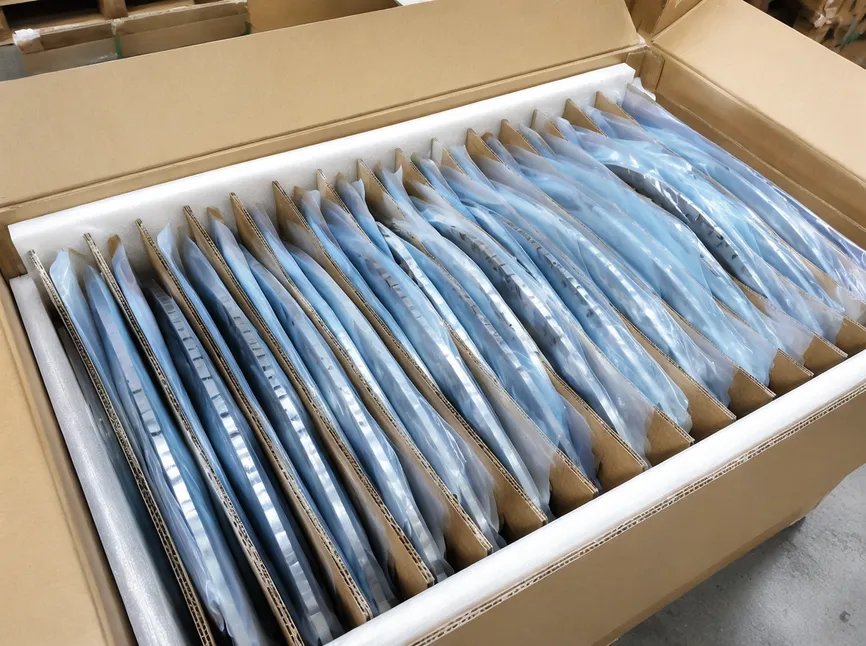
Bridge saw blades ship individually wrapped in VCI anti-corrosion film with rigid cardboard dividers between blades. Blades 400 mm and above get foam-padded cartons; smaller diameters nest in stackable cardboard boxes.
Container Loading Reference
Plan your order economics — exact quantities depend on final packaging configuration and whether blades ship with or without individual retail boxes.
| Blade Diameter | Pieces per 20GP | Pieces per 40HQ | Packaging Format |
|---|---|---|---|
| 300–350 mm | ~3,000–4,000 | ~6,500–8,000 | Stacked in cartons, 10 pcs per box |
| 400–500 mm | ~1,800–2,500 | ~4,000–5,000 | Individual foam cartons, palletized |
| 600–700 mm | ~800–1,200 | ~1,800–2,500 | Wooden crate, foam separated |
| 900 mm | ~400–600 | ~900–1,200 | Wooden crate with edge protection |
Mixed-SKU Container Loading
For distributors consolidating multiple blade types in a single container: we coordinate mixed-SKU loading to maximize your container utilization. Tell us your full order across all specifications and we'll provide a loading plan showing exactly how many pieces of each size fit and what pallet positions they occupy.
We do this routinely for buyers ordering bridge saw blades alongside cutting discs and grinding tools — filling the container gaps with smaller-diameter products improves your landed cost per piece on the large blades.
Standard formulas and specifications from order confirmation to port
Repeat orders on file formulas
First orders with custom formula development — add for sampling and approval
Bridge Saw Blade vs. Stone-Specific Blades — Helping You Build the Right SKU Mix
This isn't a "which is better" comparison — it's a stocking strategy decision. Here's how the products relate:
| Factor | Bridge Saw Blade (this page) | Stone-Specific Blade |
|---|---|---|
| Optimized for | Multi-material versatility | Single stone type performance |
| Cutting speed | Mid-range across all materials | 15–25% faster on target material |
| Edge quality | Good across materials | Excellent on target material |
| Blade life | Consistent across stone types | Longest on target, shorter on off-spec material |
| SKU count needed | 1 per diameter covers most jobs | 1 per diameter per stone type |
| Best for | Mixed-material shops, trial accounts, showrooms | High-volume single-stone fabricators |
| Reorder logic | Universal replacement — always needed | Only when cutting that specific stone |
Our Recommendation for Distributors
Stock bridge saw blades as your entry-level product and lead with them for new accounts. Once you understand what each customer primarily cuts, introduce stone-specific blades as an upsell.
The bridge saw blade stays in their rotation for odd jobs and unfamiliar materials — it never becomes obsolete, even after they add specialized blades. This gives you two revenue streams per account instead of one.
Frequently Asked Questions
Practical answers drawn from fabrication-distributor conversations — covering blade life, compatibility, performance comparisons, and ordering logistics.
What is the typical cutting life of a bridge saw blade on mixed materials?
On a standard 400 mm blade with 10 mm segments running at recommended feed rates with water cooling: expect 800–1,200 linear meters of mixed stone cutting. Granite-heavy usage falls toward the lower end; marble and engineered quartz push it higher because softer materials wear segments more slowly.
With our 12 mm segment option, add roughly 20% to those numbers.
Actual life depends on feed rate, water flow, slab thickness, and operator discipline — but these ranges represent what our fabrication-distributor partners report across normal production conditions.
What arbor bore size do I need for my market's bridge saws?
50 mm bore covers the majority of bridge saws manufactured in Italy (Breton, Pedrini, GMM, Barsanti), China (Wanlong, Hualong, XGMA), and Turkey.
60 mm bore is required for some older Prussiani and certain Spanish machines.
If you're unsure, send us the machine brand and model — we maintain a compatibility database covering most commercial bridge saw platforms.
For truly unusual bores, we CNC-cut custom holes at no extra charge above 50 pieces.
How does bridge saw blade performance compare to Arix-segment blades on granite?
On hard granite specifically, an Arix-segment blade will outperform a standard bridge saw blade by 20–30% in both speed and life — the arranged diamond pattern exposes cutting surfaces more efficiently in dense, non-abrasive material. However, that advantage diminishes or reverses on softer stone.
If your customer cuts primarily hard granite, recommend our ARIX Diamond Blades.
If they cut mixed materials, the standard bridge saw blade formula delivers better all-around economics because the Arix advantage only manifests on one portion of their material mix.
Can I mix bridge saw blade sizes in a minimum order?
Yes. Our MOQ of 50 pieces per specification means 50 of the same diameter and formula combination. But within a single order, you can combine multiple specifications — 50 pieces of 400 mm, 50 pieces of 500 mm, and 30 pieces of 350 mm (below MOQ for the 350 mm in this case, but we'll accommodate it within a larger combined order).
For market-testing a new diameter in your product line, we offer sample quantities of 5–10 pieces at production pricing before you commit to a full MOQ run.
What's the difference between this page and "Diamond Bridge Saw Blades"?
Same product category, different buyer entry points. This page covers our general-purpose bridge saw blade range with multi-stone formula optimization. The Diamond Bridge Saw Blades page emphasizes the diamond technology and construction options.
If you landed here looking for stone-specific bridge saw blades (granite-only, marble-only), those have dedicated pages linked in the comparison section above.
How do I know if my customers need laser-welded or high-frequency welded bridge saw blades?
Wet cutting on a standard bridge saw with proper coolant flow: high-frequency welded. This covers 90%+ of bridge saw applications and costs less per blade.
Laser welding is necessary only for dry-cut situations (no water supply, portable bridge saw setups) or if your customer runs blades at RPM significantly above the manufacturer's recommendation.
If you're stocking for a general fabrication market, HF-welded is your default — add laser-welded only if you've confirmed dry-cut demand from specific accounts.
Your Next Step — Start with Your Market, Not Our Catalog
Send us three things and we'll turn around a specific recommendation within 48 hours:
Your primary stone types
What your customers cut most, even an approximate percentage split (e.g., "60% granite, 30% quartz, 10% marble")
Target diameters
Which sizes move in your market (or tell us the machine brands and we'll tell you the diameters)
Monthly or quarterly volume
Helps us quote the right price tier and plan production allocation
We'll respond with formula recommendations, pricing by tier, and lead time for your first order. If you want to test before committing, we ship 5–10 blade samples at production pricing so you can put them in your customers' hands first.
Ready to get started?
Include stone types, quantities, and target FOB budget if you have one. The more specific your request, the faster we produce an actionable quote.