

Laser Welded Diamond Blades Built for Dry Cutting & High-RPM Demand
Segment joints engineered for thermal cycling, high centrifugal loads, and waterless operation. When your customers cut dry or push RPM past what brazed joints survive, laser welding is the only joint method that holds.
We manufacture the full diameter range — 300–3200 mm — with automated laser welding systems and formula-matched segments. OEM/ODM standard workflow.
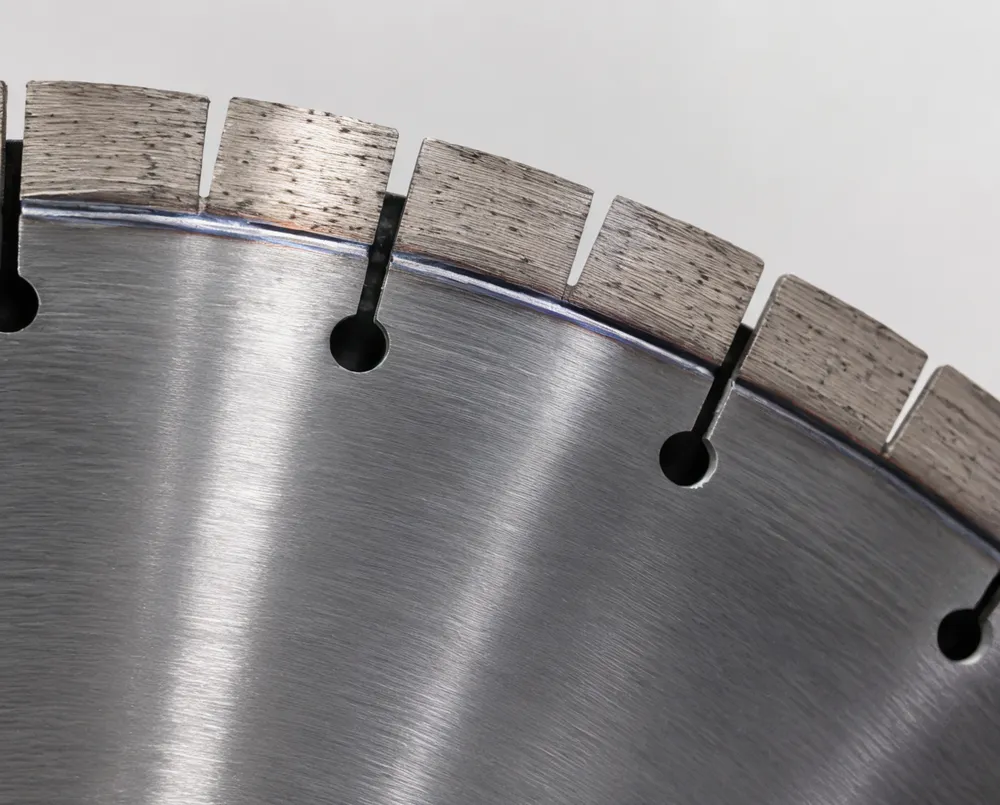
What Makes a Laser Welded Diamond Blade Different — and Who Buys Them
A laser welded diamond blade uses a concentrated laser beam to fuse the diamond segment directly to the steel core at the molecular level. The result is a metallurgical bond between segment and core that withstands repeated thermal expansion and contraction without cracking — the specific stress pattern that destroys high-frequency (HF) welded and brazed joints during dry cutting.
Your stocking decision comes down to this: if your customers cut without water — hand-held power cutters on construction sites, walk-behind road saws where water supply is impractical, rescue operations with no time for hookup — they need laser welded blades. Period. HF-welded blades in dry-cut applications develop micro-cracks at the joint within dozens of cuts as the segment heats and cools without water moderation. The first segment that detaches at 4,000+ RPM is the last sale you make to that customer.
We also see consistent demand for laser welded blades in high-RPM wet applications — smaller-diameter blades on high-speed table saws and angle grinder attachments where peripheral speed pushes centrifugal force beyond what HF joints reliably contain. The laser bond's shear strength is typically 25–40% higher than equivalent HF joints, so you carry less safety liability in your product line.
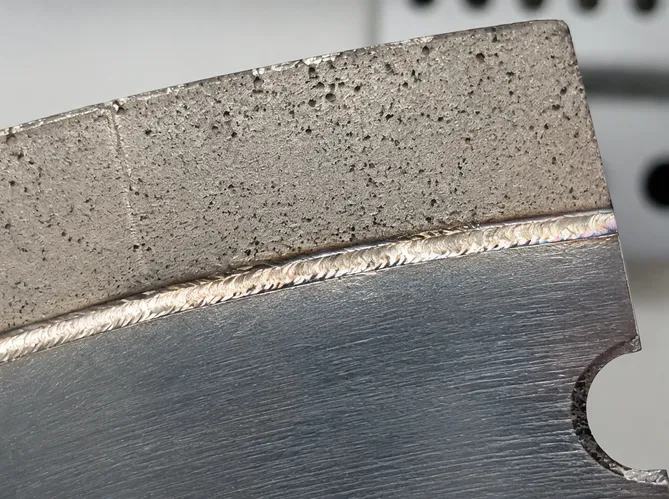
Key Insight
Laser welded blades cost more to produce than HF-welded — the equipment investment is significant, and cycle time per blade is longer. Your margin per unit is higher, but your customers also expect the performance to justify the premium. This is a value SKU, not a price-fighter.
Dry-Cut Construction
Hand-held power cutters on job sites where water hookup is unavailable or impractical. The primary volume driver for laser welded blades.
Walk-Behind Road Saws
Dry road-cutting operations where water supply logistics don't support continuous wet cutting — thermal cycling demands the laser bond.
High-RPM Wet Applications
Smaller-diameter blades on high-speed table saws and angle grinders where centrifugal force exceeds HF joint tolerance even with water present.
Technical Specifications — Laser Welded Diamond Blade Range
Standard production ranges covering the full diameter spectrum. Exact values depend on diameter, segment formula, and application.
| Parameter | Specification |
|---|---|
| Diameter range | 105 mm – 900 mm (standard); custom up to 1600 mm |
| Segment height | 8 mm – 15 mm (varies by diameter and application) |
| Segment width | 2.2 mm – 3.6 mm (thin kerf); 3.2 mm – 7.0 mm (standard) |
| Core thickness | 1.6 mm – 4.5 mm |
| Arbor bore | 20 mm, 22.23 mm, 25.4 mm, 50 mm (custom bore available) |
| Welding method | Automated CNC laser welding |
| Segment bond | Cobalt-based, iron-based, and composite formulas matched to material |
| Diamond grit | 30/35 through 50/60 mesh (application-dependent) |
| Max operating speed | Up to 80 m/s (diameter-dependent; exceeds HF-welded limits) |
| Cutting mode | Dry cutting, wet cutting, or combination |
| Target materials | Concrete (green, cured, reinforced), asphalt, granite, general stone, masonry, refractory brick |
| Certifications | ISO 9001:2015, CE, SGS, MPA |
Specifications shown are standard production ranges. Exact values depend on diameter, segment formula, and application. Contact us for product data sheets specific to your requirements.
Diameter Volume Distribution — From Our Order History
Large-diameter laser welded blades above 600 mm are less common — at those sizes, wet cutting is almost always available, so HF welding is more cost-effective. We produce them when specified, but we'll advise you honestly on whether the premium is justified for your application.
How We Manufacture Laser Welded Diamond Blades
The process matters because it determines consistency. Here's what happens on our production floor — and where quality is won or lost.
Steel Core Production
CNC laser-cut from heat-treated 65Mn or 50Mn2V steel plate. Tensioned, stress-relieved, and runout-checked to ±0.05 mm. The core is the foundation — if it's not flat and tensioned correctly, the blade won't track straight regardless of segment quality.
Diamond Segment Pressing & Sintering
Metal powder mixed with calibrated diamond grit, cold-pressed into green compacts, then hot-pressed or vacuum sintered at controlled temperature profiles. Bond hardness is matched to the target material — harder bonds for abrasive materials, softer bonds for hard, dense stone.
CNC Laser Welding
Segments are positioned on the core using automated fixtures. A high-power laser (typically 2–4 kW fiber laser) fuses segment to core in a controlled atmosphere. Weld penetration depth is monitored in real-time. Each segment receives a consistent energy input — no operator variability.
Quality Control & Testing
Every blade is visually inspected, dimensionally checked, and batch-sampled for destructive pull testing. Weld joints must exceed 1000 N/mm shear strength. Blades failing any checkpoint are rejected — not reworked, rejected.
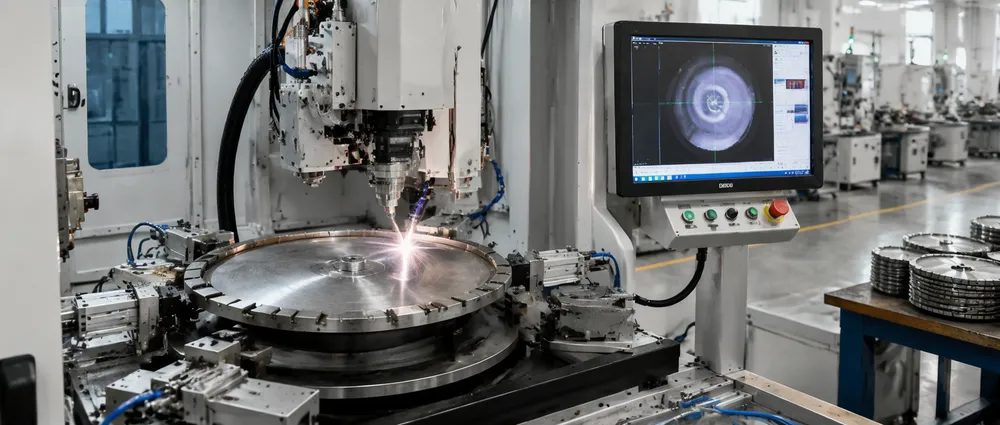
Quality Consistency at Scale
Automated laser welding removes the single biggest variable in blade production: operator skill. With HF welding, an experienced operator can produce excellent joints, but consistency across shifts and workers varies. Laser welding delivers the same joint every time — which is what you need when you're putting your brand on thousands of blades per month.
Laser Welded vs. Other Bonding Methods
Choosing between laser welding, high-frequency (HF/induction) welding, and sintered/brazed segments depends on the end application, price point, and safety requirements.
| Characteristic | Laser Welded | HF / Induction Welded | Sintered (One-Piece) |
|---|---|---|---|
| Joint Strength | Highest — metallurgical fusion | High — brazing alloy bond | N/A — no joint |
| Dry Cutting Safe | Yes | Risk of segment loss | Yes |
| Max Peripheral Speed | Up to 80 m/s | Up to 60 m/s (typical) | Varies by design |
| Production Cost | Higher — equipment-intensive | Lower — established process | Lowest (small diameters) |
| Heat-Affected Zone | Minimal — focused energy | Wider — induction heating | N/A |
| Segment Replaceability | Not practical | Possible (re-tip) | Not applicable |
| Best For | Dry cutting, high RPM, safety-critical | Wet cutting, cost-sensitive, large diameters | Small blades ≤125 mm, DIY market |
Practical Guidance for B2B Buyers
If your end users are cutting dry on hand-held saws, laser welded is the only responsible choice. If they're running large-diameter wet saws with consistent coolant supply, HF welding delivers the same functional result at lower cost.
We manufacture both. We'll tell you which makes sense for your specific product line rather than pushing you toward the higher-margin option. Long-term supplier relationships matter more than one upsold order.
OEM & Private Label Partnership
Most of our laser welded blade output ships under our customers' brands. Here's how we support that.
Custom Branding & Packaging
Full-color printing on blade core, custom segment paint, branded packaging design, and retail-ready blister packs or industrial boxes.
Custom Segment Formulation
Work with our R&D team to develop proprietary segment formulas optimized for your regional materials — European aggregates differ from Middle Eastern limestone.
Flexible MOQs
Standard SKUs from 100 pieces. Custom formulations from 500 pieces per specification. We understand that not every SKU in your catalogue moves 10,000 units per quarter.
Certification Support
We provide test reports, material certificates, and documentation packages for CE marking, MPA certification, and regional compliance requirements.
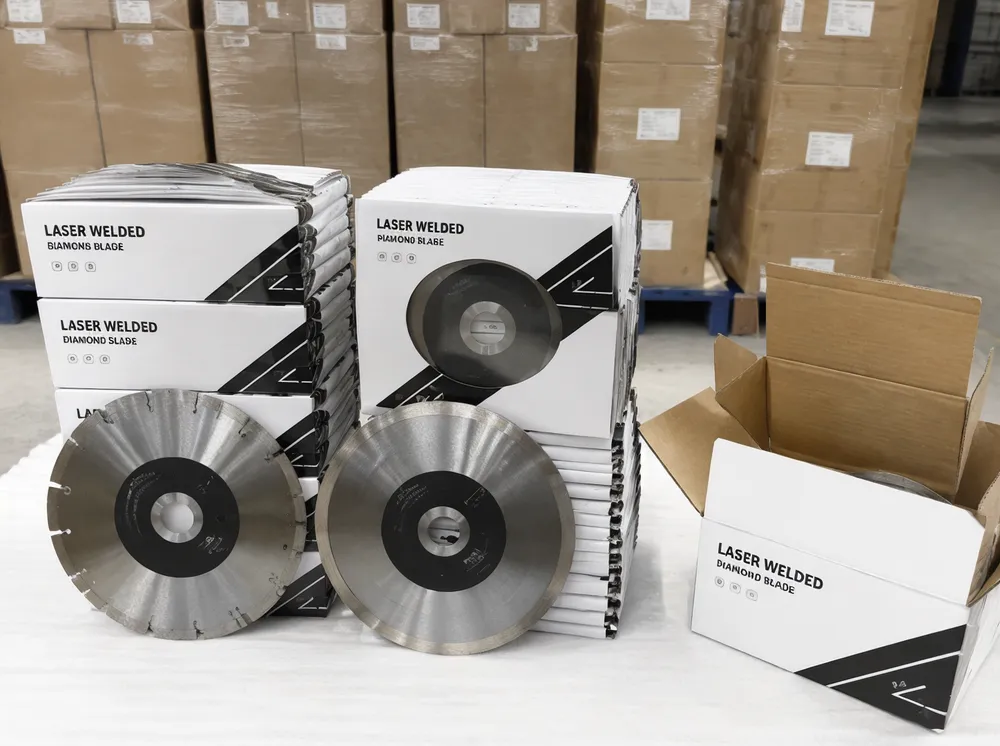
Example of private label packaging — your brand, our manufacturing.
How Engagements Typically Start
- You send us your target specs — diameters, materials to cut, price positioning, and volume estimates.
- We recommend segment formulas and provide sample blades (typically 2–4 weeks to produce).
- You test and provide feedback. We iterate if needed — usually one or two rounds.
- Approval confirmed, we produce your first production order (4–6 weeks lead time).
- Ongoing: scheduled production runs, inventory holding if agreed, and continuous improvement based on field data.
Segment Design Philosophy
The laser weld holds the segment on. But the segment itself determines whether the blade cuts well. Here's how we think about segment design for laser welded applications.
Diamond Quality & Concentration
We use industrial-grade synthetic diamond from established suppliers. Concentration is specified in carats per segment and matched to the material hardness and abrasiveness.
Higher concentration doesn't always mean better performance. Over-concentrated segments in abrasive materials glaze instead of self-sharpening. We balance concentration against bond erosion rate.
Bond Matrix Selection
Cobalt-dominant bonds for hard, non-abrasive materials (granite, engineered stone). Iron-based bonds for abrasive materials (green concrete, asphalt). Composite formulas for mixed-material cutting.
The bond must erode at the same rate diamonds are consumed. Too hard and the blade stops cutting. Too soft and segment life is unacceptably short.
Segment Geometry
Standard flat segments for general purpose. Turbo segments for faster chip clearance in soft materials. Arrayed (sandwich) segments with alternating diamond layers for consistent performance through the full segment height.
Segment shape also affects welding — the contact geometry between segment base and core must match the laser focus parameters.
Frequently Asked Questions
Common questions from distributors and brand owners evaluating laser welded diamond blades.
Can laser welded blades be used for wet cutting?
What is the minimum order quantity for custom laser welded blades?
How do you verify weld quality?
What lead time should we expect?
Do you export and handle international logistics?
Can I get laser welded blades with turbo or segmented rims?
Ready to Source Laser Welded Diamond Blades?
Tell us your diameters, target materials, and volume expectations. We'll come back with specifications, pricing, and sample availability — typically within 24 hours.
Laser Welding vs. High-Frequency Welding — A Stocking Decision, Not Just a Technical Distinction
The parent category page covers both welding methods at the category level. Here's the product-specific breakdown that determines which to stock and for whom.
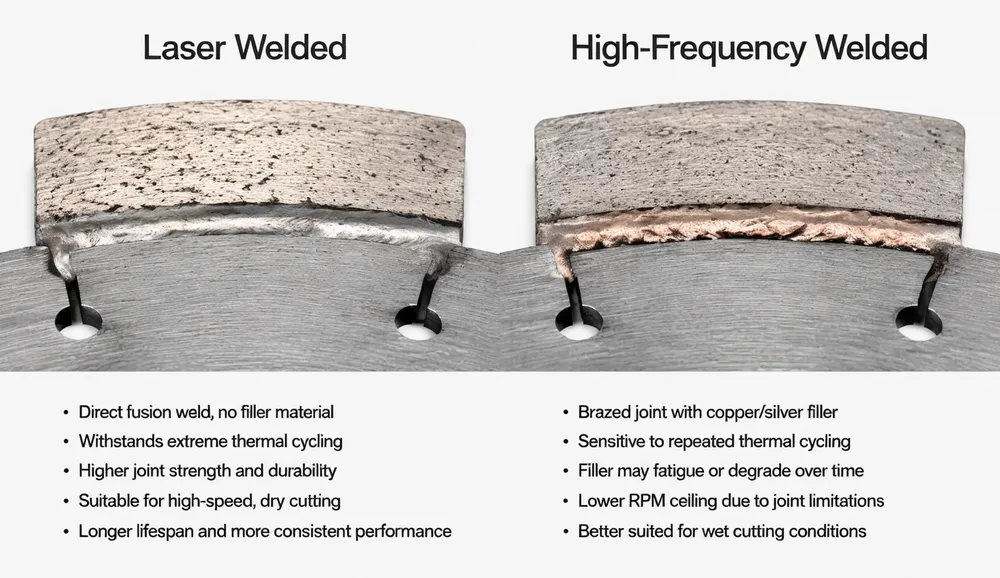
Joint Strength Under Thermal Stress
HF welding creates a brazed-type joint using silver solder or copper filler. It performs well under stable thermal conditions (wet cutting with continuous water flow). Under thermal cycling — heating to 600–700°C during dry cutting, then rapid cooling when the operator pauses — the filler material fatigues.
Laser welding fuses the segment material directly to the core steel without filler, creating a joint that tolerates thousands of thermal cycles without degradation.
RPM Ceiling
HF-welded joints have a practical RPM limit because centrifugal force at high peripheral speed can exceed the solder's shear capacity. Laser joints push that ceiling higher.
For a 350 mm blade, the difference between a safe HF operating speed of 50 m/s and a laser-welded blade rated to 80 m/s means your construction customers can run higher spindle speeds without safety concerns.
Cost Structure
Laser welded blades carry a 15–30% manufacturing cost premium over equivalent HF-welded blades — the laser equipment amortization and slower cycle time per unit drive this.
Your selling price reflects that, and your per-unit margin in absolute terms is higher. Laser welded blades sell as a performance product, not a commodity. Buyers who stock both typically sell HF-welded as their price-competitive line and laser welded as their professional/premium line.
Your Stocking Logic
If your market is primarily wet-cut fabrication shops with bridge saws and table saws, HF-welded covers 90% of demand at lower cost.
If your market includes construction, road cutting, demolition, rescue, or any dry-cut scenario, you need laser welded blades — and they become your differentiation from distributors selling only HF-welded products.
Most distributors serving mixed markets carry both: segmented diamond blades in HF-welded for fabrication, laser welded for construction and dry cutting.
Where Laser Welded Diamond Blades Move Volume — Market Segments Worth Targeting
Road and Infrastructure Maintenance
Repeatable volume segment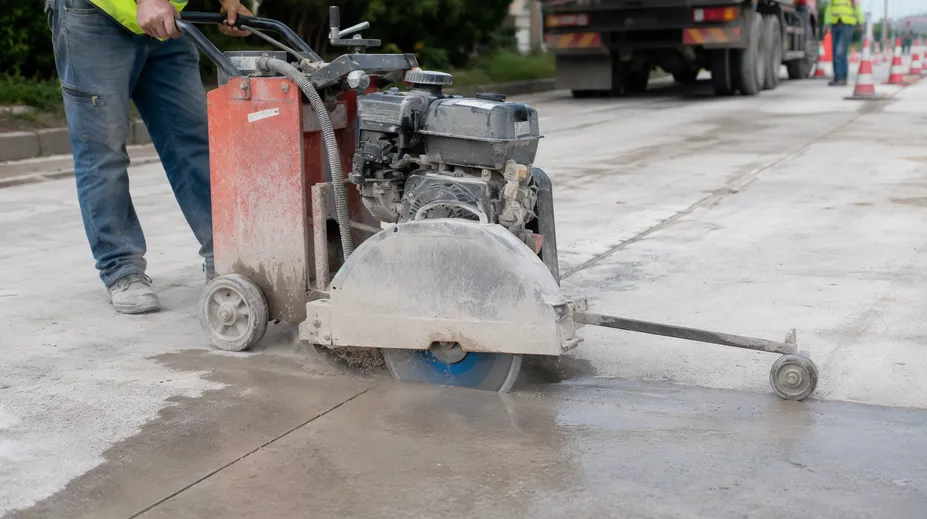
Municipal road repair, utility trenching, joint cutting in concrete pavements. Walk-behind floor saws and road saws consume 350–500 mm laser welded concrete blades as a routine operational expense.
These are frequently government-funded projects with stable budgets. A single municipal contract can generate 200–500 blade orders per season, with annual reorder cycles as blades are consumables.
If you're selling into construction supply, this is your repeatable volume segment for laser welded product.
General Construction and Demolition
Broad project-driven volume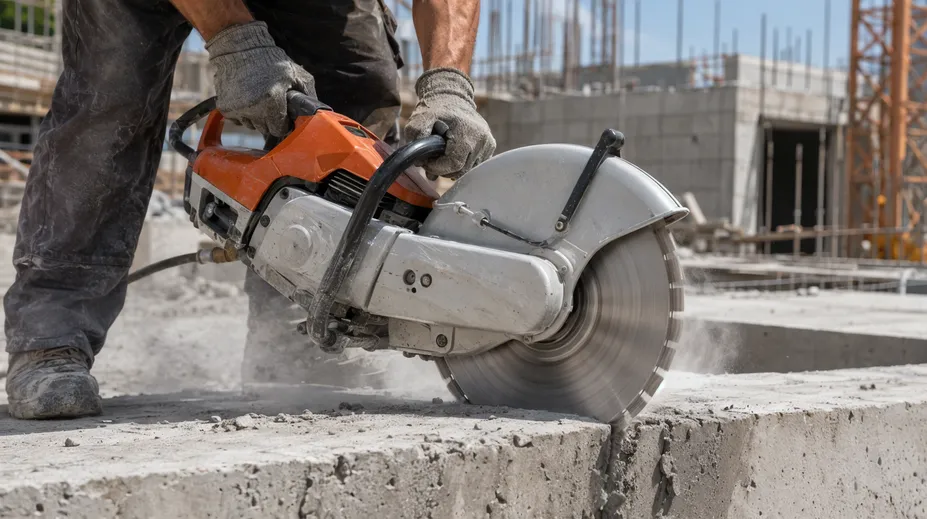
Hand-held power cutters (the Stihl/Husqvarna class of gas-powered and battery-powered saws) dominate this segment. Operators cut concrete, block, rebar-embedded walls, and pipe openings — always dry, always at high RPM, always in environments where a detached segment is a liability.
Standard diameters are 300–400 mm with 20 mm or 22.23 mm arbors.
Volume is project-driven but broad — every construction company owns these saws and burns through blades.
Emergency and Rescue Services
High margin · Brand loyalty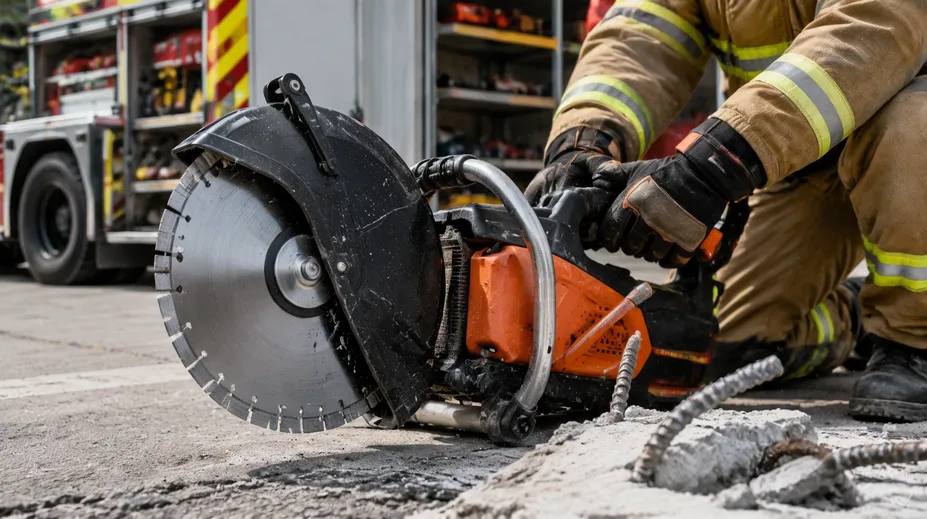
Fire departments and rescue teams use diamond blades on rotary rescue saws. These are extreme dry-cut applications: maximum RPM, no water, cutting through concrete, steel rebar, vehicle components.
Laser welding isn't optional here — it's a safety requirement.
Volumes per customer are small, but the pricing tolerance is high and brand loyalty is strong once specified. Worth pursuing if you serve public-sector accounts.
Landscaping and Hardscape Installation
Fragmented · High total volume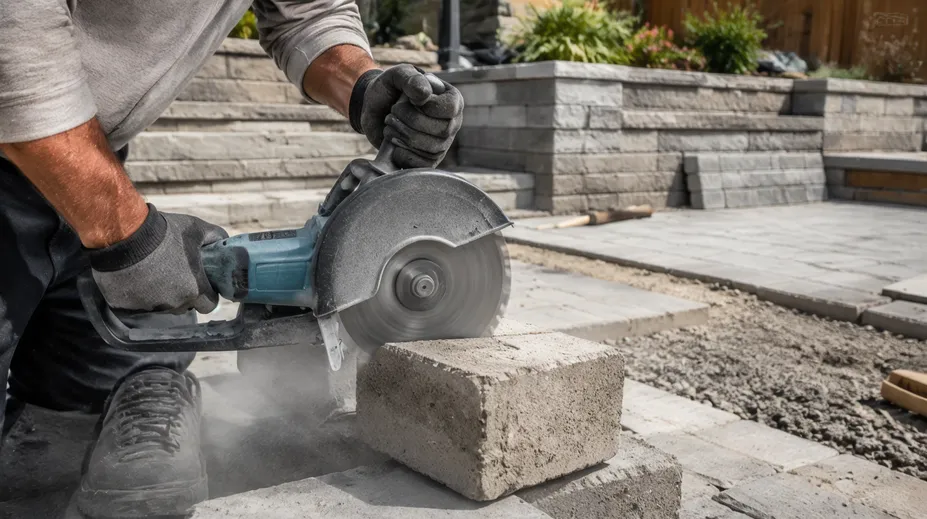
Paver cutting, retaining wall blocks, natural stone for outdoor projects. Small contractors run hand-held grinders and small table saws — frequently without water connections on remote job sites.
Diameters cluster at 105–230 mm. This is a fragmented market with high total volume distributed across many small buyers.
A laser welded concrete blade that survives dry cutting outlasts a cheap HF-welded blade by a wide margin, which is your selling argument to the contractor who currently replaces blades every few days.
This segment has grown steadily for us over the last five years — the shift to larger-format pavers and thicker landscape stone means more aggressive cutting requirements that favor laser welded product.
Tell us your target market segments
We'll recommend a starter SKU mix tailored to your buyers.
How We Manufacture Laser Welded Diamond Blades — Process Control That Protects Your Margin
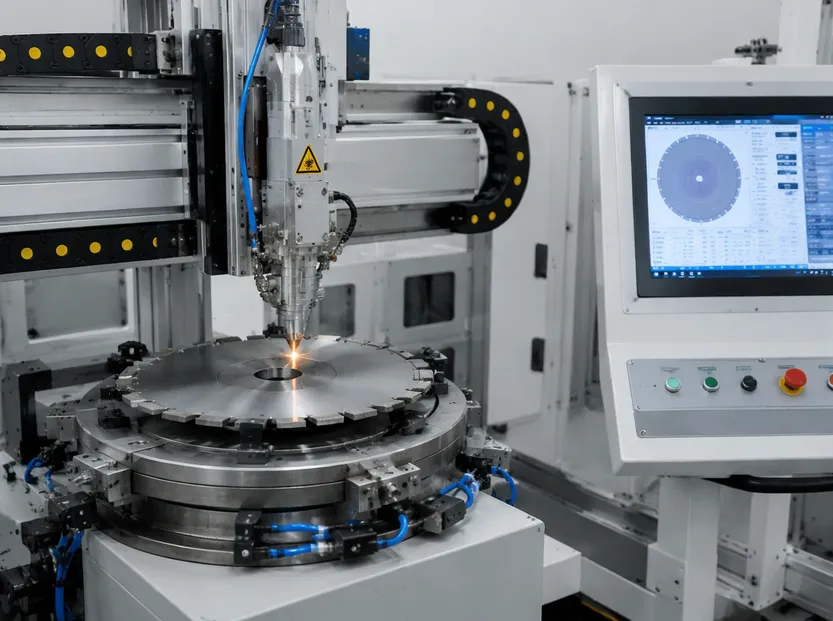
Our laser welding line runs CNC-controlled fiber laser systems. Each blade is fixtured in a precision rotary jig, and the laser head follows a programmed weld path around the circumference — segment by segment, with parameters (power, pulse duration, focal point, travel speed) locked to the specific blade diameter and segment geometry.
The critical difference between our automated process and manual/semi-automatic laser welding: consistency across a production run. When you order 2,000 blades, you need blade #2,000 to have identical joint strength to blade #1. Manual laser welding introduces operator variation — weld depth fluctuates, segments get slightly misaligned, power delivery varies based on fatigue. Our CNC system eliminates this. We program the parameters once, validate with destructive pull testing on the first 5 pieces, and the system replicates those exact parameters for the entire run.
Pre-Weld Surface Preparation
The steel core seating surface gets ground to a consistent roughness profile (we target Ra 1.6–3.2 μm) and cleaned of any oxide layer immediately before welding.
We learned early that oxide contamination is invisible to the eye but reduces laser weld penetration depth by up to 30% — which means joints that look fine but fail under thermal cycling. Every core passes through our grinding and cleaning station in-line, not as a separate batch process where they might sit and re-oxidize.
Post-Weld Inspection
Every laser welded blade gets a visual inspection under magnification for weld bead continuity, plus dimensional checks for segment alignment (radial runout).
Random samples from each batch — typically 3–5% — undergo destructive shear testing. Our internal threshold for shear strength is set above the MPA certification requirement by a safety margin we don't publish, but if you've had segment-loss issues from other suppliers, ask us about our pull-test data versus theirs.
Full-Penetration Welding
We run our laser parameters to achieve full-penetration welds on standard segment widths.
Some factories reduce laser power to extend consumable life or speed up cycle time, producing partial-penetration welds that pass visual inspection but have lower shear capacity. Your downstream customers can't see this difference — they only discover it when a segment detaches. Full-penetration welding costs us more in energy and cycle time, but it's why we hold MPA certification and competitors lose it.
On partial vs. full-penetration welds: Your downstream customers can't see the difference between a full-penetration weld and a partial one. They only discover it when a segment detaches at operating speed. Full-penetration welding costs more in energy and cycle time — but it's what separates an MPA-certified blade from one that loses certification on audit.
Customization for Laser Welded Diamond Blades
Diameter & Arbor
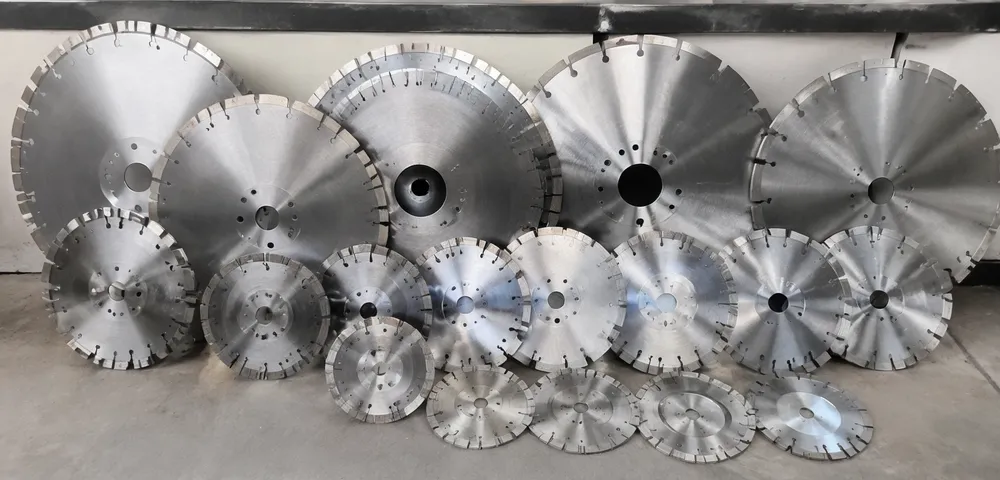
Any standard diameter from 105 mm to 900 mm. Custom diameters up to 1600 mm are possible but discuss with our engineering team first — laser welding parameters change significantly at large diameters.
Arbor bore customized to match your market's machines (South American and Southeast Asian equipment often use non-standard bores).
Segment Formula
The segment chemistry is independent of the welding method. Whether your customers cut concrete, granite, asphalt, or reinforced masonry, we match the bond formula to the material.
A laser welded concrete blade uses a different segment formula than a laser welded granite blade — same welding, different cutting chemistry. Tell us what your market cuts, and we'll spec the right formula.
Segment Geometry
Standard flat-top segments, turbo rim, segmented with gullets, or protective segments (with a welded-on wear guard that covers the steel core to prevent undercutting in abrasive materials).
We can modify segment height, width, and gullet depth to match your performance requirements.
Core Design
Standard flat cores, silent cores (sandwich steel with damping slots for noise reduction), or keyhole/U-gullet designs for improved debris clearance.
Core steel grade selection (typically 65Mn or 75Cr1 spring steel, heat-treated for the specific diameter's operating stress) is matched to the blade's intended RPM range.
Private Label
Your brand, your color coding, your packaging. We maintain your artwork files and apply them consistently across reorders.
Laser engraving on the core (safety markings, your brand logo, RPM limits) is standard — not an upcharge.
MOQ for Customization
Ready to customize?
Send your specifications — diameter, material, and volume — for a custom quote.
Get Custom QuotePackaging, Loading, and Lead Times for Bulk Laser Welded Blade Orders
Individual Blade Packaging
Each blade is wrapped in VCI (vapor corrosion inhibitor) film to prevent core oxidation during ocean transit, then placed in a protective sleeve or reinforced inner box.
Segment edges get foam-insert protection — laser welded segments are firmly attached, but diamond tips are still vulnerable to lateral impact damage from blade-to-blade contact in shipping.
Carton & Pallet Configuration
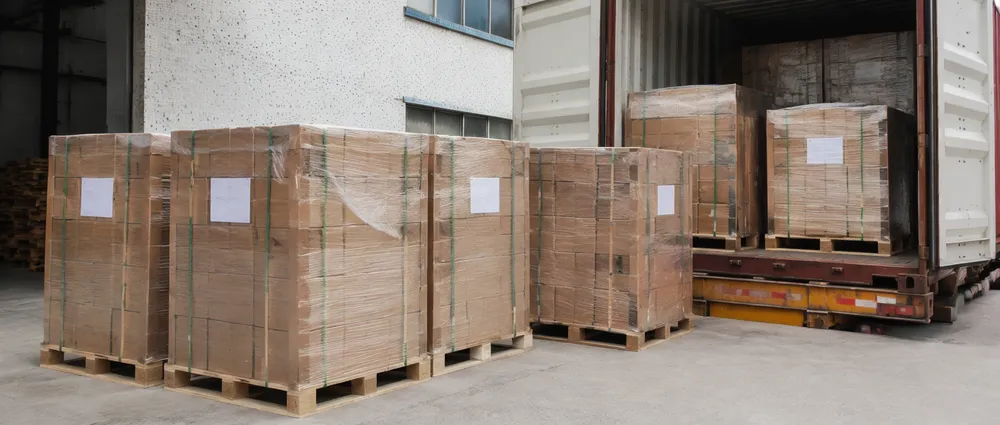
Standard diameters (300–500 mm) pack 5–10 per inner carton, with outer master cartons palletized for container loading.
Smaller diameters (105–230 mm) pack in higher density — up to 50 per carton. We optimize carton dimensions to maximize container fill rate and can provide pallet loading plans with your quotation.
Container Loading
A 20GP container holds approximately 10,000–15,000 pieces of 300–400 mm laser welded blades (volume is the constraint, not weight).
For mixed-diameter orders, we provide container loading optimization to maximize your shipping cost efficiency.
Standard Lead Time
20–30 days from order confirmation for stock formulas in standard diameters. Custom formula development adds 2–3 weeks for sampling and approval.
Repeat orders on existing formulas and specs ship faster — we keep your production parameters on file.
Export Documentation
Full export documentation including commercial invoice, packing list, certificate of origin, CE/MPA certificates, and fumigation certificate for wooden packaging when applicable.
Frequently Asked Questions
When should I stock laser welded diamond blades instead of high-frequency welded?
Stock laser welded blades when your market includes any dry-cutting application: construction, road repair, demolition, rescue, or jobsite work without water supply. Also stock them for high-RPM applications where blade diameter is small (105–350 mm) and spindle speeds are high.
If your customers exclusively cut wet on bridge saws and table saws, HF-welded is more cost-effective.
Most distributors carrying both see laser welded blades account for 30–50% of their total blade sales by revenue, concentrated in the construction segment.
Can a laser welded diamond blade be used for wet cutting too?
Yes — laser welding determines joint durability, not cutting mode. A laser welded blade performs identically to an HF-welded blade of the same formula in wet-cutting conditions, with the added safety margin of a stronger joint.
Some buyers standardize on laser welded across their range to simplify inventory and eliminate the risk of end users accidentally running an HF blade dry. The cost premium is the only trade-off.
What is the typical lifespan difference between a laser welded concrete blade and an HF-welded concrete blade?
In wet cutting, lifespan is determined by the segment formula, not the weld type — both last equally long because the joint isn't being stressed by thermal cycling.
In dry cutting, the comparison is different: an HF-welded blade may lose segments prematurely (catastrophic failure) before the segment material is consumed, while a laser welded blade runs until the segments wear down naturally.
Effective cutting life in dry applications can be 2–3x longer simply because the blade survives long enough for the segments to be fully used.
What causes laser welded segments to fail?
The two realistic failure modes: exceeding the blade's rated RPM (centrifugal force overwhelming even the laser joint — this requires extreme over-speed, typically 50%+ beyond rated limits) or lateral bending impact (dropping a blade on its edge, binding in a cut with severe deflection).
Under normal operating conditions within rated parameters, a properly laser welded joint should not fail within the segment's useful life.
If you're seeing segment loss on blades marketed as "laser welded," the root cause is often partial-penetration welding or contaminated weld surfaces — manufacturing shortcuts, not inherent technology limitations.
What is the minimum order quantity for laser welded diamond blades?
Standard-Formula (Common Diameters)
300, 350, 400, 450 mm: MOQ 50 pieces per specification.
Custom Formulas / Non-Standard
MOQ 100–200 pieces depending on complexity.
Private-Label (Full Custom Packaging)
MOQ 200 pieces per SKU.
Sample Orders (Market Testing)
10–20 pieces at production pricing, with full-volume pricing quoted for the subsequent production order.
Laser welded concrete blade vs. laser welded granite blade — can one blade do both?
Technically you can cut either material with either blade, but performance and lifespan suffer significantly. Concrete contains aggregate and rebar — the segment formula needs hard bond and impact-resistant diamond. Granite requires controlled self-sharpening with specific bond erosion rates.
A "general purpose" laser welded blade exists for mixed use, but a customer cutting primarily one material gets 30–40% better value from a formula-matched blade.
We recommend stocking both if your market includes both segments, rather than compromising with a universal formula.
Tell Us What Your Market Cuts
The fastest path to a quote: send us your target diameters, the materials your customers cut (concrete types, stone types, or both), and your estimated monthly or quarterly volume. We'll come back with a recommended laser welded blade specification list, formula details, and FOB pricing within 48 hours.
If you're adding laser welded blades to an existing product line, tell us what you currently stock — we'll identify the gaps and suggest specifications that complement rather than cannibalize your existing range.
What to Include in Your Inquiry
- Target diameters (e.g., 4"–16", or specific sizes)
- Materials your customers cut — concrete types, stone types, or both
- Estimated monthly or quarterly volume
- Current product line details (if adding to existing stock)
Reach Us Directly
The more specific your request, the faster we deliver an actionable quote.
Submit Detailed RFQLearn About Our Manufacturing Capabilities
Facility, equipment, and process overview