

Wet Cut Diamond Blades Factory-Direct from CLSEG
Water-cooled cutting unlocks everything a dry blade can't do — higher diamond concentration, faster feed rates, cleaner edges, longer segment life. Every segment leaves our facility with a bond formula matched to the stone type your customers actually cut.
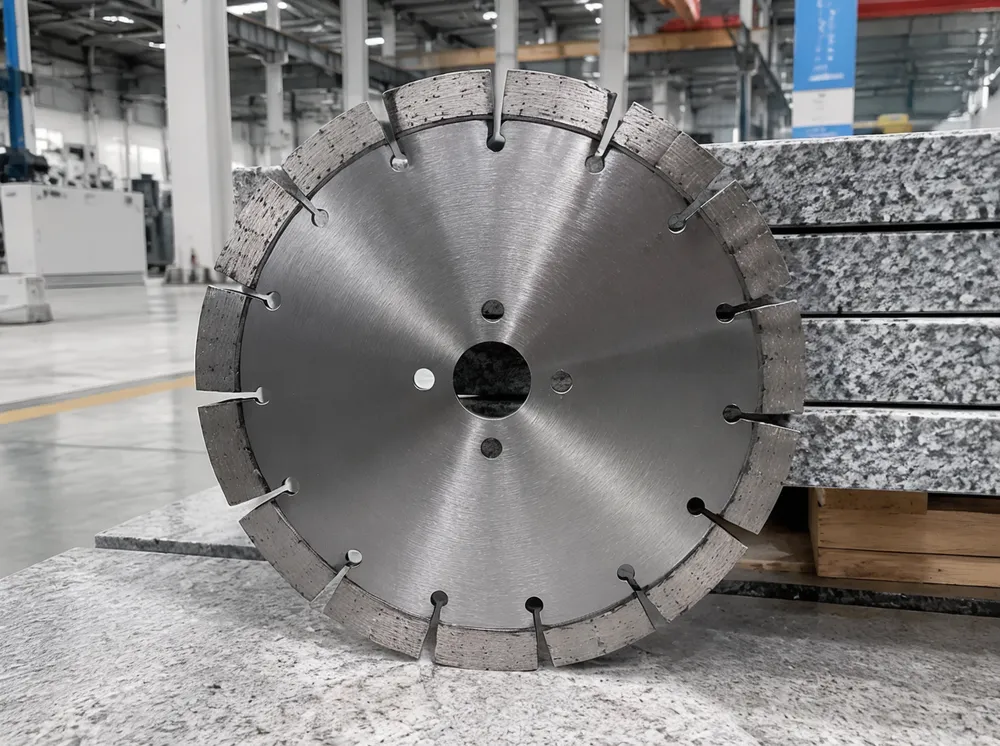
What Wet Cutting Actually Changes — and Why It Matters for Your Buyers
A wet cut diamond blade isn't just a standard blade used with water. The water flow changes the thermal equation so completely that we can formulate the bond differently from the ground up. In a dry-cutting blade, the bond has to manage heat buildup as a primary constraint — that limits how aggressively we can tune diamond concentration and exposure rate. With continuous water cooling, that constraint is removed.
What that means in practice: wet cut blades run higher diamond concentration per segment, which translates directly to faster cutting speeds and longer segment life compared to dry-cut alternatives of the same diameter and segment height. The water also flushes swarf out of the cut, preventing diamond glazing from debris packing — which is one of the main failure modes in dry cutting that customers blame on the blade when it's actually a thermal and debris management issue.
For your buyers — fabrication shops, stone processors, tile operations — the commercial case lands on throughput. A shop running bridge saws eight hours a day measures its cost per cut, not its cost per blade. A blade that cuts 30% faster and lasts 40% longer changes that number substantially, and that's the argument that wins repeat orders. Once a fabricator's machine is set up and the feed rate calibrated to a specific blade, they don't switch without a reason. Your goal is to be the reason they don't look elsewhere.
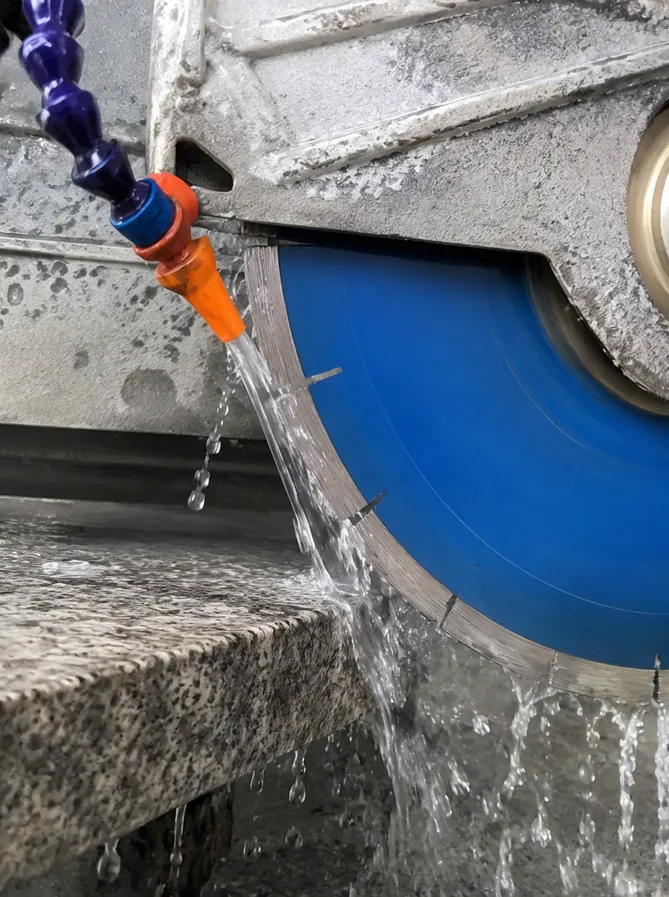
The Commercial Case: Cost Per Cut, Not Cost Per Blade
A fabrication shop running bridge saws eight hours a day measures throughput economics differently. When a blade cuts faster and lasts longer, the cost-per-cut drops substantially — and that's the metric that wins repeat orders. Once a fabricator's feed rate is calibrated to a specific blade, switching costs are real. Your job is to be the blade they calibrate to.
Water Flow Is the Customer's Responsibility
Proper flow rate, clean water, correct nozzle positioning. When a blade underperforms with water, the first thing we ask is flow rate. Inadequate water flow defeats the entire thermal advantage of the wet-cut design. This is the most common root cause when end users report dissatisfaction — and it's diagnosable before any warranty claim.
Bond Chemistry for Wet Cutting — What We Optimize and Why
This is where the product actually lives or dies, and it's worth understanding even if you don't pass this level of detail to your end customers.
Stable Low-Temperature Interface
In wet cutting, the water flow creates a stable low-temperature environment at the cutting interface. This means we can run a softer, more reactive bond matrix — the bond erodes at a rate that continuously exposes fresh diamonds without the thermal overhang that would cause premature segment erosion in a dry environment.
Stone-by-Stone Calibration
We calibrate bond hardness on a stone-by-stone basis: hard, non-abrasive granite needs a soft bond so diamonds self-sharpen aggressively; abrasive sandstone or concrete needs a harder bond to resist matrix erosion from the abrasive aggregate. The water doesn't change this fundamental matching logic, but it widens the operating window on both ends of the hardness scale.
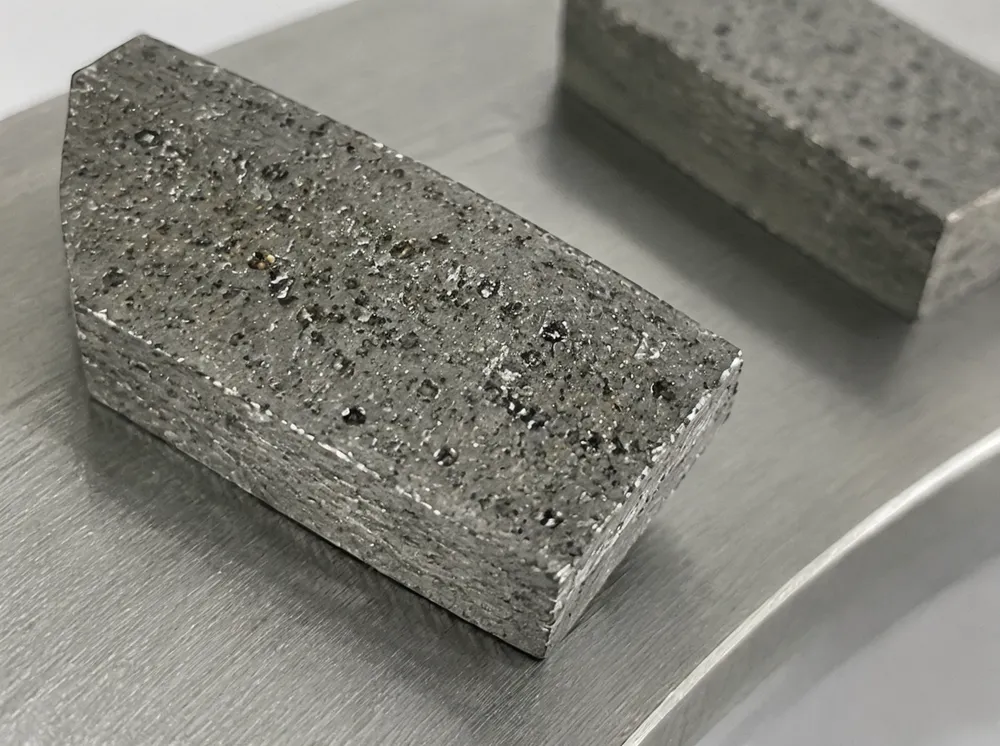
Higher Diamond Concentration
Diamond concentration in wet-cut segments runs higher than equivalent dry-cut formulas. We've validated through our own test bench that wet-cut segments with higher concentration deliver better life-to-cost ratios across the stone varieties our export customers cut most — Brazilian granite, Indian black granite, Chinese marble, Middle Eastern limestone.
Validated Formula Variants by Stone Type
Those aren't the same material or the same cutting challenge — we maintain separate formula variants for each.
Steel Core Engineering for Wet Environments
Wet cutting means the core is continuously exposed to water. We use carbon steel cores with tensioning treatments that maintain flatness under operational RPM and corrosion-resistant surface finishes for the water environment.
A core that goes slightly concave from moisture absorption over time causes vibration and uneven segment loading — that's how good segments get used up unevenly, and the customer blames the blade when the problem is the core.
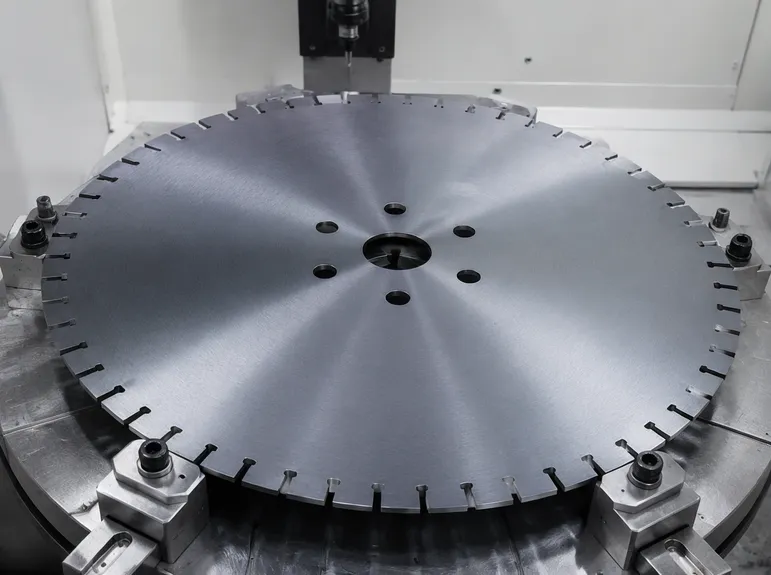
We tension our cores on CNC machines and introduced the surface treatment for wet-cut blades specifically after seeing this failure mode in cores from other suppliers used for reference testing in our lab.
The wet-cut product range draws from that library directly, with formulas developed for specific stone types and cutting environments.
Learn About Our R&DProduct Range Architecture — What's in the Wet-Cut Line
Our wet-cut range is structured around application rather than arbitrary SKU proliferation. Each series exists because the cutting environment demands a distinct formula-and-geometry combination.
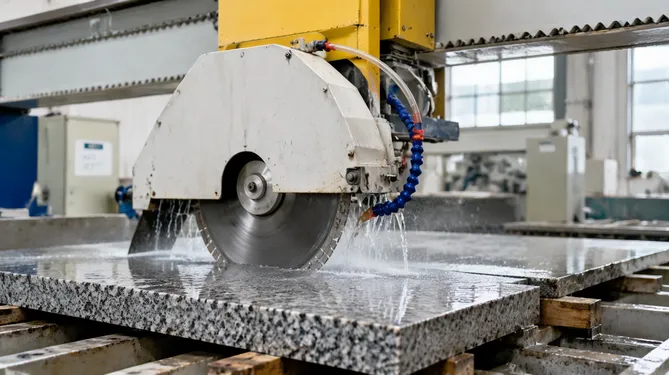
Bridge Saw Blades
350mm to 900mm. Designed for automated and semi-automated bridge saws cutting granite, marble, engineered stone. These are the volume product for fabrication shops.
- Silent core options for noise-sensitive environments
- Segmented and continuous rim variants
- High-concentration segments for production runs
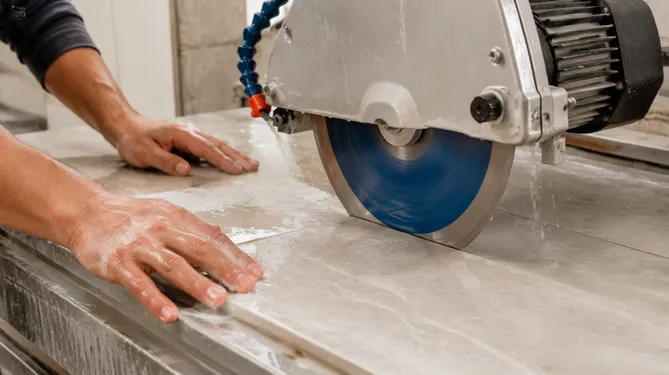
Table Saw & Tile Saw Blades
115mm to 350mm. Continuous rim designs for chip-free cuts on porcelain, ceramic, glass mosaic, and thin natural stone. The installer and tiler market.
- Ultra-thin kerf for reduced chipping
- Continuous rim for clean edge finish
- Reinforced cores for portable saw vibration
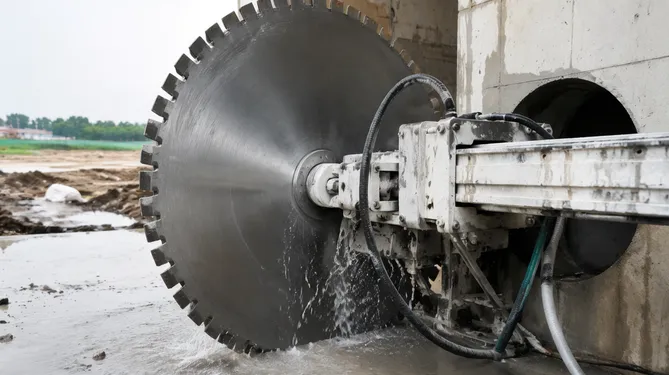
Wall Saw & Floor Saw Blades
600mm to 1600mm. Heavy-duty wet-cut blades for concrete, reinforced concrete, and asphalt. Construction and demolition applications with high-flow water systems.
- Laser-welded segments for high-RPM safety
- Reinforced steel rebar formulas available
- Large gullet designs for slurry evacuation
Available Diameter Range
Standard sizes in stock. Custom diameters available at MOQ.
| Application | Diameter Range | Segment Height | Arbor Options |
|---|---|---|---|
| Tile & Porcelain | 115mm – 350mm | 7mm – 10mm | 20mm, 22.23mm, 25.4mm |
| Bridge Saw (Stone) | 350mm – 900mm | 10mm – 15mm | 50mm, 60mm |
| Wall & Floor Saw | 600mm – 1600mm | 12mm – 20mm | 25.4mm, 50mm, 60mm |
| CNC / Multi-Blade | 250mm – 600mm | 8mm – 12mm | Custom per machine spec |
OEM & Private Label Manufacturing
We manufacture under your brand with your specifications. Custom packaging, custom color coding, custom segment printing. MOQs start at 50 pieces for standard diameters, 200 pieces for custom specifications. Lead time: 25–35 days from order confirmation to port.
Quality Assurance — What We Test and How We Know It Works
Every wet-cut blade ships with traceable test data. Here's what that actually means in practice.
Raw Material Inspection
Diamond grit grading, metal powder composition verification, steel core flatness measurement before any manufacturing begins.
Segment Sintering QC
Density measurement, hardness testing (HRC), and dimensional verification on every sintering batch. Segments outside tolerance get scrapped, not reworked.
Welding Integrity
Every laser-welded segment undergoes pull-test sampling at batch level. Minimum threshold: 30% above operational stress at rated RPM. This is a safety-critical test.
Wet-Cut Performance Bench Test
Representative samples from each production run cut actual stone on our test bridge saw. We measure cut speed (m²/hr), segment wear rate, and surface finish quality against the formula's target parameters.
Final Inspection & Packaging
Balance check, visual inspection, runout measurement. Blades are individually packaged with protection against shipping damage and moisture exposure.
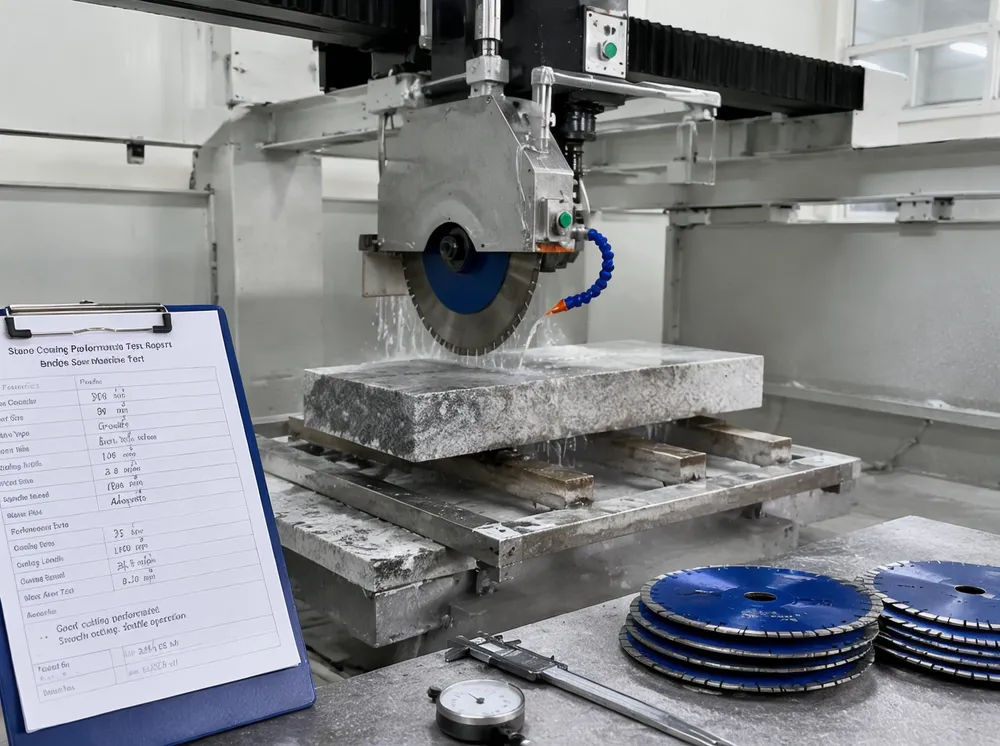
Every shipment includes a test report with the actual cut-speed and wear data from that batch's bench test. You can share this with your end customers or keep it as internal QC documentation. Either way, it's traceable back to the production run.
Distributor Support — How We Help You Sell More Blades
We don't just ship product and disappear. Here's what working with us actually looks like after the first order lands.
Technical Support for Your Customers
When your customer calls with a cutting problem, you can call us. We help you troubleshoot blade selection, operating parameters, and material matching so you look like the expert. Response time: same business day.
Product Training Materials
We provide blade selection guides, comparison charts, and application-specific recommendation sheets. Available as PDFs for your sales team or as web-ready content for your e-commerce platform.
Inventory Planning
We help you forecast demand based on your market. Seasonal patterns, project cycles, new product introductions — we'll help you stock the right SKUs in the right quantities so capital isn't tied up in slow movers.
Marketing Assets
High-resolution product photography, technical specification sheets, application videos, and social media content. All provided free for active distributors. We want you to have the tools to sell effectively.
Flexible Logistics
FOB Xiamen/Shanghai or CIF to your port. We handle export documentation, customs classification, and can ship mixed containers combining multiple product lines. Container consolidation available for smaller orders.
Quality Guarantee
If a blade doesn't perform to specification, we replace it or credit you. No arguments, no runaround. We track every batch, so if there's a systemic issue we catch it before you do. Claims resolved within 7 business days.
Partnership Structure
- Full product catalog access
- Technical support
- Marketing materials
- MOQ: 50 pcs per SKU
- Everything in Standard
- Volume pricing tiers
- Priority production scheduling
- Custom packaging options
- Quarterly business reviews
- Everything in Preferred
- Full custom branding
- Custom segment formulas
- Exclusive territory options
- Dedicated account manager
Frequently Asked Questions — Wet-Cut Diamond Blades
Real questions from distributors and contractors. Straight answers.
What's the difference between wet-cut and dry-cut diamond blades?
Wet-cut blades are designed to operate with a continuous water supply that cools the blade, flushes cutting debris, and suppresses dust. This allows for softer bond matrices that expose diamond more aggressively, giving you faster cuts and longer blade life on hard, dense materials like granite, porcelain, and engineered stone.
Dry-cut blades use harder bonds and require heat-dissipation features (like key slots or cooling holes) built into the steel core. They're more convenient for jobsite work but wear faster on hard materials and produce significant dust.
Bottom line: if you have water available, wet-cut gives better performance and longer life on hard materials. If you're cutting on a jobsite without water supply, you need dry-cut.
What's the minimum order quantity for private label blades?
For standard diameters (115mm–350mm) with your branding on existing formulas: 50 pieces per SKU. For custom segment formulas or non-standard diameters: 200 pieces per SKU. Custom packaging design is included at no extra charge above 500 pieces per order.
How do I choose the right segment formula for my market?
Tell us what materials your customers cut most frequently, what machines they use, and whether they prioritize cut speed or blade life. We'll recommend 2–3 formulas and send samples for testing. Most distributors need 3–5 SKUs to cover their market: a general-purpose blade, a hard material specialist, and a fast-cut option for softer stone.
What's the typical lead time from order to delivery?
Standard products (existing formulas, standard branding): 15–20 days production + shipping time. Custom/OEM orders: 25–35 days production + shipping. Sea freight to major ports: 18–30 days depending on destination. We can air freight urgent orders at additional cost — typical air transit is 5–7 days.
Do you provide samples before committing to an order?
Yes. We provide up to 3 sample blades free of charge for qualified distributors (you cover shipping). Samples ship within 5–7 days. We include a test protocol so you can evaluate them systematically and compare results against your current supplier. Most new partners convert after testing.
What certifications do your blades carry?
Our facility is ISO 9001:2015 certified. Blades meet EN 13236 safety standards for diamond tools. We provide MPA/oSa certification for blades sold in the EU market. For other regional certifications, we work with you to obtain whatever your market requires — we've done this for distributors in 30+ countries.
Ready to Test Our Wet-Cut Blades Against Your Current Supplier?
Request samples, get pricing for your volume, or discuss a custom formula for your market. No pressure, no minimum commitment to start a conversation.
Technical Specifications
| Parameter | Typical Value / Range |
|---|---|
| Diameter | 300 mm – 1600 mm (custom up to 3200 mm) |
| Segment Height | 10 mm – 20 mm (stone); 7 mm – 15 mm (tile/ceramic) |
| Segment Width | 2.8 mm – 7.0 mm |
| Core Thickness | 2.0 mm – 4.5 mm |
| Arbor Bore | 25.4 mm, 50 mm, 60 mm (custom available) |
| Diamond Grit | 30/35, 35/40, 40/50 mesh (matched to stone hardness) |
| Bond Type | Cobalt-based, iron-based, proprietary composite |
| Welding Method | High-frequency welding (standard wet-cut) |
| Segment Count | 14 segments (300 mm) to 60+ segments (1200 mm) |
| Operating Speed | 25–45 m/s (diameter and application dependent) |
| Certifications | ISO 9001:2015 CE SGS MPA |
| Water Flow | 3–8 L/min (depending on diameter and feed rate) |
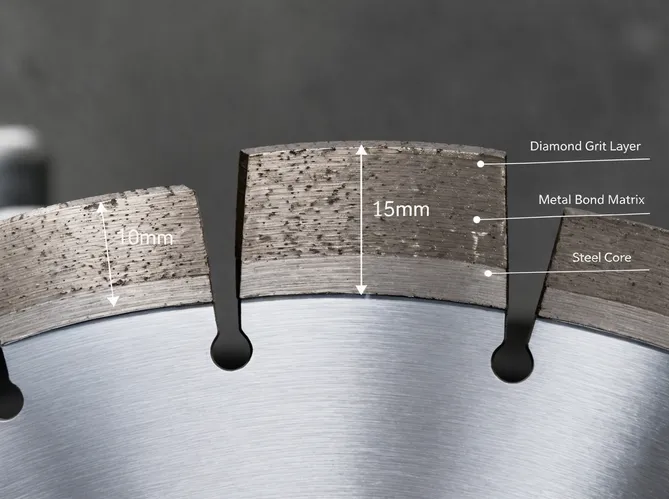
Segment Height Matters for Quotes
A 10 mm segment and a 15 mm segment cost meaningfully different amounts to produce — and a shorter segment means fewer sharpening cycles before the blade is consumed.
Price comparisons between suppliers need to account for this. We spec segment heights based on the application's expected cutting load, not to hit a target price.
Formula-Matched Per Application
Specifications reflect industry-standard values for this blade type. Exact parameters vary by application and formula selection. Contact us for product data sheets specific to your stone type and machine configuration.
Where Wet Cut Diamond Blades Move Volume — Market Segments Worth Building
Stone Fabrication Shops (Bridge Saws and Table Saws)
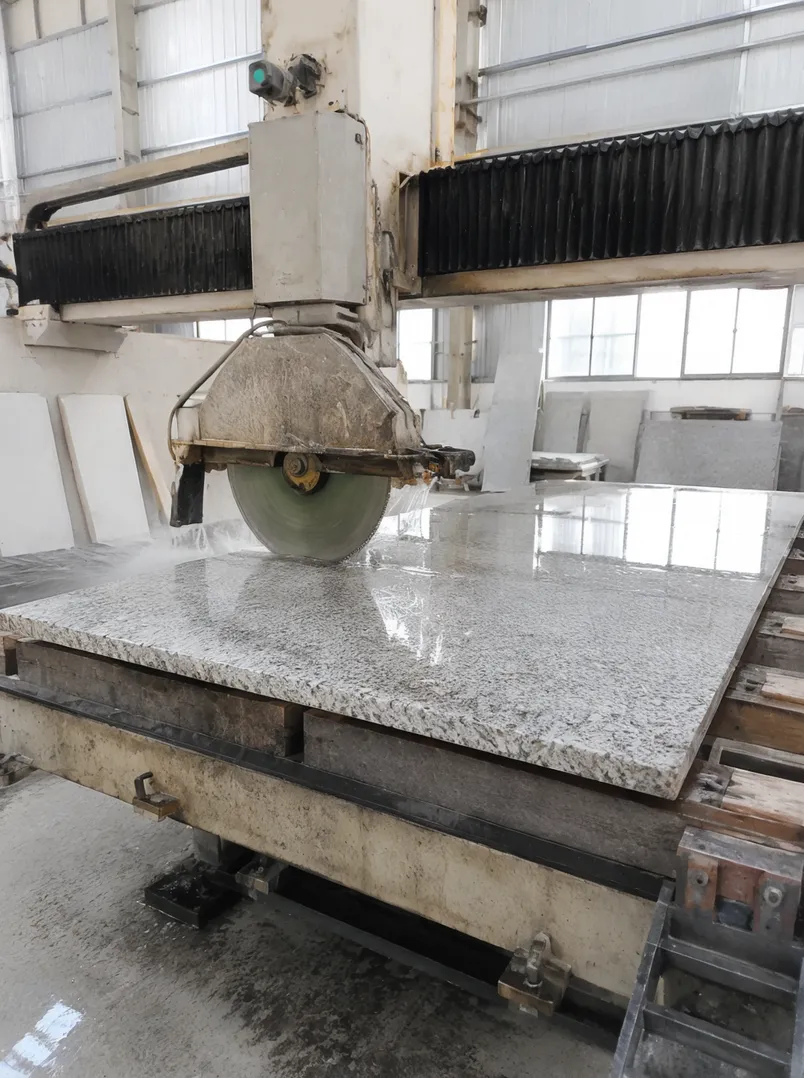
This is the core market for wet cut diamond blades. A fabrication shop cutting granite countertops runs a bridge saw continuously — the machine is water-cooled by design, and wet cut blades are the default standard. A mid-size fabrication operation consuming 20–50 blades per month per saw is a predictable recurring account. The purchase decision is made by the shop owner or production manager, not a procurement committee, so reorders happen fast once you're the established supplier. Granite and engineered quartz (Silestone, Caesarstone-type products) are the volume materials; the blade that works on hard granite at a reasonable cost wins the shelf.
For Distributors Supplying This Segment
- Typical ask: 300–600 mm range in granite, marble, and general-purpose variants
- Shops running multiple stone types often stock 2–3 blade specs
- Reorder cycle: monthly to quarterly depending on volume
- Reliable performance across batches is the retention factor — shops set machine parameters once and don't want to recalibrate every order
Tile Manufacturing and Tile Distribution
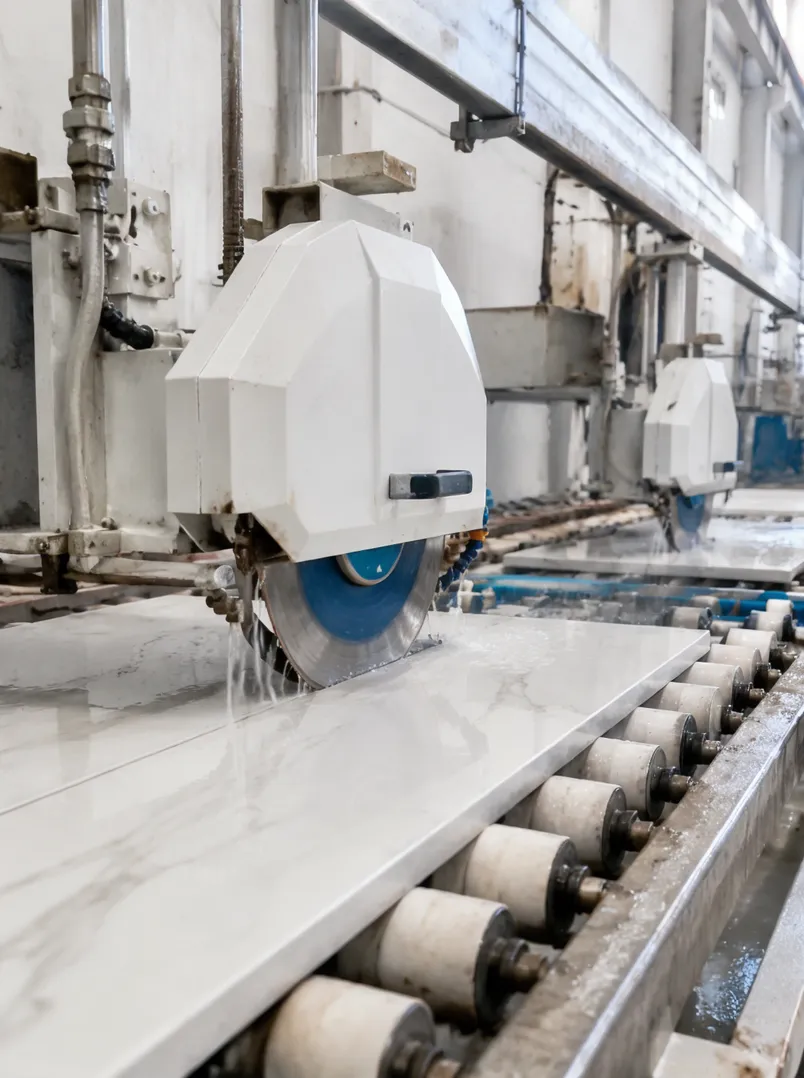
Large-format porcelain tile and ceramic slab production lines run wet cut blades for all trim and dimensioning cuts. The demands are different from stone fabrication: lower edge chipping tolerance, very consistent kerf width, long run times at moderate feed rates. Tile manufacturers ordering for their own production lines represent high-volume, high-consistency requirements — they'll order matched sets across multiple saws and require certified dimensional uniformity between blades in the set. This is a segment where our in-process quality controls (density variation checks per batch, dimensional tolerance on every finished blade) justify the sourcing conversation.
For Distributors
Tile retailers and tile installation contractors also consume wet cut blades for jobsite cutting on tile wet saws. These are smaller-diameter blades (105–230 mm), which fall under our Diamond Cutting Discs category rather than this range.
Marble and Soft Stone Processing
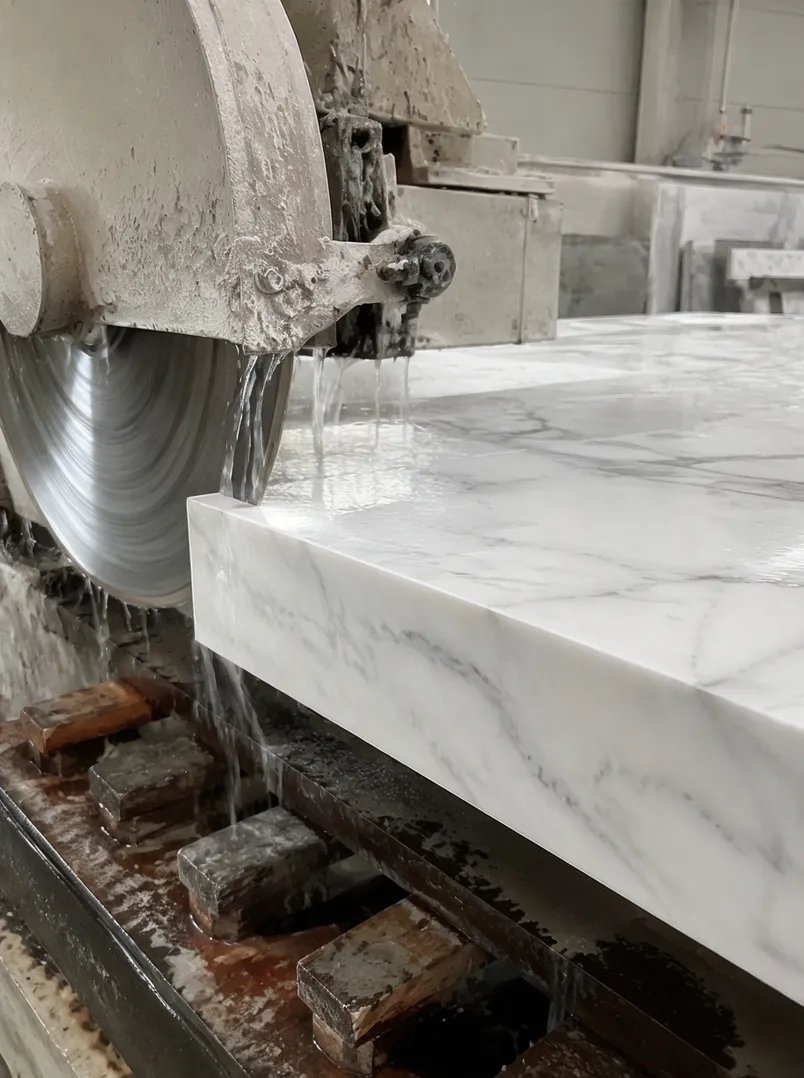
Marble and soft natural stone require wet cutting almost without exception — dry cutting creates heat that discolors marble and accelerates surface fracturing on the cut face. The commercial premium here is edge quality: a clean, unchipped edge on expensive marble adds value to the finished slab. Premium and exotic marble (Calacatta, Statuario, book-matched panels) sells at several hundred dollars per square meter — a chipping blade is a materials-cost problem, not just a blade problem. Distributors supplying premium stone importers and fabricators can position wet cut blades as a risk-reduction purchase: the blade cost is negligible against the slab value.
Soft stone also means faster cutting — these machines run higher feed rates, and blade consumption rate per shop increases. High reorder frequency in this segment.
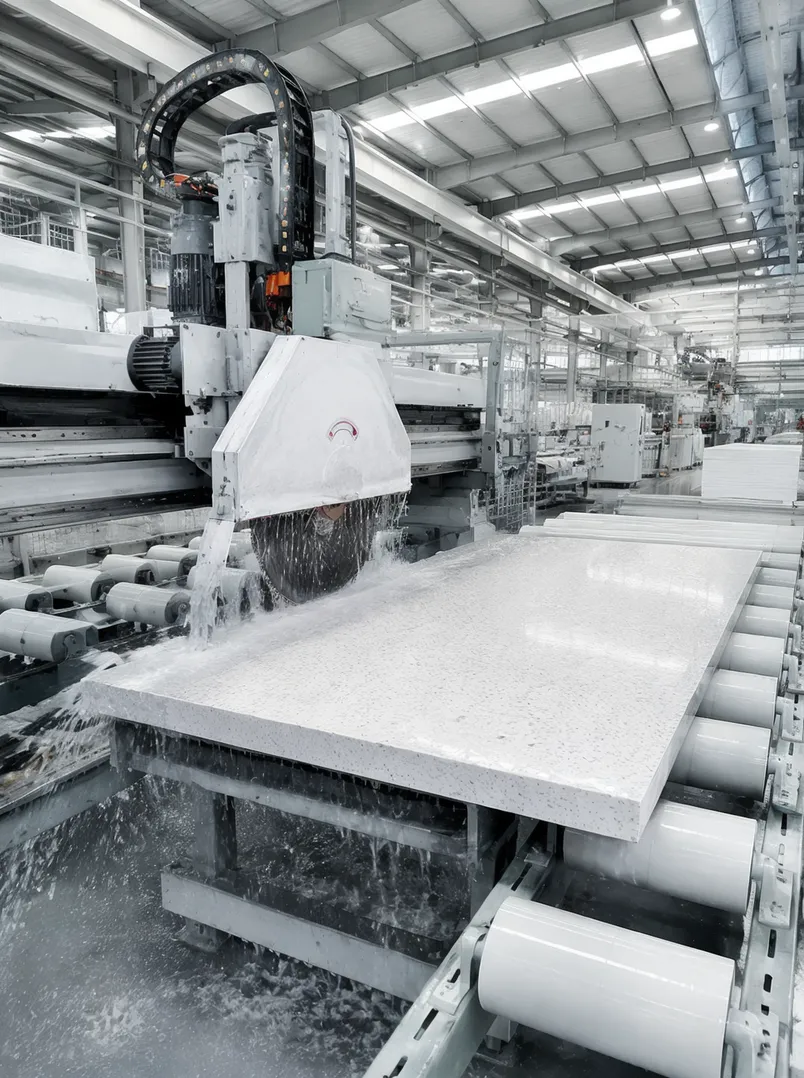
Engineered Stone and Quartz Countertop Plants
Engineered quartz (quartz aggregate bonded with polymer resin) is highly abrasive and generates substantial heat at the cutting interface. Wet cooling is essential, and the blade formula needs to account for both the abrasive quartz content and the polymer resin that can soften and resmear in the cut under heat. We've developed specific wet-cut formulas for engineered stone that handle the dual-phase cutting environment — the resin matrix clogs standard blades faster than pure stone cutting does. (This is one area where buying a generic "stone blade" and using it on engineered quartz produces predictably bad results — we see this feedback from new distributors fairly regularly.)
Engineered stone plants are industrial buyers — they run high volumes, have in-house QA, and test blades systematically. Getting on their approved supplier list takes longer, but the account lifetime and order volumes are significant.
Customization Options — What You Can Specify
We operate as an OEM/ODM manufacturer. Most of our international orders have at least one customized parameter. Here's what you can adjust:
Bond Formula
The most impactful customization. Tell us the stone type, machine type (bridge saw, gang saw, table saw), and whether your customers prioritize speed or blade life. We match bond hardness and diamond concentration to your application.
For markets with locally distinctive stone varieties, we've formulated against stone samples sent by importers.
Diameter & Segment Geometry
Non-standard diameters, custom segment heights, modified segment widths for specific kerf requirements. We produce across a wide range; if your machines use non-standard arbor sizes, we accommodate.
Diamond Concentration & Grit Grade
Higher concentration for harder stone where self-sharpening demand is high; coarser grit for softer materials where cutting speed dominates. We calibrate these based on the stone's abrasiveness and your customer's throughput priorities.
Core Specification
Slot pattern, core thickness, flange dimensions. Silent-core options (sandwich steel with vibration-dampening slots) are available for indoor fabrication facilities with occupational noise requirements.
Private Label & Packaging
Your brand on the blade, your logo on the box, core color to your specification. MOQ for private-label runs is lower than most buyers expect — we're set up for it as a standard workflow, not a special request.
We've done private-label for distributors in Southeast Asia, the Middle East, and Europe. If you're building a product line around your brand, we can be the factory behind it without the trading-company layer.
Extended Lead Time Items
Novel formula development for stone types not in our existing library requires 4–6 weeks for formula development, test cutting, and sample approval before production.
Plan this into your new-product launch timeline.
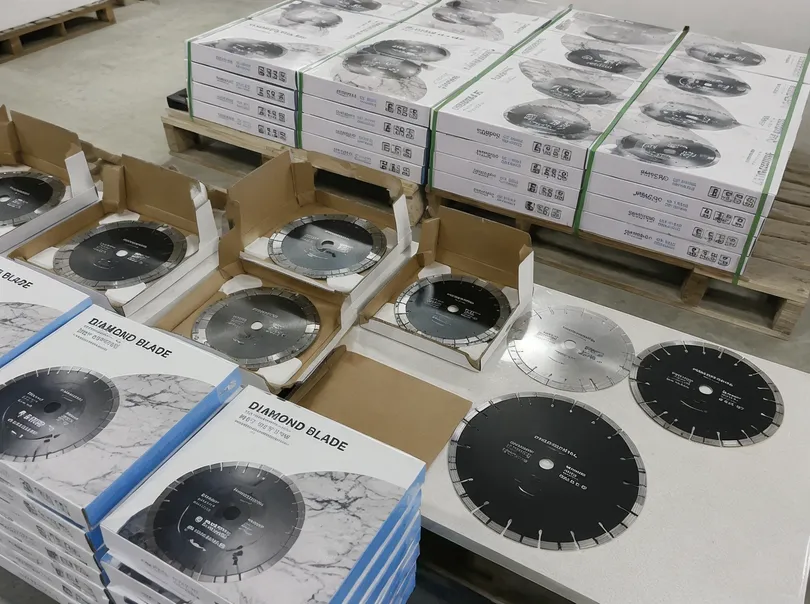
Quick Customization Reference
- Bond formula — matched to stone type, machine, speed vs. life priority
- Diameter, segment height/width, arbor size — full range
- Diamond concentration & grit — calibrated to stone abrasiveness
- Core spec — slot pattern, thickness, silent-core available
- Private label — your brand, your packaging, low MOQ
Wet Cut vs. Dry Cut — Stocking the Right Mix
The parent category page covers this in detail — see the Diamond Saw Blades procurement framework — but for this product specifically, here's the stocking logic:
Wet Cut Blades
Primary stock for most distributorsDominate stone fabrication and any indoor application with water infrastructure. Most fabrication distributors stock almost exclusively wet cut.
Best for:
- Stone fabrication shops
- Indoor applications with water infrastructure
- Bridge saw, table saw, CNC operations
Dry Cut Blades
Complementary line for constructionCover jobsite concrete cutting where water isn't practical — road repair, utility trenching, demolition work. Most construction tool distributors carry a mix.
Best for:
- Jobsite concrete cutting
- Road repair, utility trenching
- Demolition work without water access
Critical Technical Detail — Train Your Customers on This
High-frequency welded joints — which wet cut blades use — cannot withstand the thermal cycling of dry cutting. Running a wet-cut blade dry will eventually crack the weld joint, with segment detachment as the end state.
This isn't a manufacturing defect; it's operating outside the blade's design parameters. Training your customers on this distinction prevents returns and protects your service reputation.
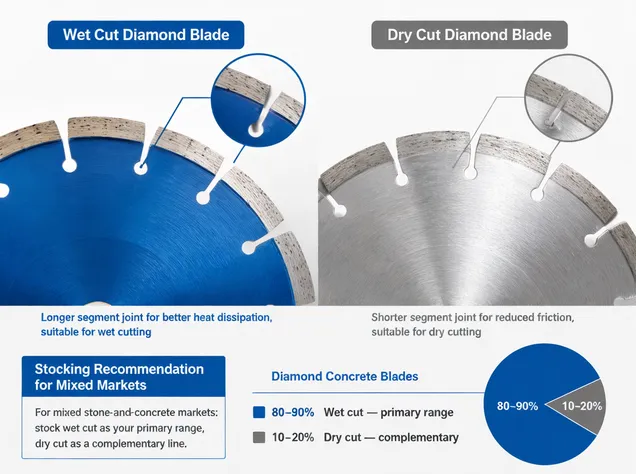
Stocking Recommendation for Mixed Markets
For mixed stone-and-concrete markets: stock wet cut as your primary range, dry cut Diamond Concrete Blades as a complementary line. You cover both segments without SKU proliferation.
Quality Verification — What We Test Before Your Container Ships
Wet cut blades have two critical failure modes beyond general diamond blade quality: weld joint integrity (the water environment accelerates corrosion at any micro-gap in the joint) and core flatness under operational RPM (water absorption in improperly tensioned cores). Our QC addresses both directly.
Segment Production
- Random samples from each sintering batch undergo density measurement and hardness testing
- Batch-to-batch variation within internal specification bands — if a batch drifts, it gets flagged, not shipped
- Diamond distribution uniformity verified through destructive segment cross-sections periodically across production runs
Weld Joint Testing
- Automated welding lines run programmed energy profiles for consistent joint formation
- Random destructive pull tests on finished blades verify actual joint strength
- Every core seating surface ground and cleaned before welding — contamination under the segment is the primary cause of joint weakness, and visual inspection after welding doesn't catch it
Core Flatness & Runout
- CNC tensioning after welding ensures proper stress distribution
- Final runout measurement on every blade — no sampling, 100% inspection
- Large-diameter blades get dynamic balance testing
- Flatness spec matters more in wet cutting — the water column at the blade face amplifies vibration from any core deviation; a slightly out-of-true blade vibrates more noticeably in water-cooled operation than in dry cutting
Outgoing Inspection
- Dimensional checks: diameter, bore tolerance, segment height
- Visual inspection on every blade
- Cutting performance testing on sample blades from each production run using in-house test bench
- If a blade underperforms on our test bench, it doesn't go in your container
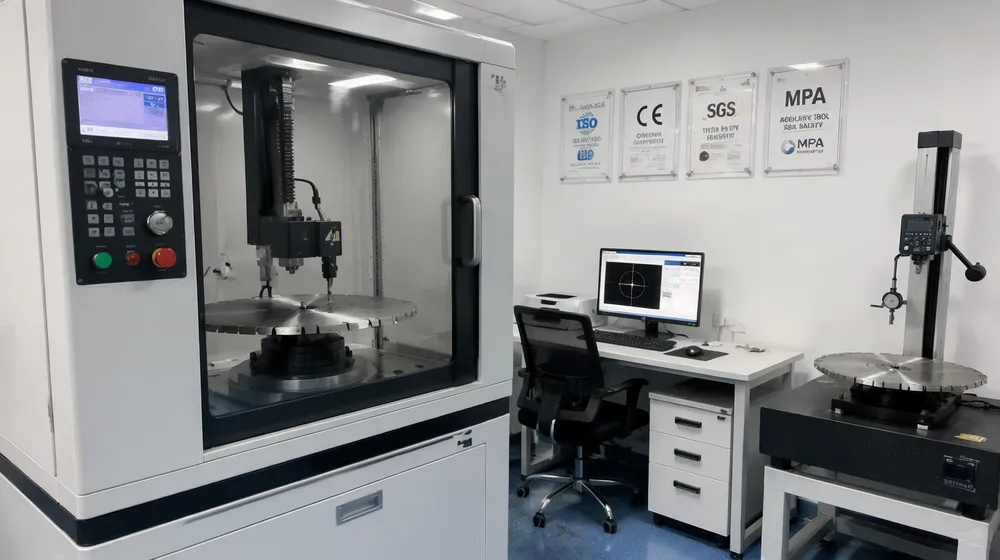
Certifications Held
The MPA certification specifically covers safety certification for abrasive tools required by European distributors.
Packaging and Export Logistics
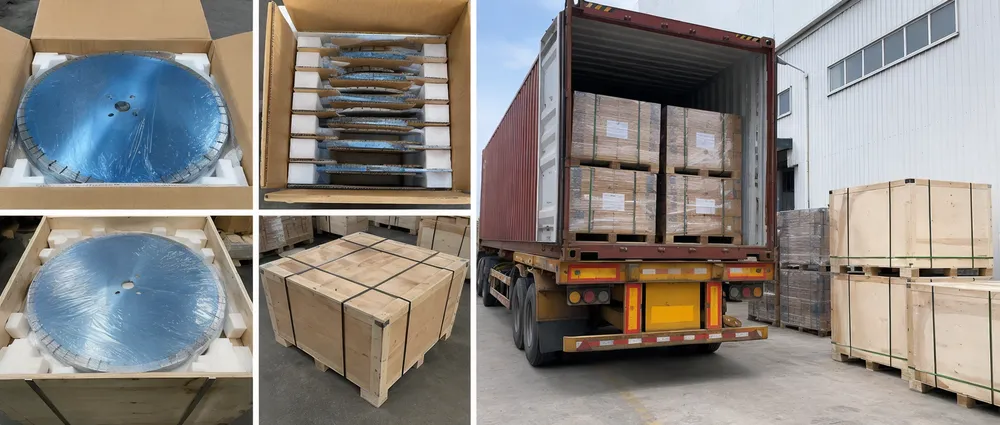
Protective Packaging
VCI Film Wrapping
Individual blades wrapped in vapor corrosion inhibitor film — important for wet-cut blades that may be warehoused before sale in humid climates.
Standard Diameters (≤600 mm)
Reinforced cartons with foam separators for impact isolation during transit.
Large Diameters (600 mm+)
Wooden crate packaging with moisture barriers for ocean freight. Edge protection inserts prevent segment damage from lateral impact during handling and container loading.
Container Loading Density
Approximately 8,000–12,000 pieces per 20-foot general purpose container. Stone fabrication standard diameters.
Crate dimensions optimized for container fill rate. We provide loading diagrams with your quote.
Lead Time
From order confirmation for orders on existing formulas.
Repeat orders on stock formulas run faster — we maintain your formula records and production parameters.
New formula development adds 2–3 weeks for sampling before production starts.
Export Markets
Independent export rights. Year-round shipping to:
- Southeast Asia
- Middle East
- Europe
- South America
- Africa
Export Documentation
Complete documentation provided:
- Commercial invoice
- Packing list
- Certificate of origin
- Fumigation certificate (wooden packaging)
- CE / SGS / MPA certificates as applicable
Frequently Asked Questions
Practical answers to the questions our distributors and fabrication customers ask most often about wet cut diamond blade selection, operation, and troubleshooting.
What's the optimal water flow rate for wet cut diamond blades?
For blades in the 300–600 mm range on bridge saws and table saws, 3–5 L/min at the cutting interface is the typical recommendation. Larger diameters (900 mm and above) benefit from 6–8 L/min to maintain adequate cooling across the longer cutting arc.
Too little flow overheats the segment and defeats the bond chemistry advantages of the wet-cut design; too much creates unnecessary turbulence without additional cooling benefit.
Nozzle position matters as much as flow rate — water should contact the blade just before the cutting zone, not flood the workpiece surface away from the cut.
Can I run a wet cut diamond blade dry if water isn't available?
Not safely or effectively. Wet cut blades use high-frequency welded joints and bond formulas calibrated for water-cooled thermal conditions. Running dry creates joint thermal stress that HF welds aren't rated for — segment detachment is the failure mode, and it's a safety hazard at operating RPM.
If your customers need occasional dry-cut capability, stock our dry-cut concrete blades as a parallel SKU; those use laser-welded joints rated for the thermal cycling of dry cutting.
How do I match a wet cut blade formula to a specific stone type?
The key variable is stone hardness and abrasiveness:
- Hard, dense, non-abrasive stone (quartzite, hard granite, some basalt) needs a soft bond matrix — the matrix erodes in concert with the stone, continuously exposing fresh diamonds.
- Soft, abrasive stone (sandstone, abrasive limestone, green concrete) needs a harder bond that resists premature matrix erosion.
When you place an order, tell us the stone type and the quarry region if you know it. We have formulas in our library for hundreds of stone varieties from over 30 countries. If your stone is outside our library, send a sample and we'll develop and test a formula against it.
What's the MOQ for wet cut diamond blades?
Standard Diameters (300–600 mm)
50 pcs
Per specification, existing formulas
Private-Label Orders
100+ pcs
Custom packaging, setup included
For larger diameters or custom formula development, MOQ is negotiable based on blade size and production complexity.
Market-test samples: 5–10 pieces at production pricing — most new buyers use these to run trials with their best customers before committing to a full order.
Wet cut blade performance dropped after the first 100 cuts — what happened?
Three possibilities, in order of likelihood:
- 1 Water flow rate dropped — check for clogged nozzles or pressure drop in the supply line.
- 2 Different material zone — the blade encountered harder inclusions in granite, or a transition to more abrasive aggregate in engineered stone. This is natural and the blade will self-sharpen if you make a few passes through an abrasive dressing stick.
- 3 Bond glazing — the bond is slightly too hard for the material being cut, causing the diamonds not to expose. If it's glazing, we can adjust the formula on the next order.
Quick diagnosis: Send us a photo of the segment face and we can usually diagnose from that.
Can wet cut blades be used on a tile wet saw for large-format porcelain?
For 105–230 mm tile saw blades, those are in our Diamond Cutting Discs range.
This wet cut blade range covers 300 mm and above — bridge saws, table saws, gang saws, and large industrial equipment.
If you're sourcing for tile retail distribution, contact us and specify the tile saw size; we'll direct you to the right product range.
Your Next Step — Tell Us What Your Market Cuts
The fastest path to a quote: send us the stone type, blade diameter, and machine type your customers use. If you're building a distribution line from scratch, tell us your market and volume expectations — we'll suggest a starter formula selection based on what's moving for our existing distributors in that region.
Most new buyers start with a 5–10 piece sample order to run trials with their top customers before committing to a container load. We ship production-grade samples, not marketing samples — what you test is what you'll receive at scale.
Direct Contact
sales@clseg.com
+86 13177381650
For the Fastest Quote, Include:
- Stone type and quarry region (if known)
- Blade diameter and segment height
- Machine type (bridge saw, table saw, gang saw)
- Estimated quantities and target pricing
- Private-label or custom packaging needs
The more specific your inquiry, the faster we turn around an actionable quote.
Explore the Diamond Saw Blades Range