Turbo Diamond Cutting Discs The Multi-Material Workhorse
Serrated continuous rim cuts stone, concrete, tile, and masonry without switching blades. One SKU that covers the widest range of job site materials — built for distributors who need fewer part numbers with broader applicability.
- Dry and wet cutting
- OEM/private label available
- 20+ years manufacturing
- 105–230mm range
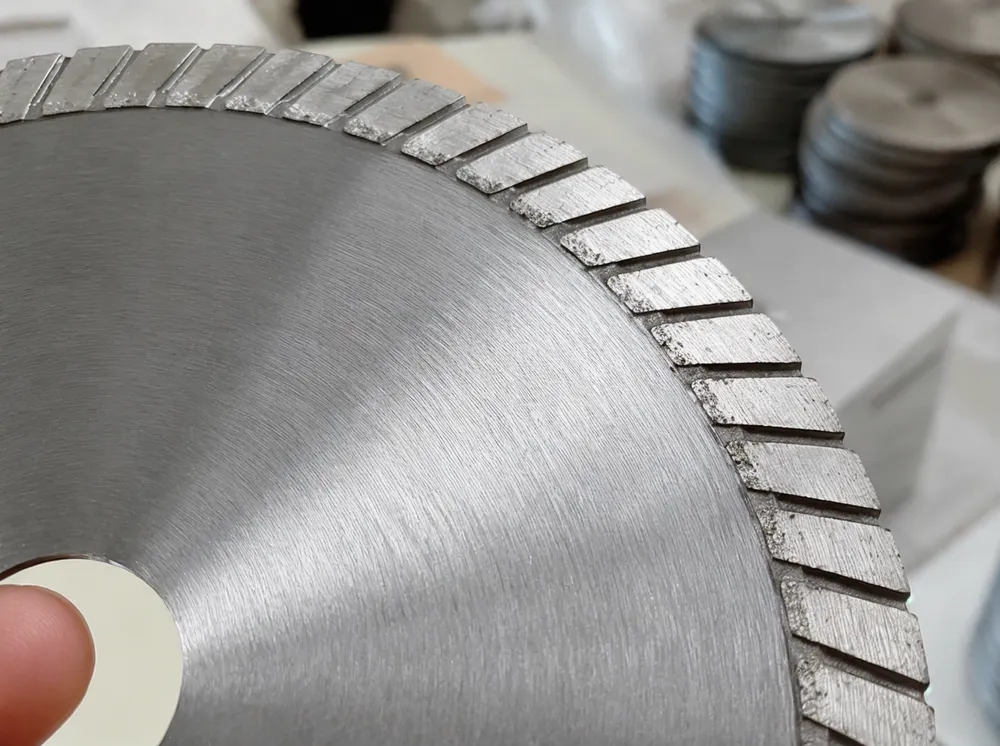
What a Turbo Diamond Cutting Disc Actually Does Differently
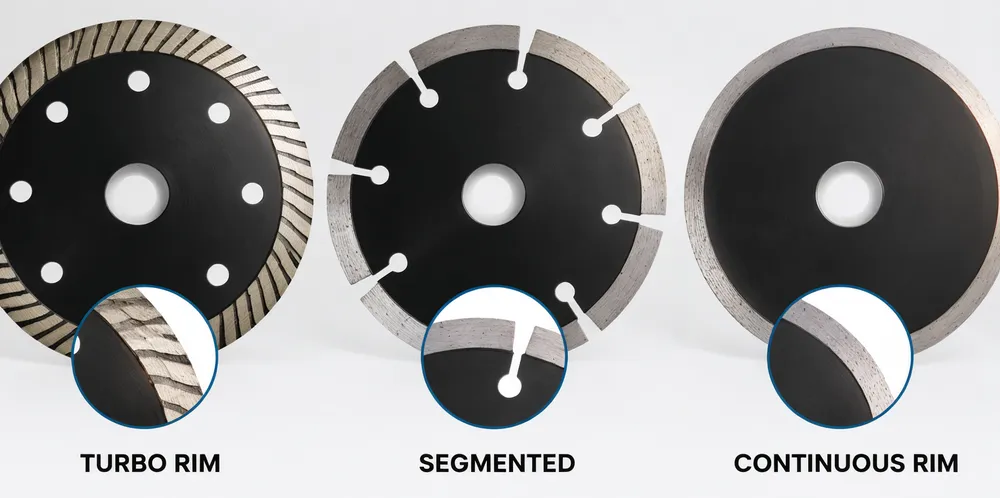
The turbo rim is a serrated continuous edge — think of it as the middle ground between a segmented disc and a continuous rim disc. The serrations (small wave-shaped notches machined or molded into the rim) create turbulence channels that clear debris and pull cooling air across the contact zone, while the continuous diamond edge maintains a smoother cut than a segmented blade with open gullets.
For your inventory, this translates to a disc that handles granite, marble, concrete, brick, ceramic tile, and masonry block without forcing your customers to switch blades. Contractors working mixed-material job sites — cutting a concrete lintel, then trimming a ceramic tile, then slicing a marble threshold — reach for a turbo disc because it does all three adequately. Not the fastest in concrete (segmented wins there), not the cleanest in porcelain (continuous rim wins there), but competent across the board.
That versatility is the commercial proposition: fewer SKUs to stock, broader customer base per SKU, lower dead inventory risk. A turbo diamond cutting blade is the single disc you recommend when a customer says "I cut a bit of everything."
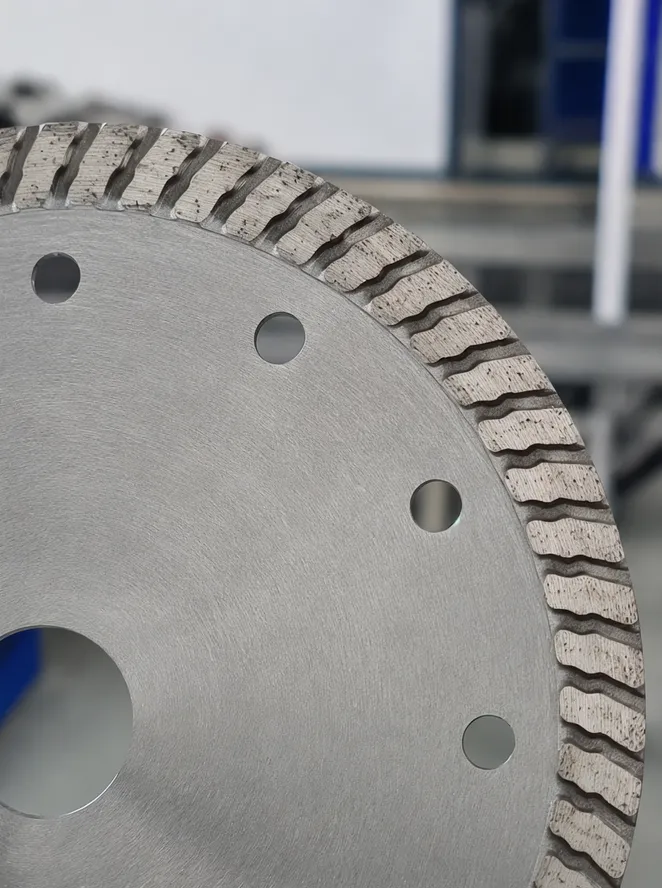
Segmented Disc
Fastest in concrete and hard masonry. Open gullets clear heavy debris but leave a rougher cut edge. Best for demolition-heavy work.
Turbo Disc
The middle ground. Serrated continuous edge balances speed and finish quality. Handles granite, marble, concrete, brick, ceramic tile, and masonry block.
Continuous Rim
Cleanest cut in porcelain and fine ceramics. No serrations means minimal chipping, but slower in hard materials and needs wet operation.
Regional Market Note
We sell more turbo rim blades into the Middle East and Africa than any other rim type — those markets value versatility because contractors there work across multiple material types in a single project. Worth noting if you supply those regions.
Turbo Rim Geometry — How the Serration Pattern Drives Performance
We produce two turbo rim configurations, and the distinction matters for your product line positioning:
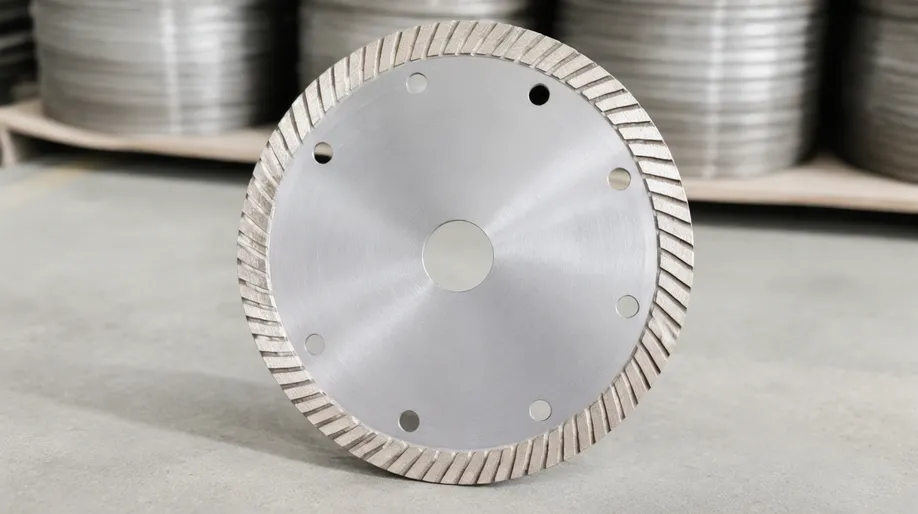
Uniform Serrations — Full Rim
The wave pattern is pressed into the segment during cold pressing, so the serration depth and pitch are consistent piece to piece across a production run.
This configuration delivers balanced cutting speed and finish quality. It's the default choice for general construction applications and hardware store shelf stock.
Best For
- General construction applications
- Hardware store shelf stock
- Entry price point positioning
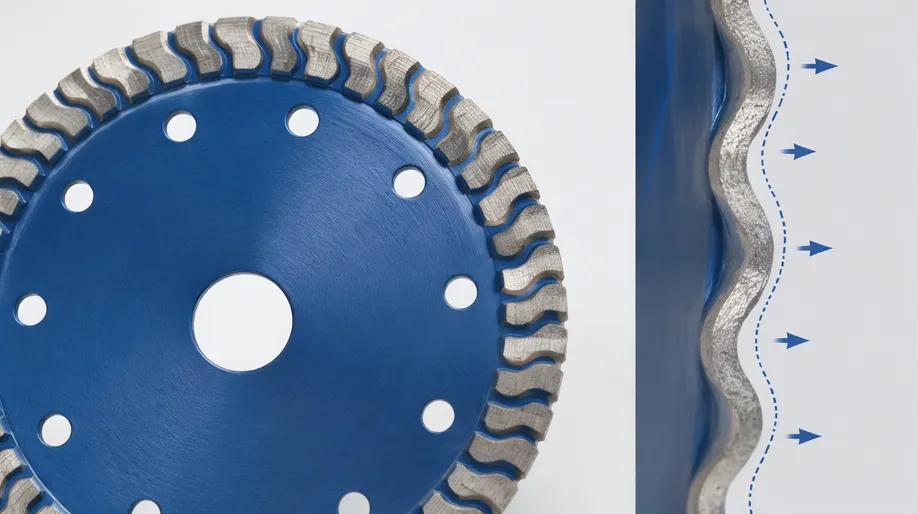
Undulating Rim — Sinusoidal Wave
The rim follows a sinusoidal wave pattern in the vertical axis, not just surface serrations. This deeper geometry moves material out of the kerf more aggressively, reduces blade-to-workpiece contact area (less friction, less heat), and noticeably reduces vibration felt by the operator.
We developed our turbo wave profile over several iterations — the first version cleared debris well but chattered on thin ceramic tiles. The current geometry uses a shallower wave amplitude specifically to maintain stability on brittle materials while still gaining the speed advantage on concrete and stone.
Best For
- Premium upsell positioning
- Speed-critical applications in concrete/stone
- Reduced operator fatigue (less vibration)
Standard Angle Grinder Compatible
Both configurations run on standard angle grinders without modifications. No adapter or specialty tool required — your customers use the same grinder they already own.
Good / Better Stocking Strategy
Stock both as a "good/better" pairing — standard turbo at your entry price point, turbo wave as the premium upsell with tangible performance differentiation your sales team can demonstrate on the job site.
Technical Specifications for Turbo Diamond Cutting Discs
| Parameter | Standard Values |
|---|---|
| Diameter | 105 mm, 110 mm, 115 mm, 125 mm, 150 mm, 180 mm, 200 mm, 230 mm |
| Arbor bore | 16 mm, 20 mm, 22.23 mm, 25.4 mm (non-standard on request) |
| Segment height | 8–10 mm (standard), 12 mm (long-life version) |
| Segment thickness | 1.8–2.4 mm |
| Blade body thickness | 1.4–2.0 mm |
| Turbo serration pitch | 3–5 mm (diameter dependent) |
| Cutting method | Dry and wet — dual-use design |
| Segment attachment | High-frequency welded (standard), laser welded (dry-cut premium) |
| Maximum RPM | 12,000–14,000 RPM (105–125 mm), 8,500–10,000 RPM (180–230 mm) |
| Compatible tools | 4"–9" angle grinders, handheld cut-off saws, masonry saws |
| Target materials | Granite, marble, concrete, brick, block, ceramic tile, sandstone, limestone |
Specifications shown are standard production values. Custom diameters, segment heights, and arbor configurations available — contact us for detailed product data sheets.
115 mm
22.23 mm arbor, 10 mm segment, HF welded — most commonly ordered turbo disc globally.
125 mm
Has overtaken 115 mm as the default in European and South American markets.
105 mm
Remains the volume mover for Southeast Asian distribution channels.
We stock tooling for all standard sizes and can run mixed-diameter orders in a single production batch.
Get pricing for your size and volumeManufacturing Decisions Specific to Our Turbo Rim Production
The turbo rim's serration pattern creates a manufacturing challenge that generic factories often handle poorly: maintaining consistent diamond distribution across the wave geometry. In a flat continuous rim, diamond grit distributes evenly during pressing because the mold cavity is uniform. In a turbo rim, the wave troughs tend to accumulate higher diamond concentration while peaks run lean — unless you compensate in the pressing process.
We address this with a two-stage pressing approach. First, a pre-distribution layer spreads calibrated diamond-metal powder into the wave-profile mold using a custom spreader that deposits more material on peaks and less in troughs. Then the full cold-press cycle compacts the segment to final density. The result: uniform diamond concentration measured at ±5% variance across the entire rim profile.
Without this step, you get a blade that cuts unevenly — fast in sections with high diamond density, slow where the peaks are diamond-starved — and wears into an irregular profile after a few cuts.
Sintering Profile Differentiation
We also run a different sintering temperature profile for turbo segments versus flat segments. The wave geometry has varying cross-sectional mass, so we use a slower ramp rate to ensure the thinnest sections (wave peaks) don't over-sinter while the thicker sections (wave troughs) reach full density.
This is a detail you'd never see on a data sheet, but it's why our turbo discs maintain a consistent rim profile through their full working life rather than developing "teeth" as thinner peaks wear first.
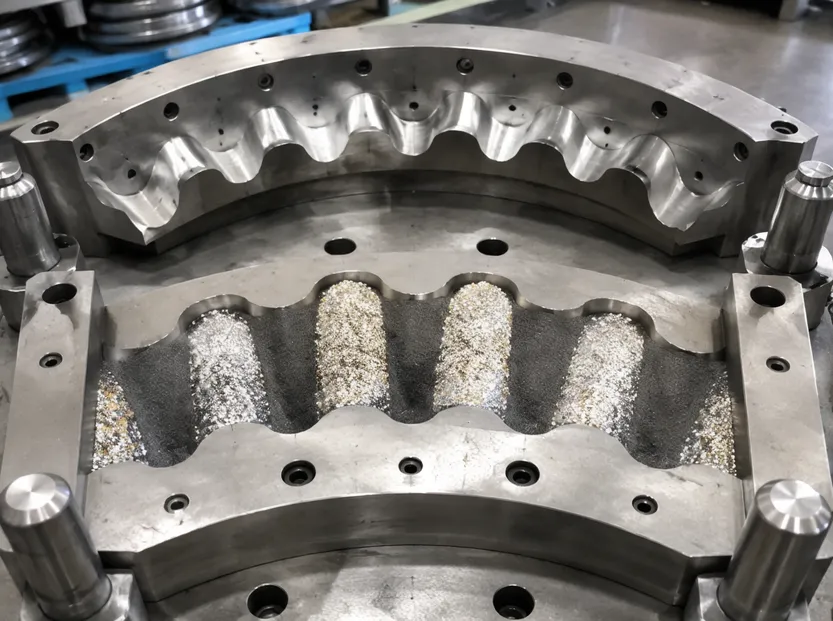
Since 2006
Turbo rim production
We started producing turbo rims in 2006. The first two years of production had inconsistent segment wear exactly because we hadn't solved the diamond distribution problem yet. Sixteen years of refinement on this specific rim geometry — that accumulated process knowledge is embedded in our tooling and sintering programs now.
±5%
Diamond variance across rim
16+
Years refining turbo process
Without compensation
- Uneven diamond distribution — troughs diamond-rich, peaks diamond-starved
- Blade cuts fast in some sections, slow in others
- Irregular rim profile develops after a few cuts — "teeth" form as thin peaks wear first
Our two-stage process
- Pre-distribution layer compensates for wave geometry before pressing
- Uniform ±5% diamond concentration across the entire rim profile
- Slower sintering ramp rate prevents over-sintering at peaks while troughs reach full density
- Consistent rim profile maintained through full working life
Where Turbo Diamond Cutting Discs Generate Repeat Orders
Each application below represents a market segment where the turbo rim's multi-material versatility drives measurable commercial value for your distribution business.
General Construction Contractors
Reorder cycle: 2–4 weeks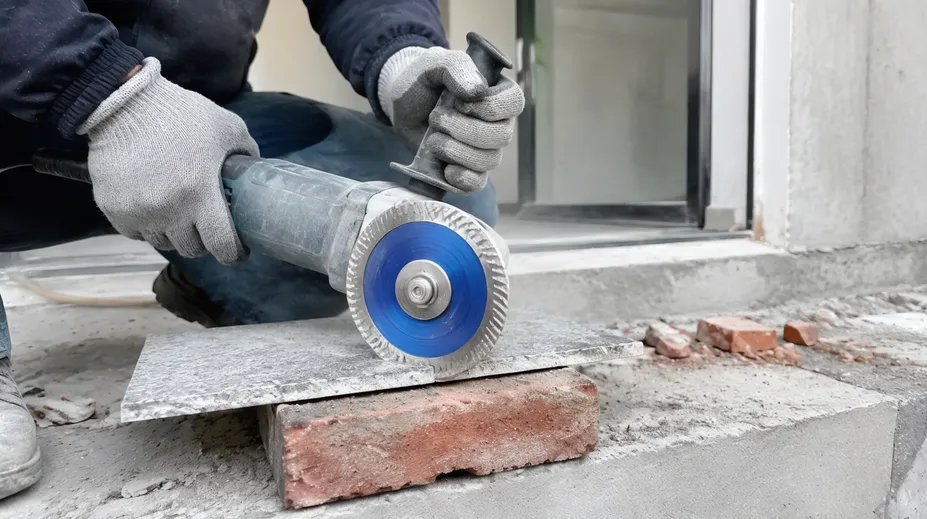
The turbo rim diamond disc is the default blade on mixed-material construction sites. A typical renovation contractor cuts concrete, brick, stone cladding, and tile in a single day — carrying one disc type instead of three saves tool changes, reduces jobsite inventory, and eliminates the "wrong blade for the material" mistake.
For your distribution business, this means every angle grinder owner in the construction trades is a potential customer, and turbo discs wear out at a predictable rate (typically 2–4 weeks of daily use, depending on material hardness). The reorder cycle is reliable.
Typical Order Patterns:
- 100–500 pieces per SKU from regional distributors supplying contractor networks
- 115 mm and 125 mm are shelf staples for hardware stores serving walk-in trade customers
- Monthly restock cadence for retail-facing channels
Landscaping and Hardscape Installation
Seasonal · High per-season volume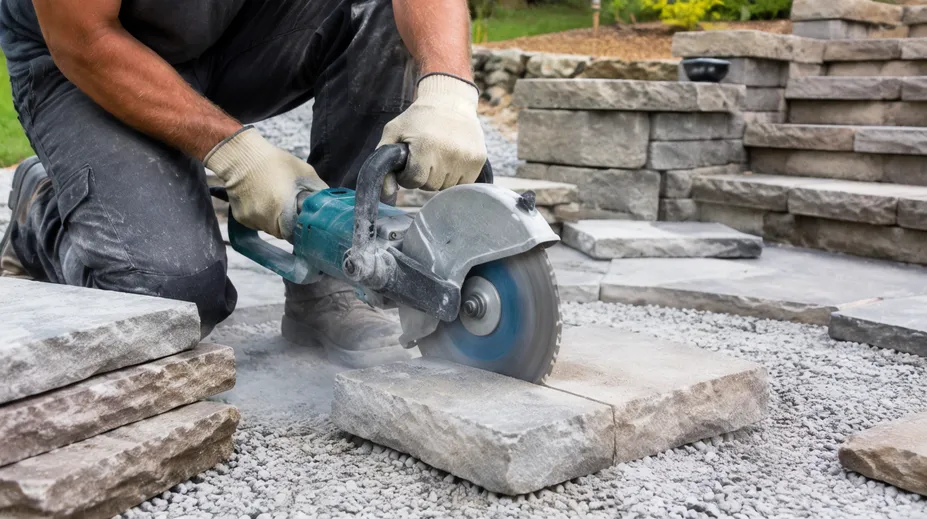
Pavers, natural stone coping, concrete edging, brick borders — hardscape work is almost entirely mixed-material cutting. Landscaping crews favor turbo discs because they move between materials without switching.
This segment is seasonal (spring through fall in temperate markets) but the per-season consumption is substantial. Hardscape contractors typically purchase through specialist landscape supply distributors rather than general hardware — a differentiated channel if you're looking to avoid competing purely on price against big-box retailers.
Channel Advantage:
- Specialist landscape supply distributors — less price competition vs. big-box retail
- Multi-material versatility is the primary purchase driver for hardscape crews
Property Maintenance and Facility Management
Year-round · 20–50 pcs/order
Building maintenance teams handle ad-hoc cutting across every material in the structure — patching concrete, replacing tiles, cutting masonry for HVAC penetrations. They buy in smaller quantities (20–50 discs at a time) but with total predictability — facilities consume blades year-round.
This segment values convenience (one blade type for everything) over absolute cutting speed in any single material.
Emerging Markets and Multi-Trade Distribution
40–60% of small blade volume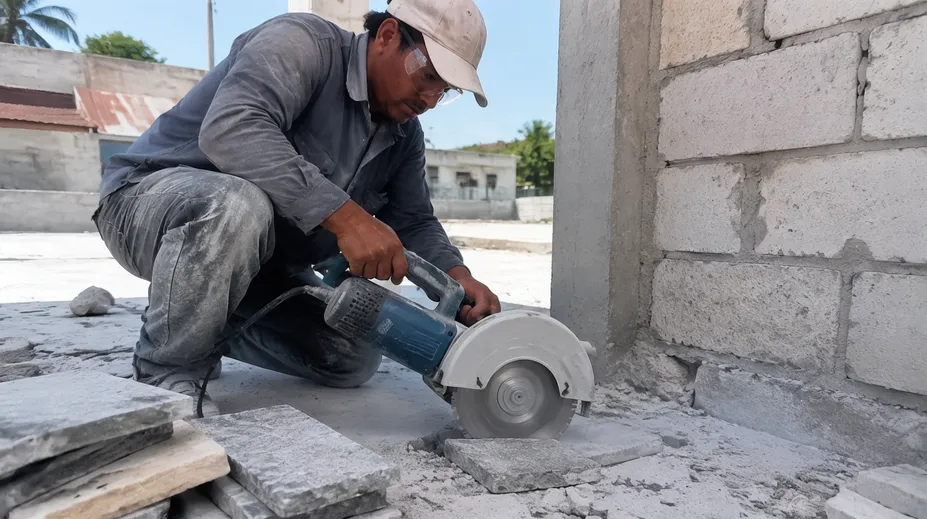
In markets where specialization hasn't fully developed — parts of Africa, Central Asia, Southeast Asia — contractors perform multiple trades rather than specializing. A single worker might cut concrete, stone, and ceramic in one project. The turbo diamond cutting blade is the natural fit because it doesn't punish material variety.
If you distribute in these regions, turbo rims can constitute 40–60% of your small blade sales volume. We've seen this consistently across our African and Middle Eastern accounts.
Volume Insight:
- Turbo rims = 40–60% of small blade sales in multi-trade markets
- Single blade type simplifies inventory for distributors serving non-specialized trades
Tell us your target market and volume
We'll recommend the exact specs for your distribution channel.
Customization Specific to Turbo Diamond Cutting Discs
Beyond the category-wide customization options (formula, packaging, labeling, arbor sizes), turbo discs have product-specific parameters you can adjust:
Serration Geometry
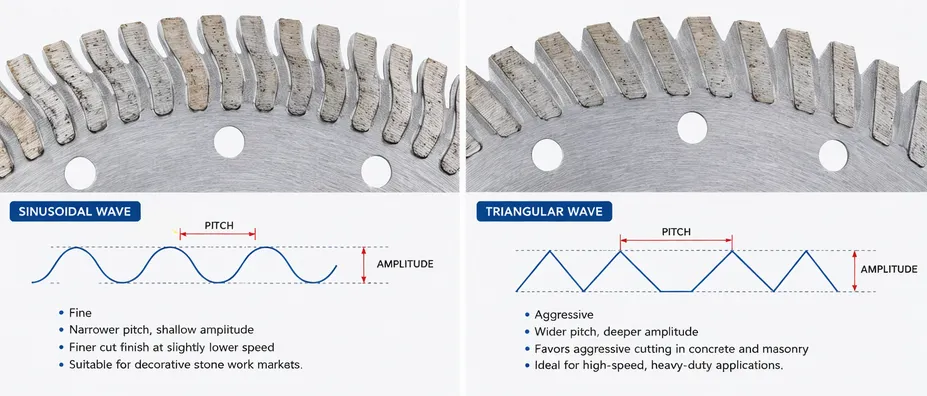
Pitch (spacing between wave peaks), amplitude (depth of the wave), and profile shape (sinusoidal vs. triangular) are all adjustable parameters.
Narrower pitch with shallow amplitude — finer cut finish at slightly lower speed. Suitable for decorative stone work markets.
Wider pitch with deeper amplitude — favors aggressive cutting in concrete and masonry.
We can produce both configurations at the same diameter, giving you a two-tier product line from one basic design.
Segment Height for Life Tuning
Segment height directly controls blade life. The taller segment adds minimal cost (it's mostly additional powder) but supports differentiated positioning:
Professional / Contractor Pack
Extends usable life by ~20% vs. standard. Supports a premium price point.
Standard Commercial
Typical commercial blade life. The baseline for most turbo rim SKUs.
Economy Positioning
Reduces per-unit cost while delivering adequate life for light-duty use.
Bond Formula by Market
We maintain three standard bond formulas for turbo rims. If your region cuts predominantly one material type, we tune the formula accordingly. If your market is genuinely mixed, the medium bond is designed exactly for that scenario.
| Bond Type | Best For | Notes |
|---|---|---|
| Soft Bond | Hard granite, engineered stone | Faster diamond exposure on hard materials |
| Medium Bond | Mixed-material general construction | Most popular — designed for material variety |
| Hard Bond | Highly abrasive soft stone & concrete | Resists premature segment wear on abrasive cuts |
Color-Coded Cores
Popular for retail distribution: different blade core colors indicating application. We paint after welding and before final inspection.
Custom RAL colors available on runs of 500+ pieces.
MOQ for Turbo-Specific Customization
Formula or segment height changes using existing serration tooling
Custom serration geometry requiring new mold inserts
Standard turbo rims with private labeling only
Turbo vs. Segmented vs. Continuous — Helping Your Customers Choose
Your customers will ask which blade to buy. Here's the positioning logic you can pass directly to your sales team or print on point-of-sale materials.
| Criterion | Turbo Rim | Segmented | Continuous Rim |
|---|---|---|---|
| Cut speed | Medium-fast | Fastest | Slowest |
| Cut finish quality | Medium-smooth | Roughest | Smoothest |
| Material versatility | Widest range | Concrete/masonry focused | Tile/stone focused |
| Dry cutting capability | Yes — serrations provide cooling | Yes — gullets provide cooling | Limited — needs water for most materials |
| Typical buyer need | "I cut multiple materials" | "I cut concrete all day" | "I need chip-free tile edges" |
| Noise/vibration level | Low-medium | Highest | Lowest |
| Blade life (same segment height) | Medium | Shortest (aggressive wear) | Longest (less material removal) |
Turbo Rim
- Cut speed
- Medium-fast
- Cut finish
- Medium-smooth
- Versatility
- Widest range
- Dry cutting
- Yes — serrations cool
- Noise/vibration
- Low-medium
- Blade life
- Medium
"I cut multiple materials"
Segmented
- Cut speed
- Fastest
- Cut finish
- Roughest
- Versatility
- Concrete/masonry focused
- Dry cutting
- Yes — gullets cool
- Noise/vibration
- Highest
- Blade life
- Shortest (aggressive wear)
"I cut concrete all day"
Continuous Rim
- Cut speed
- Slowest
- Cut finish
- Smoothest
- Versatility
- Tile/stone focused
- Dry cutting
- Limited — needs water
- Noise/vibration
- Lowest
- Blade life
- Longest (less removal)
"I need chip-free tile edges"
Product Line Positioning
The turbo diamond cutting disc fills the middle of your product line — it's not the specialist for any single job, but it's the only disc that handles the full material range without compromise. Stock it alongside segmented cutting discs for your concrete-focused customers and ceramic tile cutting discs for tile specialists.
Starter Range Recommendation
For distributors building a starter range: turbo + segmented covers 80% of the job site applications your customers encounter. Add a continuous rim for tile work and you have a complete three-SKU offering at each diameter.
Packaging and Freight for Turbo Blade Orders
Turbo discs pack identically to other small blade types in our range. Standard export configuration designed for ocean freight integrity and efficient redistribution.
Individual Wrap
VCI anti-rust paper wrap on each blade for corrosion protection during transit.
Inner Boxes
10 or 25 pieces per inner box — 10-pack suits retail redistribution, 25-pack suits wholesale/contractor bulk.
Outer Cartons
Reinforced outer cartons with foam layer separators to prevent segment damage.
Palletized Freight
Stretch-wrapped pallets with moisture barrier bags for ocean freight protection.
Container Loading Reference
| Diameter | Approx. pcs / 20GP | Approx. pcs / 40HQ |
|---|---|---|
| 115 mm | ~65,000 | ~130,000 |
| 125 mm | ~50,000 | ~100,000 |
| 230 mm | ~20,000 | ~40,000 |
Retail-Ready Packaging
For retail-ready orders (blister packs, printed cards, hang-hole packaging), volume per container decreases 10–20% due to larger per-unit package dimensions. We'll calculate exact loading plans with your quotation.
Mixed Loading
Mixed loading with other blade types in our diamond cutting disc range is standard — most distributors combine turbo, segmented, and continuous rim in one shipment to optimize freight cost across their product line.

Frequently Asked Questions
Technical and commercial answers for distributors evaluating turbo diamond cutting discs for their product lines.
Can a turbo diamond cutting disc replace both segmented and continuous rim blades?
In mixed-material scenarios, yes — a turbo disc handles granite, concrete, tile, and masonry without the operator switching blades. It won't match a segmented disc's raw speed in heavy concrete work (the open gullets clear slurry faster), and it won't match a continuous rim's edge finish on polished porcelain.
But for contractors who prioritize convenience over maximum single-material performance, one turbo disc does the work of three blade types at 85–90% efficiency in each application. Stock turbo for generalists, specialists for specialists.
What is the typical blade life of a turbo diamond cutting disc on granite versus concrete?
On medium-hard granite (G654, G603 type), expect roughly 50–80 linear meters of cut per disc at 115 mm diameter with 10 mm segments — depending on feed pressure and whether water is used.
On standard cured concrete (non-reinforced), the same disc yields 100–150 linear meters because concrete is softer and the bond wears more slowly. These are field-typical numbers, not laboratory maximums.
If your customers report shorter life, the bond hardness may need adjustment for their specific material — send us a sample or material description and we'll recommend the correct formula.
Turbo diamond cutting blade — dry or wet cutting?
Both. The serrated rim geometry creates its own cooling channels, so turbo discs are genuinely rated for dry cutting on angle grinders without water. However, adding water doubles to triples blade life on most materials by reducing thermal stress on the diamond crystals and the bond.
We recommend marketing turbo discs as "dry/wet dual-use" — your customers get the flexibility to cut dry on site and wet in the shop, from the same blade.
The laser-welded version is preferred for heavy dry cutting because the joint handles thermal cycling better than high-frequency welding under sustained dry use.
What is the minimum order quantity for custom-branded turbo diamond cutting discs?
Private-Label Printing
300 pieces per SKU on standard turbo configurations
Formula / Segment Adjustments
500 pieces per SKU for bond or height modifications
Custom Serration Geometry
2,000+ pieces per SKU (requires new mold tooling)
Field Testing (First Order)
200–500 neutral-branded pieces before custom branding commitment
How do I know if a turbo or turbo wave rim is better for my market?
Standard turbo serves 80% of markets well — it's the safe default. Turbo wave commands a price premium and performs noticeably better in two scenarios:
- Markets with high concrete/masonry volume where the extra debris clearance improves cutting speed by 15–20%.
- Markets where operators prioritize reduced vibration — regulatory environments with hand-arm vibration limits, or customers doing overhead cutting where fatigue matters.
If you're unsure, start with standard turbo in your first order. We can supply turbo wave samples alongside for your own side-by-side testing.
Why do some turbo diamond discs develop uneven rim wear after 20% of their life?
Inconsistent diamond distribution in the turbo segment — the wave geometry causes diamond grit to concentrate in troughs during manufacturing if the pressing process isn't compensated. The result: troughs cut aggressively while peaks wear without cutting, creating an uneven scalloped edge.
This is the most common quality problem with cheap turbo blades.
We solve it with a pre-distribution pressing step that normalizes diamond concentration across the rim profile. If you're switching from a supplier whose turbo discs develop this issue, that's the root cause.
Start with a Sample Order
Not sure whether standard turbo or turbo wave fits your market? Most new buyers in this category order 200–500 pieces across both configurations for field comparison.
We'll spec the bond formula based on the dominant materials in your market, ship samples within 25 days, and include test guidelines so your customers can evaluate side-by-side.
Send us:
- Your target market region
- The materials your end users cut most
- Your preferred diameter and arbor
- Approximate annual volume expectations
We'll respond with a specific recommendation, pricing tiers by quantity, and sample logistics — typically within 24 hours.