

Engineered Stone Saw Blades Bond Chemistry for Resin-Bound Materials
Quartz countertop fabrication eats standard blades alive. The resin content changes everything about how the bond should wear. We've spent years developing formulas that handle the heat, the gummy buildup, and the abrasive silica without glazing or segment loss.
- ISO 9001 Certified
- CE · MPA Certified
- 60+ Formula Patents
- Factory-Direct Pricing
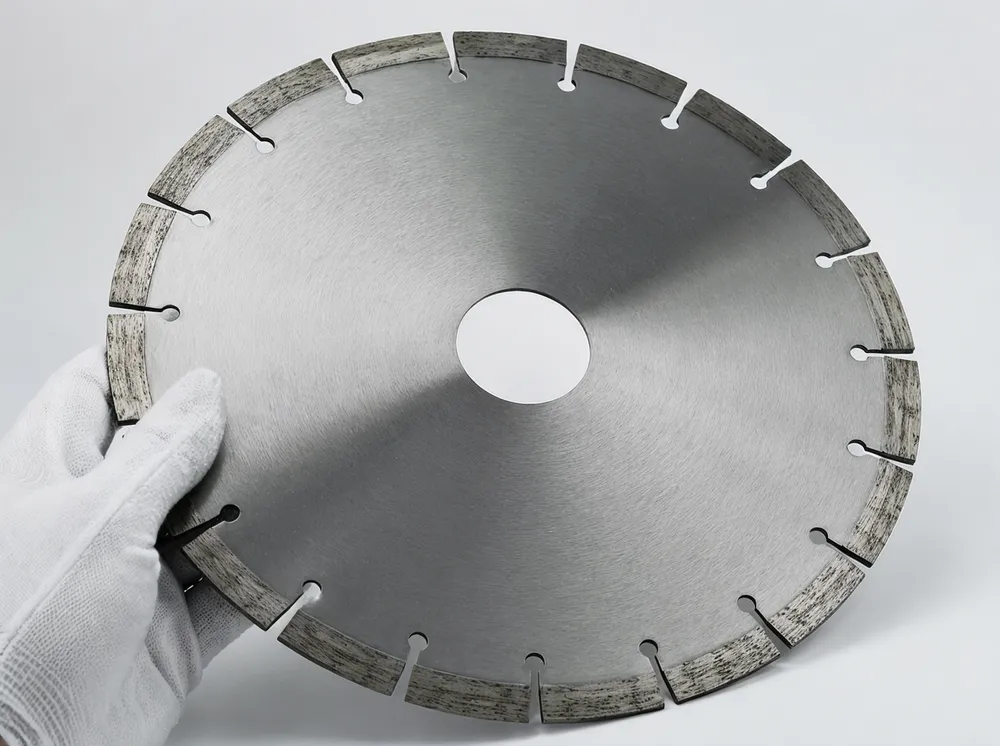
What Makes Engineered Stone a Different Cutting Problem
Understanding why standard granite blades fail on quartz composites — and what the material demands from the bond matrix.
Engineered stone — quartz countertop material, Silestone, Caesarstone, Cambria, and similar brands — is not natural stone. It's roughly 90–94% crushed quartz aggregate bound together with 6–10% polyester resin and pigments. That composition creates a cutting environment that destroys blades designed for natural granite or marble.
Here's what happens: the resin binder generates heat during cutting. That heat softens the resin further, which then smears onto the blade segments and clogs the diamond cutting surface. Simultaneously, the crushed quartz aggregate is extremely abrasive — harder than most natural granites. So you get a blade fighting two problems at once: heat-related resin glazing that blocks diamond exposure, and aggressive silica wear that erodes the bond matrix.
A standard granite blade either glazes over (bond too hard, can't self-sharpen through the resin smear) or wears out in a fraction of its expected life (bond too soft, can't handle the quartz abrasion).
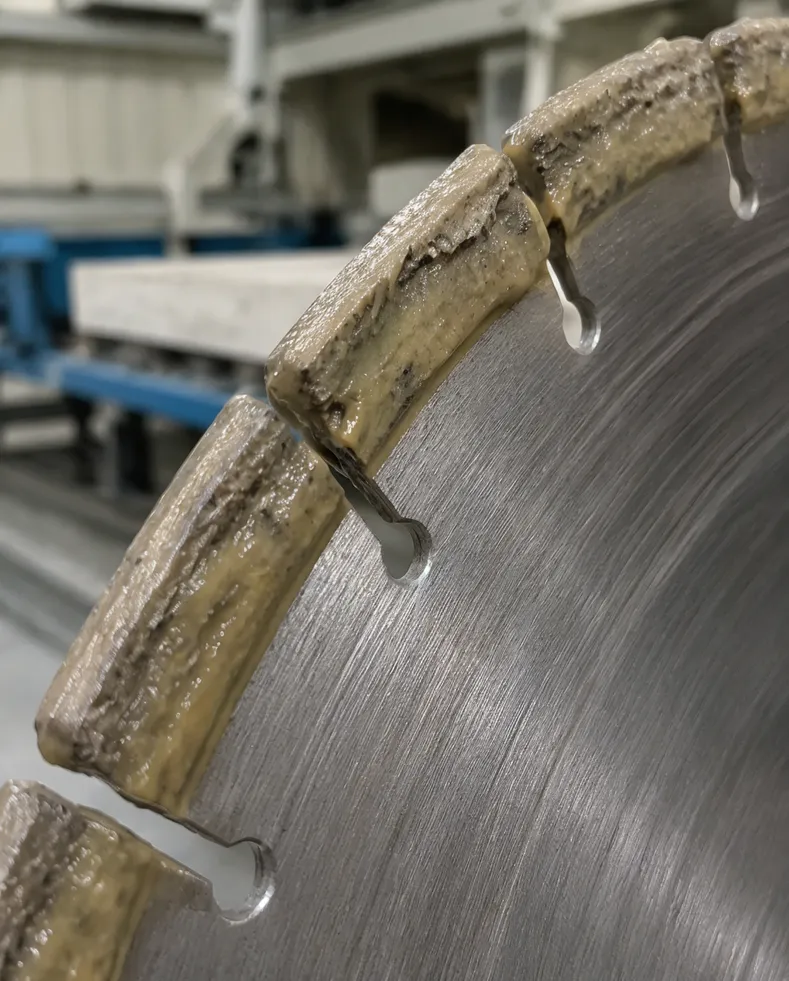
Problem 1: Resin Glazing
Heat from cutting softens the polyester resin binder, which smears onto segment faces and clogs the diamond cutting surface. Diamonds become buried under a gummy film. Feed rate drops. The operator pushes harder, generating more heat — accelerating the glazing cycle. A bond that's too hard can't shed this clogged layer to re-expose fresh diamonds.
Problem 2: Silica Erosion
Crushed quartz aggregate at 90–94% concentration is extremely abrasive — harder than most natural granites. A bond that's too soft to resist this silica attack erodes rapidly, losing segment height and diamond retention. The blade wears out in a fraction of its expected life.
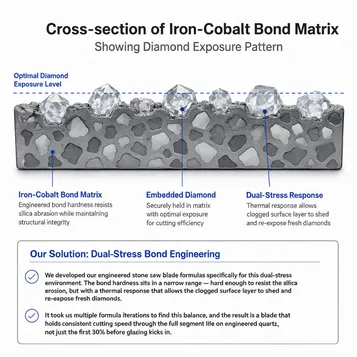
Our Solution: Dual-Stress Bond Engineering
We developed our engineered stone saw blade formulas specifically for this dual-stress environment. The bond hardness sits in a narrow range — hard enough to resist the silica erosion, but with a thermal response that allows the clogged surface layer to shed and re-expose fresh diamonds.
It took us multiple formula iterations to find this balance, and the result is a blade that holds consistent cutting speed through the full segment life on engineered quartz, not just the first 30% before glazing kicks in.
If you're currently selling repurposed granite blades to your quartz countertop customers, they're complaining about short life and slow feed rates in the second half of the blade's service. Our engineered quartz saw blade solves that specific problem.
Technical Specifications
Standard production values for our engineered stone blade range. Custom diameters, segment heights, and bond formulations available on request.
| Parameter | Specification |
|---|---|
| Diameter Range | 300, 350, 400, 450, 500, 600 mm |
| Segment Height | 10 mm – 15 mm (typical) |
| Segment Width | 3.0 mm – 4.0 mm |
| Core Thickness | 2.2 mm – 3.2 mm |
| Arbor Bore | 50 mm, 60 mm (25.4 mm available) |
| Segment Type | Standard, silent-core, Arix-pattern (varies by diameter) |
| Welding Method | High-frequency welding (standard); laser welding available |
| Diamond Grit | 40/50, 50/60 mesh |
| Bond Type | Proprietary iron-cobalt composite, engineered for resin-bound substrates |
| Recommended Machines | Bridge saws, CNC saws, automatic cutting lines |
| Cooling | Wet cutting required (water flow min. 15 L/min recommended) |
| Operating Speed | 28–35 m/s (varies by diameter) |
Default Grit Selection
The 50/60 mesh grit is our default for engineered quartz — finer grit for cleaner edges on resin composites. If your customers are running CNC machines with programmed feed rates above 3 m/min, we typically shift to 40/50 for better swarf clearance.
Let us know your application and we'll recommend the right mesh.
Custom Options
- Non-standard diameters (e.g., 350 mm for compact bridge saws)
- Taller segments (15 mm+) for high-volume cutting lines
- Silent-core steel bodies for noise-sensitive shops
- Private labeling and custom packaging
MOQs apply for custom specs. Contact us for details.
Stock Availability
Our most popular sizes (400 mm and 500 mm, 50/60 mesh, 10 mm segment) are held in production-ready inventory for fast dispatch. Non-standard configurations typically ship within 15–20 working days.
Performance & Material Compatibility
Tested across the major engineered stone brands and compositions. Here's what to expect in real production conditions.
1.5–2.5
m/min feed rate (bridge saw)
800–1200
linear meters per blade (20 mm slab)
< 1 mm
edge chipping (typical)
±5%
speed variance first-to-last cut
Material Compatibility Guide
| Material | Quartz Content | Performance | Notes |
|---|---|---|---|
| Engineered Quartz (Caesarstone, Silestone, Cambria, etc.) | 90–94% | Optimized | Primary target material. Bond formula tuned for this composition. |
| Sintered Stone (Dekton, Neolith, Lapitec) | Variable | Compatible* | Works well but our Dekton-specific blade is better suited. |
| Porcelain Panels (large format) | N/A | Not Recommended | Different material structure. Use our porcelain blade instead. |
| Natural Granite | 20–60% | Overkill | Will cut granite fine but you'll overpay. Standard granite blades are more cost-effective. |
| Marble / Soft Stone | Low | Not Suitable | Bond too hard for soft stone. Will glaze and overheat. Use a marble-specific blade. |
Performance figures are guidelines, not guarantees. Actual results vary with machine condition, water flow, slab thickness, operator technique, and specific quartz brand composition. We provide these numbers so you can benchmark against your current tooling — contact us for application-specific recommendations.
Why Distributors Choose Us for Engineered Stone Blades
We manufacture diamond saw blades. We don't distribute them. That means we're set up to support your business, not compete with it.
Application-Specific R&D
We don't sell one generic blade for "hard materials." Our engineered quartz formula was developed through iterative testing on Caesarstone, Silestone, and Cambria slabs specifically — not adapted from a granite blade.
Your Brand, Your Margin
Private label available on all products. We supply the blade; you control the brand, positioning, and pricing to your customer base. No minimum order surprises — MOQs are transparent from the start.
Technical Support for Your Sales Team
We provide spec sheets, cutting parameter guides, and troubleshooting documentation you can share with end users. If your customer has a problem, we help you solve it — not go around you.
Consistent Quality at Scale
Every blade from the same SKU performs the same. Our QC process includes segment weight tolerance checks, diamond concentration verification, and runout testing on every production batch.
Reliable Lead Times
Stock sizes ship within 3–5 days. Custom orders 15–20 working days. We don't quote lead times we can't hit — if there's a delay, you hear about it before it affects your delivery schedule.
No Channel Conflict
We sell to distributors, not to their customers. We don't list on Amazon, we don't sell retail, and we don't undercut you. Your territory is your territory.
The Bond Formula Problem — and How We Solved It
This is the core of why a dedicated engineered stone cutting blade exists as a product category, and why you can't just stock general-purpose bridge saw blades for your quartz countertop customers.
The Natural Stone Cycle Breaks Down
Natural granite is crystalline. When a diamond blade cuts granite, the cutting action produces hard mineral chips that help abrade the bond matrix, exposing fresh diamonds in a predictable self-sharpening cycle. The bond wears, new diamonds appear, cutting continues at a steady rate. A well-matched granite blade formula maintains relatively consistent performance from first cut to last segment millimeter.
Engineered quartz doesn't cooperate with that cycle. The resin binder melts at cutting temperatures and creates a gummy film that coats the segment face. This film blocks the abrasion cycle — the quartz chips can't reach the bond matrix to erode it, so diamonds don't re-expose. The blade glazes.
Your customer's fabricator slows feed rate, pushes harder, generates more heat, creates more resin smear, and the problem accelerates. Eventually they call you and say the blade is "worn out" when it still has 60% of its segment height remaining.
Our Engineered Solution
We addressed this with a bond system that has two characteristics working together:
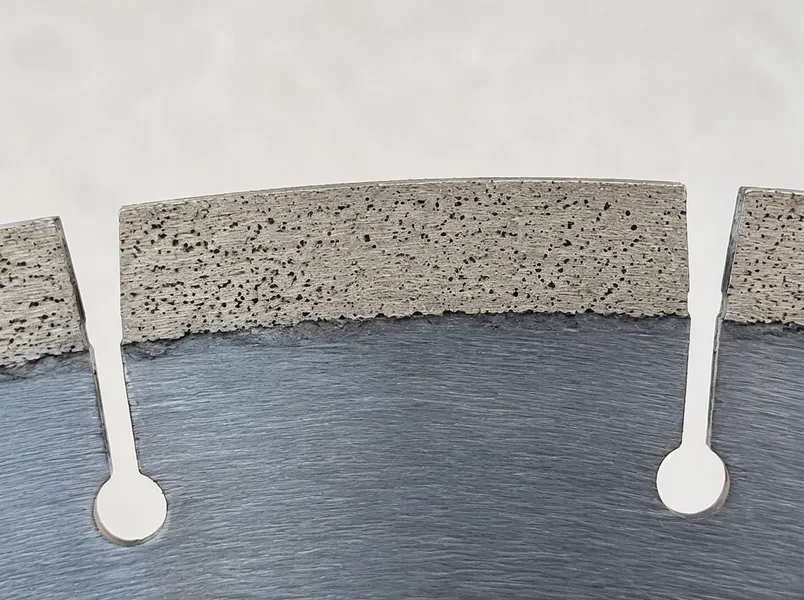
- Controlled porosity in the matrix that gives the resin film somewhere to go instead of building up as a surface layer
- Thermal response curve that allows the outermost bond layer to shed at cutting temperatures rather than polishing smooth
- Thermally stable synthetic diamonds that maintain crystal integrity at elevated temperatures resin-cutting generates, rather than graphitizing and losing their cutting edges
Validated Across Global Quartz Brands
We've run this formula against Caesarstone, Silestone, Cambria, and a dozen regional engineered quartz brands from factories in China, Turkey, India, and Brazil. The composition varies between manufacturers (resin percentage, quartz grain size, pigment type), but our formula handles the range without requiring per-brand adjustment for most applications.
The exception: some ultra-compact surfaces like Dekton require a different approach entirely — those live in our sintered stone saw blade range.
Market Segments You Can Sell Into
Countertop Fabrication Shops
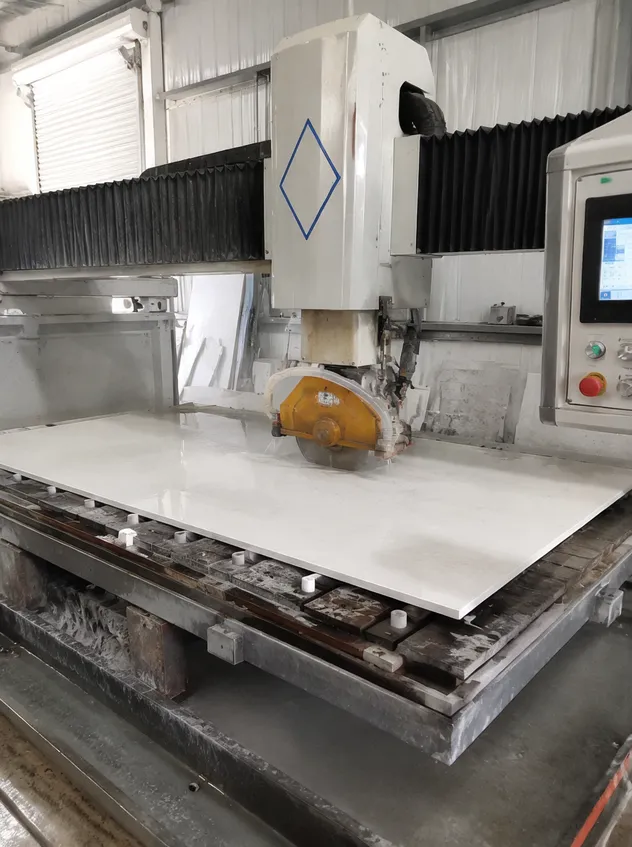
This is your highest-volume, highest-reorder segment for engineered stone saw blades. The global shift from natural granite to engineered quartz for kitchen and bathroom countertops has been underway for a decade, and fabrication shops that used to cut 70% granite now cut 60–70% engineered quartz. Their blade consumption patterns changed, but many are still running granite blade formulas because their supplier (possibly you) hasn't offered them a dedicated alternative.
Fabricators running bridge saws or CNC lines on engineered quartz typically consume 2–4 blades per month per machine in a mid-volume shop. They notice immediately when a blade holds its speed versus one that glazes after 20 linear meters. Once a fabricator finds an engineered quartz blade that works, they reorder the same SKU without shopping around — consistency matters more than saving a few percent per blade when machine time costs $80–120/hour.
Your opportunity: introduce an engineered stone cutting blade alongside your existing granite blades and immediately capture the portion of your customers' spend that's currently going to a competitor who has a quartz-specific product. We've seen this play out with distributors in Southeast Asia and the Middle East — adding a dedicated quartz blade increased their per-account revenue 20–30% because the customer was splitting orders before.
2–4
Blades/month/machine
$80–120
Machine time/hr
Large-Format Slab Processors
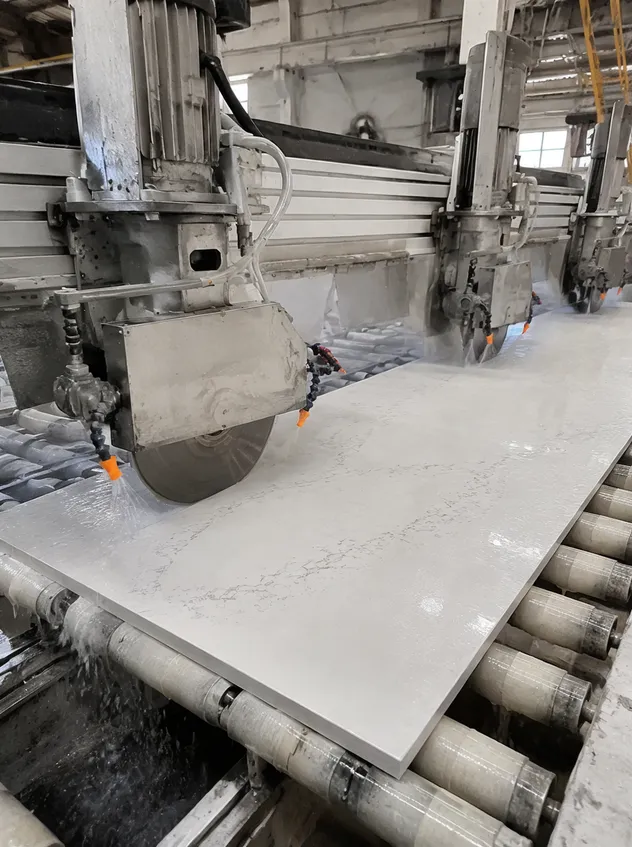
Engineered quartz slabs are manufactured in standard sizes (typically 3050 × 1440 mm or 3200 × 1600 mm) and arrive at fabrication facilities as full slabs that need primary cutting into countertop blanks before any CNC edgework. This primary cutting uses larger-diameter blades (450–600 mm) at aggressive feed rates on automated lines. The volume per machine is higher than a bridge saw cutting individual pieces.
Slab processors care about two things: consistent cut quality (the edges feed directly into CNC profiling with no secondary straightening) and segment life measured in linear meters per mm of segment consumed. They track cost-per-meter religiously and will pay a premium per blade if the cost-per-meter comes down.
Performance advantage: Our engineered quartz saw blade formula delivers 15–25% more linear meters per segment millimeter compared to a general-purpose bridge saw blade on the same material — that math sells itself.
450–600mm
Blade diameter
+15–25%
Linear meters/mm
Commercial Fit-Out Contractors
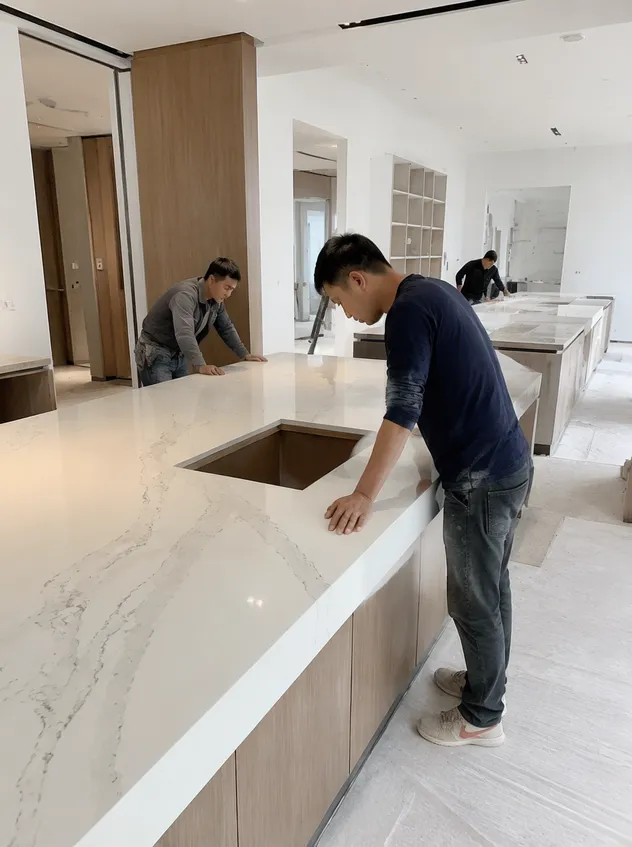
Hotels, retail chains, airport terminals, restaurant groups — commercial fit-outs increasingly specify engineered quartz for countertops, reception desks, bathroom vanities, and wall cladding because of its consistency (no natural stone color variation between slabs), low maintenance, and certification for food-contact surfaces. Contractors running these projects order blades in batches matched to the project scope.
Project-based orders are less frequent but larger per order — a hotel renovation might need 30–50 blades over 3 months. The contractor's priority is no mid-project blade failure that delays the handover date. Position your quartz countertop saw blade as the reliability choice with known performance metrics, and you capture the project spend that currently goes to whatever the contractor's usual tool supplier stocks.
30–50
Blades per project
3 mo
Typical timeline
Have a specific market in mind?
Tell us the application and we'll recommend the right blade spec.
Customization for Your Specific Market
Engineered quartz isn't identical everywhere. Chinese-manufactured quartz tends to use slightly higher resin percentages. Turkish quartz often uses coarser quartz aggregate. Indian engineered stone brands sometimes incorporate recycled glass particles that change the abrasion profile. If you're distributing into a market dominated by one or two local quartz manufacturers, we can adjust the bond formula to optimize for that specific material composition.
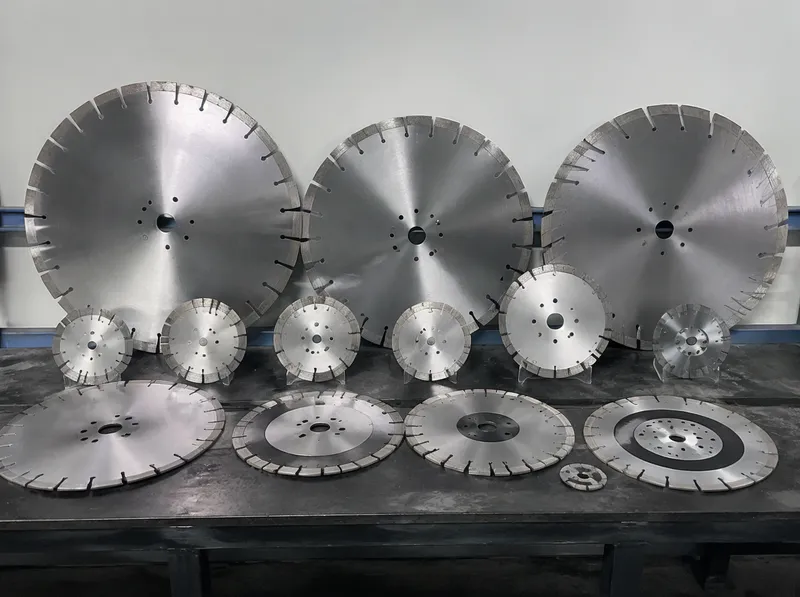
What we customize on engineered stone saw blades
Bond Hardness Adjustment
Shifting the wear rate to match your regional quartz brand composition. Standard formula covers 85% of engineered quartz on the market; the remaining 15% (high-resin, coarse-aggregate, or glass-containing variants) benefit from a targeted formula tweak.
Diameter and Arbor
We produce all standard metric sizes. Non-standard arbors (for older Italian machines or Chinese-market CNC saws with proprietary spindles) are production-ready.
Segment Geometry
Standard flat-top segments for general use. Turbo or V-slot segments available for applications demanding faster swarf clearance on thicker slabs (30 mm engineered quartz is becoming common for island countertops).
Silent-Core Option
Sandwich steel cores with laser-cut dampening slots for fabrication shops in residential areas or enclosed factory buildings with noise restrictions.
Private-Label Packaging
Your brand, your part numbers, your color coding on the steel core. MOQ for private-label starts at 100 pieces per specification.
Customization Limitations Worth Knowing
- Minimum order for custom formula development: 200 pieces (to justify the formula mixing and test-cutting cycle)
- Custom arbor bores below 25 mm or above 60 mm require tooling charges
- Segment heights above 15 mm on diameters below 350 mm are structurally inadvisable — we'll recommend an alternative configuration
We keep formula records on file for every custom run. Your second order ships faster because we don't need to re-develop — we pull the formula card and run production directly.
Send Requirements — Confirm Feasibility in 48hStone brand, machine type, desired diameter — that's all we need to start.
How We Manufacture Engineered Stone Blades Differently
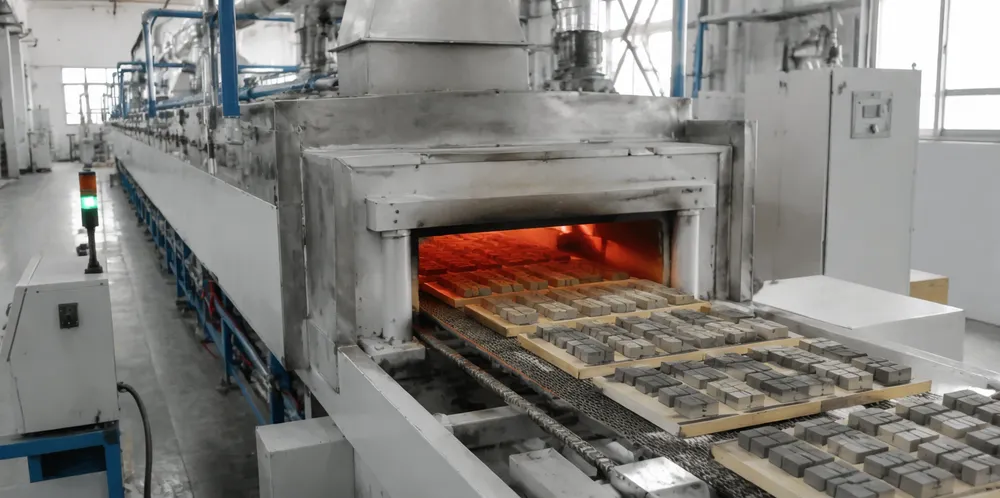
The production process for our engineered stone saw blade diverges from our standard granite blade line at two critical points: powder formulation and sintering profile.
Powder Mixing
Our engineered stone formula uses a proprietary iron-cobalt matrix with controlled porosity additives. These additives burn out during sintering, leaving micro-voids in the bond structure that prevent resin buildup from completely sealing the segment face.
The mixing ratios are precise — too much porosity and the segment erodes too fast on the quartz aggregate; too little and you're back to the glazing problem. We blend in a dedicated mixer to avoid cross-contamination with our granite and concrete formulas.
Cross-contamination sounds minor, but even 2–3% of a hard granite bond powder in an engineered stone formula measurably changes the wear rate. We learned this the hard way during an early production run where cleaning protocols weren't tight enough.
Sintering Profile
Engineered stone segments sinter at a slightly lower peak temperature and longer hold time compared to our granite segments. This produces a finer grain structure in the bond matrix that wears more predictably under the thermal cycling that resin-cutting creates.
The automated furnace runs a specific program code — operators select the product type and the furnace executes the validated profile. No manual temperature adjustments, so your repeat orders perform identically to your test samples.
Automated profile = consistency between batches. No operator variance.
Diamond Selection
We use thermally stable synthetic diamonds with higher-than-standard thermal shock resistance for this product line. Standard diamond grit starts graphitizing (losing its crystalline cutting structure) above 700°C.
Engineered quartz cutting generates localized temperatures at the diamond tip of 600–800°C because the resin acts as a thermal insulator. Our selected grit maintains integrity across this range, so cutting performance doesn't degrade mid-segment the way it does with standard-grade diamonds.
The Margin Opportunity
The result: a blade that costs more to produce than a generic bridge saw blade (the raw materials and process controls are genuinely more demanding), but delivers enough additional cutting life on engineered quartz to justify a premium selling price in your market. Your margin opportunity is in the premium, not the commodity price — and you have real technical differentiation to explain the price to your customers.
Engineered Stone vs. Natural Stone vs. Sintered Panels — Choosing the Right Blade
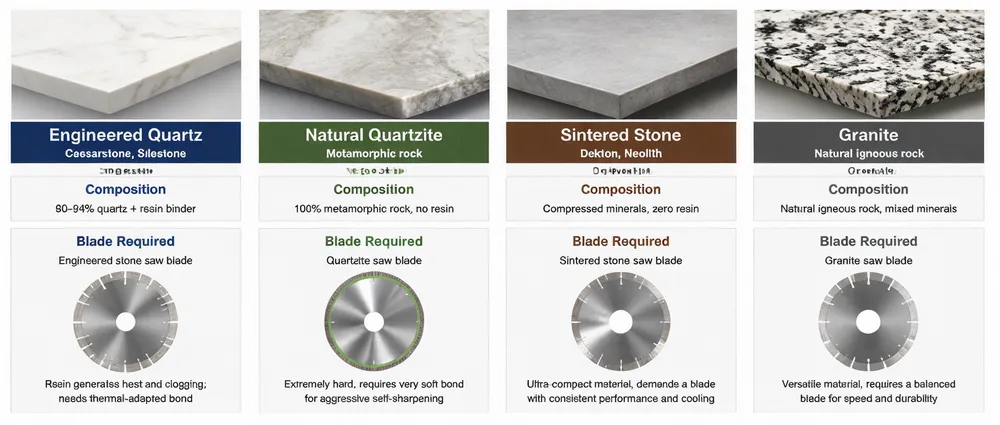
Your customers may not always communicate clearly what they're cutting. "Quartz" gets used loosely — it might mean engineered quartz (Caesarstone), natural quartzite (a metamorphic rock), or even sintered surfaces (Dekton, Neolith). Each requires a fundamentally different blade.
Engineered Quartz
Caesarstone, Silestone
Natural Quartzite
Metamorphic rock
Sintered Stone
Dekton, Neolith
Granite (Natural)
Crystalline igneous rock
Inventory Differentiation Advantage
If your inventory currently uses one blade type to cover "everything quartz," you're losing customers to suppliers who differentiate. Stocking the right blade for the right material protects your reputation as a knowledgeable source — which is what keeps fabricators loyal.
Sales Team Training Tip
When a customer asks for a "quartz blade," train your team to ask back whether they mean engineered countertops or natural quartzite. The answer determines which product you ship and whether your customer gets good results.
Packaging and Logistics
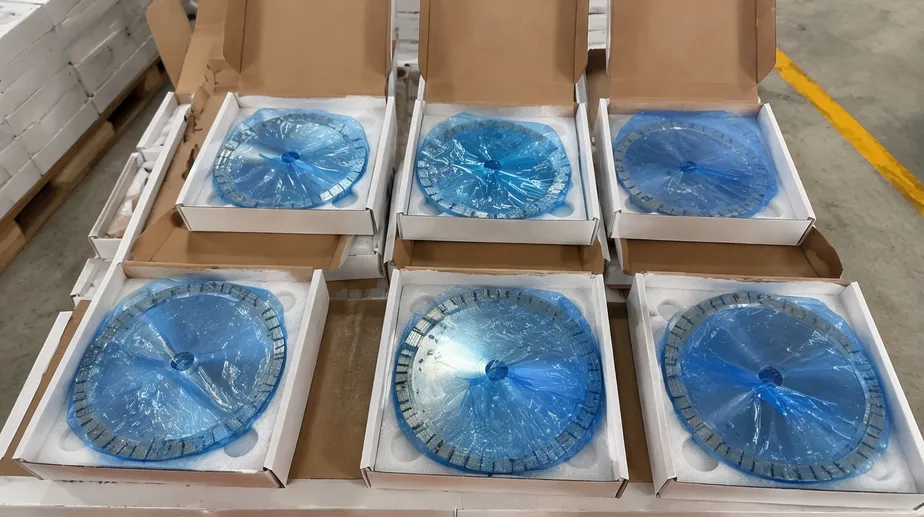
Individual Blade Packaging
- VCI anti-corrosion film wrap
- Foam-padded interior protection
- Individual color-printed box (or white box for OEM/private-label)
- Stored flat to prevent warping during transit
Carton Packing
- 5–20 blades per carton (diameter-dependent)
- Foam separators between each blade
- Double-wall corrugated outer cartons
- Rated for stacking in container shipping
Export Documentation
- Commercial invoice & packing list
- Certificate of Origin (CO)
- Fumigation certificate (wooden packaging, on request)
- Independent export rights — handled in-house
Container Loading Reference (based on 400 mm diameter, standard packaging)
| Container | Approx. Capacity | Notes |
|---|---|---|
| 20GP | 3,000–4,000 blades | Volume-limited, not weight-limited |
| 40HQ | 7,000–9,000 blades | Allows mixed-diameter loading |
Lead Time
Standard Formula Orders
From order confirmation to shipping
Custom Formula (First Run)
Additional time for formula iteration and test-cutting approval
Repeat Orders (Recorded Formula)
Faster turnaround on proven specifications
Shipping & Freight
We coordinate with your freight forwarder or arrange shipping on your behalf. Available terms:
All export documentation handled in-house — we hold independent export rights. No third-party trading companies in the chain.
Frequently Asked Questions
What diamond grit size is best for cutting engineered quartz countertops?
For bridge saws running at standard feed rates (1–2.5 m/min), 50/60 mesh delivers the cleanest edge with the best balance of life and speed on engineered quartz. For high-speed CNC lines pushing above 3 m/min, shift to 40/50 mesh — the coarser grit handles the faster swarf generation without packing.
If your customer is doing finish cuts where edge quality is critical (mitered edges, visible seams), 60/80 mesh gives a finer finish but wears faster.
We stock 50/60 as the default and adjust on request.
How many linear meters can I expect per blade on engineered stone?
Typical cutting life on standard engineered quartz (20 mm thick slab, wet cut, bridge saw at 1.5 m/min): 300–500 linear meters for a 400 mm blade with 12 mm segments.
Variables that shorten life:
- Running dry or with insufficient water flow
- Cutting 30 mm thick material (double the material per pass)
- Contaminated coolant water carrying abrasive particles back onto the blade
Variables that extend life:
- Proper water flow (15+ L/min)
- Consistent feed rate (no stalling and restarting)
- Running the blade at recommended RPM
We provide a performance estimate with every quote based on your specific application details.
Why does my current blade glaze after cutting a few meters of engineered quartz?
The bond is too hard for engineered stone. A granite-optimized bond relies on the stone's mineral chips to abrade the matrix and expose new diamonds. Engineered quartz's resin binder produces soft, gummy swarf instead of hard mineral chips.
The bond matrix doesn't erode, spent diamonds don't shed, and the segment face polishes smooth.
The fix isn't dressing the blade (that only buys a few more cuts) — it's switching to a formula designed for resin-bound substrates with a thermal wear mechanism instead of relying on abrasive wear alone.
Can one blade cut both engineered quartz and natural granite effectively?
Possible, but with trade-offs. Our engineered stone formula works adequately on natural granite — you'll get reasonable life and speed, though not as optimal as our dedicated granite formula. Going the other direction is worse: a granite blade on engineered quartz glazes quickly.
If your customer cuts 80%+ engineered quartz with occasional granite jobs, stocking our engineered stone blade as their primary and keeping one granite blade for full granite days is the practical approach.
If the split is 50/50, they genuinely need both blade types.
What is the minimum order quantity for engineered stone saw blades?
| Order Type | Minimum Quantity |
|---|---|
| Standard formula, standard sizes | 50 pcs per specification |
| Private-label with custom packaging | 100 pcs minimum |
| Custom formula development (first order) | 200 pcs minimum |
| Sample orders for market testing | 5–10 blades at production pricing |
Do I need a silent-core version for engineered quartz cutting?
Only if your customer's fabrication shop has noise restrictions — enclosed buildings in residential areas, or jurisdictions with occupational noise limits below 85 dB.
Standard cores on our engineered stone blade already run quieter than typical granite blades (the resin in engineered quartz dampens vibration somewhat). Silent cores add cost and we recommend them only when regulations require it or the shop owner specifically requests noise reduction.
Ask your customer about their environment before defaulting to the premium option.
Get Started — Tell Us What Your Market Cuts
The fastest path to the right engineered stone saw blade for your business: send us the quartz brand or brands your fabrication customers work with, the machine type (bridge saw model, CNC line, or manual saw), and your target order volume.
We'll respond with a formula recommendation, per-unit FOB pricing, and a sample offer so you can validate performance before committing to volume.
If you're already selling granite blades and want to add engineered quartz to your product line, we can structure a mixed-order across multiple blade types to consolidate your sourcing and simplify logistics.
Include in your inquiry for the fastest quote:
- Quartz brand(s) your customers cut (Caesarstone, Silestone, etc.)
- Machine type — bridge saw model, CNC line, or manual saw
- Blade diameter and arbor size needed
- Target order volume (or range)
- Whether you need private-label packaging
- Destination country (for logistics planning)
We'll turn around a specific quote within 48 hours — including formula recommendation, per-unit FOB pricing, and sample availability.