

Gang Saw Blades Multi-Blade Diamond Sets
Diamond gang saw blades manufactured for frame-set uniformity — every blade in your 20–80 piece set wears at the same rate.
When one underperforming blade means scrapping an entire frame's output, segment consistency isn't a spec — it's your margin protection.
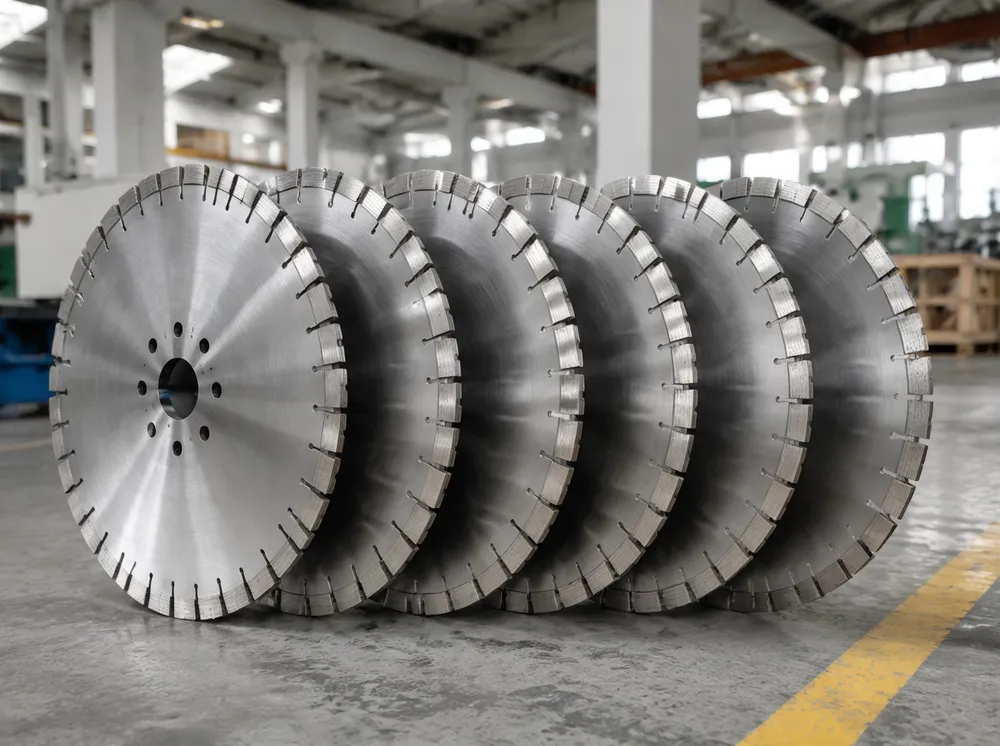
What a Gang Saw Blade Is — and Why Set Uniformity Is Your Only Real Spec
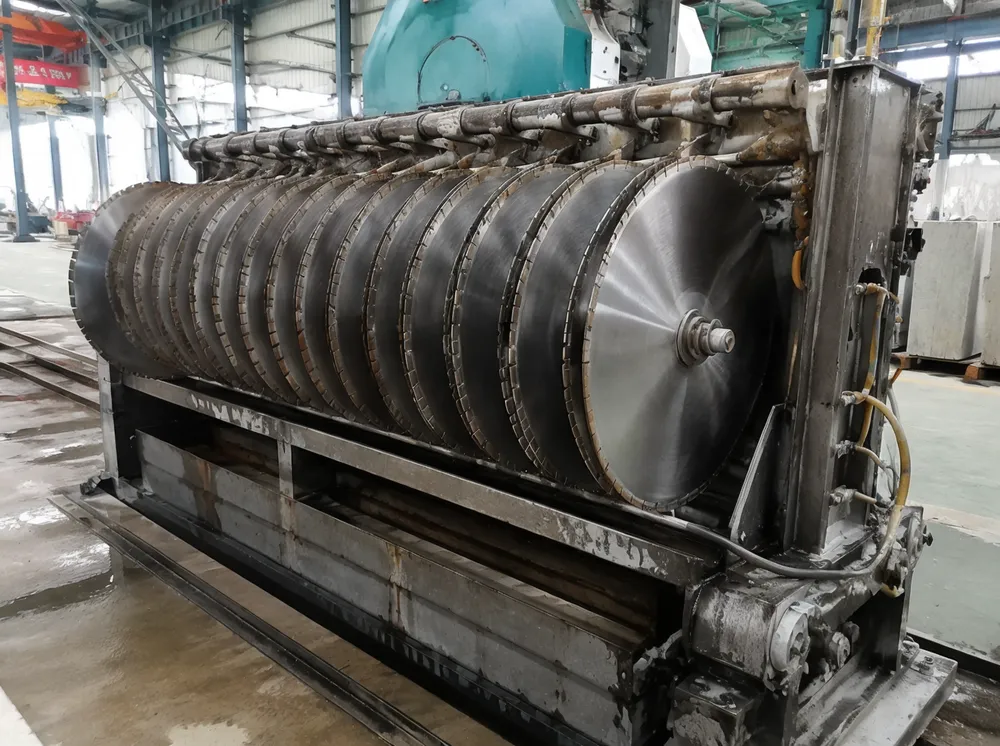
A gang saw blade is a large-diameter diamond blade designed to operate in a multi-blade frame — typically 20 to 80 blades mounted in parallel, slicing a stone block into slabs in a single pass. The frame reciprocates or rotates (depending on the machine type), and every blade in the frame contacts the stone simultaneously.
Here's the commercial reality: a single gang saw blade is not a product. A matched set is. If blade #34 in your 60-blade frame wears 15% faster than its neighbors, it produces thinner slabs at that position. The quarry operator either lives with inconsistent slab thickness (downgraded material, lost revenue) or replaces the entire frame early (your customer calls to complain, your replacement cost goes up, your reputation takes the hit).
We've seen distributors lose quarry accounts over this exact scenario — they sourced cheap sets, two blades underperformed, and the quarry switched suppliers permanently.
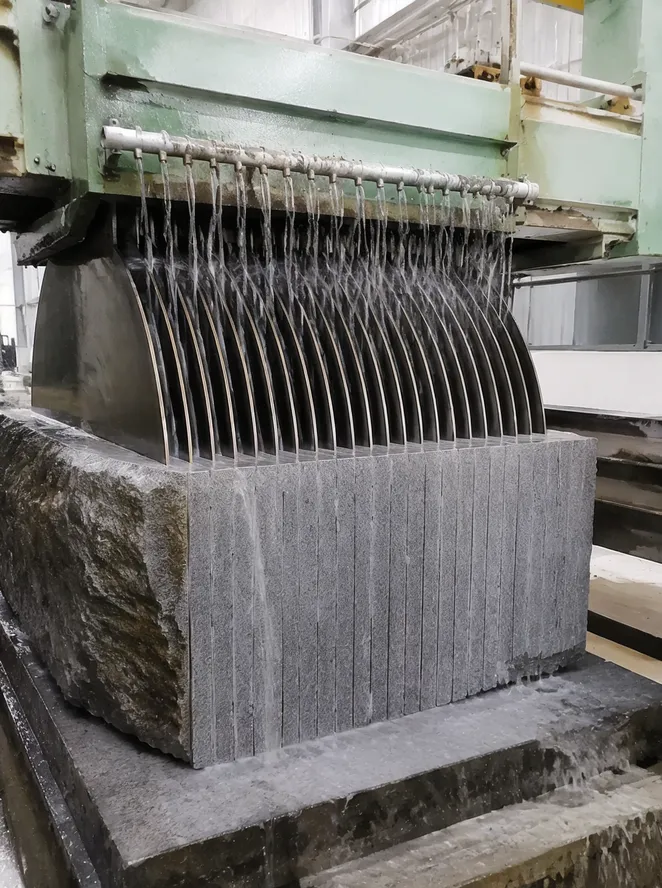
Manufactured as Sets, Not Assembled from Stock
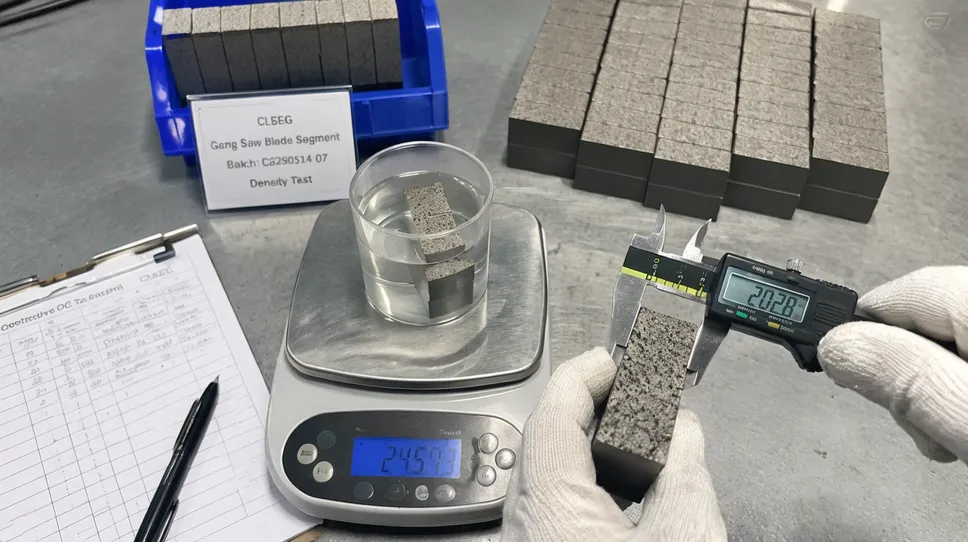
Our diamond gang saw blades are manufactured as sets, not as individual blades that happen to ship together. Every segment in a set comes from the same sintering batch, same formula mix, same cold-press run. We measure density variation across the set before shipping — standard deviation stays below 1.5% piece-to-piece.
- Uniform slab thickness across the full block width
- Frame-change intervals stay predictable
- No calls about one position cutting faster than the rest
Segment Consistency Across a 60-Blade Set — How We Actually Achieve It
This is the part that separates a gang saw blade manufacturer from a trading company assembling blades from multiple segment suppliers. When you order a 60-blade set from us, here's what happens in production:
Single-Lot Powder Blending
The metal bond powder (cobalt-iron matrix with controlled copper and tin content) is blended in one lot — enough for the full set plus QC samples. Diamond grit for the entire set draws from the same supply batch, same mesh distribution, same concentration target.
Sequential Cold Pressing
Cold pressing runs the full segment count through the same die at the same tonnage in sequence. No switching between dies, no variation in press force across the set's segments.
Single Furnace Cycle
Sintering goes into a single furnace cycle — same temperature profile, same hold time, same cooling rate. The result: diamond distribution, bond hardness, and segment density are as uniform as the physics of powder metallurgy allow.
Destructive QC Sampling
We pull 5–8 segments per set for destructive testing (density measurement, cross-section diamond count, hardness verification) and record the batch statistics. If any tested segment falls outside our tolerance window, the entire batch re-runs.
Batch Rejection Rate: ~1 in 40
A full batch re-run happens maybe once per 40 batches — usually traced to a humidity fluctuation in the mixing room, which is why we climate-control it.
We then match segments to steel cores from the same batch — cores tensioned and trued on the same machine, same day. After welding, every blade in the set undergoes runout measurement.
Set-Level Runout Matching
A blade that's concentric in isolation but different from its set-mates still produces uneven slabs because the effective cutting position shifts. That's why every blade in the set undergoes runout measurement against a set-level reference — not just an individual tolerance.
This set-level manufacturing discipline is what you're buying. Individual blade specs matter, but uniformity across the set is what protects your quarry customers' slab yield — and keeps them reordering from you.
Technical Specifications for Gang Saw Blades
Industry-standard parameters for diamond gang saw blades — use these as a baseline when matching blades to your frame configuration and stone type.
| Parameter | Standard Range | Notes |
|---|---|---|
| Blade diameter | 1200 mm – 3200 mm | Most common: 1600 mm, 2000 mm, 2200 mm |
| Segment height | 15 mm – 24 mm | Determines total cutting life per set |
| Segment width (kerf) | 3.5 mm – 5.5 mm | Narrower kerf = more slabs per block = better material yield |
| Segment length | 20 mm – 40 mm | Typically 24 mm for granite, longer for softer stone |
| Core thickness | 3.0 mm – 5.0 mm | Must be thinner than segment width for clearance |
| Number of segments per blade | 20 – 40 | Varies by diameter and segment length |
| Diamond concentration | 20–35 vol% | Higher for hard stone, lower for abrasive stone |
| Diamond mesh | 30/35, 35/40, 40/50 | Coarser for aggressive bite, finer for surface finish |
| Bond type | Cobalt-based, iron-cobalt composite | Matched to stone hardness and machine parameters |
| Operating speed | 0.8 – 2.5 m/s (reciprocating); 15–25 m/s (rotary) | Frame type determines speed specification |
| Typical set size | 20 – 80 blades | One frame load |
| Welding method | High-frequency welding | Standard for gang saw applications |
| Certifications | ISO 9001:2015, CE, SGS, MPA | MPA covers segment retention safety |
Specifications shown are industry-standard values for diamond gang saw blades. Actual specifications vary by stone type, machine configuration, and production requirements. Contact us for detailed datasheets matching your frame specifications.
A Note on Kerf Width
Every 0.5 mm you save on kerf width across a 60-blade set produces one additional slab per block. On a quarry processing 500+ blocks per month, that's significant material recovery.
We can produce narrower-kerf segments for buyers prioritizing yield, but there's a trade-off in blade rigidity — worth discussing when you send your frame specs.
The Formula Problem: Why Generic Gang Saw Blades Underperform on Specific Stone
Gang saw blades face a unique formula challenge compared to single-blade applications. In a bridge saw, the operator can adjust feed rate, water flow, and downpressure to compensate for a slightly mismatched blade. In a gang saw frame, all blades see the same feed rate, same oscillation speed, same slurry flow.
There's no per-blade adjustment possible. The formula has to be right from the start, or performance degrades across the entire set simultaneously.
The core difference from bridge saws
Bridge saw operators compensate for formula mismatch with on-the-fly adjustments. Gang saw operators cannot — every blade in the frame runs identical parameters. A wrong formula means the entire set underperforms, not just one blade.
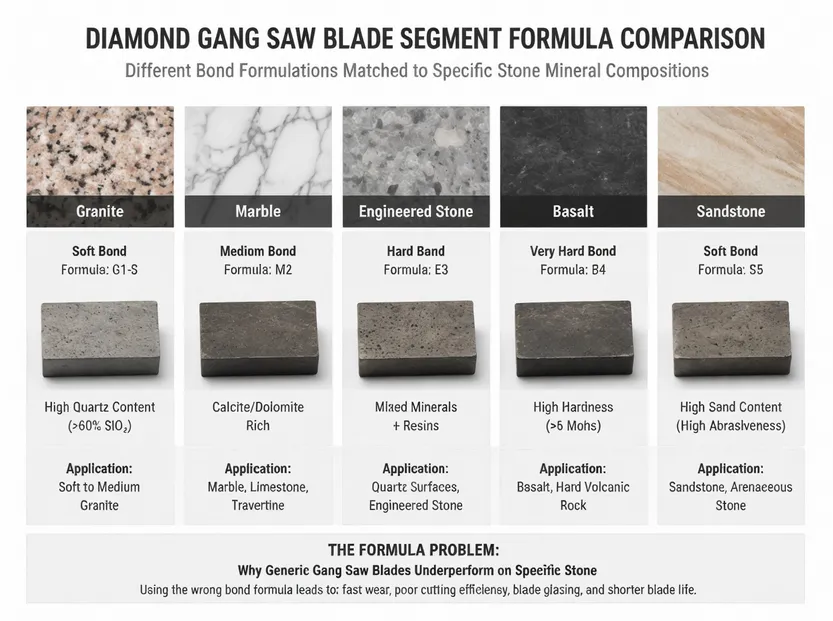
Different bond formulations matched to specific stone mineral compositions
Our Formula Libraries by Stone Family
We maintain separate formula libraries for different stone families, each engineered for the specific wear characteristics of that stone group.
Hard Granite(Low Abrasion)
- Soft cobalt-rich bond
- High diamond concentration (28–35 vol%)
- Coarser grit (30/35 or 35/40)
The matrix needs to erode steadily so fresh diamonds keep exposing.
Typical origins: Brazilian, South African, and Scandinavian granites — absolute black, steel grey, blue pearl, and similar dense granites that resist abrasion.
Medium Granite(Moderate Abrasion)
- Balanced iron-cobalt bond
- Medium concentration (22–28 vol%)
- Standard grit selection
The majority of Chinese, Indian, and Turkish granites. This is our highest-volume formula family for gang saw blades.
Volume leader: Covers the widest range of commercial granite varieties processed in multi-blade frames worldwide.
Soft / Abrasive Stone(Limestone, Sandstone, Some Marble)
- Hard iron-based bond
- Lower diamond concentration (20–25 vol%)
- Finer grit (40/50)
The bond resists the abrasive erosion that would strip segments prematurely on softer stone.
Key regions: Large marble quarries in Turkey, Italy, and Iran using gang saw frames for marble block processing — entirely different formula from granite applications.
Stone-Specific Matching Process
When you tell us the quarry name or stone variety, we match from this library. If your stone doesn't have a close match, we develop a new formulation — typical turnaround of 2–3 weeks for sample segments, then a trial set for your customer to validate before production commitment.
We've formulated for over 200 specific stone varieties across 30+ countries at this point. Egyptian granite alone required four different formula variants because the mineral composition varies significantly between quarry regions.
Formula Development Steps
- 1 You provide quarry name or stone sample
- 2 We match from existing library or develop new formulation
- 3 Sample segments produced (2–3 weeks)
- 4 Trial set for customer validation
- 5 Production commitment after field confirmation
Market Segments Where Multi Blade Gang Saw Sets Move Volume
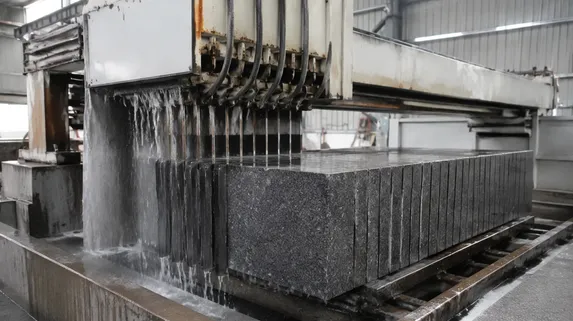
Quarry-Integrated Processing
Primary Market · Highest Retention
Quarries extracting granite, marble, or limestone blocks typically run 1–4 gang saw frames continuously. Each frame needs replacement blade sets every 3–6 months depending on block hardness and production volume.
A single quarry client represents 80–320 blades per year in recurring orders. These are high-loyalty accounts — once a quarry finds a blade set that delivers consistent slab thickness and predictable life, they don't experiment with alternatives.
Your acquisition cost per customer is high (they need to see results on a trial set first), but retention rates in this segment are exceptional.
- 1–4 frames per site, continuous operation
- Replacement cycle: every 3–6 months
- High customer lifetime value
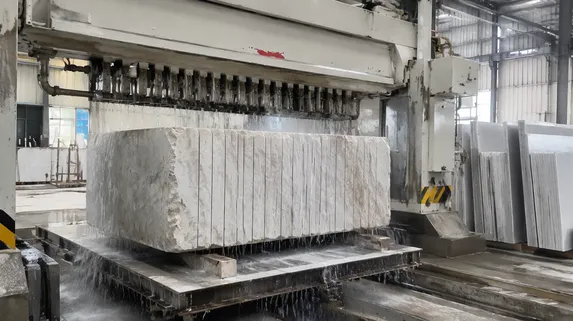
Stone Slab Processors (Non-Quarry)
Tolerance-Critical · Yield Economics
Large fabrication plants that buy raw blocks from quarries and process them into calibrated slabs for the construction and countertop markets. These operations care more about slab dimensional accuracy — thickness tolerance within ±0.5 mm across the full block width — because their downstream customers pay premium prices for consistent material.
They often run their frames at slower feed rates for better tolerances, which extends blade life but means they're especially sensitive to within-set uniformity.
A processor might accept slightly shorter overall life if every slab in the cut meets thickness spec — fewer rejects means better yield economics.
- Thickness tolerance: ±0.5 mm across full width
- Within-set uniformity prioritized over total life
- Fewer rejects = better yield economics
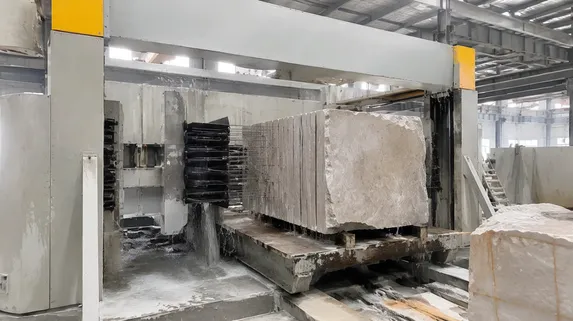
Block Sawing for Export
High Throughput · Multi-Source Stone
Some markets specialize in processing blocks for export as semi-finished slabs. Middle Eastern and North African operations often cut blocks sourced from multiple quarries, which means their blade sets encounter varying stone hardness.
For these buyers, we recommend a mid-range formula that handles 70–80% of common stone types adequately, plus specialist sets for particularly hard or soft quarry sources.
This segment reorders frequently because throughput pressure is high — they're cutting against shipping schedules.
- Mid-range formula covers 70–80% of stone types
- Specialist sets for extreme hardness/softness
- Frequent reorders driven by shipping schedules
Tell us your market segment and stone types
We'll recommend the right formula family for your operation.
Customization Parameters for Your Gang Saw Blade Orders
Gang saw specifications are less standardized than bridge saw blades because frame designs vary significantly between manufacturers — Barsanti, Pedrini, Breton, and dozens of regional machine builders each have their own configurations. Here's what we routinely customize:
Diameter & Core Geometry
Matched to your frame's blade bay dimensions. Non-standard diameters available between 1200–3200 mm in 50 mm increments.
Core arbor bore, mounting hole pattern, and drive slot configuration matched to your machine model.
Segment Specification
Height (determining total life), width (determining kerf and material yield), length, diamond concentration, bond type, and grit size.
We adjust these based on your stone type, machine parameters, and performance priority — speed vs. life vs. surface finish.
Set Composition
Full sets — all blades identical specification.
Graduated sets — outer blades with slightly different specs to account for edge effects in some frame designs.
We've supplied both configurations based on operator feedback.
Private Label
Your brand on packaging, delivery documentation, and blade markings. Several of our quarry supply distributors sell under their own brand.
MOQ for private-label gang saw sets starts at 5 sets (100–400 blades) depending on frame size — manageable for market testing.
Formula Development
If your customer's quarry produces a stone variety we haven't formulated for, we develop a matching formula from sample stone or mineral composition data.
The first trial set ships within 4–5 weeks including formulation and sintering.
Limitations Worth Noting
Blades above 3200 mm
Require custom steel core sourcing. Lead time adds 1–2 weeks.
Sets below 20 blades
Carry a per-unit premium because the batch-matching process requires minimum volumes to be economically efficient.
Segment heights below 15 mm
Possible but reduce total blade life to the point where replacement frequency may not justify the cost saving.
Submit your frame model, stone type, and set size
We'll return a complete specification and quote.
What Separates Our Gang Saw Blade Production from Standard Assembly
Most gang saw blade suppliers — even those with "manufacturing" in their company name — buy pre-made segments from third-party segment factories and weld them to purchased steel cores. The result: inconsistency between segments (different batches, different suppliers, different sintering conditions), which directly translates to uneven wear across your blade set.
We Control the Full Chain
Powder Formulation
Mixing
Cold Pressing
Sintering
Core Cutting & Tensioning
Welding
Finishing
For gang saw blades specifically, this vertical integration matters more than for any other blade type, because set uniformity is physically impossible to achieve when you're assembling segments from different production runs.
Our Specific Process Advantages for Gang Saw Blade Production
Single-Batch Sintering
All segments for one set sintered in the same furnace cycle. No mixing segments from Tuesday's run with Friday's run.
Temperature uniformity across the furnace bed is monitored with multiple thermocouples — position-dependent temperature variation stays below ±3°C.
Automated Segment Sorting
After sintering, segments are weighed, measured for height, and grouped by density.
Outliers get diverted to single-blade production (where individual variation doesn't compound). Only segments within our set-matching tolerance proceed to gang saw blade assembly.
Steel Core Batch Matching
Cores for one set are laser-cut from the same steel plate, tensioned on the same machine in sequence, and trued to the same runout specification.
Core-to-core thickness variation: < 0.05 mm within a set
Set-Level QC Reporting
We generate a batch report for every gang saw blade set showing segment density statistics, core runout values, and weld strength sample results. This report ships with your order.
Some of our distributors pass it directly to their quarry customers as a quality guarantee.
Why This Protocol Exists
We started implementing set-level batch tracking in 2016 after a Middle Eastern customer reported uneven slab output. We traced it to two blades in the set whose segments came from a different sintering run — the furnace had a temperature gradient we hadn't caught.
That incident rewrote our entire gang saw production protocol.
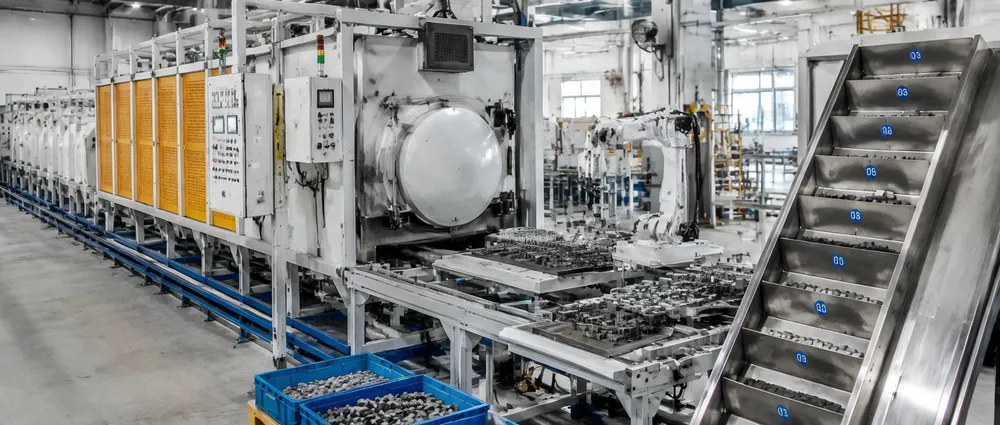
Packaging and Shipping for Large-Diameter Blade Sets
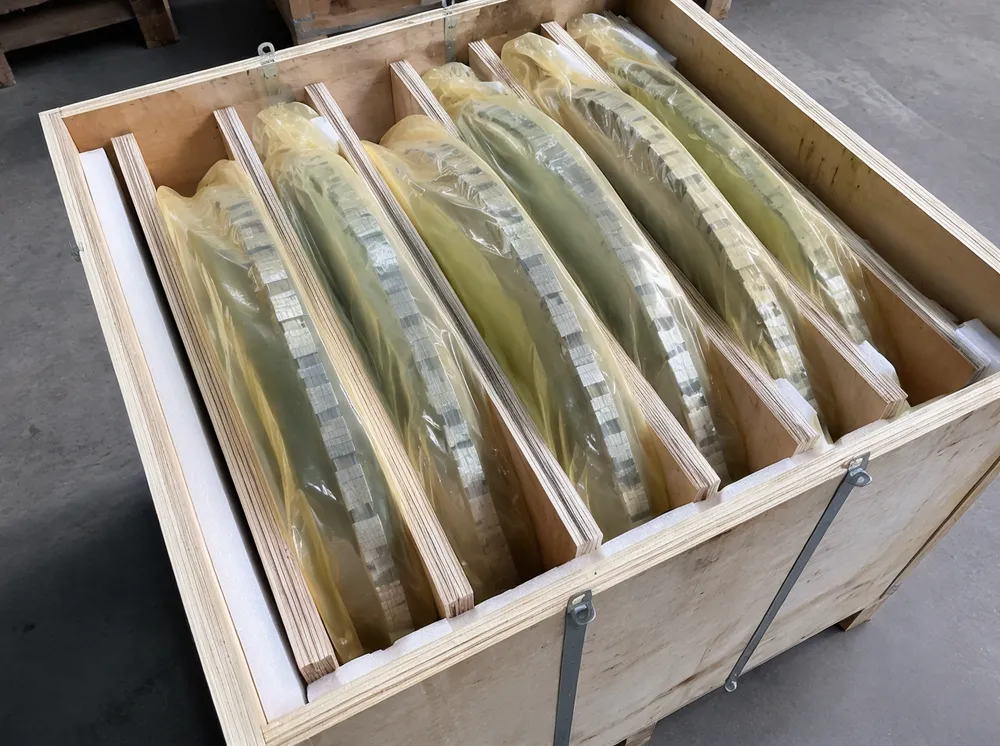
Gang saw blades are heavy, large, and vulnerable to edge damage in transit. A single 2200 mm blade weighs approximately 25–40 kg depending on core thickness. A 60-blade set in wooden crates weighs 2–3 metric tons.
Packaging Method
- Each blade is wrapped in VCI (vapor corrosion inhibitor) film to prevent core oxidation during ocean transit
- Blades are separated by plywood spacers and stacked vertically in purpose-built wooden crates with foam edge protection
- Segment tips — the most vulnerable point — face inward with protective strips between adjacent segment rows
- Crates are banded with steel straps and marked with handling orientation indicators
Container Loading
A standard 60-blade set of 2000–2200 mm blades fits in a 20GP container with room for additional smaller-diameter blades or accessory products.
For larger sets or combined orders, we optimize crate dimensions against container internal measurements and provide loading diagrams.
Gang saw blade crates must sit flat — we've seen damage from shippers trying to stack them vertically to save floor space. Our crate labeling explicitly warns against this.
Fumigation & Documentation
Wooden crates are heat-treated per ISPM-15 standards. Fumigation certificates included with every shipment.
Full documentation package:
- Commercial invoice
- Packing list
- Certificate of origin
- CE/MPA certificates
- Batch QC report
We coordinate with your freight forwarder for FOB or CIF terms.
Lead Time
Standard sets (existing formula)
30–40 days
From order confirmation
New stone formula development
+2–3 weeks
Added to standard lead time
Repeat orders
Ship faster — we maintain your formula file and production parameters permanently.
Frequently Asked Questions
Specification, performance, and ordering questions we hear from gang saw blade buyers — answered with the detail your purchasing decisions require.
How do I know if segment wear is uniform across my gang saw blade set?
Measure slab thickness at multiple positions across the block width after cutting. If slabs at certain frame positions are consistently thinner, those positions have faster-wearing segments. Uniform wear shows as equal slab thickness (±0.3 mm) across all positions.
We design for this uniformity through single-batch production, but if you're experiencing uneven results from a current supplier, send us your slab thickness measurements — we can diagnose whether it's a segment consistency issue, a frame alignment issue, or a slurry distribution problem.
What segment height should I specify for gang saw blades?
Segment height determines total cutting life. Industry standard is 15–20 mm for granite gang saw blades, with 24 mm available for operations that want to maximize intervals between set changes. Taller segments cost more upfront but reduce your per-meter-of-cutting cost and minimize machine downtime for blade changes.
For quarries processing 20+ blocks per day, the downtime savings from taller segments typically justify the premium. We recommend 20 mm as the default — it balances cost, life, and structural stability of the segment-to-core weld.
What's the difference between reciprocating and rotary gang saws — and does it affect blade specification?
Reciprocating frames move the blade set back and forth over the block. Rotary gang saws spin the blades like a circular saw. The cutting mechanics differ significantly:
Reciprocating
0.8–2.5 m/s linear speed with abrasive slurry feed. Uses coarser grit; relies on free abrasive cutting mechanics.
Rotary
15–25 m/s with water cooling. Uses finer grit with embedded diamond cutting.
We formulate differently for each type. Tell us your machine type when requesting a quote — it's the single most important variable for formula selection.
Can I order a trial set before committing to full production volumes?
Yes. We offer trial sets at production pricing (not inflated "sample" pricing) — typically one full set matching your frame configuration.
- Trial set MOQ starts at 20 blades
- Lead time for a first-order trial set: 30–40 days including formula matching
- Ships with a full batch QC report for benchmarking against your current supplier
Most distributors convert to production orders within one set lifecycle after seeing the consistency data.
How does kerf width affect my customer's profitability?
Every 0.5 mm reduction in kerf width produces approximately one additional slab per block on a standard 60-blade frame. For a quarry processing 300 blocks per month at an average slab value of $15–25 per square meter, that extra slab per block represents meaningful annual revenue.
We can produce kerf widths as narrow as 3.5 mm, but thinner segments require stiffer core steel and more precise tensioning. There's a practical lower limit based on blade rigidity — below 3.5 mm, blade deflection under cutting load causes waviness in slab surfaces.
We'll recommend the optimal kerf for your stone hardness and frame rigidity when quoting.
What causes premature segment loss on gang saw blades?
In gang saw applications specifically: thermal cycling from interrupted slurry flow (reciprocating frames), inadequate weld surface preparation, or excessive frame misalignment causing lateral stress on segment joints.
Our automated welding process with ground-and-cleaned core surfaces eliminates the preparation variable. For the thermal and alignment issues — both are operator-side factors, but we formulate segment bonds that tolerate wider thermal ranges than standard, and our weld joint geometry provides more lateral stress resistance than narrow-seat designs.
If segment loss occurs within normal operating parameters, we investigate the root cause and replace affected blades.
Stone-Specific Variants: Granite Gang Saw Blades
Different stone types and processing environments call for purpose-built blade configurations. Here's how our gang saw blade range connects to your specific application.
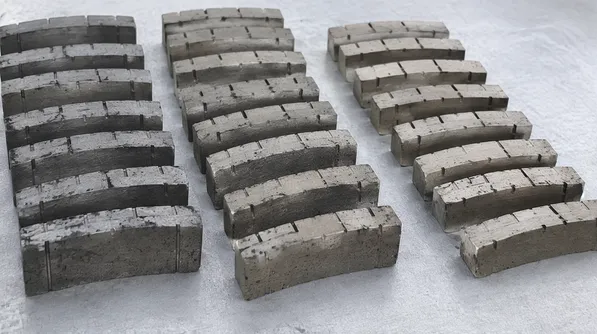
Granite Gang Saw Blades
If your primary application is granite block cutting specifically, our gang saw blade page covers the formula variants and specifications optimized for hard granite processing — including the named stone varieties we've formulated for and the specific segment geometries that perform best on granite's abrasion characteristics.
View granite specifications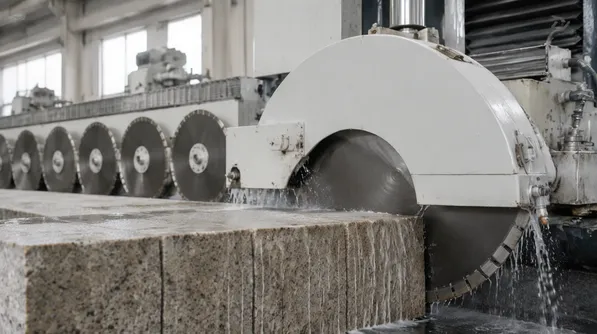
Silent Core Diamond Blades
For noise-sensitive indoor processing environments, our silent core diamond blades may be relevant — though most gang saw operations are industrial environments where noise specifications are less critical than in fabrication shops.
View silent core range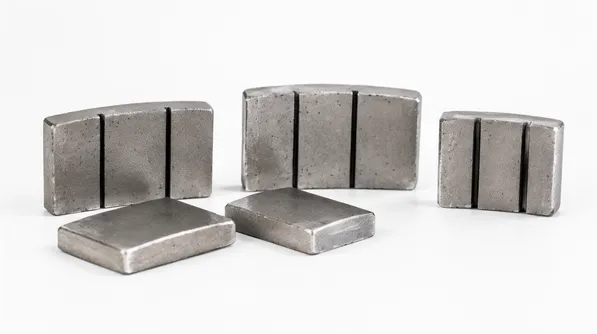
Gang Saw Segments
Need just the segments without steel cores? Some quarry operators re-tip their existing cores. Our gang saw segments are available separately for re-segmenting programs.
View segment optionsStart with Your Frame Configuration
The fastest path to accurate gang saw blade pricing: tell us your frame model (manufacturer and model number), the number of blades per set, the stone type you're cutting (quarry name helps — we may already have a formula match), and your monthly or quarterly set consumption.
We'll respond with a complete specification including segment formula, dimensional details, set-level uniformity guarantee, and FOB pricing per set. For new stone varieties, we'll include a formula development timeline.
Most new gang saw blade customers start with a single trial set. After one cutting cycle proves the consistency, they move to quarterly supply agreements.
What to Include in Your Inquiry
- Frame model — manufacturer and model number
- Set size — number of blades per set
- Stone type — quarry name accelerates formula matching
- Consumption rate — monthly or quarterly set volume
- Current blade specs if available — helps benchmark improvement
Direct Contact
The more detail you provide, the more precise our initial recommendation.