Wall Chaser Diamond Blades Built for Dual-Blade Groove Cutting
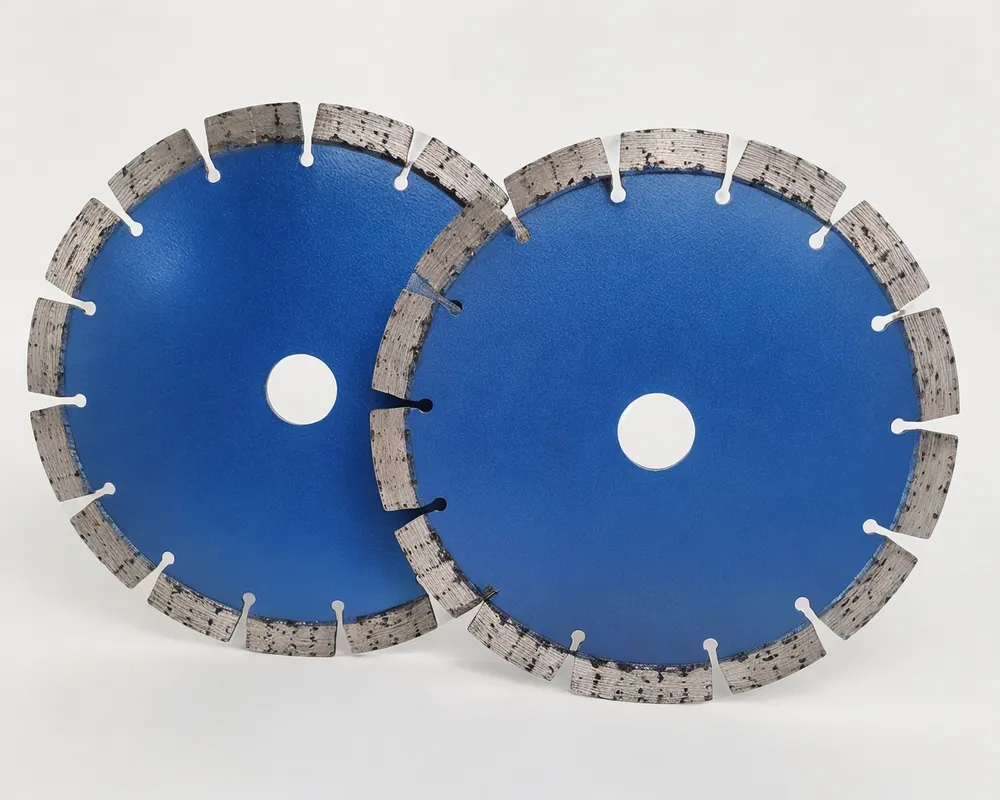
Segmented rim design with reinforced weld joints and narrower kerf, sized 110–150 mm for dedicated wall chasing machines. We manufacture these blades with a formula tuned for concrete and masonry dust extraction — not adapted from general-purpose cutting discs.
OEM/private label available · Typical lead time 25–35 days
What Makes a Wall Chaser Blade Different From a Standard Cutting Disc
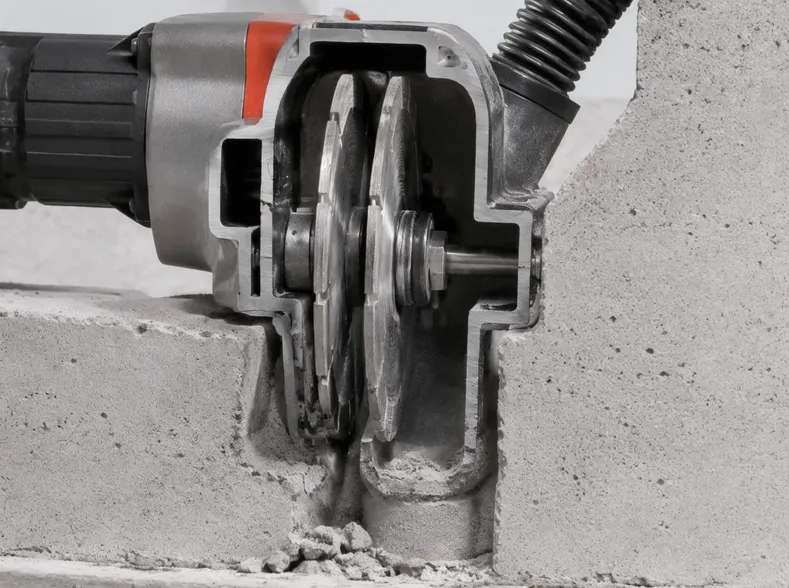
A wall chaser diamond blade looks similar to a general-purpose segmented disc, but it operates under fundamentally different conditions. Wall chasing machines run two blades simultaneously on a single spindle, with a fixed groove width between them. That parallel operation doubles the load on the motor, traps dust between the blades, and generates significantly more heat in the cutting zone than a single blade in an open cut.
We manufacture our wall chaser blades specifically for this environment. The segment geometry, bond formula, and core profile are not borrowed from our general cutting disc line — they're developed for the thermal and mechanical reality of enclosed groove cutting. A standard 125 mm angle grinder disc mounted on a wall chaser will overheat, glaze, or shed segments within the first few meters of cutting. We've seen it happen with blades from factories that simply rebox their general-purpose SKU with a "wall chaser" label.
The core difference is in three areas: narrower body thickness to reduce motor load when two blades spin together, harder bond formula to survive the heat buildup from restricted airflow, and reinforced segment welds to handle the torque spikes when both blades simultaneously hit rebar or aggregate. These aren't premium upgrades — they're baseline engineering for a blade that will actually survive in a wall chaser.
Three Engineering Differences
-
Narrower Body Thickness
Reduces motor load when two blades spin simultaneously on a single spindle
-
Harder Bond Formula
Survives heat buildup from restricted airflow in enclosed groove channels
-
Reinforced Segment Welds
Handles torque spikes when both blades simultaneously hit rebar or aggregate
Technical Specifications for Wall Chaser Diamond Blades
Specifications shown are industry-standard values for wall chaser blade products. Actual specifications may vary by configuration. Contact us for detailed product data sheets.
| Parameter | Standard Values |
|---|---|
| Diameter | 110 mm, 125 mm, 133 mm, 150 mm |
| Arbor Bore | 20 mm, 22.23 mm (other sizes on request) |
| Segment Height | 10–12 mm |
| Segment Thickness | 1.8–2.4 mm |
| Blade Body Thickness | 1.4–2.0 mm |
| Segment Count | 8–12 (diameter dependent) |
| Segment Attachment | High-frequency welded (std) / Laser welded (premium) |
| Maximum RPM | 12,000–14,000 RPM |
| Cutting Method | Dry cutting (machine-integrated dust extraction) |
| Target Materials | Concrete, masonry block, brick, aerated concrete, plaster over brick, lightweight block |
| Compatible Machines | Hilti, Bosch, Makita, Metabo, Chinese-brand equivalents |
Dust Clearance Design
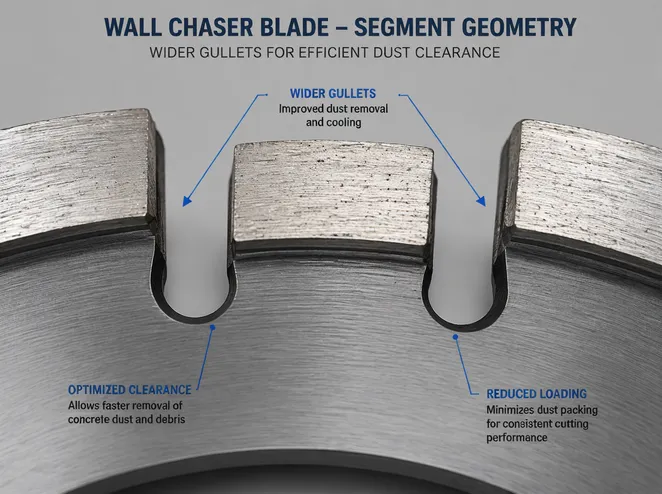
These blades are designed for dry operation with machine-integrated vacuum extraction. The segment geometry — wider gullets relative to blade diameter — facilitates dust clearance even in the confined groove channel.
Wet-Compatible Variant
If your market uses older wall chasers without dust extraction, ask us about our wet-compatible variant — we can adjust the bond formula for occasional water-assisted cutting, though dedicated wall chasers are overwhelmingly dry-cut machines.
The Manufacturing Decisions Behind Our Wall Chaser Blade
We run wall chaser blades on a separate sintering program from our general cutting disc range. The bond matrix is iron-cobalt based with a higher cobalt content than our standard concrete formula — cobalt's thermal conductivity helps dissipate the heat that builds up between two parallel blades in an enclosed groove. We add a small percentage of tungsten carbide particles to the bond for abrasion resistance, because the fine dust recirculating in the groove acts like a sandblast on the segment face.
Segment geometry uses wider gullets proportional to the smaller diameter. On a 125 mm wall chaser blade, we typically run 8 segments rather than the 10 we'd use on a general-purpose 125 mm disc. Those extra gaps matter — they're the only path for dust to exit the cut when two blades occupy the same groove simultaneously.
Early testing note: We tested 10-segment configurations early on. Cutting speed was marginally faster for the first 30 seconds, then performance collapsed as packed debris overheated the segments.
Weld Zone Integrity
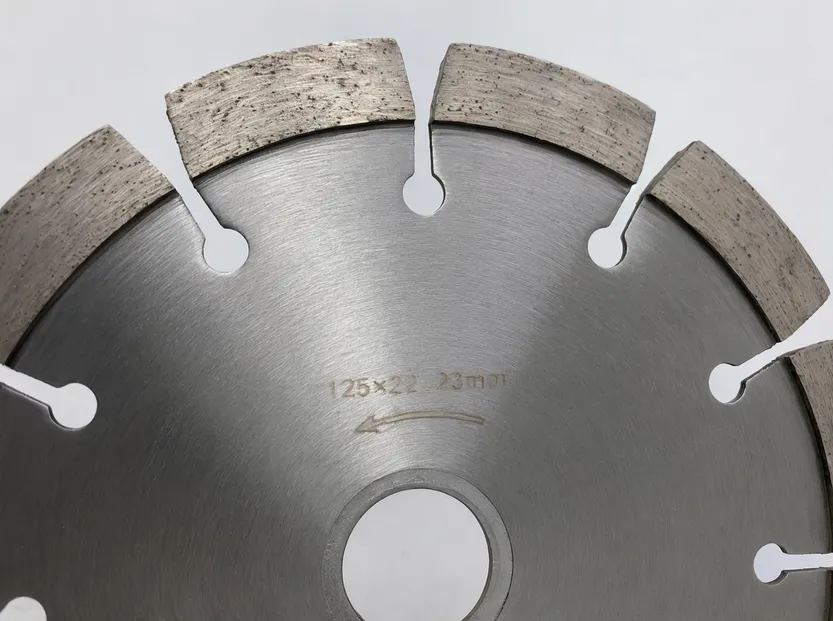
Wall chasers generate intermittent torque spikes when blades contact embedded conduit, rebar ties, or hard aggregate pockets — and the shock hits both blades at different angles simultaneously.
- Premium line: laser-welded with extended weld penetration
- Standard line: high-frequency welded with extended weld penetration
- Every batch undergoes destructive shear testing at 150% of rated load
- If a blade fails the pull test, the entire batch returns to the welding line
Core Profile Engineering
Core profile is slightly thinner than our general-purpose equivalent at the same diameter. Two blades on one spindle means the motor works harder.
- Body thickness reduced 0.2–0.4 mm vs. single-use disc — measurably reduces power draw without compromising rigidity at wall-chaser RPM ranges
- Cores tensioned specifically for dual-blade operation, where vibration harmonics differ from single-blade cutting
Market Segments Where Wall Chaser Blades Generate Consistent Reorders
Wall chaser blades occupy a specific niche in the diamond tool market — smaller volume than general-purpose discs, but significantly less price competition and higher per-unit margins. Here's where the volume concentrates:
Electrical Installation Contractors
Daily consumption · Predictable reorder cycleEvery new building and every renovation project requires conduit channels in walls. Electrical contractors run wall chasers daily during rough-in phases, consuming blades at a predictable rate.
This is a steady, repeatable consumable purchase — not a one-time tool buy.
Plumbing and HVAC Installers
Higher wear rate · Wider channelsWater supply lines, drainage pipes, and HVAC ducting all require wall channels in masonry and concrete structures. Plumbing channels tend to be wider and deeper than electrical, which means higher blade wear and faster replacement cycles.
If you're already supplying this trade segment with pipe fittings or tools, wall chaser blades are a natural add-on SKU.
Building Renovation & Retrofit Specialists
Mixed materials · Growing demandOlder buildings getting electrical upgrades, smart home wiring, or HVAC additions need extensive wall chasing through established masonry. This segment is growing in European and Middle Eastern markets as building renovation spending increases.
The materials are often mixed — plaster over brick, concrete block with render, sometimes stone — which demands a versatile bond formula.
Hardware Tool Distributors Serving the Construction Trades
Premium positioning · Wallet share captureWall chaser blades are a specialty accessory that hardware retailers often under-stock. If your channel serves electrical and plumbing professionals, offering wall chaser blades alongside general diamond discs captures wallet share from a buyer who's already in your catalog.
The specialty positioning supports premium pricing — contractors don't comparison-shop wall chaser blades the way they do 115 mm general discs.
Growing Export Markets
This segment has been quietly growing in our export mix for three years, especially to Middle Eastern and North African markets where new residential construction uses concrete block almost exclusively. If you have distribution in those regions, wall chaser blades fill a gap most competitors aren't covering with dedicated product.
Customization for Wall Chaser Diamond Blades
Wall chasers vary significantly by brand and region — Hilti machines are standard in Europe, Bosch and Makita dominate in Asia-Pacific, and Chinese-brand chasers (often OEM'd under local labels) serve price-sensitive markets. Your blades need to match what your customers actually own.
Diameter & Arbor
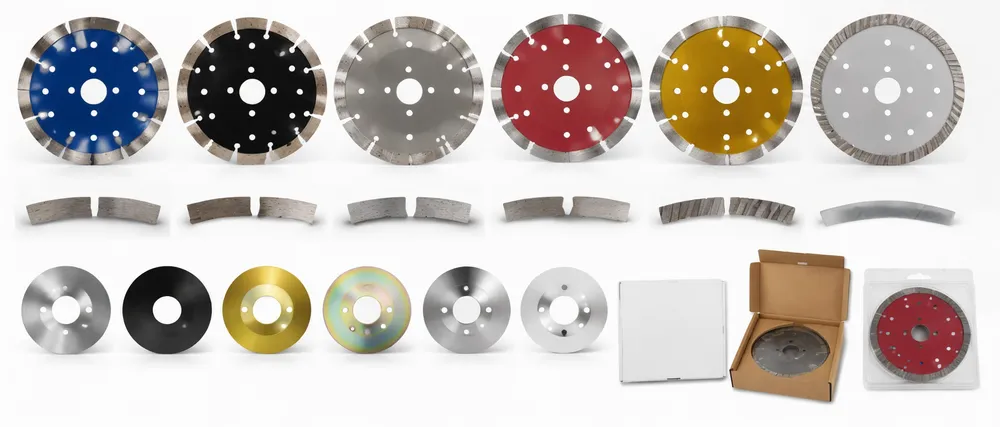
Any combination within 110–150 mm diameter range and standard arbor sizes. Non-standard arbor bores available with tooling adjustment.
Segment Count & Geometry
Adjustable based on target material — fewer segments for soft masonry, more for reinforced concrete — and target balance between cut speed and blade life.
Bond Formula
Tuned to the dominant wall material in your market. Middle Eastern markets cutting through dense concrete block need a different bond than European markets cutting mixed brick and plaster.
Segment Attachment
High-frequency welded (standard, cost-effective) or laser welded (premium, for contractors who prioritize safety and dry-cut performance).
Core Finish
Painted (custom color to match your brand identity), bare steel, or laser-etched branding.
Packaging
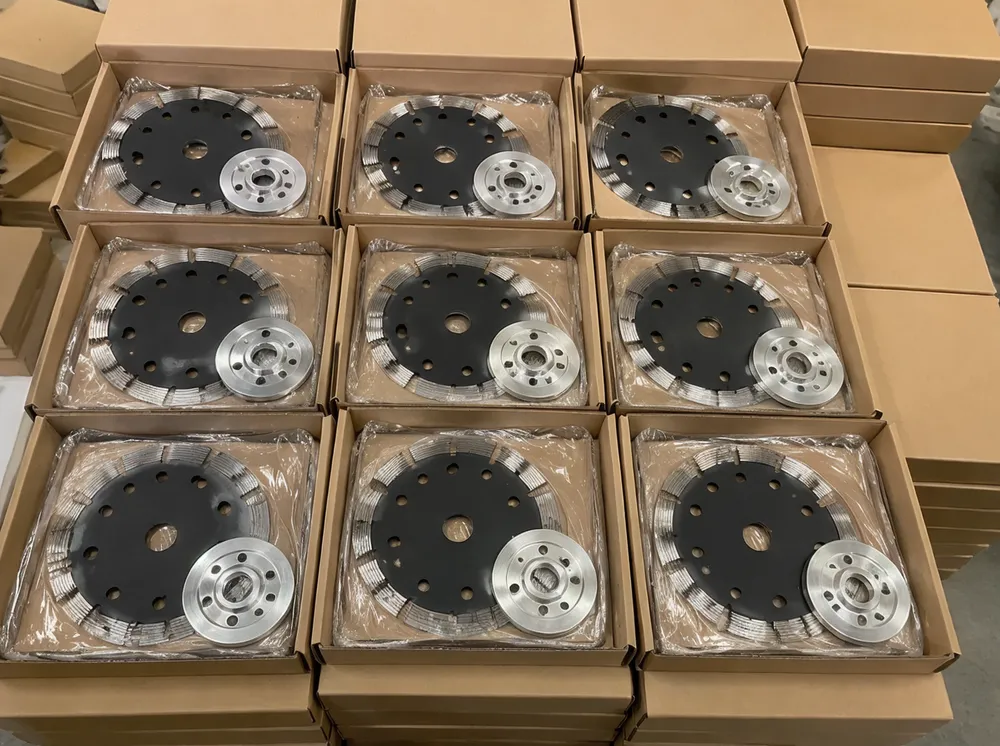
Blister pack, cardboard sleeve, double-blade paired packs (wall chasers always use two blades — selling in pre-matched pairs makes sense for retail), or bulk box packaging.
MOQ for Wall Chaser Blades
- 500 pieces per SKU for standard formula with custom labeling
- 1,000+ pieces per SKU for fully custom bond formula and packaging
- Paired packaging (two blades per unit) supported without additional tooling charges on blister packs already in stock
Limitation to Be Aware Of
Wall chaser blades below 110 mm or above 150 mm are outside our standard tooling range for this product type.
- Below 110 mm: Segment count becomes too low for stable dual-blade operation.
- Above 150 mm: Typically cut-off saws rather than wall chasers — our general cutting disc line serves that better.
Paired Blade Packaging and Supply Chain Logic
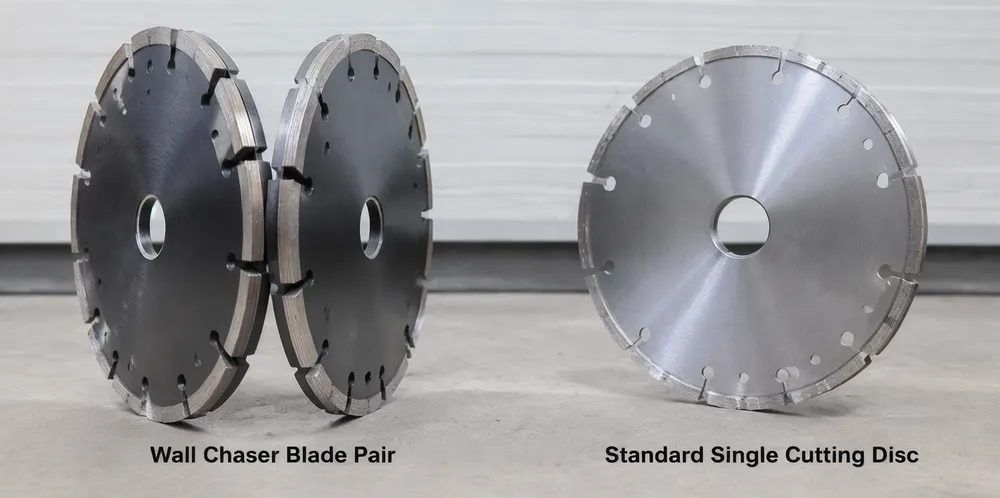
Wall chasers require two blades of identical specification operating simultaneously. This creates a unique packaging and inventory consideration that most diamond blade suppliers ignore — they sell individual blades and leave the pairing to the end user.
Matched-Pair Packaging as Standard
We offer paired packaging as standard: two matched blades from the same production batch, packaged together in a single retail unit. Same diameter, same batch, same segment height (within 0.1 mm tolerance), same weld parameters.
This matters because mismatched blades — even blades of the same SKU from different batches — can wear at slightly different rates, causing uneven groove depth and accelerated wear on the faster-cutting blade.
Why This Matters for Your Margin
Paired packaging lets you sell a higher-value unit (two blades instead of one) with a perceived quality premium.
Your retail price per pair can carry better margin than two individually sold blades, because you're solving a selection problem for the contractor. They don't need to hand-match blades on the job site.
Value Positioning
Higher perceived value → better per-unit margin → simplified contractor purchasing
Container Loading Efficiency
Container loading for wall chaser blades is efficient due to their small diameter. A mixed container alongside your general-purpose cutting disc order adds minimal freight cost per unit while capturing a higher-margin niche segment.
We typically see distributors adding 5,000–10,000 wall chaser blade units (2,500–5,000 pairs) to their regular container orders as a supplementary line.
Typical Add-On Volume
2,500–5,000 paired units per container shipment
±0.1mm
Segment Height Tolerance
Same Batch
Production Matching
2-in-1
Retail Unit Format
110–150mm
Compact Container Fit
Wall Chaser Blade vs. Standard Cutting Disc — Helping Your Customers Choose
Your sales team and retail staff need clear guidance on when to recommend a wall chaser blade versus a standard disc. Here's the decision framework:
| Factor | Wall Chaser Blade | Standard Cutting Disc |
|---|---|---|
| Machine type | Dedicated wall chasers (dual-spindle) | Angle grinders, cut-off saws (single blade) |
| Operating condition | Enclosed groove, dust-trapped, high heat | Open cut, free debris ejection |
| Bond formula | Harder, heat-resistant for restricted airflow | Matched to material (varies soft to hard) |
| Core thickness | Thinner for reduced dual-blade motor load | Standard thickness for single-blade rigidity |
| Segment gullets | Wider proportional to diameter (dust extraction) | Standard proportional width |
| Sold as | Paired (two matched blades) | Individual |
| Typical end user | Electricians, plumbers, HVAC installers | General contractors, fabricators, masons |
"Can I use a regular diamond disc in my wall chaser?"
If your customer asks this — technically yes, briefly. But the blade will overheat, underperform, and die early. The correct recommendation is always a blade designed for the dual-blade, enclosed-groove environment. That recommendation protects your warranty exposure and builds trade confidence in your brand.
Angle Grinder + Chisel Method
For customers who cut occasional wall grooves with a single angle grinder and chisel (common in developing markets without widespread wall chaser adoption), our standard segmented cutting discs or concrete cutting discs are the appropriate recommendation.
Certifications and Compliance for Wall Chaser Blades
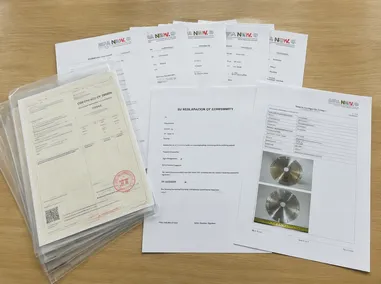
Our wall chaser diamond blades are manufactured under the same certified quality system as our full cutting disc range:
ISO 9001:2015
Quality management system, externally audited
CE
European conformity marking for power tool accessories
MPA
German safety certification for rotating abrasive tools, confirming segment retention and structural integrity at rated RPM
SGS
Third-party test reports available per shipment batch
Why MPA Matters for Wall Chaser Blades Specifically
MPA certification is particularly relevant for wall chaser blades because these blades operate in an enclosed space inches from the operator's hands. Segment ejection in a wall chaser is more dangerous than on an open-cut angle grinder.
MPA testing validates that the segment-to-core bond withstands operational forces with a defined safety margin — documentation you can pass directly to safety-conscious European buyers.
Complete Compliance Documentation, Prepared In-House
- Certificates of origin with every shipment
- Compliance documentation tailored to destination market
- Batch-matched test reports for traceability
- EU Declaration of Conformity prepared when required
If you're importing into markets requiring specific documentation (EU Declaration of Conformity, for instance), we prepare this in-house — no third-party paperwork delays.
Frequently Asked Questions
How many linear meters can a wall chaser blade cut before replacement?
This depends heavily on the material. In standard concrete block or brick masonry, a quality 125 mm wall chaser blade typically delivers 60–120 linear meters of groove at 35 mm depth. In reinforced concrete, expect 30–60 linear meters.
We spec conservative bond formulas for longevity rather than aggressive cut speed, because a wall chaser blade that dies mid-groove leaves the contractor unable to finish the channel — they can't just switch tools like they would with an angle grinder. Your downstream customers value predictable life over marginal speed gains.
What causes wall chaser blades to overheat and glaze faster than standard cutting discs?
Two blades sharing one groove means half the airflow reaches each cutting face compared to an open single-blade cut. Dust trapped between the blades acts as an insulating layer and also as an abrasive that heats through friction. If the bond formula isn't specifically hardened for this thermal environment, the matrix overheats, diamond crystals recede below the surface, and the blade glazes.
The fix is at the formula level — harder bond with better thermal conductivity — not something the end user can solve by adjusting feed rate. When your customers complain about blades "going blunt" on wall chasers, it's almost always because they're using general-purpose discs, not dedicated wall chaser blades.
Should I stock laser-welded or high-frequency welded wall chaser blades?
For most markets, high-frequency welded blades cover 80% of demand — they're proven, cost-effective, and perform well when the machine has proper dust extraction. Laser-welded commands a 25–35% price premium and targets professional contractors who prioritize safety margins and run blades hard all day.
If your market is predominantly professional trades (European electrical contractors, for instance), the laser-welded SKU justifies its margin. If you're serving price-sensitive developing markets, high-frequency welded with proper quality control is the value sweet spot.
We recommend stocking both and letting the market tell you the ratio — most distributors land on 70/30 HF-to-laser after the first year.
What is the minimum order quantity for OEM wall chaser blades?
500 pieces per SKU for custom-labeled standard-formula blades. For custom bond formulas tailored to your market's specific wall materials, minimum is 1,000 pieces per SKU.
Paired packaging (two matched blades per retail unit) has no additional MOQ surcharge — we set up paired packing as standard workflow.
Trial orders of 200–500 pieces in neutral packaging are available for performance validation before committing to branded production.
Can wall chaser blades cut through rebar embedded in concrete walls?
Wall chaser blades are designed for brief, incidental rebar contact — the kind you encounter when a groove crosses a rebar tie or hits a short reinforcing bar. They handle it without segment loss because of the reinforced welds and thermally stable bond.
But they're not rebar-cutting tools. Prolonged steel cutting overheats the diamond crystals and degrades segment life. For projects where heavy rebar contact is expected (chasing channels in heavily reinforced structural concrete), inform your customers to expect reduced blade life and recommend our laser-welded variant for the additional weld strength.
If the application is predominantly metal cutting, that's a different product category entirely.
Start Sourcing Wall Chaser Blades
Most distributors adding wall chaser blades to their lineup start with a focused SKU set: 125 mm diameter (the global standard for most wall chaser machines), in both high-frequency welded and laser-welded variants, packaged in pairs. That gives you a good/better shelf offering with minimal inventory commitment.
Tell us:
- Which wall chaser machine brands dominate in your market (determines arbor and diameter priority)
- Your primary wall material (concrete block, brick, aerated concrete, mixed) — we'll recommend the right bond
- Target volume for the first order (or trial quantity for testing)
- Whether you want paired or individual packaging
Send these details and we'll come back with a specific formula recommendation, paired packaging options, and pricing — typically within 24 hours.