

Turbo Diamond Saw Blades Fast Cutting, Cooler Running
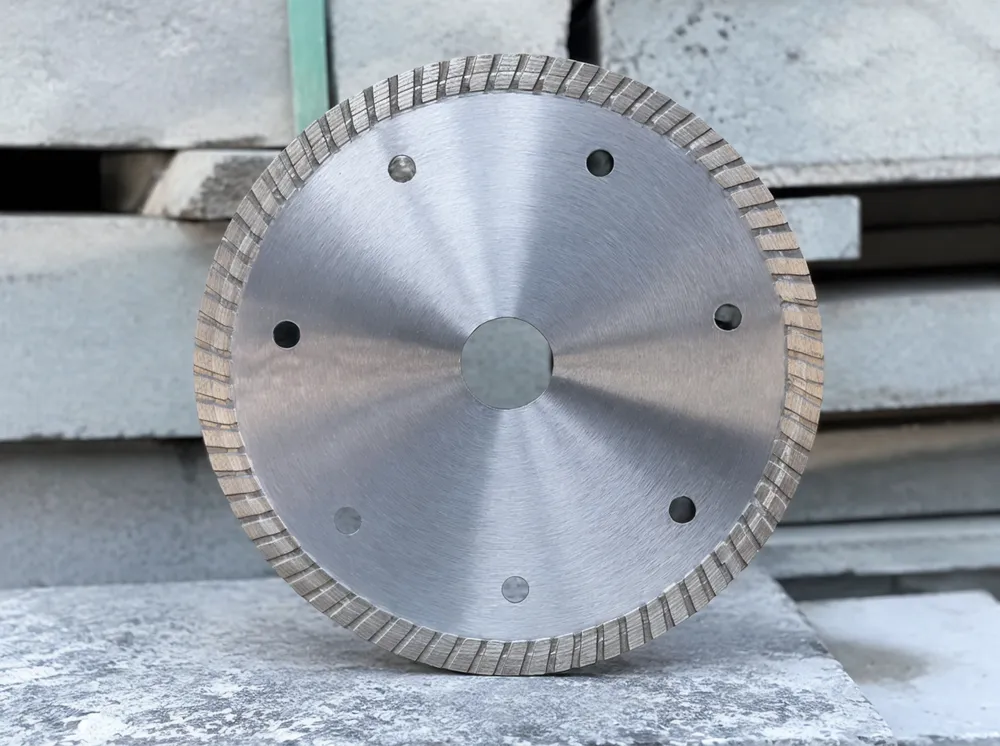
Continuous rim with serrated turbo segments for faster debris clearance and aggressive cutting on stone, masonry, and concrete.
The turbo rim sits between continuous rim (slow, clean) and segmented (fast, rough). You get speed without sacrificing edge quality — and that in-between positioning makes this blade one of the highest-volume SKUs for distributors serving mixed-material markets.
- OEM/Private-Label Ready
- 3M+ Annual Capacity
- Exported to 30+ Countries
- Factory-Direct Pricing
What a Turbo Rim Does Differently — and Why Your Customers Keep Reordering It
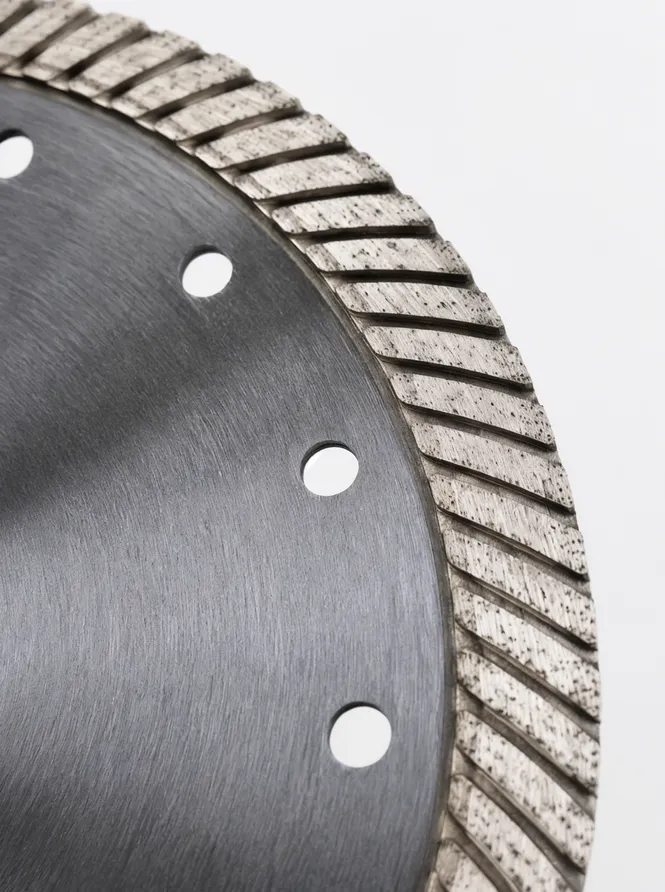
The turbo diamond saw blade uses a continuous rim with a wavy (serrated) profile pressed directly into the segment edge. That wave pattern creates turbulence in the cooling water or air flow, channels swarf out of the cut, and reduces contact area between segment and material at any given moment. The result: 20–40% faster cutting than a standard continuous rim blade, cleaner cuts than a segmented blade, and less heat buildup than either.
We've made turbo rim blades since our early years — they were actually one of the first product types we exported because the demand is universal. Every market with construction and renovation activity needs them. Your stone fabrication customers use them as their general-purpose blade for mixed materials. Your construction supply customers use them for masonry, block, and concrete. Your tile and renovation trade customers use them for one-blade-does-everything convenience.
From your distribution perspective, turbo blades are a volume product. They sell into more end-user segments than any other single rim type because they don't specialize — they generalize well. Lower SKU count for you, broader market coverage per inventory dollar.
Speed Without Trade-offs
20–40% faster cutting than continuous rim while maintaining cleaner edges than segmented blades. The wavy profile reduces contact area at any given moment.
Cooler Running
Wave pattern creates turbulence in cooling water or air flow, channeling swarf out of the cut and dissipating heat — less thermal stress on both blade and material.
Universal Demand
Sells into more end-user segments than any other single rim type — stone fabrication, construction supply, tile and renovation. Lower SKU count, broader market coverage.
Ready to stock turbo blades?
Get volume pricing based on what's moving for distributors in your region.
Turbo Diamond Saw Blade Specifications
Specifications shown are industry-standard values for turbo diamond saw blades. Actual specifications may vary by formula and configuration. Contact us for detailed product data sheets.
| Parameter | Specification |
|---|---|
| Diameter range | 105 mm – 350 mm (standard); 400–500 mm available on request |
| Segment height | 8 mm – 12 mm (standard); 15 mm for extended-life versions |
| Segment width | 1.8 mm – 3.2 mm (varies by diameter) |
| Core thickness | 1.4 mm – 2.6 mm |
| Arbor bore | 20 mm, 22.23 mm, 25.4 mm (custom bore available) |
| Rim type | Continuous turbo (wave/serrated profile) |
| Welding method | High-frequency welding (standard); laser welding (for dry-cut models) |
| Diamond grit | 30/40, 40/50, 50/60 mesh (matched to material hardness) |
| Bond type | Cobalt-based and iron-based, with formula adjustment per application |
| Max operating speed | 80–100 m/s (varies by diameter; consult recommended RPM table per size) |
| Applicable machines | Angle grinders, circular saws, table saws, masonry saws, tile saws |
| Cutting method | Wet and dry (laser-welded models for dry; HF-welded for wet) |
| Certifications | ISO 9001:2015, CE, SGS, MPA |
Inventory Focus: 105–230 mm Range
The 105–230 mm range accounts for roughly 70% of turbo blade orders globally — these are the angle grinder and small circular saw sizes that construction crews and fabricators burn through at high volumes. If you're building your initial turbo blade inventory, start there.
We can recommend the exact diameter breakdown based on what's moving for our existing distributors in your region.
Recommended RPM by Diameter
End users need this information to avoid over-speeding. We include recommended RPM on every blade label and can provide printed reference cards for your sales team.
What Turbo Blades Cut — And Who's Buying Them
Turbo blades sell across more job categories than any other rim type. Here's how the demand breaks down by material and buyer segment — useful context for your inventory planning.
Materials
Granite & Engineered Stone
Countertop cutouts, edge profiling, sink holes. High-volume demand from fabrication shops.
Concrete & Masonry Block
Score lines, openings, demolition prep. Construction crews use these daily.
Porcelain & Ceramic Tile
Straight cuts and miters on large-format tile. Renovation trades prefer turbo over segmented for cleaner edges.
Marble & Limestone
Cladding, flooring, memorial work. Softer stones but still require controlled cutting speed to prevent micro-fractures.
Pavers & Roof Tiles
Landscaping cuts, roof renovation. High piece count means blade consumption adds up fast.
Buyer Segments
Hardware & Tool Retailers
Walk-in trade and DIY. Turbo blades are their top-selling diamond blade category because end users default to them.
Construction Supply Distributors
Bulk orders for contractor accounts. Repeat consumption — crews go through 2–5 blades per week on active sites.
Stone Fabrication Suppliers
Fabricators need consistent quality across batches. They buy by the case and test new suppliers cautiously.
Tile & Flooring Specialists
Renovation and fit-out contractors. Price-sensitive but will pay more for blades that reduce chipping on expensive tile.
Online & E-commerce Sellers
Marketplace sellers and e-commerce brands sourcing private-label blades. Need reliable product photos, specs, and consistent packaging.
Distribution Insight
Turbo blades work as your entry SKU when onboarding new retail accounts. They're the blade type with the least explaining required — end users already know them. Once the account is established and reordering, you can introduce specialized blades (continuous rim for tile, segmented for heavy concrete) as add-on SKUs.
Turbo Blade Variants We Manufacture
Not all turbo blades are the same product. We manufacture several variants that serve different price points and performance requirements — helping you offer good-better-best options to your customers.
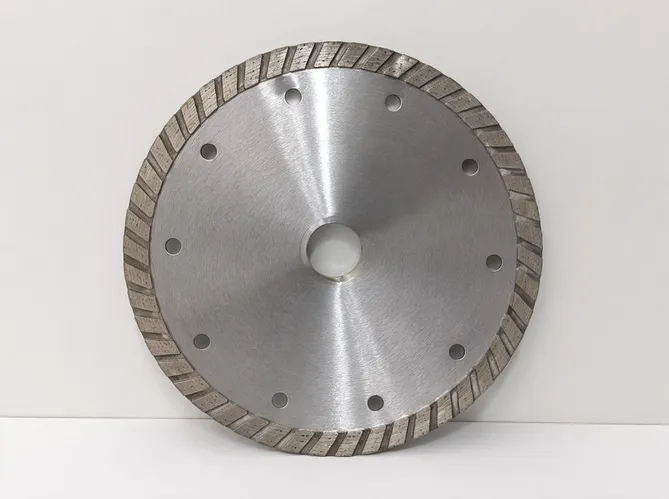
Standard Turbo (Hot-Pressed)
Your workhorse SKU. Hot-pressed sintering with high-frequency welding. Optimized for wet cutting on angle grinders and table saws. Best price-to-life ratio for general contractors.
- 105–350 mm diameter range
- HF welding standard
- Best for: price-competitive markets
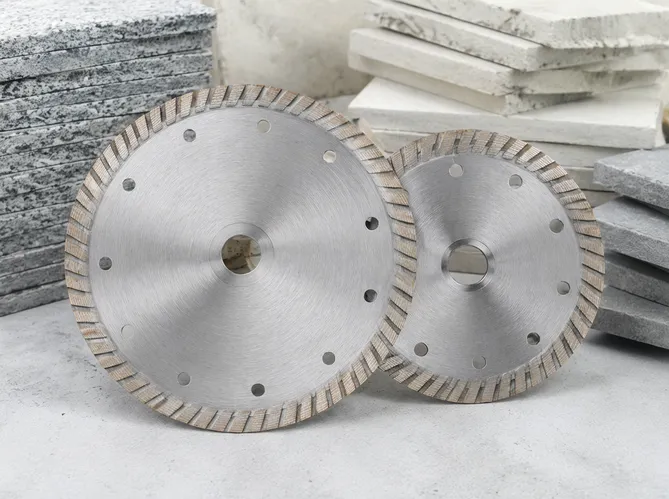
Laser-Welded Turbo (Dry-Cut)
Higher segment bond strength allows dry cutting without water. Laser welding survives the thermal shock. Preferred by contractors who can't run water on job sites — renovation, indoor, elevated work.
- 115–230 mm most popular sizes
- Laser welding for safety
- Best for: premium and professional accounts
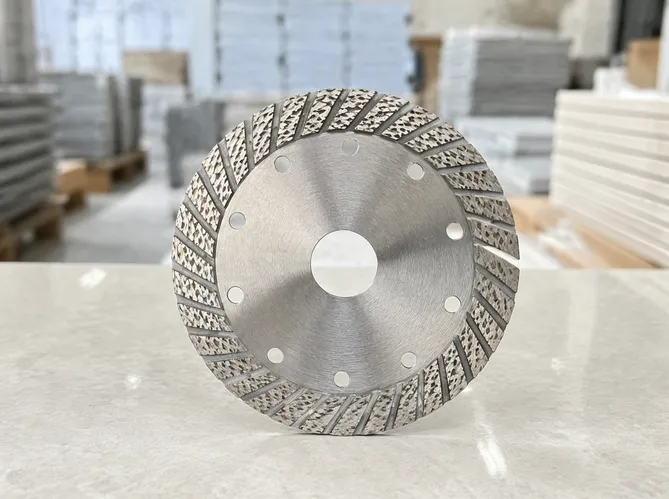
Mesh / X-Turbo (Tile Optimized)
Diamond-coated mesh pattern over steel core with turbo-style edge geometry. Designed for chip-free cuts on porcelain and large-format tile. Higher margin product for tile-focused distributors.
- 105–125 mm most common
- Near-zero chipping on porcelain
- Best for: tile and renovation markets
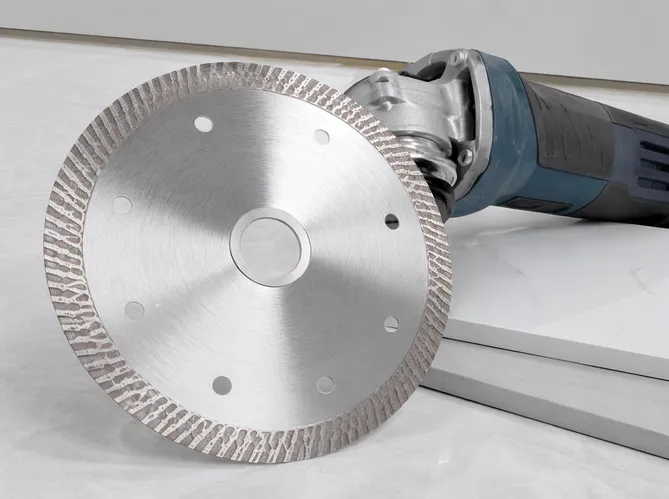
Super-Thin Turbo (Narrow Kerf)
1.2–1.4 mm cutting width. Less material waste, lower power draw, faster feed rate. Ideal for battery-powered tools where motor strain matters. Growing demand as cordless tools dominate.
- 105–180 mm range
- Optimized for cordless tools
- Best for: markets with high cordless adoption
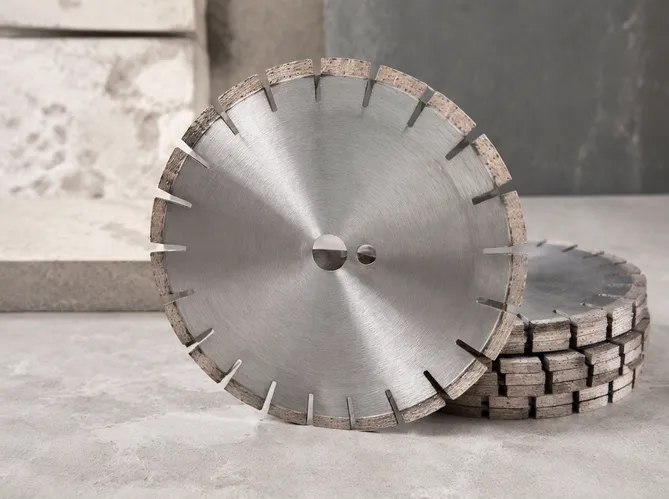
Deep-Segment Turbo (Long Life)
12–15 mm segment height versus the standard 8–10 mm. 40–60% more diamond material means proportionally longer blade life. Sold into accounts where blade changes cost more than the blade itself.
- 180–350 mm range
- 15 mm segment height available
- Best for: high-production sites, rental fleets
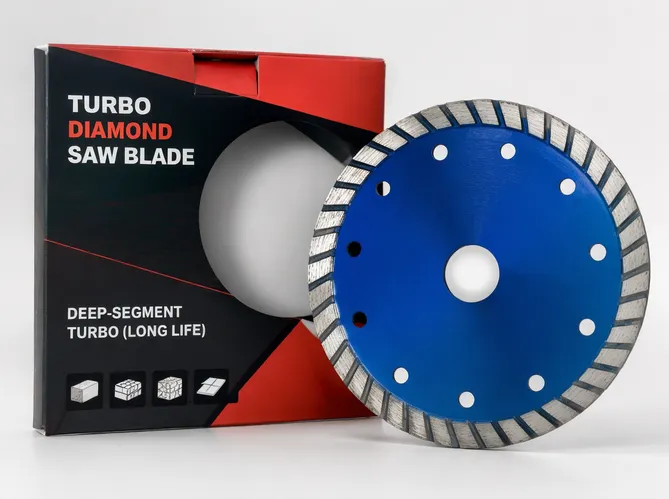
Custom / Private-Label Turbo
Any of the above variants manufactured under your brand. Custom color coating, laser-etched logos, branded packaging. Same blade, your identity. MOQ from 100 pieces per size.
- Your brand, our manufacturing
- MOQ: 100 pcs per SKU
- Best for: brand-building distributors
Not sure which variants fit your market?
Tell us your customer segments and we'll recommend the right product mix.
How We Manufacture Turbo Rim Segments —
The Process That Protects Your Return Rate
Standard turbo blades from commodity sources often fail at the rim profile. The wavy edge is the blade's performance feature, but it's also the manufacturing challenge — uneven wave depth means inconsistent cutting speed, and poor wave-to-core alignment causes vibration. We solve this at two stages.
Segment Pressing
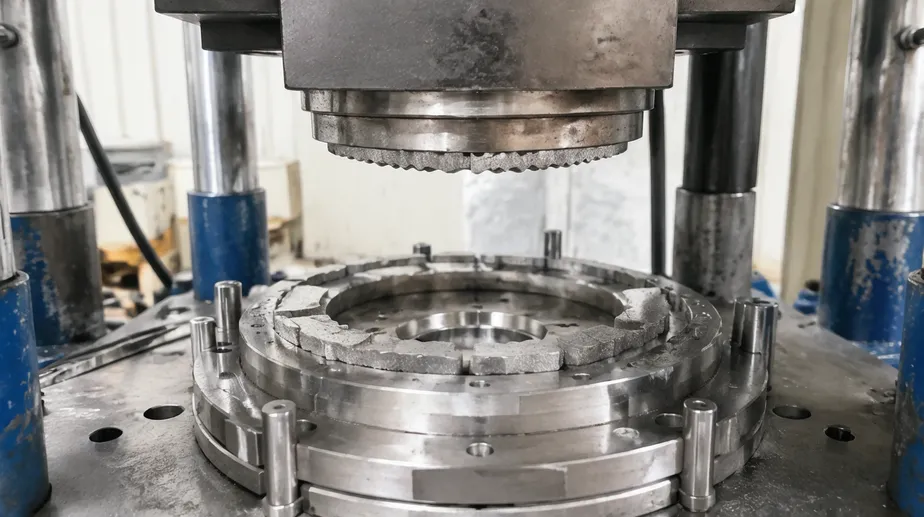
The turbo profile is formed during cold pressing, not ground after sintering. We press the wave pattern directly into the segment blank using precision dies machined to ±0.05 mm tolerance. This means the diamond distribution follows the wave geometry — diamonds are where the cutting happens, not randomly distributed across a flat face that was reshaped afterward.
Why cheaper blades fail:
Cheaper blades grind the wave profile into a standard flat segment after sintering. That approach cuts through diamond-rich layers unevenly and leaves some wave peaks with low diamond density — which is why those blades lose aggression after the first few cuts.
Core-to-Segment Alignment
On turbo blades, the segment sits continuous around the circumference with no gullets to self-align during welding. Our automated welding fixtures hold concentricity to 0.1 mm runout, so the turbo rim tracks true at full RPM.
We check every blade post-weld with a dial indicator — anything outside tolerance gets re-tensioned or rejected.

±0.05mm
Die Tolerance
0.1mm
Max Runout
The manufacturing difference shows up in your returns data
A well-made turbo blade maintains its cutting speed from first cut to last millimeter of segment life. A poorly made one cuts fast for the first 10 meters and then glazes because the wave peaks have burned through their diamonds. Your customers don't know why — they just know the blade "stopped working" and blame the supplier.
Market Segments Where Turbo Blades
Drive Repeat Revenue
General Construction Supply
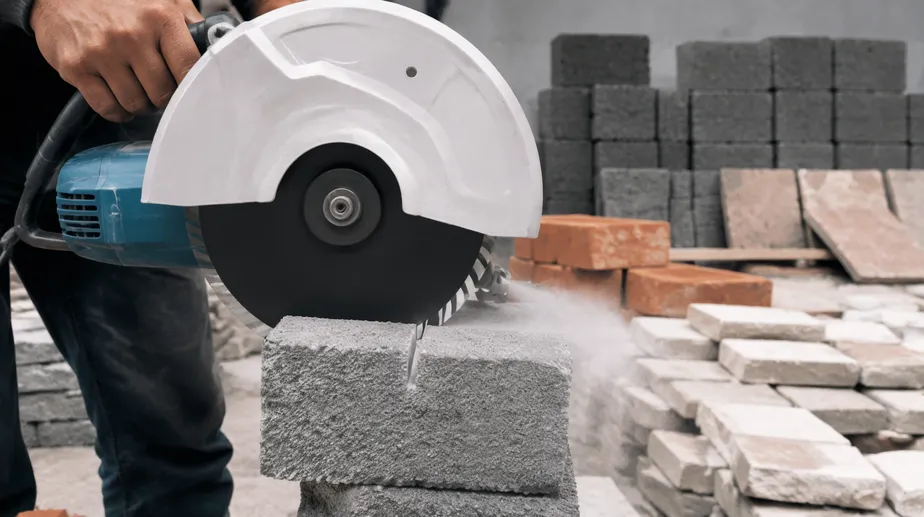
The broadest market for turbo blades. Contractors, masons, and renovation crews buy them as consumables — 5 to 20 blades per month per crew depending on workload. They're cutting brick, block, pavers, concrete, natural stone cladding, and roof tiles.
The turbo rim handles all of these acceptably well, so the crew carries one blade type instead of three.
- High reorder frequency
- Predictable demand
- Simple inventory management
Stone Fabrication (Small-Diameter Work)
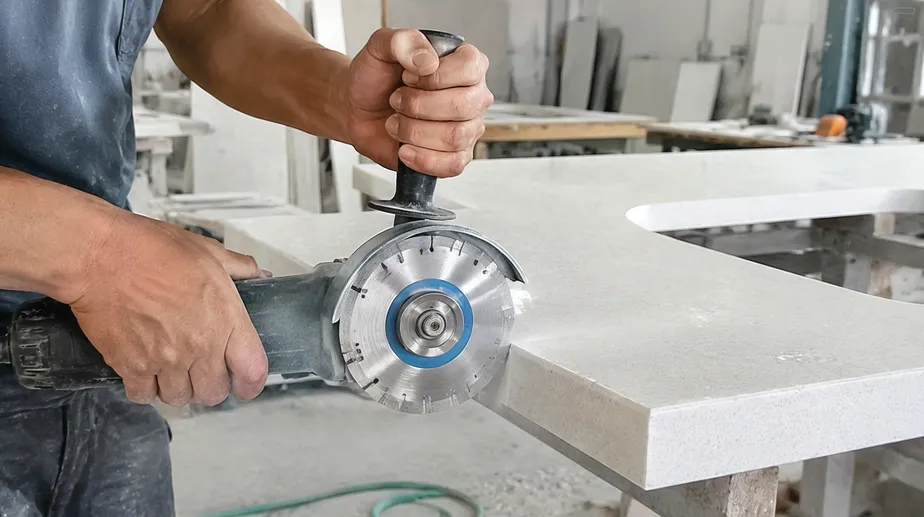
Countertop shops and tile installers running angle grinders for edge profiling, sink cutouts, and field trimming. They need a blade that cuts fast enough to stay productive but clean enough to avoid chipping visible edges. Turbo sits in that sweet spot.
Fabricators typically go through 3–6 turbo blades per week depending on the stone hardness — that's recurring revenue with minimal sales effort once you're the established supplier.
- 3–6 blades per week consumption
- Recurring with minimal sales effort
Tile and Renovation Trade

Tile setters and renovation contractors working with porcelain, ceramic, and natural stone tiles. The turbo rim's reduced chipping (compared to segmented) matters here because every chip means a wasted tile.
For distributors supplying the renovation trade, turbo blades pair naturally with tile saws and wet/dry combos — bundle them as a package sale.
- Reduced chipping vs segmented
- Natural bundle with tile saws
Landscaping and Hardscape
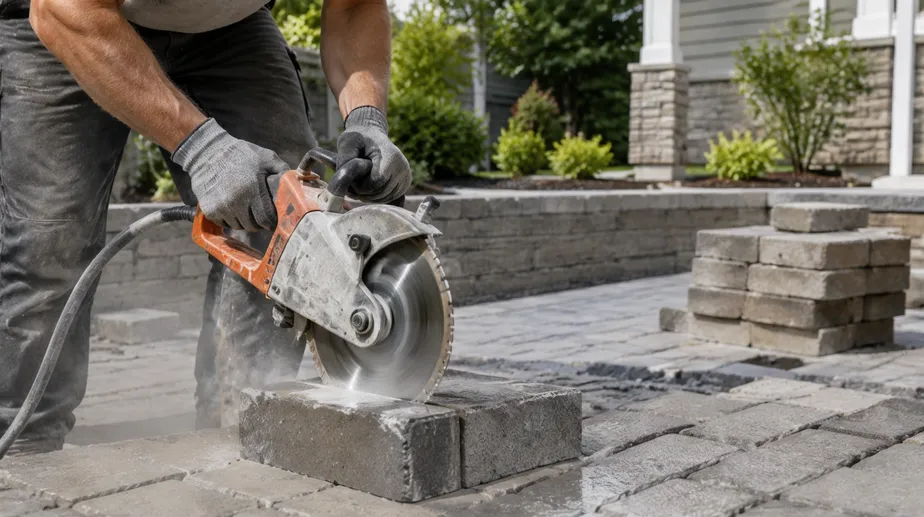
Paver cutting, retaining wall block, decorative stone installations. Seasonal in temperate markets, year-round in warmer climates.
Landscape contractors often buy at hardware stores — if you're supplying that retail channel, turbo blades are your highest-turn diamond blade SKU.
- Highest-turn SKU in retail channel
- Year-round demand in warm climates
One product line, four revenue streams
Each of these segments represents a sales channel with different ordering patterns but the same product. Your turbo blade line doesn't need ten variations — three or four diameter/formula combinations cover 80% of use cases across all four segments.
Customization: What You Can Specify on Turbo Diamond Saw Blades
We produce turbo blades as OEM/ODM — here's exactly what you control:
Formula Adjustment
Harder bond for abrasive concrete and block — the bond resists erosion so the blade doesn't wear too fast on gritty material. Softer bond for hard, dense stone like granite or engineered quartz — diamonds need to self-sharpen aggressively.
If your market primarily cuts one material type, we tune the formula to optimize life in that application rather than shipping a generic middle-ground blade.
Segment Height
Standard 10 mm for normal commercial life. Extended 12–15 mm for professional users who want fewer blade changes per shift.
Taller segments cost more per blade but deliver lower cost-per-cut — you can position them as a premium tier and capture higher margin.
Diameter & Arbor
Any standard diameter from 105 mm to 350 mm. Custom arbor sizes if your market uses non-standard machines.
We've produced 20 mm, 22.23 mm, 25.4 mm, and custom bores for specific power tool brands.
Welding Method
HF welding for wet-cut applications — lower cost, adequate for water-cooled use.
Laser welding for dry-cut or dual-purpose blades — withstands thermal cycling without joint failure.
Private Label
Your brand printed on the core, your packaging, your color coding. We maintain brand-specific tooling and artwork files for repeat orders — you don't re-submit assets each time.
MOQ for private-label turbo blades starts at 200 pieces per diameter, which is lower than many buyers expect.
Limitations to Be Aware Of
Turbo blades above 500 mm diameter aren't practical — the continuous rim design lacks the gullet ventilation needed for larger-diameter thermal management.
Below 105 mm, the turbo wave profile becomes too compressed to function properly — continuous rim is the better choice at very small diameters.
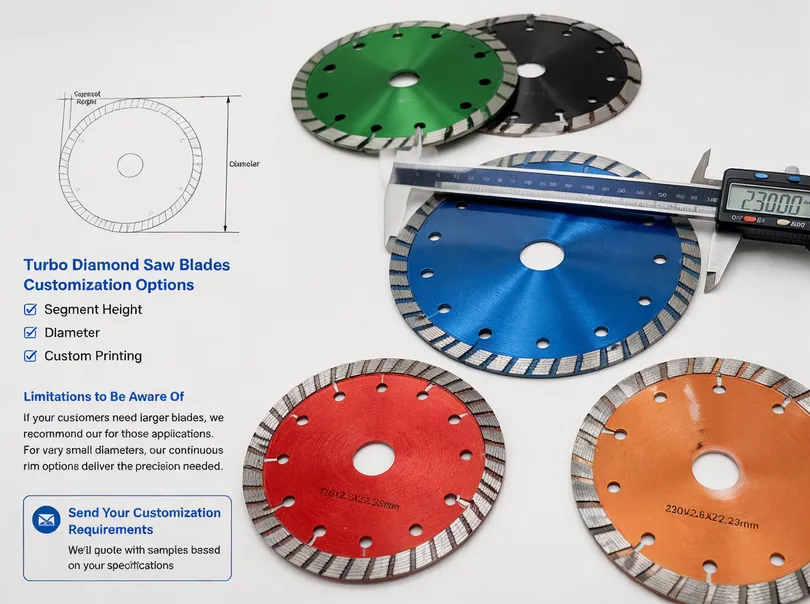
If your customers need larger blades, we recommend our segmented diamond blades for those applications. For very small diameters, our continuous rim options deliver the precision needed.
Send Your Customization RequirementsWe'll quote with samples based on your specifications
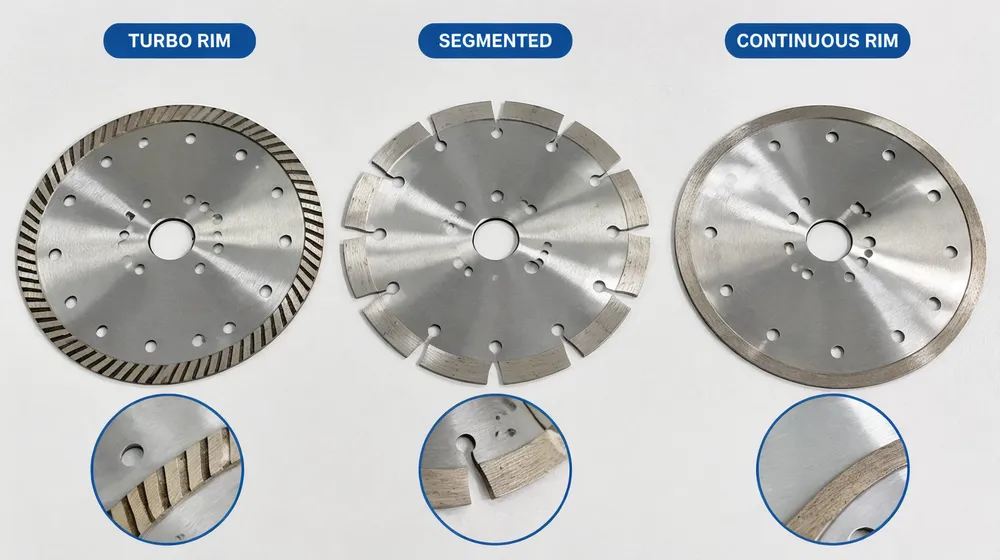
Turbo vs. Segmented vs. Continuous Rim — Helping You Stock the Right Mix
Your customers ask "which blade do I need?" — here's the decision logic, and what it means for your inventory:
| Factor | Turbo Rim | Segmented | Continuous Rim |
|---|---|---|---|
| Cut Speed | Fast | Fastest | Slowest |
| Edge Quality | Good — minimal chipping | Rougher — visible chip marks on brittle materials | Best — virtually chip-free |
| Cooling Efficiency | High — wave pattern creates airflow | Highest — deep gullets maximize air/water flow | Lowest — full contact, most heat |
| Best For | Mixed materials, general construction, renovation | Concrete, asphalt, aggressive masonry cutting | Porcelain, marble, decorative stone, precision tile work |
| Wet/Dry Versatility | Both (with correct welding method) | Both | Primarily wet |
| Your Stocking Decision | High-volume all-purpose SKU | Specialist SKU for heavy construction customers | Specialist SKU for tile/stone finish customers |
The Commercial Implication
Turbo blades are your core SKU. Segmented and continuous rim are specialist additions for customers with specific needs.
If you're entering the diamond blade market or expanding your range, turbo gets you the widest market coverage with the fewest SKUs.
Turbo rim — covers 60–70% of general demand
Segmented + Continuous rim for vertical-specific accounts
Need the Full Range Under One Roof?
We manufacture turbo, segmented, and continuous rim blades in the same facility. Consolidate your sourcing and reduce logistics complexity.
- Segmented blades for your heavy construction customers — concrete, asphalt, aggressive masonry
- Continuous rim blades for your tile accounts — porcelain, marble, decorative stone
- Full diamond saw blade range — browse all categories
Packaging and Container Loading for Turbo Blade Orders
Turbo diamond saw blades are compact and stack efficiently — they're one of the better products for container utilization.
Individual Packaging
- Each blade in a printed color box (your brand or CLSEG standard)
- Blister packs available for retail/display channel
- Inner protective sleeve prevents segment damage during handling
Carton Packing
- 105–125 mm blades: 50 pcs/carton
- 230 mm blades: 20 pcs/carton
- 350 mm blades: 10 pcs/carton
- 10–50 blades per carton depending on diameter
Container Loading
- 20GP container: approx. 15,000–25,000 pcs of 115–125 mm turbo blades
- Mixed-SKU loads typical for first orders
- Palletized and loading-optimized for any volume
Lead Time
- Standard formulas, popular diameters: 20–30 days from order confirmation
- Private-label (first order): +5–7 days for artwork & printing setup
- Repeat orders use stored templates — standard lead time maintained
Low freight cost per unit — air freight viable for urgent restocking
Turbo blades are lightweight relative to large-diameter saw blades, so your freight cost per unit is low. This makes air freight viable for urgent restocking — we've shipped sample orders and emergency fills via air express when distributors ran into unexpected demand spikes.


Frequently Asked Questions
What is the minimum order quantity for turbo diamond saw blades?
50 pieces per specification for standard formulas and CLSEG-branded packaging. Private-label orders start at 200 pieces per diameter to cover packaging setup costs.
For market-entry testing, we ship sample sets of 5–10 pieces at production pricing so you can trial with your customers before committing to bulk.
Can a turbo diamond saw blade cut granite effectively?
Yes — with the correct bond formula. We produce turbo blades specifically formulated for hard natural stone. The key is using a softer bond matrix so diamonds self-sharpen against the non-abrasive granite surface.
A turbo blade formulated for concrete (hard bond) won't perform well on granite — it glazes. Tell us the primary material your customers cut and we match the formula accordingly.
Common sourcing mistake: Buyers ordering "turbo blades" without specifying the target material, then getting a generic concrete formula that underperforms on stone.
Turbo blade vs. turbo cutting disc — what's the difference?
Nomenclature overlaps in the market, but in our catalog: turbo diamond saw blades are the 105–500 mm range designed for angle grinders, circular saws, and masonry saws. Our turbo diamond cutting discs cover the same rim type in smaller-diameter, thinner-core configurations optimized for handheld grinders.
The rim technology is identical — the difference is core thickness, arbor size, and target machine compatibility.
If you're sourcing both, we consolidate under one order for simplified logistics.
How long does a turbo diamond saw blade last compared to segmented?
On the same material and same machine, a turbo blade typically delivers 10–15% fewer linear meters than a segmented blade of equivalent diamond specification because the continuous rim has lower cooling efficiency under sustained load.
The trade-off: the turbo blade produces a cleaner cut with less chipping.
Choose Turbo When:
Edge quality matters — stone cladding, pavers with exposed faces, decorative block. Slight life reduction is worth the edge quality gain.
Choose Segmented When:
Buried or concealed cuts — concrete slabs, structural masonry. Segmented blades are more cost-effective here.
What RPM should turbo diamond saw blades run at?
Operating speed depends on diameter. The safe maximum peripheral speed for our turbo blades is 80 m/s (standard) to 100 m/s (MPA-rated professional grade).
| Blade Diameter | Max RPM (approx.) |
|---|---|
| 115 mm | 12,000–13,000 RPM |
| 230 mm | 6,500–7,000 RPM |
We provide a recommended RPM table with every shipment — matching blade RPM to your customers' specific power tools.
Running below max RPM is fine and often preferable for controlled cuts; exceeding it risks segment detachment.
Do you offer turbo blades with laser welding for dry cutting?
Yes. Our laser-welded turbo blades handle intermittent dry cutting and mixed wet/dry use without joint failure. The turbo rim's wave profile helps with air cooling during dry cuts — moving more air across the segment face than a flat continuous rim would.
Ideal markets: Job sites that commonly lack water supply — renovation interior work, elevated cutting on scaffolding.
MOQ and pricing are slightly higher than HF-welded equivalents due to the welding process cost, but the difference is modest at production volumes.
Start with Your Material, Your Machine, Your Volume
The fastest path to a turbo diamond saw blade quote: tell us three things.
Primary Material
What are your customers cutting most? Concrete, granite, brick, pavers, mixed, specific stone types?
Machine Types & Diameters
What size blades do they mount? 115 mm angle grinder, 230 mm masonry saw, 350 mm table saw?
Volume
Monthly or quarterly quantity expectations, even approximate.
We'll respond within 48 hours with a recommended formula, spec sheet, FOB pricing, and — if you want — sample blades for your own testing.
Most new turbo blade partners start with 3–4 core diameters on one formula, test with their customers for a month, and expand from there. We keep your formula on file for seamless reorders.
Explore More Diamond Saw Blades
Related products from our catalog