

Gang Saw Diamond Segments Batch-Consistent Sintering for Multi-Blade Frame Operations
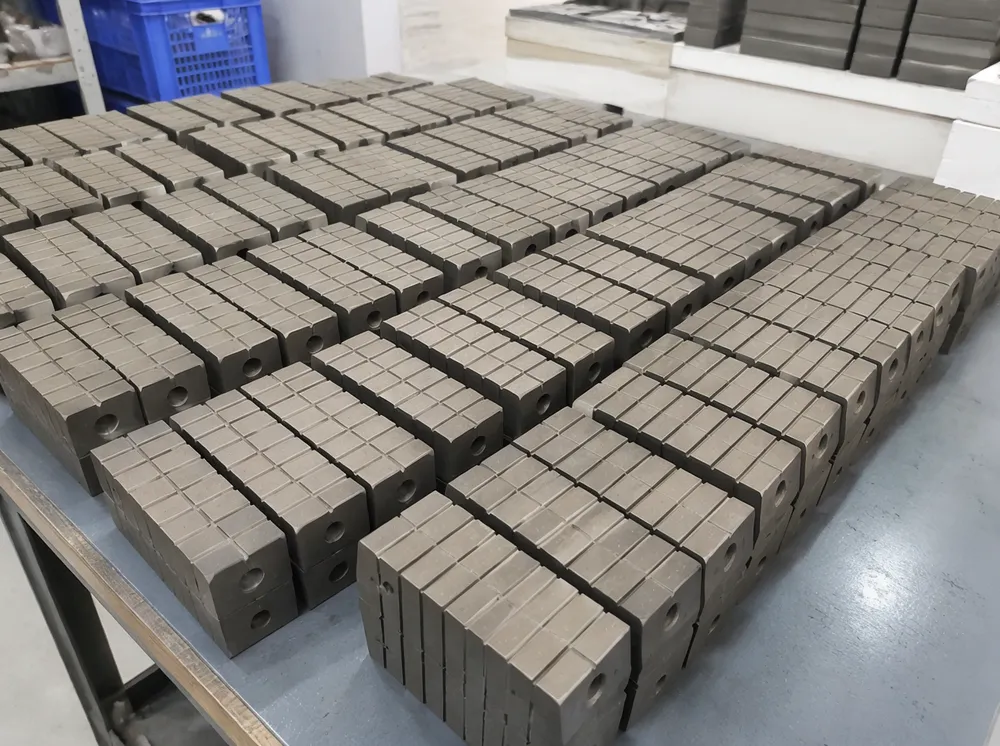
When 60–80 segments run on the same frame cutting a single stone block, uniformity isn't a preference — it's the difference between sellable slabs and scrap. We sinter gang saw segments under locked automated profiles specifically designed for frame-level consistency.
±0.5 HRC hardness variance control across production batches
What Makes Gang Saw Segments a Different Manufacturing Problem
A gang saw segment isn't simply a larger version of a circular saw segment. The operational environment is fundamentally different, and the manufacturing requirements follow from that difference.
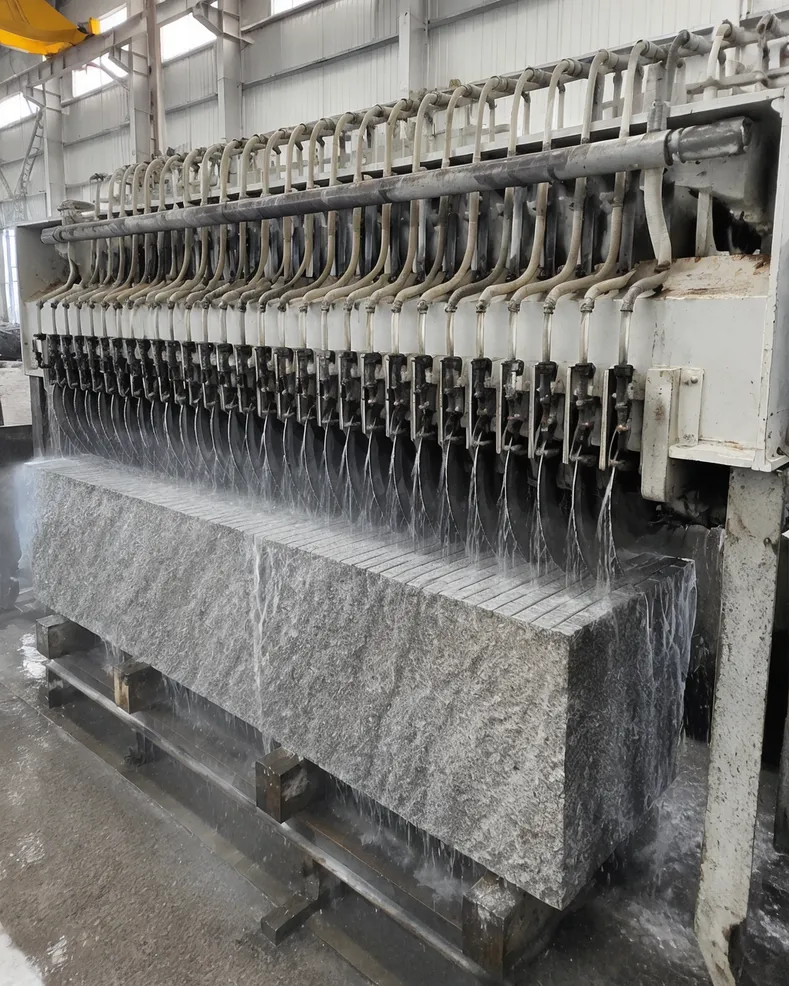
On a circular saw, one blade runs independently — if a segment is slightly harder or softer than its neighbors, the blade self-compensates through variable cutting pressure. On a gang saw frame, 60 to 100 blades cut simultaneously through the same stone block, all advancing at the same feed rate. Every segment on every blade must wear at nearly the same rate. If one blade's segments are 2 HRC harder than the rest of the frame, that blade lags behind, creates uneven slab thickness, and can crack the block during the final cuts.
We've seen buyers lose entire blocks of premium granite — blocks worth thousands of dollars — to segment inconsistency that wouldn't even be noticeable on a single circular saw.
This is why we maintain tighter production tolerances on gang saw segments than on any other segment type we produce. Every batch is sintered under the same locked furnace profile, and we pull more frequent samples for hardness and density testing. The target is ±0.5 HRC hardness variance across a batch, and ±0.1 g/cm³ density variance. These aren't aspirational numbers — they're the reject thresholds. Segments outside these windows don't ship.
Circular Saw Operation
- Single blade runs independently
- Variable cutting pressure self-compensates for segment hardness differences
- Minor segment inconsistency is tolerable — blade adjusts automatically
Gang Saw Frame Operation
- 60–100 blades cut simultaneously through the same block
- All blades advance at the same feed rate — no individual compensation
- 2 HRC deviation = uneven slabs, cracked blocks, thousands of dollars in scrap
Technical Specifications for Gang Saw Segments
Specifications shown are industry-standard values for gang saw diamond segments. Actual specifications are calibrated per stone type and gang saw machine parameters.
Dimensions
- Segment Height
- 15 – 25 mm
- Segment Length
- 100 – 180 mm
- Segment Width (Kerf)
- 3.2 – 7.0 mm
- Geometry
- Flat-top, sandwich
Diamond & Bond
- Grit Size
- 30/35 – 50/60 mesh
- Concentration
- 20% – 35%
- Bond Hardness
- HRC 18 – HRC 30
- Welding Method
- HF / Silver braze
Compatibility
- Blade Length
- 1600 – 3500 mm
- Stone Types
- Granite (all hardness grades), marble, limestone, travertine
- Welding Options
- High-frequency induction welding, silver brazing, laser welding (on request)
Stone-Specific Segment Selection
Gang saw segments aren't universal. The bond matrix, diamond concentration, and grit selection must be tuned to the specific stone type and its abrasiveness. Here's how the formulation shifts across stone categories.
Hard Granite
Mohs 6.5–7 | Low abrasiveness
- Softer bond matrix (HRC 18–22) for consistent diamond exposure
- Higher diamond concentration (30–35%)
- Coarser grit (30/35 mesh) for aggressive cutting
- Examples: Black Galaxy, Absolute Black, Baltic Brown
Medium Granite
Mohs 5.5–6.5 | Moderate abrasiveness
- Medium bond hardness (HRC 22–26)
- Standard concentration (25–30%)
- Mid-range grit (40/45 mesh) balances speed and life
- Examples: Rosa Beta, Giallo Fiorito, Luna Pearl
Marble & Soft Stone
Mohs 3–5 | High abrasiveness
- Harder bond matrix (HRC 26–30) to prevent premature wear
- Lower concentration (20–25%) — less diamond needed
- Finer grit (50/60 mesh) for smoother slab surfaces
- Examples: Carrara, Crema Marfil, Travertine
Not sure which formulation you need?
Send us a sample of your stone or tell us the quarry name and typical block dimensions. We'll recommend the bond-diamond combination based on testing data from similar stones in our production history.
Segment Geometry & Design Variants
The shape and internal structure of a gang saw segment directly affects cutting efficiency, coolant flow, and slab surface quality. We produce three primary geometry variants.
Flat-Top Segments
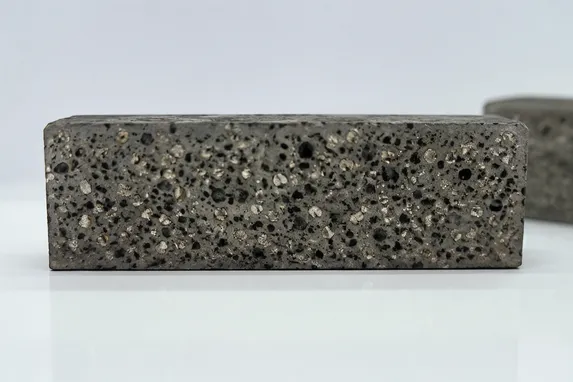
Standard rectangular profile with uniform diamond distribution throughout the matrix. The workhorse geometry for most gang saw applications.
- Predictable, linear wear pattern
- Simplest to manufacture with tight tolerances
- Best cost-per-square-meter ratio on medium stone
Sandwich Segments
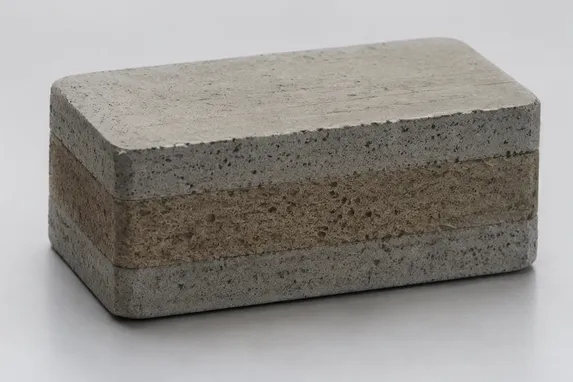
Multi-layer construction with a softer center matrix flanked by harder outer layers. The center wears faster, creating a natural coolant channel during cutting.
- Self-clearing coolant channel reduces heat buildup
- Better swarf evacuation on deep cuts
- Preferred for hard granites where heat is the primary failure mode
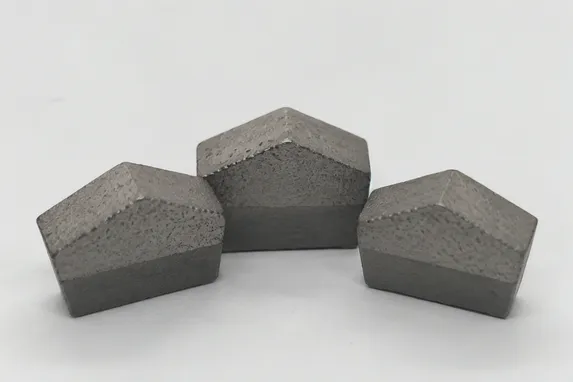
V-Shaped (Roof-Top)
Tapered top profile that concentrates cutting force at the center point. Provides faster initial penetration and reduces blade deflection during entry.
- Faster block entry — reduces initial cutting time
- Reduced blade wobble on first contact
- Transitions to flat cutting surface after initial wear
Performance Metrics & Expected Lifespan
Real-world performance data from production environments. These figures represent typical ranges — actual results depend on stone hardness, machine condition, feed rate, and coolant management.
| Stone Type | Cutting Speed | Segment Life | Yield (m²/segment) |
|---|---|---|---|
| Hard Granite | 15–25 cm/hr | 800–1200 m² | 3.5–5.0 m² |
| Medium Granite | 25–40 cm/hr | 1200–1800 m² | 5.0–7.5 m² |
| Soft Granite | 35–55 cm/hr | 1500–2500 m² | 6.5–10.0 m² |
| Marble | 40–70 cm/hr | 2000–3500 m² | 8.0–14.0 m² |
* Performance data collected from partner quarries and processing plants across India, Brazil, and Europe. Cutting speed measured as vertical descent rate through block.
Quality Control & Manufacturing Process
Gang saw segments demand manufacturing discipline that goes beyond standard diamond tool production. Here's what our process looks like from powder to packaged segment.
Powder Blending
Metal powders (Co, Fe, Cu, Ni, WC) weighed to ±0.1g accuracy and blended in V-mixer for minimum 4 hours. Diamond added last to prevent coating damage.
Cold Pressing
Powder compacted in graphite molds at controlled pressure. Sandwich segments require multi-fill technique with precise layer boundaries.
Hot Press Sintering
Sintered under locked furnace profile — temperature, pressure, and time parameters are fixed per formula. No operator override permitted during cycle.
QC & Inspection
Every batch tested for hardness (Rockwell C), density (Archimedes method), dimensions (digital caliper ±0.01mm), and visual inspection for cracks or voids.
Batch Acceptance Criteria
Common Gang Saw Problems & How We Solve Them
Most gang saw segment failures come down to three root causes: inconsistency, wrong formulation, or poor coolant management. Here's how each manifests and what we do differently.
Uneven Slab Thickness
Slabs come out at different thicknesses across the block. Some are 20mm, others 22mm from the same cut cycle. Material waste increases and calibration time doubles.
Root cause: Segment hardness variation causing different wear rates across blades.
Our Solution
Batch hardness controlled to ±0.5 HRC across all segments in a set. Every segment in your order comes from the same sintering run, ensuring identical wear rates blade-to-blade. Result: consistent slab thickness within ±0.3mm.
Segment Detachment / Loss
Segments break away from the steel blade core during cutting. This damages the block, ruins adjacent blades, and creates a safety hazard in the pit.
Root cause: Poor brazing quality, incorrect gap design, or thermal shock from inadequate coolant flow.
Our Solution
Segments manufactured with precision base geometry for optimal silver brazing contact area. We provide detailed brazing guidelines with every order and offer pre-brazed blade assemblies for customers who prefer turnkey solutions.
Premature Diamond Pullout
Diamonds are lost before they've done useful cutting work. Segment life drops by 30–50% compared to spec. Cost per square meter becomes uneconomical.
Root cause: Bond matrix too soft for the stone, or sintering temperature damaged diamond crystal structure.
Our Solution
Bond hardness matched to stone abrasiveness using our proprietary matrix selection system. We use high-thermal-stability diamonds (TI ≥ 30) and controlled sintering profiles that never exceed diamond degradation thresholds. Diamond retention verified via cross-section microscopy on sample segments.
Blade Deviation / Wandering
Blades don't track straight through the block. Cut surfaces show waviness or curvature. Slabs require excessive calibration grinding, eating into margin.
Root cause: Uneven segment wear profile or asymmetric diamond distribution creating lateral cutting forces.
Our Solution
Sandwich segment construction with calibrated layer thicknesses ensures symmetric wear. Diamond concentration and mesh size are balanced across all layers. Dimensional tolerances of ±0.05mm guarantee consistent blade kerf throughout the cut cycle.
How to Order: Specification Guide
To recommend the right segment for your operation, we need specific details about your setup. Here's what to have ready when you contact us.
Required Information
-
Stone type & origin
e.g., Black Galaxy granite from Andhra Pradesh, India
-
Gang saw make & model
e.g., Breton Megasaw 72-blade, Pedrini M595
-
Number of blades per frame
Determines total segment quantity per set
-
Segment dimensions
Length × height × thickness (mm), or blade core thickness if unknown
-
Segments per blade
Typically 18–26 depending on blade length
-
Target slab thickness
Standard 20mm, 30mm, or custom
Helpful Extras
-
Current segment brand & performance
Helps us benchmark and improve on what you're using
-
Block size (typical)
Height × length × width of blocks being cut
-
Monthly consumption
Helps us plan production scheduling and inventory
-
Specific issues you're facing
Uneven wear, low life, slow cutting — helps us target the solution
-
Photos of worn segments
Wear patterns tell us a lot about what's happening in the cut
Tip: If you're switching from another supplier, send us a sample of your current segments. We'll analyze the matrix composition and diamond quality to ensure our replacement meets or exceeds performance.
Ready to Improve Your Gang Saw Performance?
Whether you're cutting 50 blocks a month or 500, we'll match the right segment formula to your stone and machine. Get a technical recommendation within 24 hours.
Minimum order: 1 full frame set (typically 1,200–2,400 segments). Trial sets available for new customers.
Frequently Asked Questions
Quick answers to the most common questions we get about gang saw segments.
What's the difference between gang saw segments and circular saw segments?
How many segments do I need for one complete frame?
Can you match segments from another manufacturer?
What's the typical lead time for gang saw segments?
Do you offer trial quantities for testing?
What diamond quality and mesh sizes do you use?
Bond Formula Engineering for Continuous-Duty Cutting
Gang saws run 24/7 in most quarry and slab production environments. A single block cut takes 8 to 30+ hours depending on stone hardness and block dimensions. The segments must maintain consistent cutting performance from first contact through final separation — no mid-cut slowdown, no premature glazing, no uneven side wear.
We maintain a dedicated formula library for gang saw segments, separate from our circular saw and bridge saw formulas. The bond compositions are optimized for the specific conditions gang saws create: slow linear speed (typically 1.0–2.5 m/s compared to 25–40 m/s on circular saws), heavy coolant flow, low feed pressure per segment, and extremely long continuous contact time.
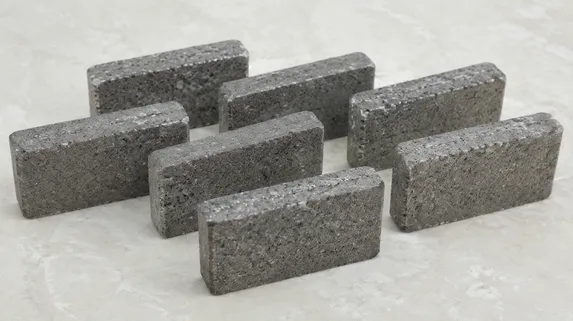
Hard Granite
Indian Tropical · Brazilian Exotics · Scandinavian High-Quartz
We use soft-bond formulas with cobalt-dominant matrices and controlled porosity. At gang saw speeds, hard stone doesn't generate enough abrasion to wear a standard bond, so we engineer the matrix to self-erode at the correct rate.
- Diamond concentration: 28–35%
- Bond type: Cobalt-dominant, controlled porosity
- Higher concentration because each exposed diamond does more work over the extended cutting cycle
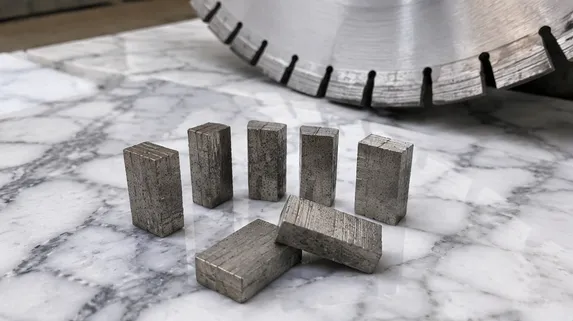
Marble & Limestone
Softer · More Abrasive · Surface Quality Critical
The bond needs to resist premature erosion during the long cutting hours. The challenge in marble isn't exposing diamonds — the stone does that easily — it's preventing the bond from wearing so fast that segment height drops unevenly.
- Diamond concentration: 20–25%
- Bond type: Iron-rich, HRC 24–30
- If segment profile degrades mid-cut, you get waviness in the slab face that requires extra polishing — a direct cost for your customer
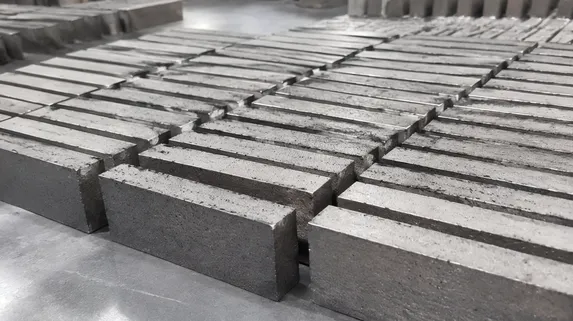
Medium-Hardness Granite
G603 · G654 · Shanxi Black — The Volume Stones
These represent the majority of global gang saw production. Our most-reordered SKU type, refined over 15+ years of field data from buyers in China, India, Turkey, Brazil, and the Middle East.
- Diamond concentration: 22–28%
- Bond type: Balanced cobalt-iron matrix
- Grit size: 40/50 mesh
Gang Saw Operating Conditions vs. Circular Saw
1.0–2.5
Linear Speed (m/s)
vs 25–40 m/s circular
8–30+
Hours per Block Cut
Continuous contact
Heavy
Coolant Flow
Constant flushing
Low
Feed Pressure/Segment
Distributed load
Batch Uniformity: The Production Process Behind ±0.5 HRC
The consistency guarantee isn't a quality promise bolted on after production — it's built into the manufacturing sequence from powder mixing through final inspection.
Powder Blending
Powder Blending
Gang saw segment batches are blended in single lots. We don't split a gang saw order across multiple mixing batches because even minor variation in powder homogeneity compounds across dozens of segments on a frame. If your order requires 5,000 segments, the entire metal bond powder batch is mixed in one run to ensure identical composition throughout.
Diamond Incorporation
Diamond Incorporation
Diamond grit is distributed into the blended powder using our automated mixing system. For gang saw segments specifically, we run extended mixing cycles — approximately 40% longer than circular saw segment batches — because the larger segment volume (compared to small-diameter segments) creates more opportunity for diamond clustering if mixing time is insufficient.
Why this matters: Clustered diamonds create localized hard spots that show up as uneven wear on the frame.
Cold Pressing
Cold Pressing
Automated cold-press machines form segment blanks at controlled pressure. We hold tighter weight tolerances on gang saw blanks (±0.3g per segment) than on standard segment types, because weight variance translates directly to density variance after sintering.
Sintering
Sintering
Fully automatic furnace cycle with locked temperature profile — typically 820–920°C for gang saw bond formulas, with controlled pressure ramps and atmosphere management. Every segment in the batch sees the same thermal history. We don't hand-load furnaces for gang saw batches; the automated loading system ensures uniform heat distribution across all positions in the furnace chamber.
Post-Sinter QC
Post-Sinter QC
This is where we verify what the process should have guaranteed. Sample segments from front, middle, and rear furnace positions are pulled for hardness testing (Rockwell C) and density measurement. If any position shows drift beyond ±0.5 HRC or ±0.1 g/cm³, the batch is flagged for expanded testing.
We've rejected batches that would pass standard segment QC because gang saw tolerances are tighter.
Full Batch Traceability
We stamp batch codes on every segment. If you ever have a field performance question — one blade on the frame wearing differently — send us the batch code and we can pull the production records, hardness test data, and sintering log for that specific segment group.
Most multi blade segment manufacturers can't do this because they don't track at this level.
±0.5
HRC Hardness Tolerance
±0.3g
Weight Tolerance per Blank
±0.1
g/cm³ Density Variance
Market Segments Where Gang Saw Segments Generate Recurring Revenue
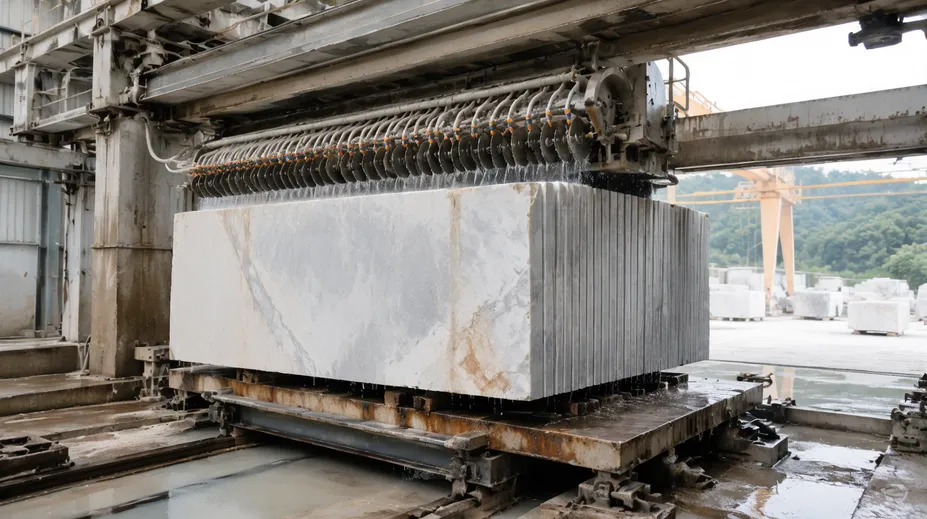
Quarry-to-Slab Processing Operations
This is the primary market for gang saw segments globally — large-scale operations cutting raw quarry blocks into calibrated slabs. These operations consume segments continuously. A single gang saw frame with 80 blades carries approximately 1,600 segments (20 per blade), and a busy slab factory runs through multiple sets per month depending on stone hardness and production volume.
If you supply into this market, your reorder cycle is predictable and frequent. Slab factories don't switch segment suppliers casually — once they've calibrated machine parameters around a specific segment formula, switching means recalibration downtime. This means your first sale, if the segment performs, locks in ongoing volume.
We help you get that first sale right by matching the formula precisely to their dominant stone type.
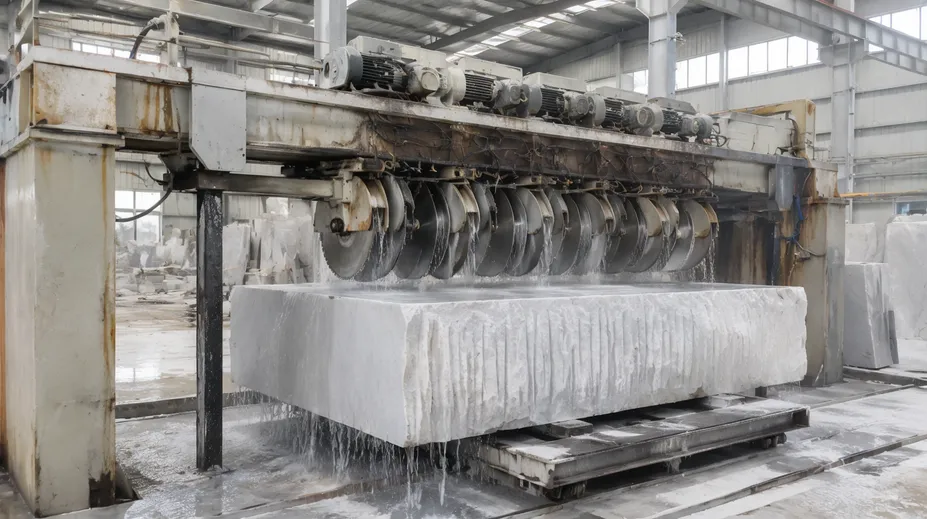
Block-Cutting Service Providers
Smaller operations that don't own quarries but buy rough blocks and cut them for resale to fabrication shops. These buyers typically run 1–2 gang saw frames and are more price-sensitive than vertically integrated quarry operations, but they also consume segments at commercial volumes.
Typical volume: 2,000–5,000 segments annually
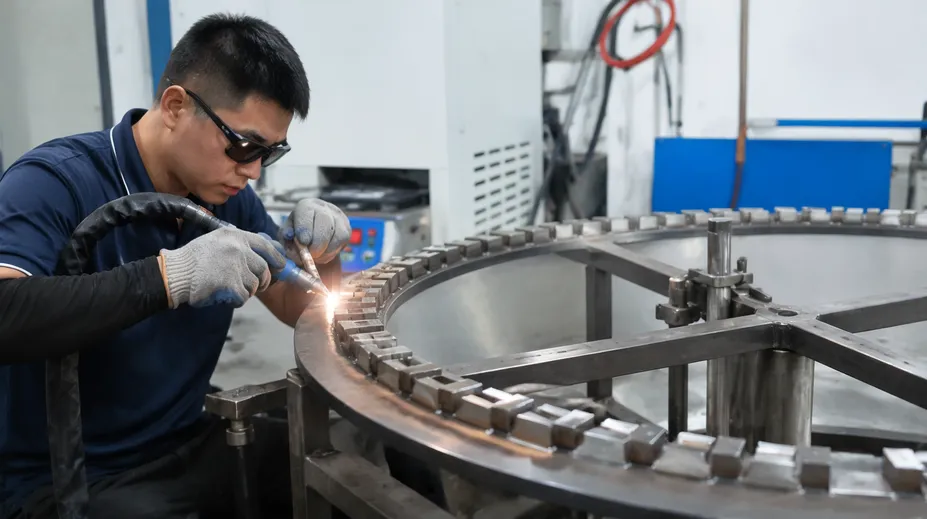
Blade Manufacturers (OEM Segment Supply)
If you manufacture gang saw blades but don't sinter your own segments, this is your supply relationship. We produce gang saw diamond segments for blade manufacturers who weld them onto their own steel frames. You get the consistency your brand requires without investing in sintering infrastructure.
Your formula stays exclusive to your account.
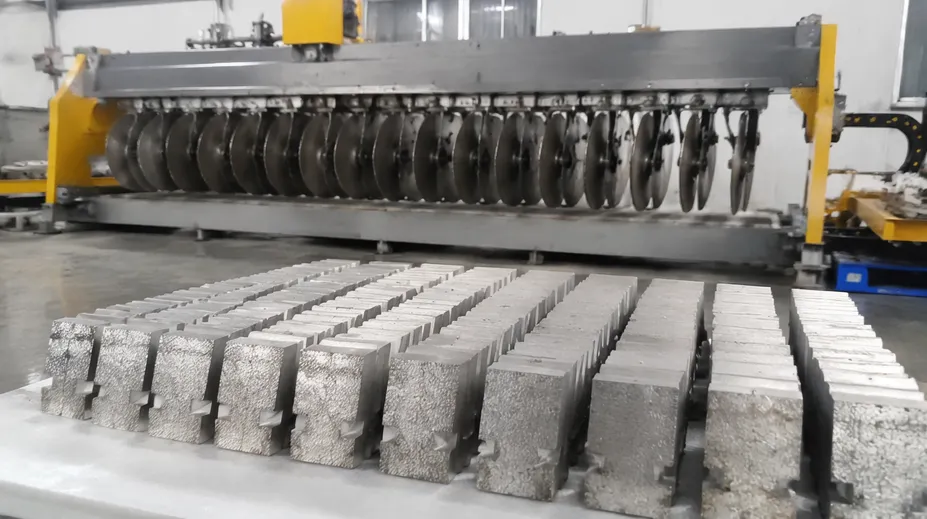
Equipment Dealers and Aftermarket Distributors
Dealers who sell gang saw machines (Pedrini, Breton, Gaspari Menotti, and Chinese-manufactured frames) also supply consumable segments to their installed base. If you're selling machines, the segment aftermarket is a recurring revenue stream with significantly higher margins than equipment sales.
We supply segments compatible with all major frame configurations — provide the blade dimensions and slot count, and we'll match the geometry.
Customization Parameters and Practical Limitations
What we routinely customize
Bond Formula
Per stone type — specify the stone and we match from our library or develop a new formula.
Segment Dimensions
Height, length, width adjustable within our spec ranges. Non-standard lengths (e.g., 140 mm for a specific frame configuration) are standard workflow.
Diamond Concentration
Adjustable based on your preferred balance between cutting speed and segment life.
Diamond Grit Specification
Mesh size, crystal quality grade, and thermal stability class.
Segment Geometry
Flat-top rectangular or sandwich-layer construction (alternating hard/soft bond layers for improved debris clearance).
Packaging
Your branded packaging, your part numbers, your QC documentation format.
What affects MOQ and lead time
Existing Library Formula
- 500-segment minimum
- Ships within 15–25 days
New Formula Development
- 1,000-segment minimum on first order
- Add 2–4 weeks for formula development and validation
- Reorders ship at standard lead time
Non-Standard Geometry
- Requires tooling modification
- Add 1–2 weeks on first order
- No impact on reorders
What we don't do
Segments shorter than 15 mm height for gang saw application
Below this height, the welding joint strength and segment life aren't commercially viable for continuous-duty gang saw operation.
Single-piece sample orders for gang saw segments
The minimum practical test quantity is one full blade set (typically 16–24 segments per blade) so you can evaluate real-world frame performance, not isolated lab cutting.
This minimum test quantity isn't us being difficult — it's because testing 2–3 gang saw segments on a bench cutter doesn't tell you anything useful about frame-level uniformity, which is the whole point of gang saw segment quality. We'd rather you test a meaningful quantity and make a confident decision.
Ready to customize?
Send your gang saw frame specifications for a custom quote.
How We Ship Gang Saw Segments for Frame Installation
Gang saw segments are heavy relative to their size (dense metal matrix), and they're precision-ground on the welding face. Shipping damage to the base surface means welding failures in the field — a problem that shows up weeks later when a segment separates mid-cut.
Layered Separation Packing
Segments packed in stacked layers with separator sheets to prevent base-surface contact damage. Each layer is isolated so precision-ground welding faces never touch adjacent segments during transit.
Moisture Barrier Wrapping
Essential for ocean freight — cobalt-rich bond matrices can surface-oxidize in humid container conditions, which weakens the brazing/welding interface. Full moisture barrier wrapping prevents oxidation across multi-week sea transits.
Weight-Rated Cartons with Internal Bracing
Gang saw segment shipments are dense and heavy; standard cartons deform under the weight over a multi-week sea transit. Our cartons are weight-rated with internal bracing engineered for the actual load density.
Batch-Code Labeling
Clear batch-code labeling on each inner package so you can match segments to blades systematically during installation. Ensures full traceability from production lot through to frame position.

Container Loading Reference
A standard 20GP container holds approximately 15–18 metric tons of gang saw segments (varies by segment dimensions). For reference, that's roughly 40,000–60,000 pieces of typical 140×15×6mm segments.
Most gang saw segment buyers ship 1–2 pallets per order (2,000–10,000 segments) as part of mixed containers that include circular saw blades and other tooling.
Frequently Asked Questions
Answers to the technical and commercial questions we receive most often from gang saw segment buyers.
How do I determine the correct gang saw segment formula for a specific granite variety?
Send us the granite trade name, quarry origin (if known), and ideally a hardness measurement (shore hardness or Mohs scale). Different granites with similar names from different quarries can have meaningfully different abrasiveness — G654 from Fujian cuts differently than G654 from Mongolia because the mineral composition varies.
We'll match from our formula library based on the specific variety's characteristics. If we haven't previously optimized for that exact stone, we develop a test formula and ship a blade set for field validation before committing to production volume.
Timeline: The initial matching process takes 3–5 business days; test segment production adds 2–3 weeks.
What causes uneven slab thickness in gang saw cutting, and how does segment selection prevent it?
Uneven slab thickness almost always traces back to segment hardness variance across the blade set. If blades at the edge of the frame carry harder segments than blades at the center, the edge blades cut slower, creating a tapered block profile.
The fix is manufacturing-side: consistent sintering across the entire batch. We control this through:
- Single-lot powder mixing
- Automated pressing with tight weight tolerances
- Locked sintering profiles
Post-production hardness testing across multiple sample positions in the furnace catches any drift before shipment.
Diagnostic tip: If you're currently experiencing thickness inconsistency, compare segment hardness across 5–6 random blades on your frame — variance above 1.0 HRC between blades is likely contributing.
What is the typical segment life expectancy on a gang saw, and what factors shorten it?
Segment life varies enormously by stone type:
8–15 m²/mm
Medium-hardness granite
(G603/G654 class)
4–8 m²/mm
Very hard granites
(Absolute Black, Blue Pearl)
12–25 m²/mm
Marble & limestone
Primary factors that shorten life beyond formula mismatch:
- Insufficient coolant flow — causes thermal damage to diamond crystals
- Excessive feed rate — overloads segment capacity
- Contaminated cooling water — abrasive particles in recycled water accelerate bond erosion
If your customers report shorter-than-expected life, get us the cutting parameters and we can usually identify whether it's a formula issue or a machine-settings issue.
Can you supply gang saw segments compatible with both silver-brazed and high-frequency welded frames?
Yes. The segment itself is the same product — the difference is in the base surface preparation.
Silver Brazing
Base ground to a specific flatness and surface roughness that promotes brazing alloy flow.
High-Frequency Welding
Smoother finish for electromagnetic coupling. Different surface preparation optimized for HF energy transfer.
When you order, specify your welding method and we'll prepare the segment bases accordingly. If you're supplying into markets where both frame types are in use, we can split a batch between the two preparations at no additional cost.
What is the minimum order quantity for gang saw segments, and do you offer trial quantities?
Standard Formulas
500 segments min.
Custom Formula (New Dev)
1,000 segments min. (first order)
For trial evaluation, we recommend ordering one full frame set — typically 1,200–2,000 segments depending on your machine configuration — so you can evaluate real frame-level performance over a full production cycle.
We don't offer 10-piece sample packs for gang saw segments because isolated bench testing doesn't replicate the multi-blade uniformity conditions that actually matter. The trial investment is meaningful, but it gives you a reliable basis for annual volume commitment.
Sibling Products: Other Segment Types in Our Line
If your business covers multiple stone processing operations beyond gang saw block cutting, we produce segments across the full application range.
Granite Diamond Segments
Formulas for circular saw blades (350–3500mm) cutting granite slabs, countertops, and fabrication work. Different operational profile from gang saw — higher linear speed, shorter cuts, single-blade operation.
View Granite SegmentsMarble Diamond Segments
Optimized for the softer stone matrix and surface-finish requirements of marble processing. Cobalt-dominant bonds with controlled porosity for clean cuts.
View Marble SegmentsCustom Diamond Segments
For applications outside our standard categories: unusual stone types, non-standard geometries (Arix, turbo, stepped-face), or specific OEM requirements that need ground-up formula development.
View Custom SegmentsConsolidate your segment sourcing under one manufacturer. One formula library, one QC standard, one engineering team for troubleshooting — regardless of segment type.
Start With Your Frame Configuration
If you're evaluating gang saw segment suppliers, here's what we need to give you a specific recommendation:
Your gang saw machine type and frame configuration (number of blades, blade length)
The stone type(s) you're cutting or supplying into
Your current segment dimensions (length × height × width) — or the machine manual spec if you're setting up new
Your welding method (high-frequency or silver brazing)
Approximate annual segment consumption
What You'll Receive
We'll respond with a formula recommendation, pricing per segment at your volume, and lead time. If you're switching from another supplier due to consistency issues, send us a sample of your current segments — we can analyze the composition and offer a matched or improved alternative.
- Formula recommendation matched to your stone and machine
- Per-segment pricing at your annual volume
- Production lead time and shipping logistics
- Composition analysis of existing segments (if switching suppliers)