

Ceramic Diamond Cutting Disc Chip-Free Cuts in Porcelain, Vitrified & Standard Tile
Your tile-installer customers judge quality by cut edges. Our bond formula and rim geometry deliver clean cuts that protect your brand reputation and eliminate returns.
OEM/private label standard · 105–200 mm range · Ships to 30+ countries
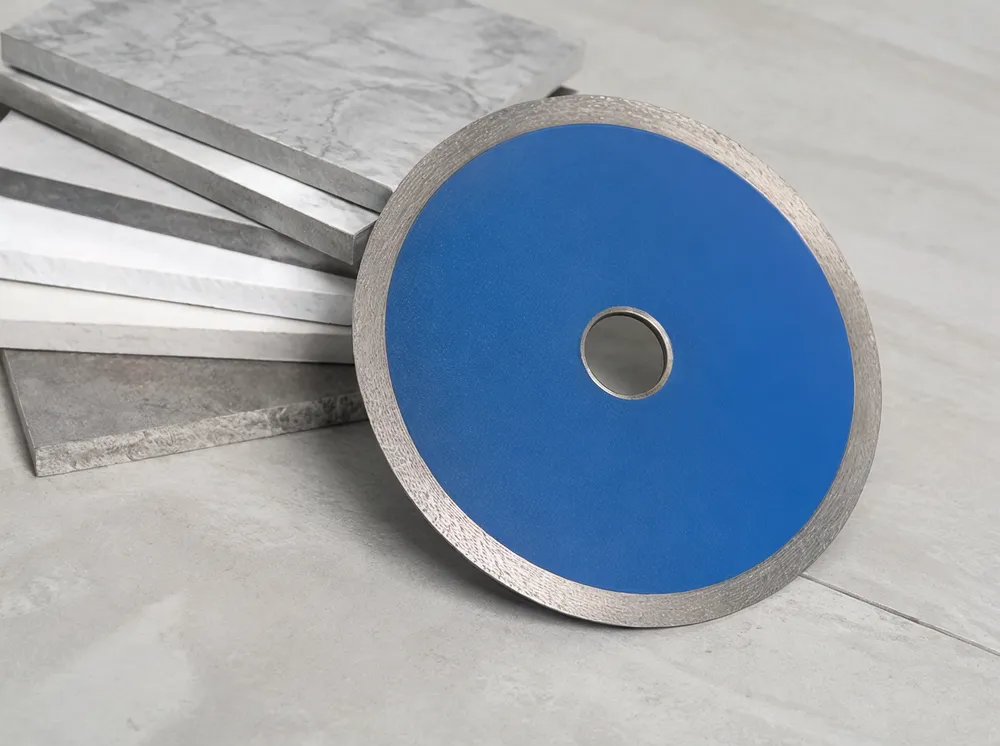
Zero-Chip Edge
Fine-grit formula
Mohs 4–8
Hardness Range
What This Blade Is — and What It's Not
A ceramic diamond cutting disc is a fine-grit, continuous-rim (or thin-turbo) blade built to cut brittle materials without micro-chipping the finished edge. Porcelain tile, ceramic wall tile, vitrified floor tile, glass mosaic — these materials shatter rather than abrade, so they demand a fundamentally different blade design than granite or concrete discs.
This isn't a general-purpose blade with a marketing label change. The diamond grit, the bond matrix, the rim geometry, and the kerf width are all purpose-developed for brittle material behavior. A blade made for concrete will destroy porcelain tile edges. A blade made for granite will overheat on dense porcelain. We've spent years isolating the formula variables that produce chip-free cuts across the tile hardness spectrum, from soft ceramic bisque tile (Mohs 4–5) through fully vitrified porcelain (Mohs 7–8).
If you're stocking tile diamond cutting discs alongside your concrete and stone disc range, this is the dedicated SKU your tile-installing customers actually need — and the one that generates the fewest complaints.
What It Is
- Fine-grit continuous-rim blade
- Purpose-developed bond matrix
- Chip-free cuts on brittle materials
- Covers Mohs 4–8 tile spectrum
What It's Not
- Not a relabeled general-purpose blade
- Not a concrete disc with new packaging
- Not a granite blade that "also cuts tile"
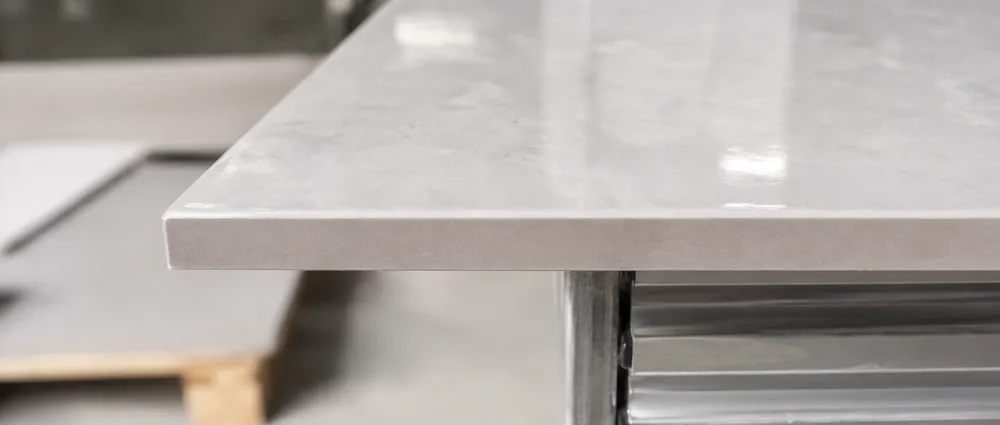
The Formula Problem Most Buyers Don't See Until Returns Start
Ceramic tile cutting disc performance is invisible until it fails. Two discs look identical on a shelf — same diameter, same continuous rim profile. But one produces glass-smooth edges on porcelain and the other micro-chips every cut. The difference is entirely in the formula and grit spec, which you can't see or test without cutting.
We run a dedicated formula set for our ceramic tile cutting disc range, separate from our granite, concrete, and general stone formulas:
Diamond Grit
60/80 – 80/100 mesh synthetic diamond — finer than what we use for granite (40/50 mesh).
Finer grit means more cutting points per unit area, lower impact force per crystal, and smoother edge finish. We specify high thermal stability grit grades because porcelain cuts generate concentrated heat in a narrow kerf.
Bond Matrix
Fe-Cu-Sn medium-soft matrix with controlled porosity.
The bond must wear evenly to keep fresh diamond exposed, but not so soft that segments erode prematurely on abrasive glazed tiles. We calibrate bond hardness against the glazed-vs-unglazed ratio of tiles in each target market — European large-format porcelain panels behave differently than Southeast Asian standard-format glazed tiles.
Rim Geometry
Continuous / Thin-Turbo configurations available.
Continuous rim for standard-duty tile cutting (smooth, uninterrupted diamond edge for maximum edge quality). Thin-turbo rim for faster cuts in thicker porcelain where some speed advantage is needed without sacrificing too much finish quality. Both configurations available across our size range.
Dedicated Formula Depth
We maintain four sub-formulas within the ceramic tile range alone — each tuned for a different tile hardness/thickness combination. Most factories run one generic "tile blade" formula. The result shows up in your return rate.
4
Sub-formulas
vs 1
Industry typical
Tell us what your end users cut — we'll recommend the right sub-formula.
Technical Specifications — Ceramic Tile Cutting Disc Range
Industry-standard values for ceramic tile cutting discs in this size range. Actual specifications may vary by specific model. Contact us for detailed product data sheets for your target configuration.
| Parameter | Standard Values |
|---|---|
| Diameter | 105, 110, 115, 125, 150, 180, 200 mm |
| Arbor Bore | 16, 20, 22.23, 25.4 mm (others on request) |
| Segment Thickness | 1.2–1.8 mm (narrow kerf) |
| Blade Body Thickness | 0.8–1.4 mm |
| Segment Height | 7–10 mm |
| Rim Type | Continuous, thin-turbo |
| Diamond Grit | 60/80 – 80/100 mesh (fine-grit, high thermal stability) |
| Max RPM | 12,000–14,000 RPM (diameter dependent) |
| Cutting Method | Wet recommended; dry capable on short cuts |
| Compatible Tools | Tile saws, angle grinders (4″–8″), handheld cutters, rail cutters |
| Target Materials | Porcelain tile, ceramic tile, vitrified tile, glass mosaic, sintered stone thin panels |
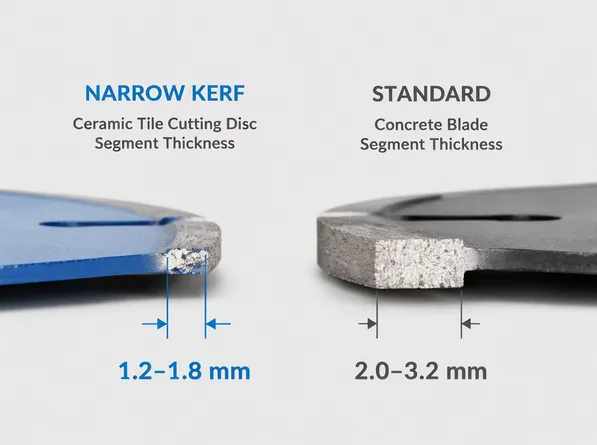
Why Narrow Kerf Matters
Our ceramic tile cutting disc range runs 1.2–1.8 mm segment thickness versus 2.0–3.2 mm for concrete and granite blades.
Narrow Kerf Benefits
- Less material displacement per cut
- Reduced lateral force on tile body
- Significantly fewer chip-outs on glazed surfaces
- Less wasted material on expensive large-format porcelain panels
Your end users save tile on every cut — which makes your blade the one they rebuy.
Request spec sheets for your target diametersManufacturing Choices That Separate This Blade from Generic "Tile" Labels
The category page covers our general manufacturing process for diamond cutting discs — sintering, welding, QC procedures. Here's what we do differently for the ceramic tile cutting disc range specifically:
Controlled Grit Distribution
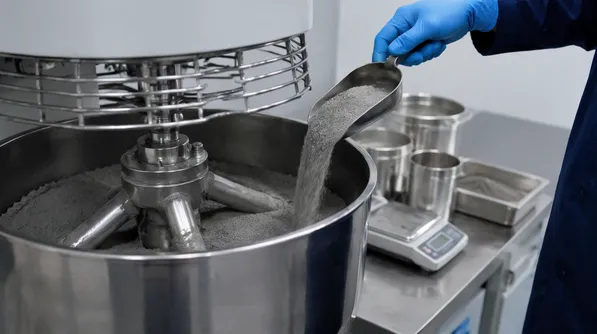
Fine-grit diamonds (60/80 and smaller) are harder to distribute uniformly in the bond matrix than coarse grit. Clumping creates hard spots in the segment — those hard spots become chip points during cutting.
We use extended mixing cycles with staged powder addition and pre-granulated diamond-bond mixtures to achieve even crystal spacing.
Distribution verified on cross-section samples under magnification during process validation runs.
Lower Sintering Temperatures

Fine-diamond segments require tighter thermal control than coarse-grit segments. Excessive sintering temperature damages smaller diamond crystals — thermal degradation begins around 700°C for standard-grade synthetic diamond.
We run our tile blade segments at the lower end of our temperature window — which slows throughput slightly but preserves diamond integrity.
Intact crystals → sharper cutting points → cleaner edges for your end users.
Thinner Core Steel, Higher Flatness
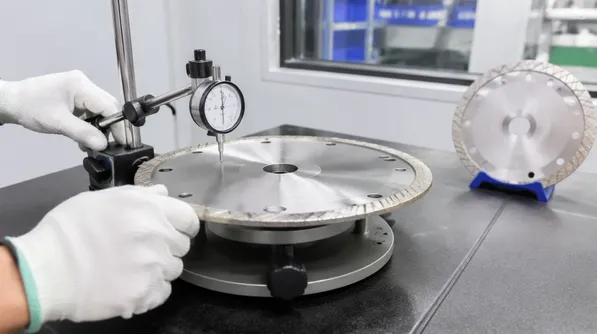
A 0.8–1.4 mm core body demands better raw steel quality than a 2.0 mm core. We specify steel with certified thickness consistency (±0.02 mm) and hardness uniformity.
Each blade is tensioned to compensate for welding-induced stress. Runout on finished ceramic tile cutting discs: ≤0.15 mm — tighter than our standard tolerance for thicker construction blades.
Less runout → less vibration at the cut face → directly reduces chipping.
Why "OEM Diamond Blade" Pricing Varies So Much
A factory that uses the same sintering profile and core steel across all products will always be cheaper per piece. But your tile-installer customers will notice the edge quality difference on the first cut — and they'll switch brands. This is where the pricing discrepancy comes from: you're paying for process differentiation that protects your brand's reorder rate.
Market Segments Where Ceramic Tile Cutting Discs Drive Reorders
Every segment below represents a channel your distribution business can serve with this product. The commercial logic varies — here's how to think about each one:
Tile and Flooring Installation Contractors
Core Volume Segment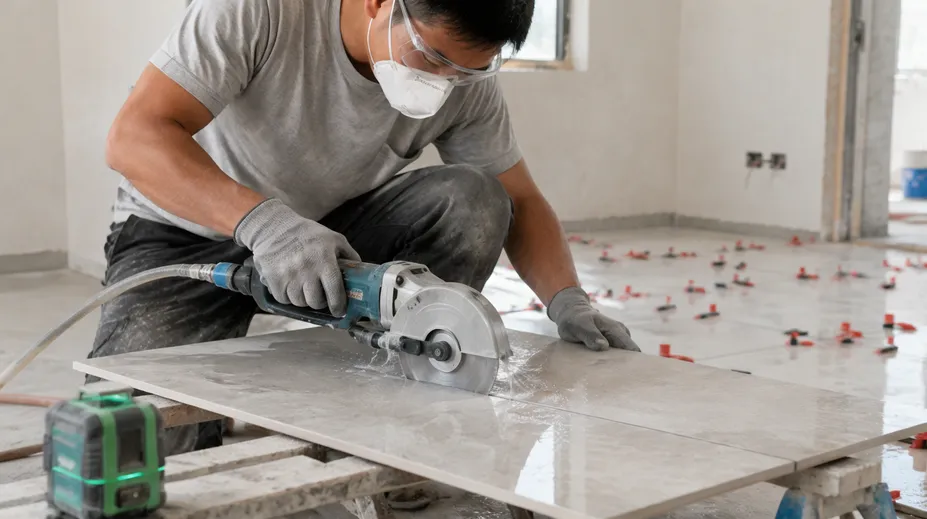
Tile installers run through ceramic diamond cutting discs at a steady rate — typically one blade per 2-3 days of active porcelain cutting on residential and commercial projects. They're the most quality-sensitive buyers in this category because edge chips are immediately visible on installed tile and result in rework (costly) or callbacks (even costlier).
When they find a blade that cuts clean, they buy it exclusively and tell other contractors. Brand loyalty in this segment is higher than general construction blades, and repeat rates reflect that.
Large-Format Porcelain Panel Fabricators
Growing Premium Segment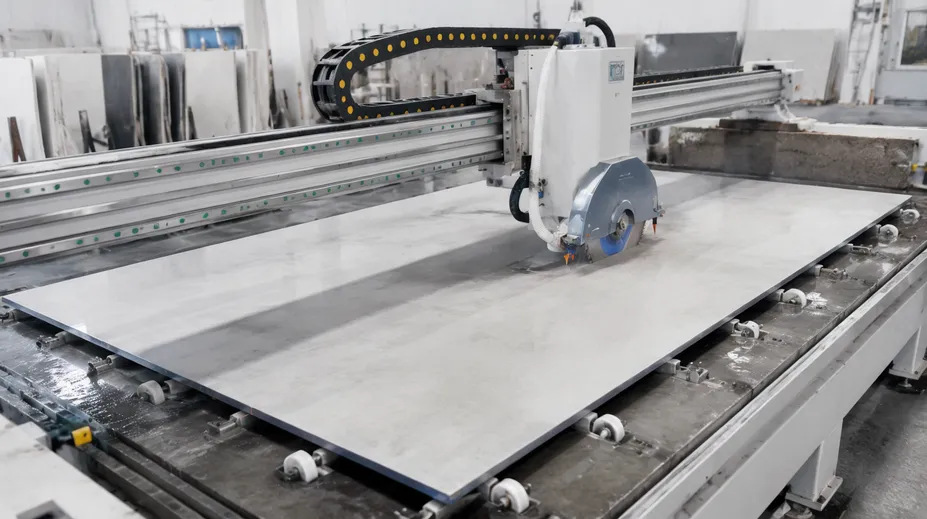
Porcelain panels (1200×2400 mm and larger, 6-12 mm thick) are replacing natural stone for countertops and wall cladding. Fabrication shops cut these panels on rail-guided saws and need blades that produce factory-edge-quality cuts to eliminate polishing.
The material is expensive — a single panel can cost $200-500 retail — so a blade that chips the edge destroys significant value. These buyers pay premium prices willingly and order in consistent monthly quantities.
Hardware Retail and Wholesale Channels
Permanent Shelf Presence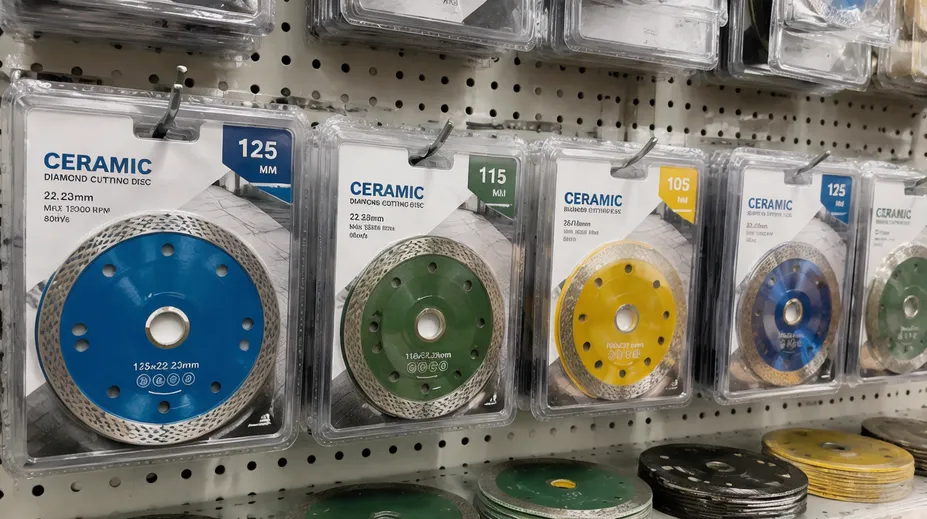
Tile cutting discs are a permanent shelf presence in any hardware store that serves the construction trades. Blister-packed retail units in 105 mm, 115 mm, and 125 mm are the standard offering.
The key commercial differentiator at retail is packaging claims backed by actual performance — "chip-free porcelain cutting" only holds as a brand promise if the blade actually delivers it. We support retail-ready packaging with your brand, your claims, your language.
Renovation and Remodeling Contractors
Versatile Volume Segment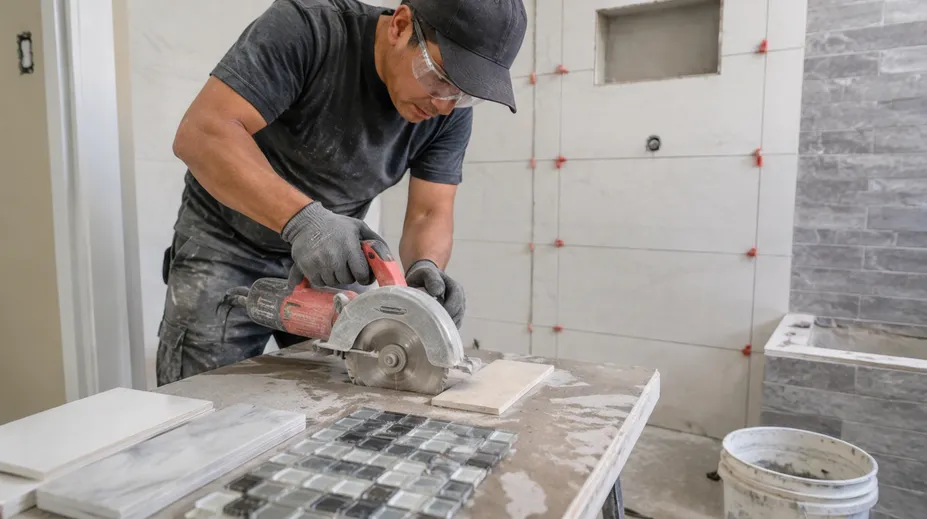
Overlaps with tile installers but distinguished by smaller, more frequent jobs and higher SKU diversity needs. Renovation contractors cut different tile types weekly — ceramic, porcelain, glass mosaic — and need a blade that handles the range without keeping multiple specialty blades on the van.
Our turbo-rim ceramic tile cutting disc configuration serves this segment well: slightly faster than pure continuous rim, versatile across tile types, good enough edge quality for renovation-grade work.
Which segment do you serve?
Tell us your channel — we'll recommend the configuration and packaging format that fits.
Get Segment-Specific RecommendationCustomization Options for Ceramic Tile Cutting Discs
We treat OEM as standard workflow. Here's what you can specify for this product specifically:
Formula Tuning
Adjust diamond concentration and grit size within the ceramic-optimized range.
- Thick porcelain (10-12 mm floor tile): Increased diamond concentration, coarser grit within the fine-grit window for faster cuts
- Thin wall ceramic (6-8 mm): Finer grit and narrower kerf for maximum edge quality
Rim Configuration
Choose the rim profile that matches your end-user application:
- Continuous rim
- Thin-turbo rim
- J-slot continuous rim (cooling slots in the rim body that improve heat dissipation on dry cuts without creating the gullet gaps that cause chipping in segmented designs)
Diameter & Arbor
Any combination in our standard range. Non-standard arbors on request:
- Full standard diameter range available
- 15.88 mm and 30 mm arbors tooled for specific regional requirements
- Custom arbor sizes on request
Core Finish & Branding
Full private-label capabilities:
- Painted cores in custom colors (RAL matching available)
- Laser-etched logos and specifications
- Diamond-pattern printing
- Full private-label packaging: blister, card, tin, or bulk box
Labeling & Compliance
Market-ready compliance support:
- Multi-language safety labels
- Country-specific certification marks
- Barcode/QR codes
- Maximum RPM marking per EN 13236 requirements
Scope Boundaries
Constraints that protect end-user value:
- No ceramic tile blades above 200 mm diameter — larger sizes are better served by our tile saw blade range for wet bridge saws
- Minimum segment height is 7 mm — below that, blade life is too short to be commercially viable for your end users
Production Parameters
MOQ
- 500 pcs/SKU — formula adjustments on standard packaging
- 2,000 pcs/SKU — custom blister pack tooling
- 200–300 pcs — trial orders in neutral packaging for performance testing
Lead Time
- 25–30 days — standard-formula production
- 35–40 days — custom formula with sample approval cycle
- 15–20 days — repeat orders on established formulas
Workflow
Application Guide
Matching the right ceramic blade specification to the right job ensures your end users get clean cuts and predictable blade life. Here's where each configuration excels.
Wall Tile Installation
Glazed ceramic wall tiles (6–8 mm thickness) in bathroom and kitchen fit-outs. Priority is chip-free edges visible at close range.
Recommended Configuration
- Continuous rim, fine grit, 115–125 mm diameter
- Narrow kerf (1.2–1.4 mm) for reduced vibration
- Wet or dry use on handheld angle grinders
Porcelain Floor Tile
Dense porcelain floor tiles (10–12 mm) including large-format slabs. Balance between cutting speed and edge finish.
Recommended Configuration
- Thin-turbo rim or J-slot continuous rim, 125–200 mm
- Higher diamond concentration for extended life in hard material
- Suitable for tabletop tile saws and handheld grinders
Mosaic & Decorative Cuts
Small-format mosaics, shaped cuts, and detail work where precision matters more than speed.
Recommended Configuration
- Continuous rim, finest available grit, 85–115 mm diameter
- Ultra-narrow kerf for intricate profiles
- Wet use recommended for longest life and cleanest edges
Renovation & Dry Cutting
On-site cuts where water is impractical — occupied buildings, upper floors, quick modifications. Speed and dust control are priorities.
Recommended Configuration
- J-slot continuous rim for heat dissipation without water
- Optimized bond hardness for dry-cut thermal management
- 115–125 mm on angle grinders with dust shrouds
Materials Compatibility
| Material | Performance | Notes |
|---|---|---|
| Glazed ceramic tile | Primary application — optimized for chip-free cuts on glaze layer | |
| Porcelain (standard) | Excellent — use higher concentration formula for dense porcelain | |
| Porcelain (rectified/polished) | Excellent — continuous rim essential for polished surface protection | |
| Terracotta | Good — softer material means faster wear; adjust expectations on blade life | |
| Glass mosaic | Good — fine grit continuous rim only; wet cutting recommended | |
| Natural stone (marble, limestone) | Functional but not optimized — see our marble blade range | |
| Granite / engineered stone | Not recommended — requires different bond and segment design |
Quality Assurance & Compliance
Every ceramic diamond blade ships with the testing and documentation your market requires. Our QC process catches problems before they reach your warehouse.
Testing Protocols
- Concentricity check: Every blade tested for runout within 0.05 mm tolerance
- Flatness measurement: Core body flatness verified to prevent wobble during cutting
- Diamond distribution: Cross-section sampling to verify uniform diamond concentration
- Cut testing: Batch samples tested on reference ceramic material for speed and chip count
- Segment bond strength: Destructive testing on sample segments to verify sintering quality
Certifications & Standards
- EN 13236: European safety standard for superabrasive products — all blades compliant
- ISO 9001: Quality management system certified manufacturing facility
- OSHA/ANSI compliance: Safety markings and maximum RPM ratings for North American market
- MPA tested: Independent third-party mechanical testing available on request
- Documentation package: Test reports, material certificates, and compliance declarations included with shipments
Every production batch is traceable to raw material lot numbers. If a quality issue is identified, we can isolate the exact batch and provide root cause analysis within 48 hours.
Ceramic Tile Cutting Disc vs. Sibling Blades — Choosing the Right SKU
Your customers might ask for "a diamond blade that cuts tile." But not every diamond disc in our range is designed for tile, and not every tile application needs the same blade. Here's how this product positions against siblings:
| If your end user cuts… | They need… | Why not a ceramic tile disc? |
|---|---|---|
| Porcelain tile, ceramic tile, glass mosaic | Ceramic tile cutting disc (this product) | — |
| Granite, engineered quartz | Granite cutting disc | Granite blades use coarser grit and harder bond — they'll chip tile |
| Concrete, concrete block, pavers | Concrete cutting disc | Aggressive segment design destroys tile edges |
| Multiple materials, general site work | Turbo diamond cutting disc | Acceptable for rough tile cuts but won't match dedicated tile blade finish |
| Thin precision cuts in expensive tile | Thin cutting disc | Thinner kerf = even less chipping, but shorter blade life. Premium SKU positioning |
| Tile on a wet bridge saw (larger format) | Tile saw blade (different product category) | Different product category — larger diameters for stationary saws |
Porcelain · Ceramic · Glass Mosaic
Ceramic tile cutting disc (this product)
Multi-material · General Site Work
Acceptable for rough tile cuts but won't match dedicated tile blade finish
Thin Precision Cuts · Expensive Tile
Thinner kerf = even less chipping, but shorter blade life. Premium SKU positioning
Wet Bridge Saw · Large Format Tile
Tile saw blade (different category)
Larger diameters for stationary saws — different product category entirely
Product Line Strategy for Tile Installation Market
Core SKU
Ceramic tile cutting disc
Your bread-and-butter — every tile installer needs one
Premium Upsell
Thin cutting disc
Precision-focused users willing to pay more per cut
Economy Option
Turbo disc
Buyers who cut tile occasionally alongside other materials
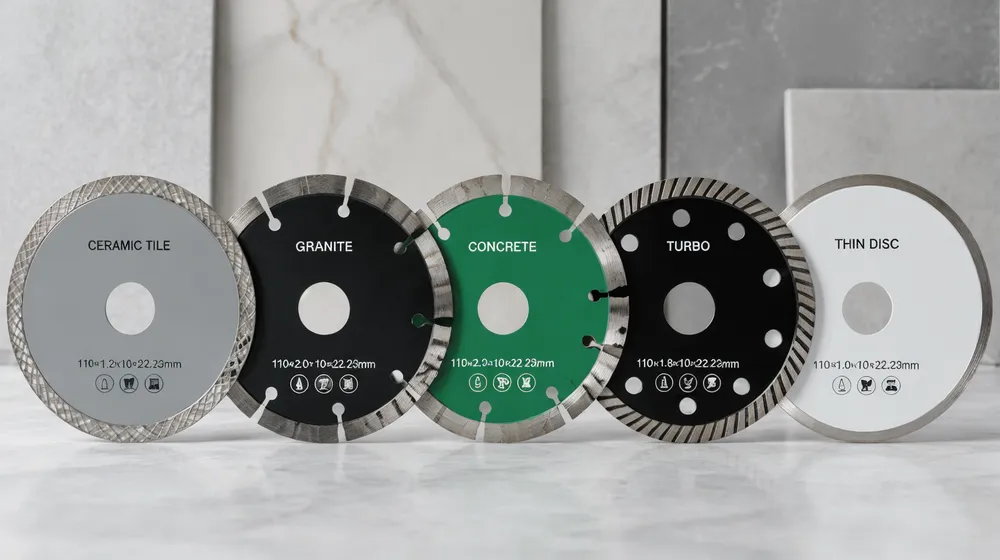
Each blade in the lineup shares CLSEG's sintered diamond segment construction, but the bond hardness, grit concentration, segment geometry, and core thickness are tuned for specific material classes. Swapping blades across applications causes premature wear, poor finish, or material damage.
If you're stocking for tile installers, the ceramic tile disc covers 80% of their daily cuts. Build outward from there based on your customer base's secondary needs.
Packaging and Container Loading for Tile Blade Orders
Ceramic tile cutting discs are lighter per unit than concrete or granite blades (thinner core, narrower segments), so container utilization is higher on piece count:
| Diameter | Approx. pcs per 20GP | Approx. pcs per 40HQ |
|---|---|---|
| 105 mm | ~95,000 pcs | ~190,000 pcs |
| 115 mm | ~80,000 pcs | ~160,000 pcs |
| 125 mm | ~60,000 pcs | ~120,000 pcs |
| 200 mm | ~30,000 pcs | ~60,000 pcs |
These are estimates for standard bulk packaging — retail blister packs increase volume per piece by 30–50% but still pack efficiently due to the thin blade profile. We provide exact loading plans with your order confirmation.
Retail-Ready Packaging Options
- Individual blister pack (most popular for hardware store distribution)
- Printed card insert with hang-hole
- 5-pack or 10-pack multi-unit packaging for pro-contractor buyers
- Counter-display boxes for retail promotions
Edge Protection
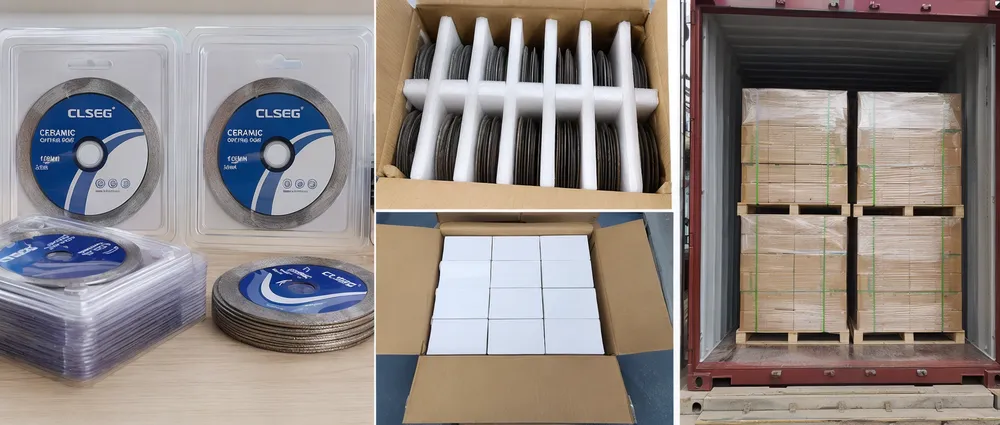
Diamond segments on tile blades are more delicate than aggressive concrete blade segments (finer grit, lower segment height). We use foam separators between each blade and rigid inner boxes to prevent segment-edge contact damage during shipping.
Zero chipped-segment arrivals is the standard — not the exception.
Tropical-Spec Export Packaging — Standard, Not Optional
We ship tile blades to Southeast Asian and Middle Eastern markets year-round in tropical-spec packaging with VCI moisture barriers. If your destination is humidity-prone, this is already built into our standard export pack — no need to request it separately.
Certifications and Compliance for Your Import Clearance
Our ceramic tile cutting disc range carries the same certification portfolio as our full diamond cutting disc category — full certification details on the parent category page.
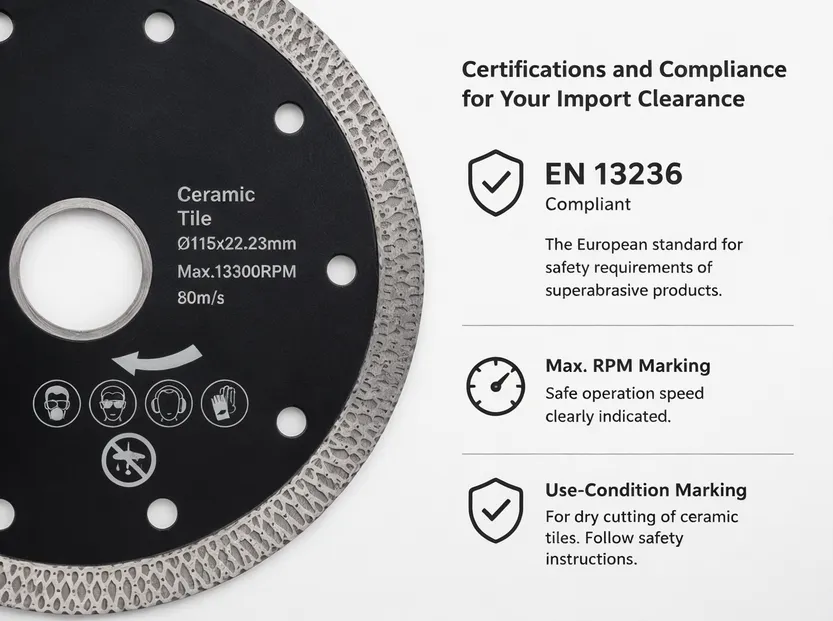
For tile blades specifically, the EN 13236 standard governs safety requirements for superabrasive products in the European market. Our blades are designed to comply with EN 13236 dimensional and mechanical requirements, and carry appropriate RPM and use-condition markings.
If your market has additional certification requirements beyond what we hold, we can work with your designated test lab to obtain them — learn more about our manufacturing and certification capabilities.
ISO 9001:2015
Externally audited quality management system covering all production processes and supply chain controls.
CE
European conformity marking for rotating power tool accessories — required for EU market entry.
MPA
German safety certification, required by many EU distributors for shelf listing and retail compliance.
SGS
Third-party inspection reports available per shipment batch for your import documentation needs.
EN 13236 Compliance
All ceramic tile cutting discs carry appropriate RPM and use-condition markings per EN 13236 dimensional and mechanical requirements. This standard specifically governs superabrasive products destined for the European market.
Frequently Asked Questions
Technical answers to the questions distributors and importers ask most about ceramic tile cutting discs.
Q What diamond grit size produces the cleanest cuts on porcelain tile?
For standard porcelain tile (8–10 mm thickness, Mohs 7–8 hardness): 60/80 mesh delivers a good balance of cut speed and edge quality.
For premium large-format porcelain panels where edge finish is critical: 80/100 mesh produces near-polished edges but cuts slower.
We recommend stocking both configurations if your customer base spans general tile installers and fabrication shops. The 80/100 mesh commands premium pricing and lower volume, while 60/80 is your bread-and-butter SKU.
Q Continuous rim vs. turbo rim for ceramic tile — which should I stock?
Continuous rim is the standard recommendation for dedicated tile cutting. It produces the cleanest edge with minimal micro-chipping.
Turbo rim (or thin-turbo) cuts faster and handles thicker tiles better, but edge quality is slightly lower — acceptable for floor tile where edges are covered by grout, less acceptable for exposed-edge installations.
If you carry both, label them clearly: continuous for "precision/exposed edges," turbo for "speed/general tile." Your tile-professional customers will self-select.
Q Can a ceramic tile cutting disc be used dry?
Short dry cuts are feasible — the continuous rim design and fine grit generate less heat per unit time than aggressive segmented blades. But sustained dry cutting on dense porcelain will overheat the blade, degrade diamond crystals, and shorten life significantly.
We design these blades for wet cutting as the primary mode. If your market requires frequent dry use (jobsites without water supply), our J-slot rim configuration improves dry cutting capability by adding cooling slots — ask us about this option.
Alternatively, consider our dry-cut diamond blade range for predominantly dry applications.
Q What is the typical blade life for a ceramic diamond cutting disc?
Blade life depends heavily on tile hardness, cut speed, and wet/dry usage. Industry-typical values for a quality ceramic tile cutting disc:
200–400 linear meters of cutting on standard porcelain tile (8 mm thick, wet cut)
Dense Indian vitrified tile wears segments faster; softer European ceramic wall tile extends life. We provide expected life ranges per formula configuration — contact us with your target tile type for specific estimates.
Our segments are developed for consistent wear rate, so you can predict reorder cycles for your customers.
Q What's the MOQ for a private-label ceramic tile cutting disc order?
500 pcs / SKU
Formula-adjusted blades in standard packaging
2,000 pcs / SKU
When custom packaging tooling (blister molds) is needed
First-time buyers typically start with 200–500 pieces in neutral packaging for field testing before committing to branded production — we encourage this approach because confirming cut quality on your local tile types protects both sides from formula mismatch issues.
Q How do I prevent edge chipping when cutting porcelain tile?
From the Blade Side
- Use a continuous-rim ceramic diamond cutting disc with fine grit (60/80 or finer)
- Ensure wet cutting with adequate water flow
- Maintain feed pressure below the point where the blade deflects laterally
From the Operational Side
- Score the glazed surface first on thick tiles
- Support the tile fully to prevent flex
- Cut face-down if the saw design allows (chips exit on the non-visible side)
Distributor tip: Including a one-page "best practices" card in your blade packaging reduces warranty claims — we can provide the content for your brand's insert if needed.
Start With a Sample Run — Here's What We Need
Most buyers in the ceramic tile cutting disc segment start with 200–500 pieces across 2–3 configurations (different diameters, or continuous vs. turbo rim) to test with their end users. We ship samples within 25 days and include cutting performance data from our test bench for each configuration.
Tell us:
- What tile types dominate your market (porcelain, ceramic, both? Glazed/unglazed? Typical thickness?)
- What diameters and arbor sizes are standard for your region
- Whether you need retail packaging or bulk
- Your approximate annual volume expectation
Send details to sales@clseg.com or WhatsApp: +86 13177381650. We'll come back with a formula recommendation, sample quote, and packaging options — typically within 24 hours.
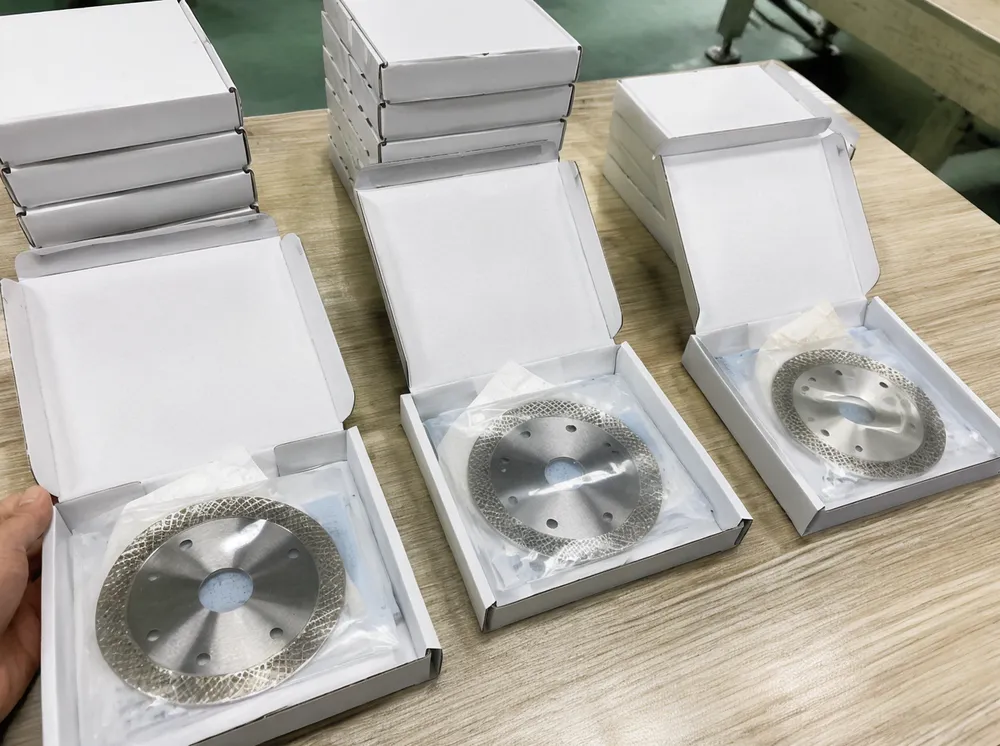
Each sample shipment includes cutting performance data from our test bench — feed rate, chip count, and blade wear metrics per configuration — so you can evaluate before committing to volume.