

Granite Diamond Cutting Discs Engineered for Hard Stone
We develop the segment formula around granite's hardness profile, so your end users get consistent feed rates instead of stalled cuts and warranty claims.
Application-matched bond formulas — because generic blades glaze over on hard stone.
- Formula library for 50+ granite varieties
- ISO 9001, CE, SGS, MPA certified
- 3M+ annual production capacity
- 105–230 mm sintered blades
20+
Years of granite-specific R&D
What This Blade Is — and What It Isn't
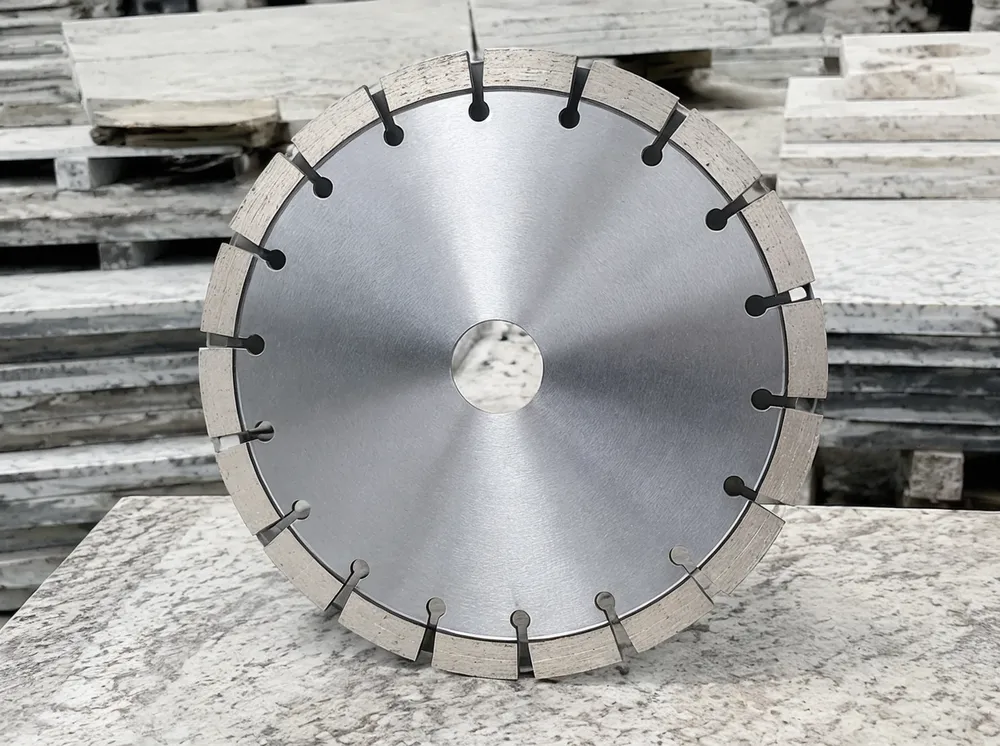
A granite diamond cutting disc is a small-diameter sintered blade (105–230 mm) designed specifically for cutting hard natural stone on angle grinders and handheld cutters. Granite sits at Mohs 6–7, is crystalline, and — critically — non-abrasive relative to concrete or sandstone. That hardness-without-abrasiveness combination is what makes generic diamond blades fail on granite: the bond matrix doesn't wear fast enough to expose fresh diamond crystals, so the blade surface glazes and cutting stalls.
Our granite cutting discs solve this with a dedicated soft-to-medium bond formulation that wears in sync with the stone's hardness. The result: diamonds expose progressively, feed rate stays consistent through the life of the blade, and your customers don't call to ask why their blade stopped cutting after ten minutes.
This is a different product from our stone cutting discs, which use harder bonds for softer, more abrasive stone like sandstone and limestone. If your market cuts primarily marble or general natural stone, those blades are the better fit. Granite discs are for hard stone — granite, engineered quartz remnants, gneiss, quartzite slabs — where the material demands aggressive diamond exposure.
Designed For
- Granite (Mohs 6–7, crystalline, non-abrasive)
- Engineered quartz remnants
- Gneiss and quartzite slabs
- Angle grinders & handheld cutters (105–230 mm)
Not Intended For
- Sandstone, limestone (use stone cutting discs)
- Concrete / masonry (use concrete cutting discs)
- Ceramic / porcelain tile (use ceramic tile cutting discs)
Generic Blade on Granite
Bond matrix too hard for non-abrasive granite. Diamond crystals stay buried under polished metal. Surface glazes within minutes. Cutting stalls. End user returns the blade.
Granite-Specific Bond Formula
Soft-to-medium bond erodes at a controlled rate against crystalline granite. Fresh diamond crystals expose progressively. Feed rate stays consistent through the entire blade life.
The Bond Formula Problem — and Why It Determines Your Return Rate
Two blades that look identical on the shelf can perform completely differently in the field. Same diameter, same segment count, same visual appearance — but one cuts granite cleanly for 30+ linear meters while the other glazes after 5 meters.
20-Year Formula Library
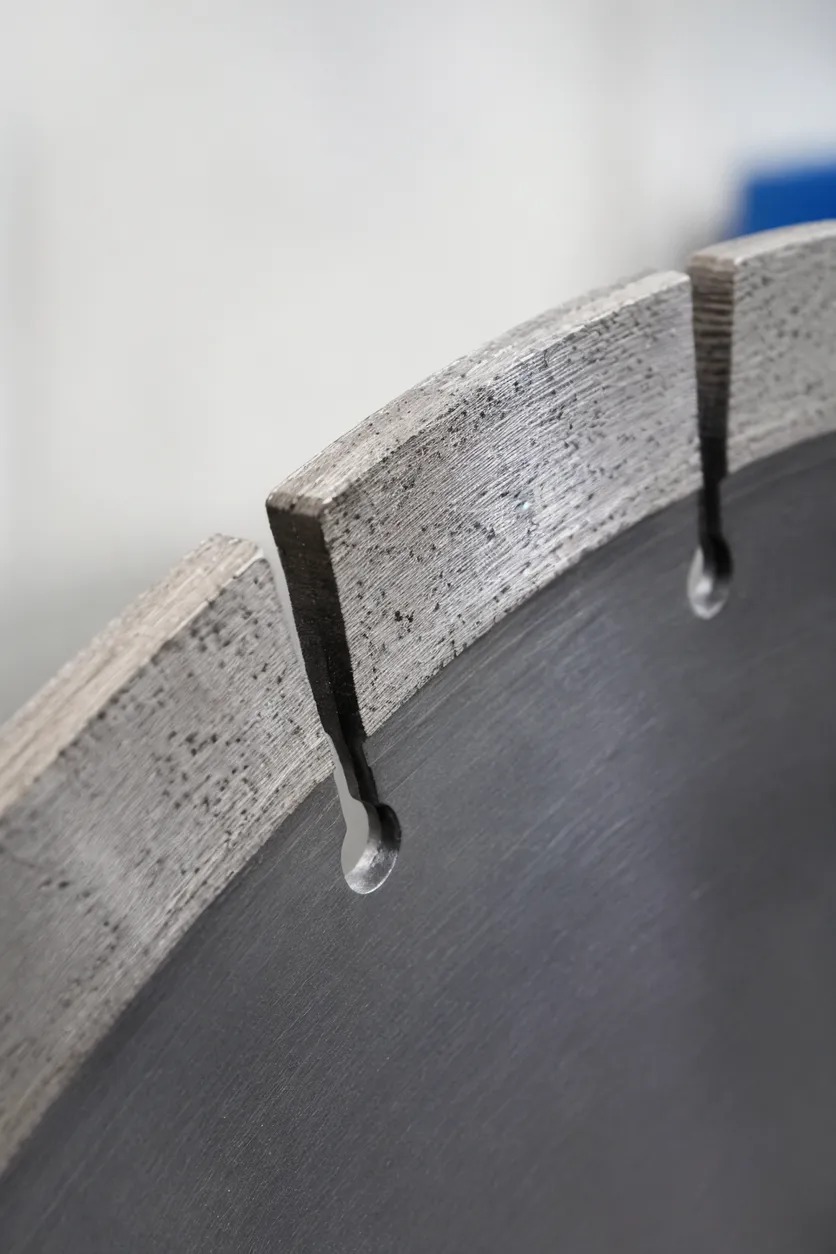
We maintain a formula library developed over 20 years of cutting hard stone specifically. For granite applications, we work with soft-medium iron-cobalt-based matrices and higher diamond concentration — typically 20–25% above what you'd see in a general-purpose disc.
Controlled Bond Erosion
The soft bond erodes at a controlled rate against granite's crystalline structure, keeping fresh diamond crystals exposed at the cutting face throughout the blade's life. No glazing, no stalling.
Field-Tested Across 30+ Countries
Each formula has a performance track record against specific stone types. Built from direct field testing and two decades of feedback from fabricators worldwide — not theoretical calculations.
Stone-Specific Formula Matching
When you tell us which granites your end users cut, we match the bond hardness and diamond grit specification to that stone profile. The difference is invisible to the eye — but it determines whether your blade lasts 5 meters or 30+.
Indian Absolute Black
Extremely hard, fine-grained → Finer diamond mesh, slightly softer bond
Brazilian Giallo
Medium hardness, coarser crystal → Standard granite bond, medium mesh
Chinese G603
Lighter color, medium density → Balanced formula for volume applications
Why This Matters for Your Business
This formula precision translates directly to your bottom line: blades that perform consistently generate reorders. Blades that glaze or wear out prematurely generate complaints, returns, and lost customers.
Your margin lives and dies on the bond formula — even if your buyer never sees it.
30+
Linear meters per blade on matched granite
50+
Granite variety formulas in library
20-25%
Higher diamond concentration vs. generic
30+
Countries with field-tested results
Technical Specifications
| Parameter | Standard Range |
|---|---|
| Diameter | 105, 110, 115, 125, 150, 180, 200, 230 mm |
| Arbor Bore | 16, 20, 22.23, 25.4 mm |
| Segment Height | 8–12 mm |
| Segment Thickness | 2.0–3.2 mm |
| Blade Body Thickness | 1.4–2.6 mm |
| Segment Type | Sintered (hot-pressed), segmented rim or turbo rim |
| Segment Attachment | High-frequency welded or laser welded |
| Maximum RPM | 12,000–14,000 (diameter dependent) |
| Cutting Method | Dry, wet, or dual-use |
| Diamond Grit | 40/50 mesh or 50/60 mesh (granite-optimized coarse grit) |
| Bond Matrix | Soft-medium hardness, iron-cobalt base |
| Target Material | Granite, engineered quartz, gneiss, quartzite, hard natural stone |
Specifications shown are industry-standard values for granite diamond cutting discs. Exact parameters depend on formula variant and customization. Contact us for detailed product data sheets.
Most Ordered Configuration
- 115 mm or 125 mm diameter
- 22.23 mm arbor bore
- Segmented rim, 8 segments
- 10 mm segment height
- High-frequency welded
This setup balances cutting speed, life expectancy, and cost per piece for general granite work on standard angle grinders.
Dry Cut Recommendation
For dry cutting applications where thermal stress on the weld joint is a concern, we recommend laser-welded attachment — it costs slightly more per unit but eliminates the segment-loss risk that generates safety complaints and warranty claims.
Rim Configurations for Granite — Choosing Your SKU Mix
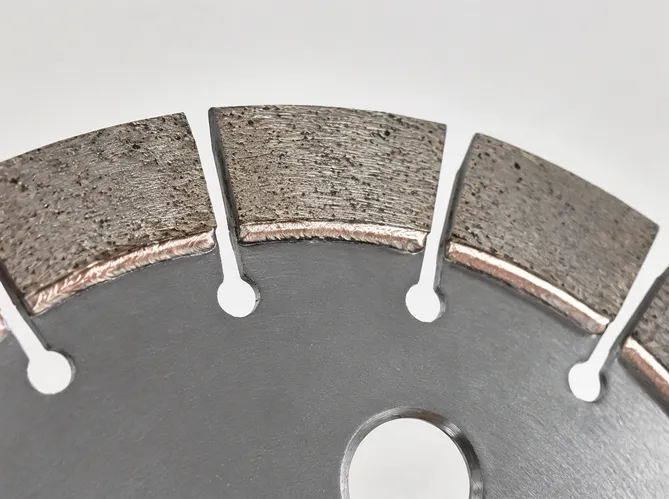
Not all granite cutting demands the same rim geometry. The choice between segmented and turbo rim drives different performance characteristics — and gives you product line differentiation on your shelf.
Segmented Rim
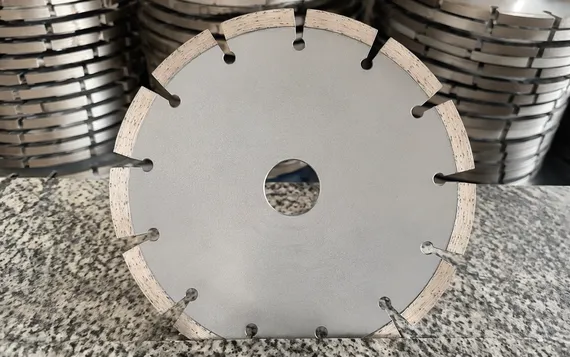
Gullets between segments clear stone dust efficiently and allow air cooling during dry cuts. Fastest cutting speed in granite. Slight edge roughness that's acceptable for structural granite work, curbing, paving, and fabrication cuts that will be polished afterward.
Best For
- Structural granite work
- Curbing & paving
- Fabrication cuts (pre-polish)
- Volume workhorse SKU
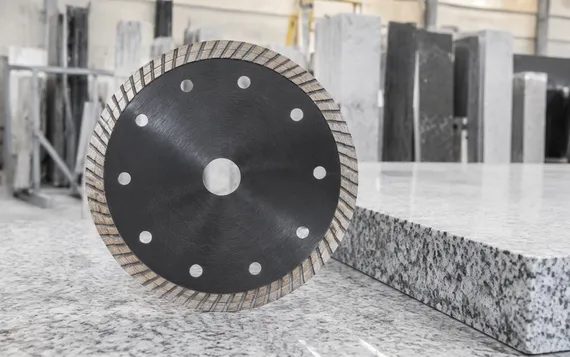
Turbo Rim
Continuous serrated rim produces cleaner cuts with less chipping than segmented, while still clearing debris better than a straight continuous rim. Slightly slower than segmented but better finish quality. Suited for exposed-edge cuts on countertop remnants and decorative granite where edge appearance matters before polishing.
Best For
- Countertop remnant cuts
- Decorative granite
- Exposed-edge work
- Fabrication customers
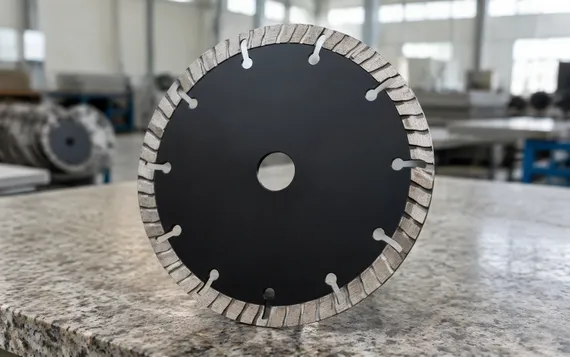
Turbo-Wave Rim
The undulating geometry reduces vibration and cuts fractionally faster than standard turbo. We've seen growing demand for this configuration from Southeast Asian and Middle Eastern fabrication markets.
Best For
- Reduced vibration cutting
- SE Asian & ME markets
- Faster than standard turbo
- Fabrication environments
What about continuous rim for granite? They exist for pure edge quality — but they're slow and overheat quickly on hard stone. We generally steer granite buyers toward segmented or turbo. If your end users need mirror-finish edges on granite, they're better served by our larger bridge saw blades designed for that specific job.
Your SKU Strategy
Carry segmented rim across all diameters as your workhorse line, add turbo rim in the 115–125 mm range as a premium option for fabrication customers. Two rim types at 3–4 diameters gives you 6–8 SKUs that cover the granite cutting market comprehensively.
Volume Line
Segmented × all diameters
105 / 115 / 125 / 150 / 180 / 230 mm
Premium Add-On
Turbo × 115 & 125 mm
Fabrication customer upsell
Where Granite Cutting Discs Move Volume — Market Segments Worth Stocking
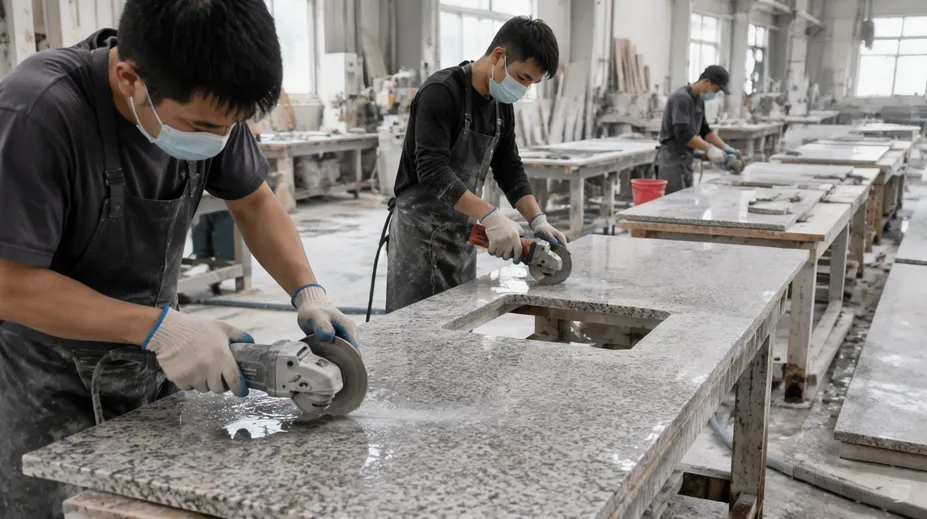
Countertop Fabrication Shops
Stone fabricators cutting granite countertops run through small diamond discs daily — trimming sink cutouts, shaping backsplash edges, making template adjustments on-site, cutting remnant pieces for small projects. A typical small fabrication shop consumes 15–30 granite cutting discs per month across two or three angle grinders running simultaneously. Larger shops with ten-plus machines burn through proportionally more.
For your distribution business, this segment offers predictable monthly reorders and low price sensitivity (fabricators care about cut consistency and blade life — a blade that costs 10% more but lasts 40% longer wins every time).
Core SKUs for this channel
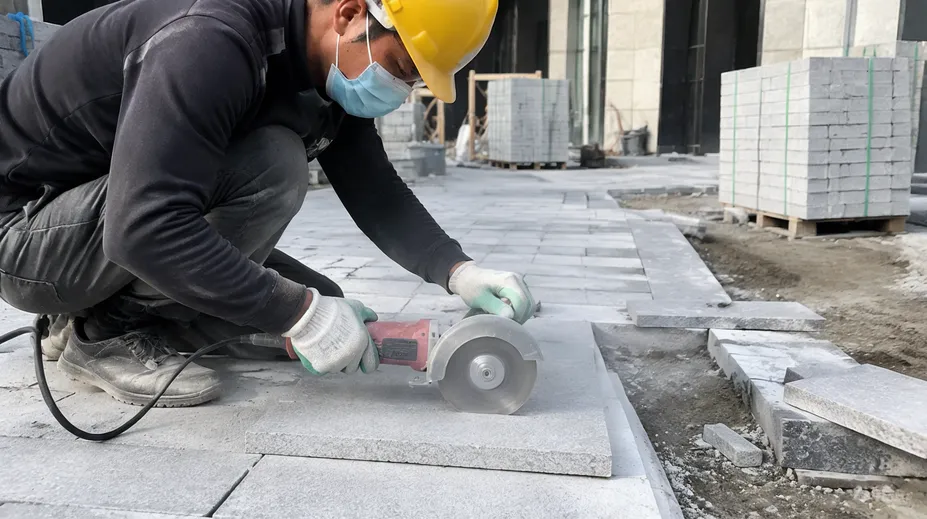
Construction Contractors — Granite Paving and Cladding
Contractors installing granite pavers, curbstones, and wall cladding need to make on-site cuts — angle adjustments, fitting around obstacles, cutting drainage channels. They work outdoors, often without water supply, which means dry-cutting capability is essential.
Order volumes tend to be project-based rather than continuous, but a single large commercial paving project can consume 200–500 blades.
Dry-cut rated for outdoor use
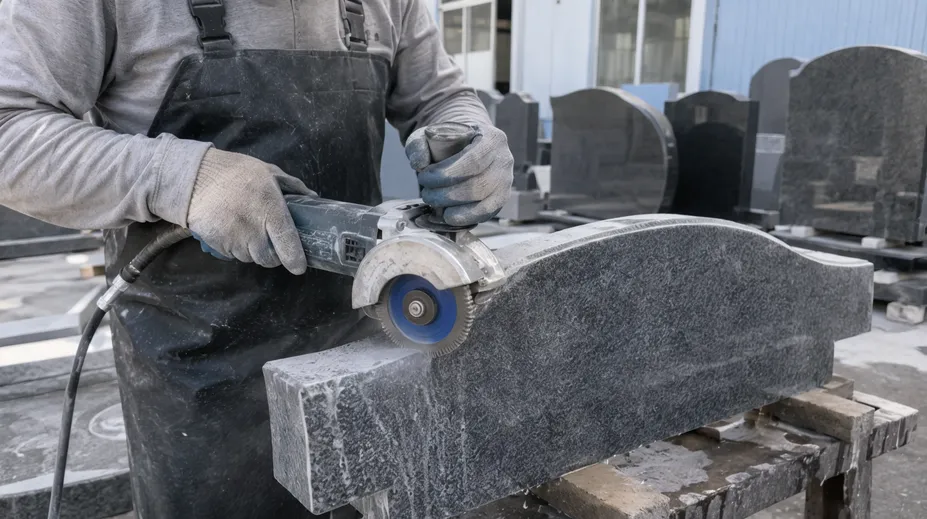
Stonemasons and Monument Fabricators
Small-scale but steady demand from monumental masons shaping headstones, building facades, and architectural stone features. They value precision and edge quality over raw cutting speed, so turbo rim discs are the preferred configuration.
Lower volume per customer but premium pricing tolerance and brand loyalty — once a mason finds a blade that performs well on their specific stone, they rarely switch.
Premium segment, high brand stickiness
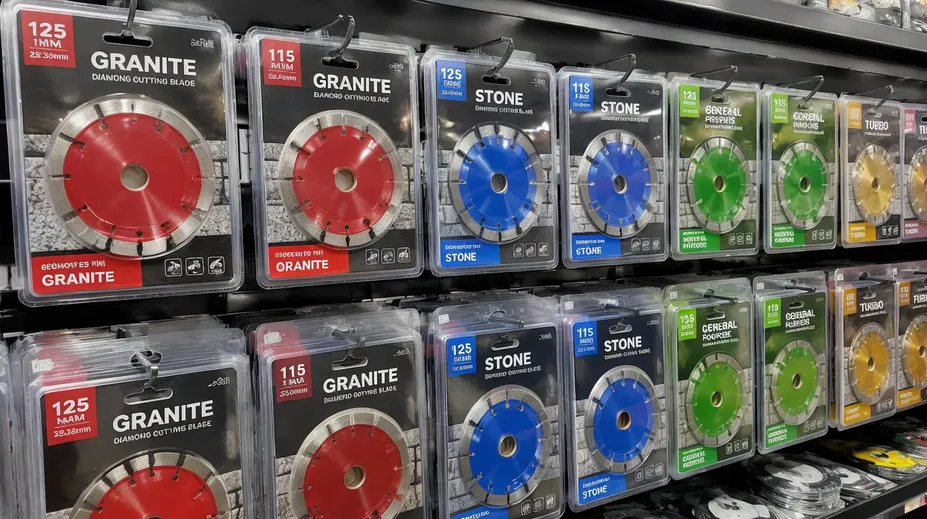
Hardware Retail Distribution
Retail blister-packed granite cutting discs for the professional tradesperson market. These are typically 115 mm and 125 mm segmented rim, branded for the end-user, displayed alongside general-purpose blades.
Your margin here comes from packaging and branding differentiation — a clearly labeled "granite-specific" blade commands a premium over generic discs on the same shelf. We supply retail-ready packaging including blister packs, color-coded headers, and printed performance specifications on the card.
The hardware retail segment has grown consistently over the past five years, especially in markets where countertop renovation is booming — buyers are increasingly asking for application-specific blades rather than generic "multi-purpose" discs.
Manufacturing: What We Do Differently for Granite Blades
The parent diamond cutting discs category page covers our general manufacturing process. Here's what's specific to how we produce granite cutting discs — the choices that differentiate these from a general-purpose blade carrying a "granite" label.
Diamond Grit Selection
Granite blades use coarser mesh (40/50 or 50/60) synthetic diamond with high thermal stability and blocky crystal morphology.
Blocky crystals resist fracturing on granite's hard crystalline matrix — they wear down gradually rather than shattering on impact, which gives consistent cutting throughout the segment life. We source diamond grit from established suppliers and verify crystal morphology and thermal stability on incoming inspection.
Cheap diamond grit with irregular crystal shapes is one of the hidden cost-cutting moves that makes low-price blades underperform — the crystals fracture early and the blade goes dull.
Controlled Diamond Concentration
Our granite formulas run higher diamond concentration than general-purpose blades — more cutting points per square centimeter of segment face, which maintains aggressive cutting in hard stone.
We weigh and verify powder batches against the formula specification for every production run. This is the kind of thing that can drift on high-volume orders if a factory isn't monitoring it, and it's invisible until the blades underperform in the field.
- Batch-verified powder weights
- Formula-locked per production run
Sintering Profile Optimization
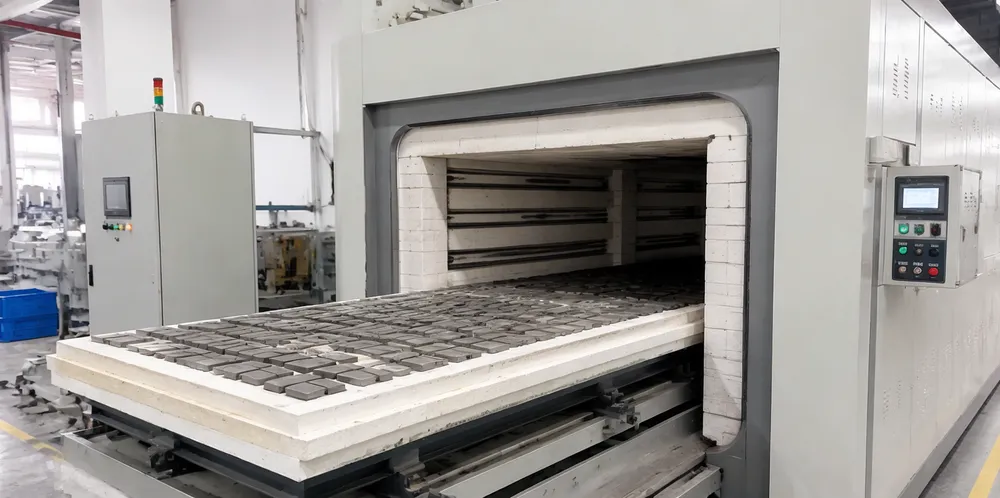
Granite segments sinter at a specific temperature-pressure curve that achieves the bond density needed for controlled wear against hard stone.
Too dense, and the bond won't erode to expose diamonds (glazing). Too porous, and segments wear prematurely. Our programmable sintering furnaces repeat the exact thermal profile across every batch, which is why your tenth container performs like your first.
Too Dense
→ Glazing, diamonds buried
Too Porous
→ Premature segment wear
Weld Joint Reliability
Granite cutting generates significant radial stress on the segment-core joint — the blade encounters hard material at every rotation.
We specify minimum weld penetration depth for granite discs and run destructive pull-test sampling on every batch.
Safety Threshold
Typical shear force threshold for our granite cutting discs: the segment will break before the weld does.
Customization — What You Can Spec, What's Fixed
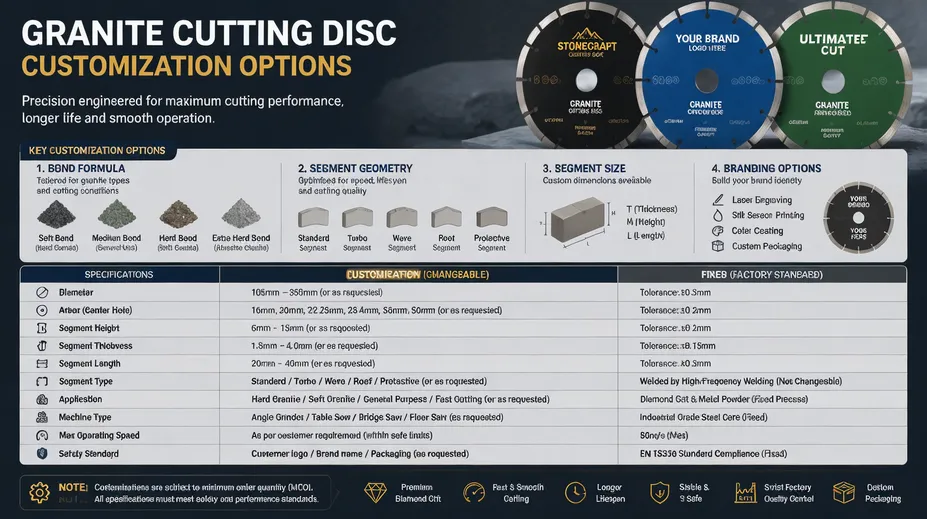
Adjustable Per Your Requirements
- Bond formula: Hardness grade, diamond concentration, and grit mesh — matched to your specific granite types
- Segment geometry: Height (8–12 mm), thickness (2.0–3.2 mm), segment count per disc
- Rim type: Segmented, turbo, turbo-wave
- Diameter and arbor: Any combination from our standard range, plus non-standard on request
- Attachment method: High-frequency welded (standard) or laser welded (premium dry-cut)
- Core finish: Plain steel, painted (any color), laser-etched with your brand logo
- Packaging: Neutral box, blister pack, custom printed sleeve, retail card, or bulk packing
- Labeling: Your brand, safety markings, regulatory text, barcodes
What Can't Change Without Significant Retooling
- Arbor bore sizes outside 12.7–32 mm range (our standard tooling covers this span)
- Diameters outside 105–230 mm for this product category (larger blades fall under our saw blade range)
- Continuous rim for granite — we'll make it if you insist, but we'll advise against it for performance reasons
MOQ and Lead Time
| Configuration | MOQ | Typical Lead Time |
|---|---|---|
| Standard formula, custom label only | 500 pcs/SKU | 20–25 days |
| Custom formula, standard packaging | 500 pcs/SKU | 25–30 days (includes sample approval) |
| Custom formula + custom packaging (new blister mold) | 2,000 pcs/SKU | 30–40 days |
| Repeat order on established spec | 300 pcs/SKU | 15–20 days |
Market-Entry Testing
For market-entry testing, we ship 100–300 pieces in neutral packaging for your field evaluation before committing to branded production. No pressure on the first round — test the blade on your stone, confirm performance, then we scale.
Packaging and Container Loading for Granite Discs
Granite cutting discs are dense, compact products with exposed diamond segments that cannot tolerate transit damage. Our packing configuration for ocean freight:
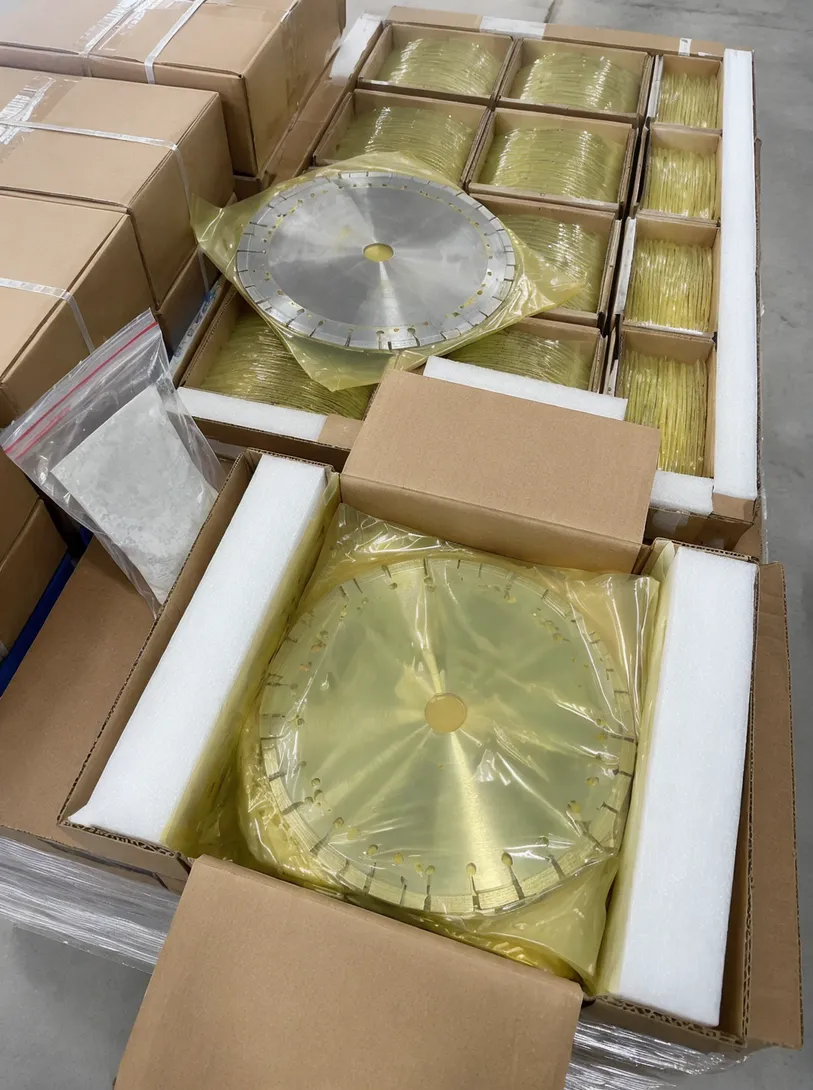
Packing Process
- 1 Individual VCI anti-rust wrapping per blade
- 2 Stacked in corrugated inner cartons with cardboard dividers (25–50 pcs per inner box depending on diameter)
- 3 Inner cartons packed into reinforced export outer cartons with foam edge protection
- 4 Palletized loading with stretch wrap and corner protectors
- 5 Moisture barrier bags included for shipments to tropical/humid destinations
Approximate Container Loading — Granite Cutting Discs Only
| Diameter | Pieces per 20GP | Pieces per 40HQ |
|---|---|---|
| 105–115 mm | ~65,000–80,000 | ~130,000–160,000 |
| 125 mm | ~50,000 | ~100,000 |
| 180–230 mm | ~20,000–30,000 | ~40,000–60,000 |
Mixed Container Loading
Many of our distributors combine granite cutting discs with other blade types in a single mixed container — it optimizes freight cost per unit while letting you restock your full product line simultaneously. We coordinate mixed-SKU loading plans as part of the order process.
Retail-Ready / Blister Packaging
If you're building retail-ready inventory with custom blister packaging, the per-piece volume increases (blister packs take more space than bulk stacking), but we adjust carton layouts to maximize loading. Send your packaging dimensions and we'll calculate the exact loading plan before you confirm quantities.
Granite Disc vs. General-Purpose Disc — Why the Distinction Matters for Your Margin
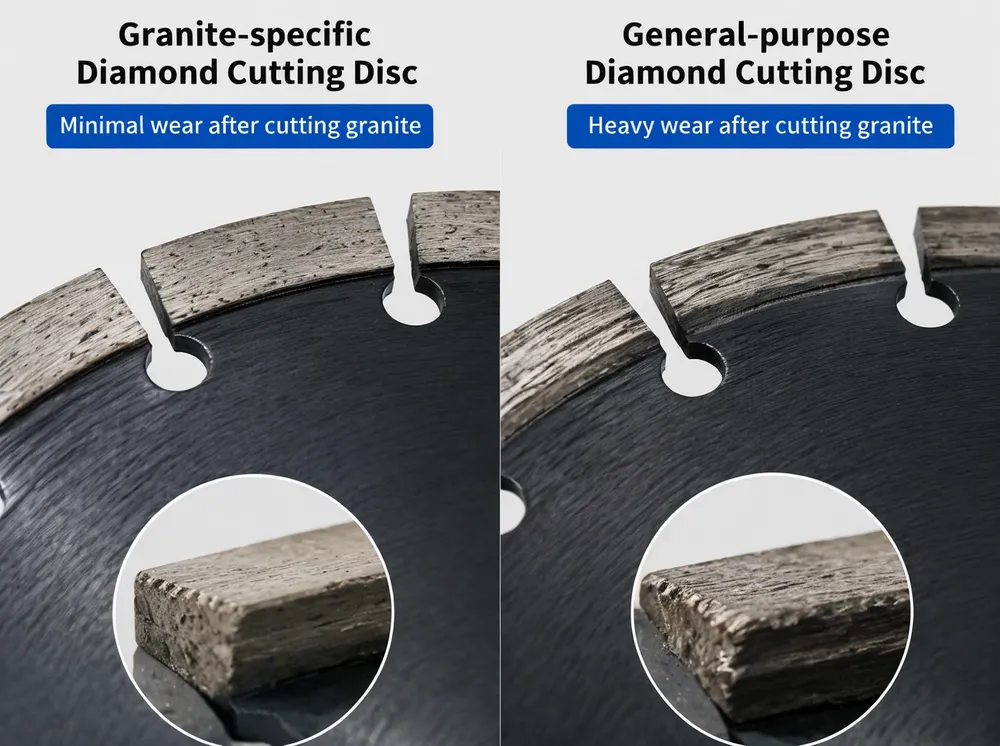
Your customers can tell the difference. A general-purpose diamond cutting disc uses a medium-hard bond formula designed to be "acceptable" across multiple materials — concrete, brick, tile, stone. On granite specifically, that medium-hard bond glazes because granite isn't abrasive enough to wear it down naturally. Result: the blade goes dull, the customer blames the blade (and your brand), and they try a different supplier next time.
A granite-specific disc with properly calibrated soft bond and coarse diamond grit will outperform the general-purpose blade by 2–3x on lifespan and maintain consistent feed speed throughout. That performance gap is your pricing differentiation: you can sell a granite-specific disc at a premium over generic discs because it demonstrably lasts longer on the material it's designed for. Your fabricator and contractor customers will pay more for a blade that works properly — because blade cost is trivial compared to labor downtime when a blade stalls mid-cut.
Performance Gap on Granite
General-Purpose Disc
- Medium-hard bond glazes on granite
- Feed speed drops as blade dulls
- Higher return rate, brand damage
Granite-Specific Disc
- Soft bond + coarse grit matched to granite
- 2–3x lifespan vs. general-purpose
- Consistent feed speed throughout life
Catalog Differentiation
Stocking application-specific blades rather than generic "multi-material" discs gives you a stronger catalog story. Your downstream customers see a range of blades matched to specific materials — granite, concrete, ceramic — and perceive a supplier that understands stone processing, not just a trader reselling whatever was cheapest at the factory gate.
Application-Specific Blades
Frequently Asked Questions
What diamond grit mesh is best for cutting granite on an angle grinder?
40/50 mesh for fast feed rate in hard granite (typical for construction granite, paving stone, and demolition cuts). 50/60 mesh when you want a balance between speed and smoother cut edges (countertop fabrication, monument work).
Finer mesh below 60/80 is generally wrong for granite — it cuts too slowly and overheats on hard crystalline stone.
We select grit mesh as part of the formula development process and can adjust per your end-user feedback.
How many linear meters can a granite diamond cutting disc cut before replacement?
It varies by granite hardness, blade diameter, and cutting depth — but as a reference range for industry-typical granite: a 115 mm segmented disc with 10 mm segment height typically delivers 25–40 linear meters of full-depth (30 mm) cut in medium-hard granite.
Harder granites (Indian Absolute Black, South African Impala) reduce that; softer granites (Chinese G603, some Brazilian varieties) extend it.
We provide expected performance ranges for each formula variant so you can set accurate customer expectations.
Should I choose laser-welded or high-frequency welded granite discs?
For wet cutting and moderate dry cutting with controlled feed pressure, high-frequency welding is the cost-effective standard — reliable joint strength and lower cost per blade.
Choose laser-welded when your end users primarily dry cut (no water on site), push hard feed rates, or when segment loss is a safety/liability concern in your market.
The price premium for laser welding is typically 15–20% per blade, which is easy to justify for professional-grade SKUs.
Can one granite cutting disc also handle engineered quartz and quartzite?
Engineered quartz (Silestone, Caesarstone type material) is resin-bonded and slightly less hard than natural granite — our granite formula works well on it.
Natural quartzite is harder than granite (Mohs 7+) and more abrasive at the crystal boundaries. Our standard granite formula handles quartzite adequately, but for markets with heavy quartzite demand, we develop a slightly modified formula with adjusted bond hardness.
Tell us your material mix and we'll recommend whether one formula covers it or you need a dedicated quartzite variant.
What causes segment loss on granite cutting discs, and how do you prevent it?
Segment loss — the segment detaching from the steel core during cutting — is almost always a weld failure caused by insufficient penetration depth, contaminated weld surfaces, or thermal fatigue from repeated dry-cutting heat cycles.
We prevent it through:
- Automated pre-weld surface preparation (shot blasting the core)
- Programmed welding parameters that guarantee minimum penetration depth
- Destructive shear-force testing on every batch
For high-risk dry-cutting applications, laser welding provides a metallurgical bond that's inherently stronger under thermal cycling than brazed or high-frequency joints.
What's the typical MOQ for private-label granite cutting discs?
500 pieces per SKU for standard granite formula with your brand label and basic packaging.
100–300 pieces for trial orders to test formula performance in your market — neutral packaging with no branding commitment.
2,000+ pieces per SKU for custom packaging with new blister mold tooling to justify setup cost.
Ready to Source Granite Cutting Discs?
Send us three things and we'll have a specific recommendation back within 24 hours.
Granite Types
What granite types your end users cut most — country of origin or trade name if you know it.
Diameters & Arbor Sizes
What diameters and arbor sizes sell in your market.
Order Volume
Your expected order volume — trial quantity is fine for the first round.
We'll come back with a formula recommendation, a sample plan, and pricing. Most granite disc partnerships start with a 200–500 piece test order — you field-test with your customers, confirm the performance holds on your specific granite, and then we move into branded production.