

Stone Diamond Cutting Discs Formulated for Natural Stone
Bond formulas developed specifically for marble, sandstone, limestone, and slate — not repurposed concrete blades with a label change.
When your customers cut natural stone, the bond matrix must match the material's hardness and abrasiveness profile. We formulate for each stone class individually, so your blades perform where generic discs glaze or wear prematurely.
- Material-matched formulas · 60+ patents
- ISO 9001, CE, SGS, MPA certified
- OEM from 500 pcs/SKU
- 20+ years stone blade manufacturing
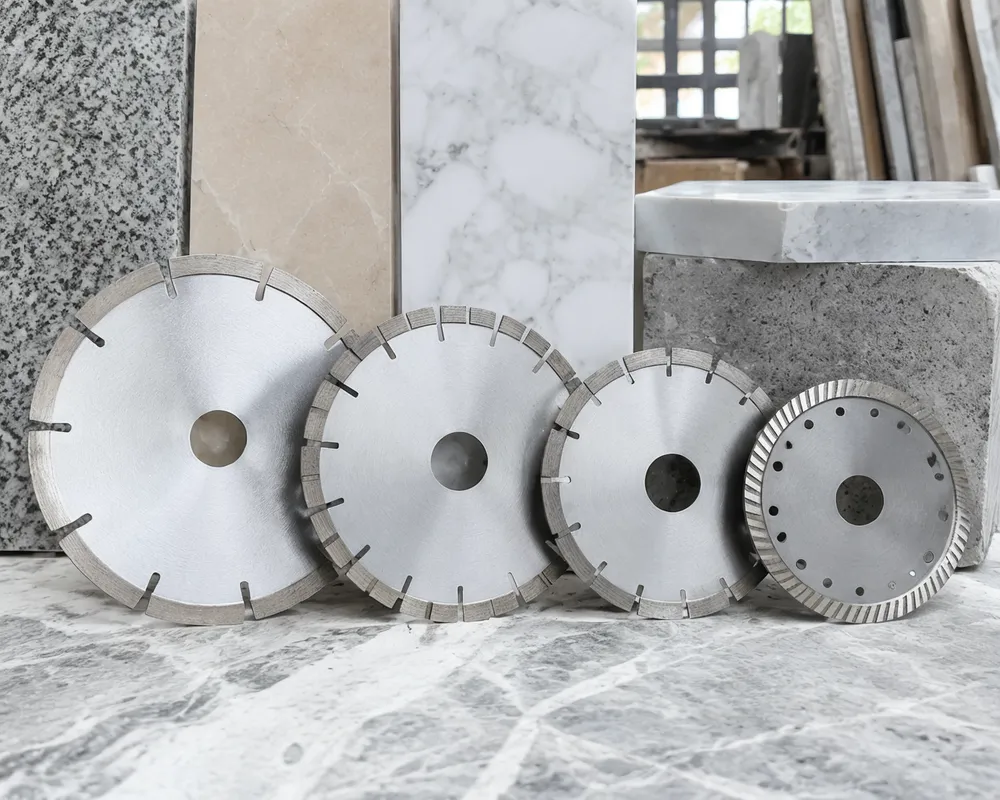
What This Product Is — and Who It's For
A stone diamond cutting disc is a small-diameter sintered blade — 105 mm to 230 mm — engineered to cut natural stone on angle grinders, masonry saws, and handheld cut-off machines. The "stone" designation isn't cosmetic. It means the diamond grit selection, bond matrix hardness, and segment geometry are calibrated for the specific wear characteristics of natural stone: marble, limestone, sandstone, travertine, slate, bluestone, and similar materials in the Mohs 3–6 hardness range.
This matters commercially because natural stone sits in a different zone from granite (Mohs 6–7, non-abrasive) and concrete (highly abrasive, heterogeneous). A blade formulated for concrete uses a hard bond matrix that will glaze immediately on marble. A granite blade uses an aggressive soft bond that erodes too fast on abrasive sandstone. Stone cutting discs occupy the middle ground — medium-hardness bonds tuned to wear at the correct rate for softer, more varied natural stone.
If your customers complain that blades "stop cutting" after a few minutes on marble or chew through segments in one afternoon on sandstone, the problem is formula mismatch — and that's exactly what this product line solves.
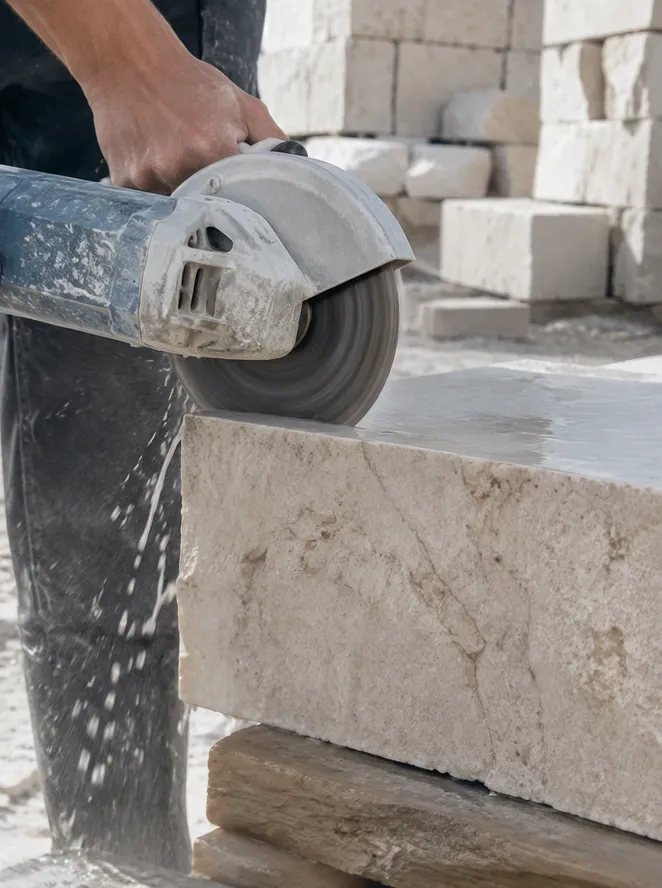
Concrete Blade on Marble
Hard bond matrix designed for abrasive concrete will glaze immediately on soft marble. The diamond never gets exposed — the blade stops cutting within minutes.
Granite Blade on Sandstone
Aggressive soft bond designed for non-abrasive granite erodes too fast on abrasive sandstone. Segments wear through in one afternoon — poor life, high cost per cut.
Stone Disc — Correct Match
Medium-hardness iron-cobalt bond tuned for Mohs 3–6 natural stone. Diamond exposure rate matched to material wear profile — consistent cutting throughout segment life.
Your Positioning Play
Stone cutting discs serve the residential renovation, landscaping, and monument/memorial segments where natural stone dominates. These are repeat-purchase consumables with predictable demand cycles and good margin potential when you're not competing on a generic "multi-purpose" blade that performs adequately at everything and excellently at nothing.
Technical Specifications for This Product
Complete specification table for the stone diamond cutting disc product line. Parameters shown are standard values — exact configurations are adjustable to your market requirements.
| Parameter | Specification |
|---|---|
| Diameter range | 105, 110, 115, 125, 150, 180, 200, 230 mm |
| Arbor bore | 16, 20, 22.23, 25.4 mm (non-standard available on custom) |
| Segment height | 8–10 mm (standard); 12 mm extended-life |
| Segment thickness | 1.8–2.4 mm (standard); thin-kerf from 1.6 mm |
| Blade body thickness | 1.4–2.0 mm |
| Segment count | 6–16 segments (diameter dependent) |
| Diamond grit | 50/60 mesh (primary); 40/50 mesh harder variants |
| Diamond concentration | Medium-high (adjusted per target stone hardness) |
| Bond matrix | Medium-hardness iron-cobalt base, Mohs 3–6 natural stone |
| Segment attachment | High-frequency welded (std); laser welded (dry-cut premium) |
| Maximum RPM | 12,000–14,000 RPM (diameter dependent; marked per blade) |
| Cutting method | Dry, wet, or dual-use (configuration dependent) |
| Rim types available | Segmented, turbo, continuous rim |
| Compatible tools | 4"–9" angle grinders, masonry saws, handheld cut-off machines, tile saws |
| Target materials | Marble, limestone, sandstone, travertine, slate, bluestone, soapstone, flagstone |
All specifications are adjustable during OEM/ODM development. If your market requires non-standard diameters, bore sizes, or segment configurations, we accommodate those in production runs of 500+ units.
Rim Types and When to Recommend Each
Three rim configurations cover the full range of stone cutting applications. The right recommendation depends on the cut quality requirement, whether water is available, and how aggressive the feed rate needs to be.
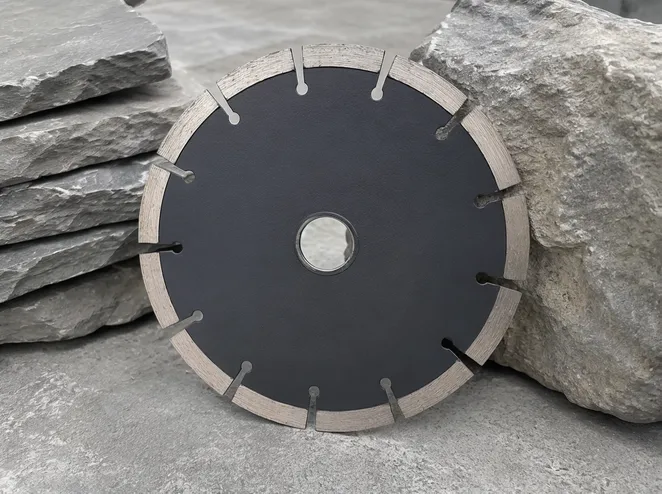
Segmented Rim
- Best for dry cutting — gullets provide air cooling
- Fastest cutting speed, most aggressive material removal
- Rougher edge finish — suitable for cuts that get hidden or ground
- Ideal for: sandstone, bluestone, flagstone, rough limestone
Recommend for: landscapers, masons doing rough cuts, demolition, and any dry-cut jobsite application.
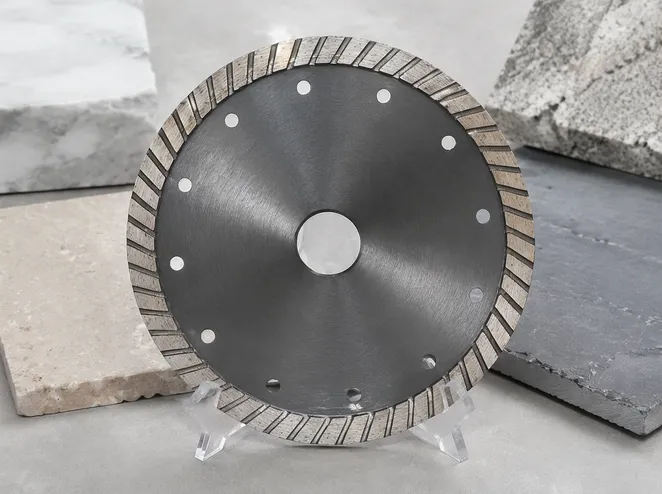
Turbo Rim
- Continuous rim with serrated edge for debris clearance
- Balanced speed and finish quality — the versatile middle option
- Works dry or wet — dual-use flexibility
- Ideal for: marble, travertine, limestone, slate
Recommend for: contractors needing one blade for multiple stone types, renovation work where speed and finish both matter.
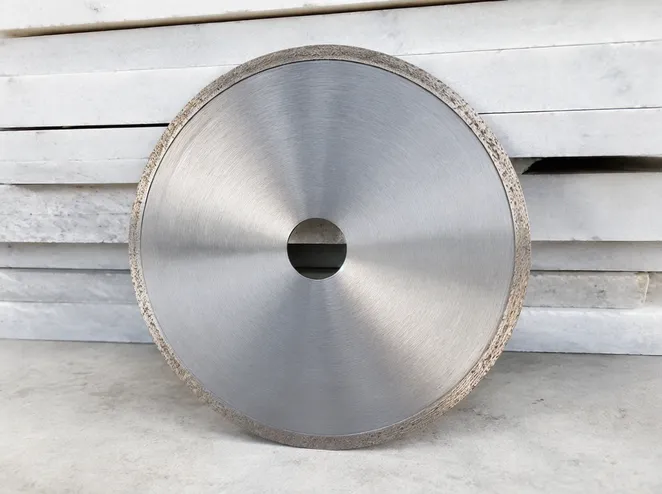
Continuous Rim
- Smoothest cut finish — minimal chipping on polished surfaces
- Requires wet cutting — water cools and flushes slurry
- Slower feed rate — precision over speed
- Ideal for: polished marble, travertine tiles, decorative stone
Recommend for: tile installers, fabricators, monument/memorial work, any application where the cut edge is visible.
Quick Selection Guide
| Application | Rim Type | Cutting Method |
|---|---|---|
| Landscaping — flagstone, bluestone paving | Segmented | Dry |
| General masonry — limestone, sandstone walls | Segmented / Turbo | Dry or Wet |
| Renovation — mixed natural stone | Turbo | Dry or Wet |
| Tile installation — marble, travertine | Continuous | Wet |
| Monument / memorial fabrication | Continuous | Wet |
| Slate roofing cuts | Turbo | Dry |
Bond Matrix Science — Why This Formula Works on Natural Stone
The bond matrix is the single most important variable determining whether a blade performs or fails on a given material. Here's the engineering logic behind the stone cutting disc formula.
The Core Principle
A diamond blade works by controlled erosion. As the blade cuts, the bond matrix wears away, exposing fresh diamond crystals at the cutting surface. The wear rate of the bond must match the abrasiveness of the material being cut. Too slow = glazing (diamonds get buried). Too fast = premature segment loss.
Natural Stone Challenge
Natural stone in the Mohs 3–6 range presents a specific challenge: moderate abrasiveness with high variability. Marble (Mohs 3) is relatively soft and low-abrasion. Sandstone (Mohs 6–7 quartz grains in softer matrix) is highly abrasive. A single bond formula needs to perform acceptably across this range without being perfect for either extreme.
Our Solution: Iron-Cobalt Medium Bond
The iron-cobalt base matrix provides a medium wear rate that self-adjusts partially to material hardness. On softer marble, the lower abrasion slows bond wear — maintaining diamond retention. On harder sandstone, increased abrasion accelerates bond wear — keeping fresh diamonds exposed. The result is a blade that performs consistently across the Mohs 3–6 range without requiring different SKUs for each stone type.
Diamond Selection
- 1 Grit size 50/60 mesh — balanced between cutting speed (coarser) and surface finish (finer). Large enough for efficient material removal, fine enough to limit chipping on softer stones.
- 2 Medium-high concentration — more diamonds per segment volume means each individual crystal bears less load, extending crystal life on softer stones that don't fracture diamonds as aggressively.
- 3 Blocky crystal morphology — selected for impact resistance over sharpness. Natural stone cutting generates less heat than granite or concrete, so thermal stability is less critical; mechanical toughness matters more.
Segment Geometry
- A Flat-top segments (standard) — even wear pattern, predictable life curve. Best for consistent materials like marble or travertine.
- B Turbo-wave segments (optional) — reduced contact area increases unit pressure, improving cutting speed on harder stones like dense limestone or slate.
- C Protective undercut (all variants) — recessed area behind the segment protects the steel core from abrasive slurry, extending blade body life beyond segment wear.
Custom Formula Development
If your market is dominated by a specific stone type — say, Indian sandstone in the UK or Carrara marble in Italy — we can shift the bond hardness to optimize for that specific material rather than the general Mohs 3–6 range. This is a formula adjustment, not a tooling change, so it's achievable at standard MOQ levels.
Market Applications and End-User Segments
Stone cutting discs serve distinct end-user segments, each with different buying patterns, performance priorities, and packaging expectations. Understanding these helps you position SKUs and set margins correctly.
Landscaping & Hardscaping
Cutting flagstone, bluestone, sandstone pavers, and natural stone edging. High volume, aggressive use, dry cutting dominant.
- Priority: cutting speed, segment life
- Rim: segmented
- Buying: bulk, price-sensitive, repeat monthly
Residential Renovation
Bathroom and kitchen stone tile cutting, marble threshold trimming, travertine floor installation. Mix of wet and dry cutting.
- Priority: clean cut, low chipping
- Rim: continuous or turbo
- Buying: per-project, quality-focused
Monument & Memorial
Headstone shaping, memorial engraving prep cuts, decorative stone fabrication. Precision-first, wet cutting standard.
- Priority: edge finish, zero chipping
- Rim: continuous
- Buying: low volume, premium pricing accepted
Masonry & Restoration
Cutting limestone blocks, sandstone coping, heritage building repairs. Heavy-duty use, often large-diameter blades on masonry saws.
- Priority: deep cut capacity, blade life
- Rim: segmented
- Buying: trade account, brand-loyal
Roofing — Slate
Trimming natural slate tiles to size. Fast, repetitive cuts on thin material. Dry cutting with angle grinders on scaffolding.
- Priority: fast cuts, portability, dust control
- Rim: turbo
- Buying: seasonal, contractor packs
DIY Retail
Homeowners cutting stone for garden paths, small tiling projects, or repairs. Infrequent use, lower performance expectations, price-driven.
- Priority: value price, clear labeling
- Rim: turbo (versatility)
- Buying: single-blade blister packs, retail display
SKU Strategy Insight
Most distributors can cover 80% of stone cutting demand with 3–4 SKUs: a 115mm segmented for landscaping, a 125mm turbo as the all-rounder, a 115mm continuous for tile work, and a 230mm segmented for masonry saws. Start there, then expand to specialized sizes based on pull-through data.
OEM/ODM Customization Options
Every element of the stone cutting disc is customizable to your brand, market, and performance requirements. Here's what you can specify and what the implications are for minimum order quantities and lead time.
Visual Branding
- Full-color printed label (up to 6 colors)
- Laser-etched logo on steel core
- Custom color-coded segments
- Brand-matched packaging design
Performance Tuning
- Bond hardness adjustment (soft/medium/hard)
- Diamond concentration level
- Segment height (standard or tall)
- Mesh size selection for target material
Dimensional Specs
- Diameter: 105mm to 900mm
- Arbor: 20mm, 22.23mm, 25.4mm, 50mm
- Blade thickness (kerf width)
- Segment number and spacing
Packaging & Compliance
- Blister pack, tin, color box, or bulk
- Barcode/EAN assignment
- EN 13236, oSa, MPA certification marks
- Multi-language safety inserts
Typical MOQ & Lead Time by Customization Level
These are guidelines — actual MOQs depend on diameter and complexity. Contact us for exact numbers.
| Customization Level | What's Included | MOQ | Lead Time |
|---|---|---|---|
| Label Only | Your brand on our standard stone blade | 200 pcs | 10–15 days |
| Label + Packaging | Custom label, box/blister, barcode | 500 pcs | 15–20 days |
| Full OEM | Custom formula, dimensions, branding, packaging | 1,000 pcs | 25–35 days |
| ODM / New Design | New segment geometry, proprietary spec development | 2,000 pcs | 35–45 days |
Quality Standards and Certifications
Stone cutting discs operate at high RPMs on handheld tools. Safety certification isn't optional — it's a market access requirement and a liability shield for your business. Here's the landscape.
EN 13236
European standard for superabrasive products. Covers mechanical safety requirements including burst speed testing, segment attachment, and dimensional tolerances.
Required: EU/UK/EEA marketsoSa / MPA
Organization for the Safety of Abrasives. Third-party testing and factory audits confirming ongoing compliance. MPA Stuttgart is the primary testing lab.
Strongly preferred: professional channelsANSI B7.1
American National Standard for safety requirements of abrasive products. Covers speed ratings, guarding requirements, and labeling for the US market.
Required: US/North American marketsISO 9001
Quality management system certification. Demonstrates consistent manufacturing processes, traceability, and continuous improvement frameworks.
Expected: all professional buyersBurst Test (2.5x)
Every production batch is burst-tested at 2.5 times the rated operating speed. This exceeds minimum requirements and provides additional safety margin for end users.
Our standard: all productsDynamic Balance
All blades above 180mm diameter are dynamically balanced to reduce vibration, improve cut quality, and extend spindle bearing life on the operator's tool.
Our standard: ≥180mm bladesCertification Support for Your Market
We handle certification paperwork and testing coordination as part of the OEM process. If you're entering a new market and need specific marks — whether that's SASO for Saudi Arabia, GOST for Russia, or BIS for India — we can advise on requirements and facilitate the approval process with our existing lab relationships.
Ordering Process and Lead Times
From initial inquiry to delivery at your warehouse, here's what the timeline looks like. We've designed the process to minimize back-and-forth and get samples in your hands quickly.
Inquiry & Specification
Tell us your target stone types, diameter requirements, rim preferences, branding needs, and estimated annual volumes. We'll respond within 24 hours with a preliminary proposal.
Day 1–2
Sample Production
We produce 3–5 samples matching your specification. Samples ship via express courier for your testing and evaluation. No charge for standard configurations.
Day 3–10
Testing & Feedback
You test samples in real working conditions. Share feedback on cutting speed, life, and finish quality. We iterate if needed — second samples typically ship within 5 days.
Day 11–20 (customer-dependent)
Order Confirmation & Artwork
Finalize quantities, confirm artwork files for labels/packaging, and arrange payment terms. We provide digital proofs for approval before production begins.
Day 21–25
Production & QC
Full batch production with in-line quality checks: dimensional inspection, hardness testing, burst testing, and dynamic balance verification. Photos of finished goods shared before packing.
Day 26–45 (volume dependent)
Shipping & Delivery
FOB, CIF, or DDP — your choice. Sea freight to major ports takes 15–30 days depending on destination. We handle export documentation, including certificates of origin and packing lists.
Day 46–65 (sea freight)
Frequently Asked Questions
Common questions from distributors and brand owners evaluating stone cutting disc suppliers.
Can the same blade cut both granite and marble?
What's the difference between hot-pressed and cold-pressed segments?
How do I determine the right blade for my market if I sell to multiple trades?
Do you offer exclusivity on custom specifications?
What certifications do your blades carry?
What is the minimum order quantity for OEM/ODM orders?
How do you ensure consistency between batches?
Ready to Source Stone Cutting Discs?
Whether you need 500 pieces or 50,000 — get a tailored quote with technical recommendations for your market within 24 hours.
No commitment required. Free samples for qualified distributors.
How We Formulate for Stone — The Manufacturing Difference That Protects Your Reorder Rate
The parent category page covers our general manufacturing process — powder mixing, sintering, welding, and QC. Here's what's specific to stone cutting disc production.
Natural stone is deceptive. It looks like a single material class, but the range from soft soapstone (Mohs 1–2) to dense limestone (Mohs 3–4) to abrasive sandstone (Mohs 5–6, loaded with quartz particles) means no single formula works optimally across the full spectrum. We maintain three primary bond recipes within this product line:
Soft Stone Formula
Marble · Travertine · Limestone
Medium-soft bond with higher diamond concentration. These stones don't wear the bond aggressively, so we need the matrix to erode freely and keep exposing fresh diamond cutting points. Without this, the blade surface glazes over within minutes and the operator thinks the blade is defective.
We use a copper-tin-dominant matrix here with controlled porosity to accelerate self-sharpening.
Abrasive Stone Formula
Sandstone · Bluestone · Flagstone
Medium-hard bond with moderate diamond concentration. Sandstone's quartz content acts like sandpaper against the segment face. A soft bond would disappear in an hour.
We increase the iron-cobalt ratio and reduce porosity to create a denser matrix that resists abrasive erosion while still releasing diamonds at an appropriate rate.
General Natural Stone Formula
Mixed-Application · Uncertain End-Use
Our balanced mid-range recipe. Suitable when your end users cut multiple stone types on the same job or when you need a single all-purpose stone SKU.
Performs respectably across the range, though not optimally at either extreme.
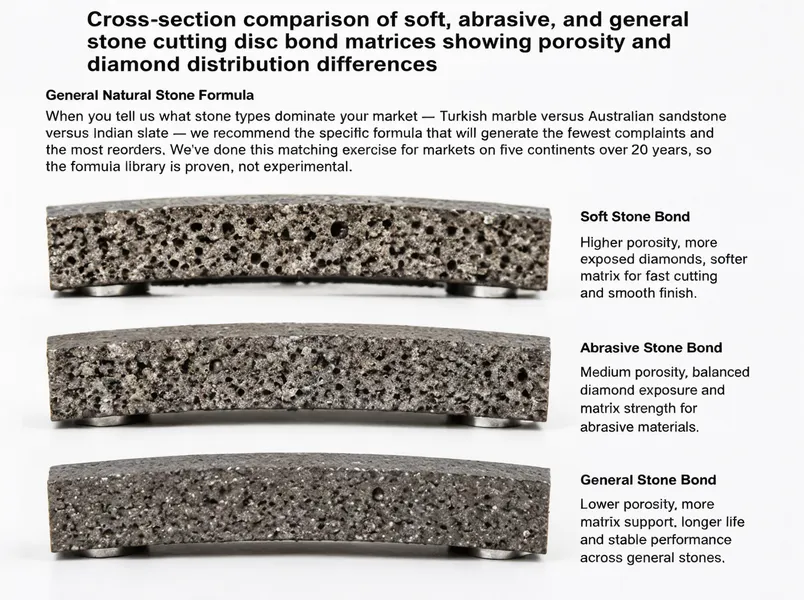
When you tell us what stone types dominate your market — Turkish marble versus Australian sandstone versus Indian slate — we recommend the specific formula that will generate the fewest complaints and the most reorders. We've done this matching exercise for markets on five continents over 20 years, so the formula library is proven, not experimental.
2018 Carrara Marble Refinement
We switched our standard soft-stone formula in 2018 after seeing inconsistent life results on Italian Carrara marble — the crystalline structure was slightly harder than our previous assumptions. The updated formula added about 8% more diamond concentration and uses a finer 60/80 mesh mix. Small adjustment, significant life improvement. This is the kind of iterative refinement that comes from two decades of field data.
Commercial Segments Where Stone Cutting Discs Drive Repeat Revenue
Each application below is a market segment with its own demand pattern and margin structure. This isn't about where the blade gets used — it's about where your sales volume lives.

Residential Renovation and Remodeling
Contractors cutting marble thresholds, limestone window sills, sandstone cladding, and slate floor tiles during home renovations consume stone cutting discs as daily expendables. The renovation cycle is project-based: each job burns 2–5 discs depending on scope, and active contractors run 15–30 jobs per year. Distributors serving this segment report monthly reorder cadences.
The blades need to deliver clean cuts without chipping polished marble edges — which is why a proper stone formula matters here and why you can price these above generic multi-purpose discs. Your contractor customers will pay the premium once they see the edge quality difference on their clients' marble.
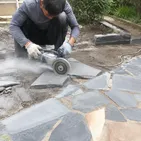
Landscaping and Hardscaping
Flagstone path cutting, sandstone wall cladding, natural stone paver trimming, water feature stonework. Landscaping is seasonal in temperate climates (spring through fall) but year-round in warm markets. Volume spikes correlate with construction seasons, giving you predictable inventory planning.
Abrasive-formula stone discs are the primary SKU here because flagstone and sandstone dominate landscaping materials. The commercial angle: landscapers burn through blades fast on abrasive stone, so a correctly formulated disc that lasts 30–40% longer than a generic alternative becomes a loyalty-building product in your catalog.
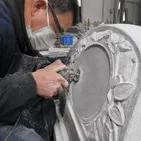
Monument, Memorial, and Stone Carving
Headstone fabricators, memorial engravers, and decorative stone carvers use small-diameter stone discs for detailed shaping and trimming on marble, granite-marble composites, and slate. Volume per customer is modest (5–20 discs/month), but the segment values precision over price and reorders consistently year-round.
This is a premium-priced niche where edge quality and smooth cutting action matter more than aggressive speed.

Stone Masonry and Restoration
Heritage building restoration, stone wall repair, church conservation — masons working with original limestone, sandstone, and slate need blades that cut without shattering brittle aged stone. Conservation projects specify careful cutting, making our clean-cutting continuous-rim stone discs a natural fit.
Contract sizes are smaller but pricing tolerance is high, and reputation-based referrals drive customer acquisition in this segment.
Market Growth Insight
The landscaping segment has grown fastest for our stone disc line in the past three years — particularly in Middle Eastern and African markets where natural stone is the default hardscaping material and imported porcelain hasn't displaced it yet. If you operate in those regions, this is the SKU to lead with.
Rim Configurations and Their Commercial Logic
The parent category page covers rim design theory. Here's how rim choice applies specifically to your stone cutting disc inventory strategy:
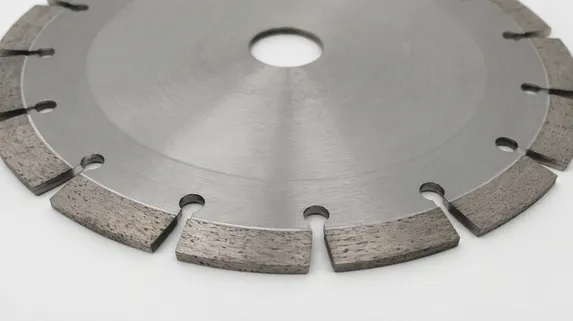
Segmented Rim
Volume SKU for Contractors
- Fastest cut speed, best debris clearance, most forgiving in dry-cutting conditions
- Segment gullets allow cooling air to reach the cut face, extending blade life during dry use
- Ideal for general construction-site stone cutting where speed matters more than edge finish
Trade-off: Visible scallop marks on the cut edge — doesn't matter for hidden cuts but rules it out for exposed decorative edges.
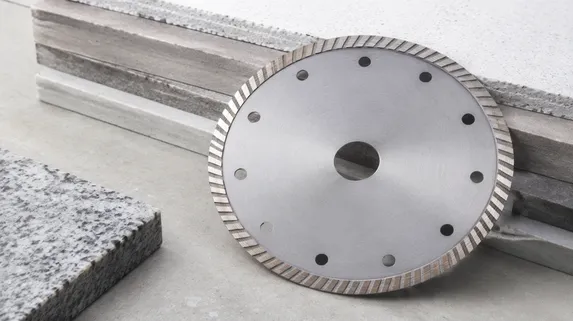
Turbo Rim
All-Rounder for Fewer SKUs
- Serrated continuous rim balances speed with smoother cut quality
- Cuts natural stone faster than continuous rim but with less chipping than segmented
- Available in standard turbo and turbo-wave (undulating profile for improved material clearance on deep cuts)
Best for: Turbo-wave is particularly effective on thicker sandstone slabs where debris loading in the cut channel slows standard rims.
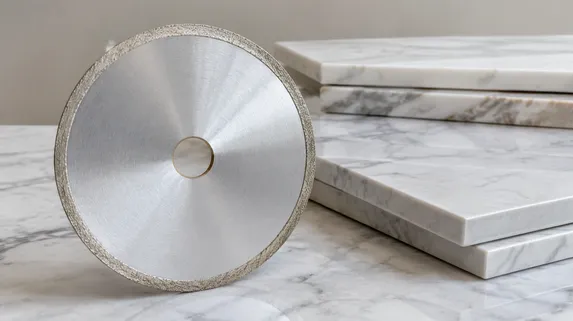
Continuous Rim
Fabrication & Renovation
- Uninterrupted diamond edge for chip-free cuts on polished marble, limestone, and finish-sensitive stone
- Edge quality eliminates grinding or polishing after cutting — essential where the cut edge is visible
- Finer diamond grit (60/80 mesh) for the cleanest possible finish
Trade-off: Slower cutting speed — suited for fabrication and renovation work, not high-volume site cutting.
Stocking Strategy
You can stock all three rim types at your primary diameter (115 mm or 125 mm) to cover the full range of use cases — or choose one based on your dominant customer segment. Most distributors start with segmented + turbo, then add continuous rim once they confirm demand from the fabrication/renovation channel.
Stone Cutting Discs vs. Granite Cutting Discs — Positioning for Your Catalog
Buyers sometimes ask whether they need both stone and granite cutting discs in their product line, or whether one covers the other. The answer depends on your market's stone types.
| Dimension | Stone Cutting Disc | Granite Cutting Disc |
|---|---|---|
| Target materials | Marble, sandstone, limestone, slate, travertine (Mohs 3–6) | Granite, engineered quartz, quartzite (Mohs 6–7) |
| Bond hardness | Medium — balanced erosion for moderately hard/abrasive stone | Soft — rapid self-sharpening against very hard, non-abrasive material |
| Diamond concentration | Medium-high | High |
| Typical grit | 50/60 mesh | 40/50 mesh (coarser for aggressive material removal) |
| Dominant segment | Renovation, landscaping, masonry | Countertop fabrication, construction with hard stone |
| Failure mode if misapplied | Too-soft bond glazes on soft marble; too-hard bond wears fast on abrasive sandstone | Glazes immediately if used on hard granite (insufficient self-sharpening) |
Soft Natural Stone Markets
If your market works primarily with soft natural stone — Mediterranean, Middle Eastern, and South American stone markets — stone cutting discs are your primary SKU.
Hard Stone & Engineered Quartz Markets
If your market processes engineered quartz and hard granite — countertop fabrication in North America, Europe, East Asia — granite discs lead.
They Don't Cannibalize Each Other
Many distributors stock both — they serve different end users and don't cannibalize each other. Stone discs target renovation, landscaping, and masonry contractors. Granite discs serve countertop fabricators and hard-stone construction.
We've seen distributors try to simplify their catalog by offering only a "universal stone" blade. It works commercially for a while — until a competitor enters with material-matched blades that outperform on specific stones. The performance gap shows up in blade life and cut quality, and your customers notice within one or two orders.
Customization Parameters for Stone Cutting Discs
Everything below is adjustable without redesigning the product from scratch. We're adjusting within an established platform, not starting over.
Formula Customization
- Bond hardness adjustment — softer for your market's harder stones, harder for abrasive materials
- Diamond concentration tuning — higher concentration = longer life at higher cost per blade; lower = faster cut speed, shorter life
- Grit size selection — 40/50, 50/60, 60/80 mesh based on target finish quality vs. cut speed priority
We need to know: what stone types your end users cut, and whether they prioritize speed or blade life
Physical Parameters
- Any standard diameter from 105–230 mm
- Arbor bore: 16, 20, 22.23, 25.4 mm or custom
- Segment height: 7–12 mm — directly determines blade life (taller = longer life)
- Segment count and width adjustable per diameter
- Continuous, turbo, or segmented rim at any diameter
Branding & Packaging
- Private-label printing on blade body — your brand, safety text, application marking
- Laser etching or silkscreen on steel core
- Custom core colors (painted — any color, MOQ applies)
- Packaging: blister card, paper sleeve, tin box, printed inner box, or bulk
- Your artwork files, your barcode/QR codes, your regulatory text — we print them
What Cannot Be Customized
- Blade diameters outside 105–230 mm for this product line — larger diameters are a different product category (see diamond saw blades)
- Maximum RPM is physics-bound to diameter and segment attachment method — we won't rate a blade beyond its safe operating speed
- Single-piece orders for custom specs — minimum 500 pcs/SKU for formula changes; 200 pcs for standard formula with custom packaging
Production Timelines
20–25
Days
Standard formula, custom packaging
30–40
Days
Custom formula + custom packaging (includes sample approval)
15–20
Days
Repeat orders on established specs
We'll spec the configuration and return a detailed proposal
Quality Assurance Specific to Stone Cutting Discs
Our ISO 9001, CE, SGS, and MPA certifications set the baseline. Here's what QC looks like specifically for this product.
Incoming Diamond Inspection
Every diamond grit batch gets particle size distribution analysis and thermal stability testing before it enters the formula. For stone cutting discs, we're verifying that grit morphology supports the self-sharpening behavior the formula depends on.
Irregular crystal shapes with sharp edges — that's what we want. Round, blocky crystals don't fracture properly and cause glazing.
We've rejected grit shipments that passed supplier QC but didn't match our morphology criteria.
Sintering Parameter Lock
Stone cutting disc segments run at lower sintering temperatures than granite or concrete segments because the softer bond matrix in our stone formulas is sensitive to thermal overshoot.
Our programmable furnaces hold temperature within ±5°C of target. We log every cycle — if a furnace drifts, the batch gets flagged and re-tested before release.
Cutting Performance Bench Testing
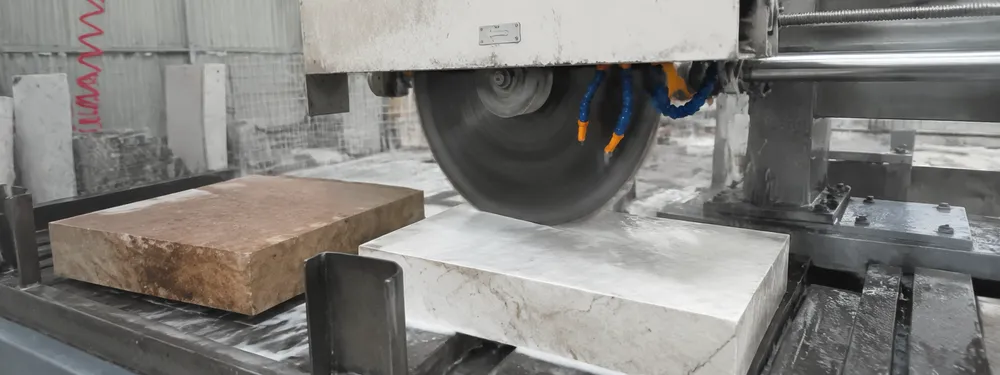
We pull samples from every production batch and run standardized cutting tests on marble and sandstone blocks on our instrumented test bench. We measure:
If a sample set underperforms against the formula's established baseline, that batch goes back to engineering for diagnosis before shipping.
Weld Integrity
Destructive pull testing on random samples from every welding run. Our minimum shear force standard for stone cutting discs is 800N per segment.
Slightly lower than our concrete disc standard because stone cutting generates less impact force, but still well above the operating loads the segments will encounter in use.
MPA Certification — European Market Relevance
MPA certification is particularly relevant if you distribute in European markets — it confirms the blade is safe for operation at rated RPM with proper segment retention. Your customers can reference our MPA certification number directly in their safety documentation.
Frequently Asked Questions
What's the typical blade life for a stone diamond cutting disc on marble versus sandstone?
On marble (Mohs 3–4, low abrasion), our standard 10 mm segment height disc in 115 mm diameter typically delivers 80–120 linear meters of cutting before segment exhaustion. On sandstone (Mohs 5–6, high quartz content), the same segment height delivers 40–60 linear meters because the abrasive material erodes the bond matrix faster.
This is why we offer the hard-bond abrasive-stone formula — it extends sandstone cutting life by approximately 30–40% over our standard stone formula.
If your market is heavily sandstone-based, specify the abrasive formula and your customers will notice the difference immediately.
Can I use a stone cutting disc on granite?
Technically yes, but performance will be poor. Stone cutting discs use a medium-hardness bond optimized for Mohs 3–6 materials. Granite (Mohs 6–7) is harder and less abrasive, which means the bond won't wear fast enough to expose fresh diamonds — the blade glazes and cutting stalls.
For granite, you need our granite cutting discs with their softer bond matrix and higher diamond concentration.
Stock both if your market uses both stone types — they're not interchangeable.
What rim type should I stock if I can only carry one stone cutting disc SKU?
Turbo rim. It's the best single-SKU compromise — cuts faster than continuous rim, cleaner than segmented.
Your customers working on renovation marble won't get chip-free results (for that they need continuous rim), and your landscaping customers won't get maximum speed (segmented beats turbo for raw cutting pace), but turbo handles both adequately.
Once you confirm demand in each segment, expand to segmented + continuous rim for customers who specialize.
What is the minimum order for private-label stone cutting discs?
500 pieces per SKU for standard-formula blades with your branding. If you need a custom formula (adjusted bond for your market's specific stone type), same 500-piece minimum.
New packaging tooling (custom blister mold) adds a one-time tooling charge and raises MOQ to 2,000–3,000 per SKU.
For market-entry testing, we ship 200–500 pieces in neutral packaging so you can field-test performance before committing to branded production.
How do I prevent stone cutting discs from cracking the stone during cutting?
Three factors: blade selection, feed pressure, and water.
- Blade selection: Continuous-rim blades with finer grit (60/80 mesh) generate the least impact and produce the cleanest cuts on brittle stone.
- Feed pressure: Should be moderate and consistent — letting the blade cut at its own pace rather than forcing it.
- Water: Wet cutting reduces thermal shock on the stone surface.
If your customers report cracking on marble or limestone, they're likely using a segmented blade (too aggressive) or cutting dry on a wet-only specification. We mark recommended cutting method on every blade for exactly this reason.
Do stone diamond cutting discs work on engineered stone (quartz composite)?
Engineered quartz (Caesarstone, Silestone, etc.) sits at Mohs 7 — harder than natural stone and non-abrasive due to the resin binder. Our stone cutting discs will cut it, but you'll get premature glazing and short blade life because the bond matrix is too hard for that material profile.
Engineered stone performs better with our granite formulation or a dedicated engineered stone blade from our larger saw blade range.
For small-diameter angle grinder work on quartz countertops, recommend the granite cutting disc to your customers.
Get Started — What We Need to Quote Your Stone Cutting Disc Order
Send us these details and we'll respond with a specific formula recommendation, pricing, and sample plan — typically within 24 hours.
What stone types your end users cut most (marble, sandstone, limestone, slate, mixed)
Target diameter and arbor size for your market
Rim type preference (or tell us the application and we'll recommend)
Approximate order volume (annual estimate or trial quantity)
Whether you need OEM branding or will start with neutral/CLSEG-branded stock
Most buyers in the stone disc category start with a 500–1,000 piece trial across two rim types to test market response. You confirm performance and demand, then we scale into branded production with your formula locked in. No volume commitment required on the first order.
24h
Quote Response
500pc
Min. Order
Free
Sample Plan
OEM
Branding Ready