

Asphalt Cutting Blades Soft-Bond Diamond Blades for Road Saws
Asphalt eats through generic concrete blades in a fraction of the rated life. Our asphalt diamond blades use softer bond matrices and wider segments to handle the abrasion, heat, and embedded aggregate that make road cutting a distinct application.
- Laser-welded for dry/semi-dry cutting
- 300–900 mm diameter range
- Factory-direct from CLSEG
- Soft-bond formula for abrasive materials
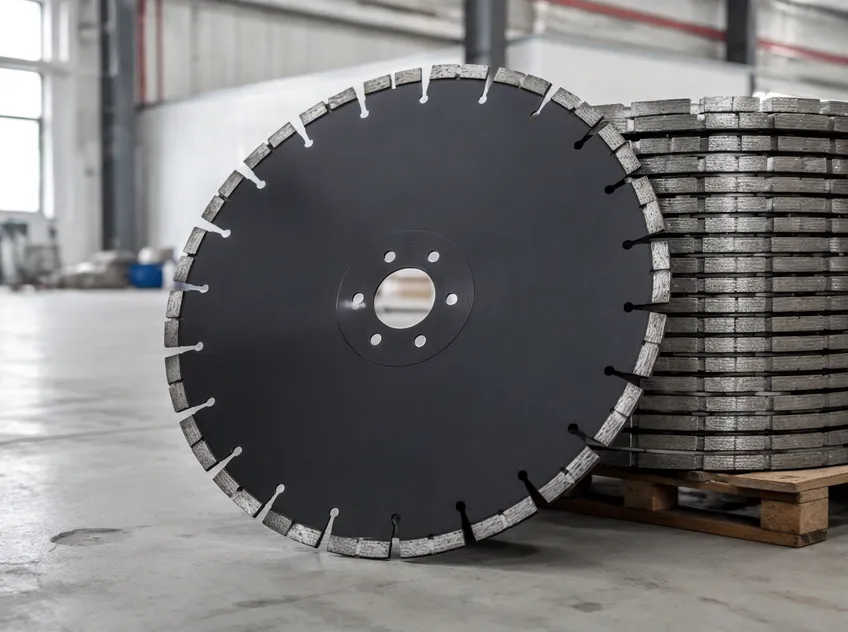
What Makes Asphalt Different from Concrete — and Why Your Blade Inventory Needs to Reflect That
Asphalt is not concrete. It behaves differently under a diamond blade, and the failure mode is different. Concrete is hard and relatively non-abrasive — the cement matrix is the challenge. Asphalt is soft, flexible, and extremely abrasive because of the loose aggregate embedded in bitumen. The bitumen itself is thermoplastic — it melts under friction heat, clogs segment gullets, and smears across the diamond surface. Standard concrete blades in asphalt lose segments or glaze within hours because the bond formula is wrong for the material.
Our asphalt cutting blades address this with three specific design choices: a softer metal bond that erodes in step with the aggressive abrasion (keeping fresh diamonds exposed continuously), wider segments with deeper gullets for heat dissipation and slurry clearance, and laser-welded joints that survive the thermal cycling inherent to semi-dry road cutting. If you're stocking road cutting blades, this is the line that keeps your contractor customers reordering instead of calling with complaints.
Softer Metal Bond
Erodes in step with aggressive abrasion, keeping fresh diamonds exposed continuously throughout the cut.
Wider Segments & Deep Gullets
Heat dissipation and slurry clearance prevent bitumen buildup from clogging the cut face.
Laser-Welded Joints
Survive the thermal cycling inherent to semi-dry road cutting where brazed joints would fail.
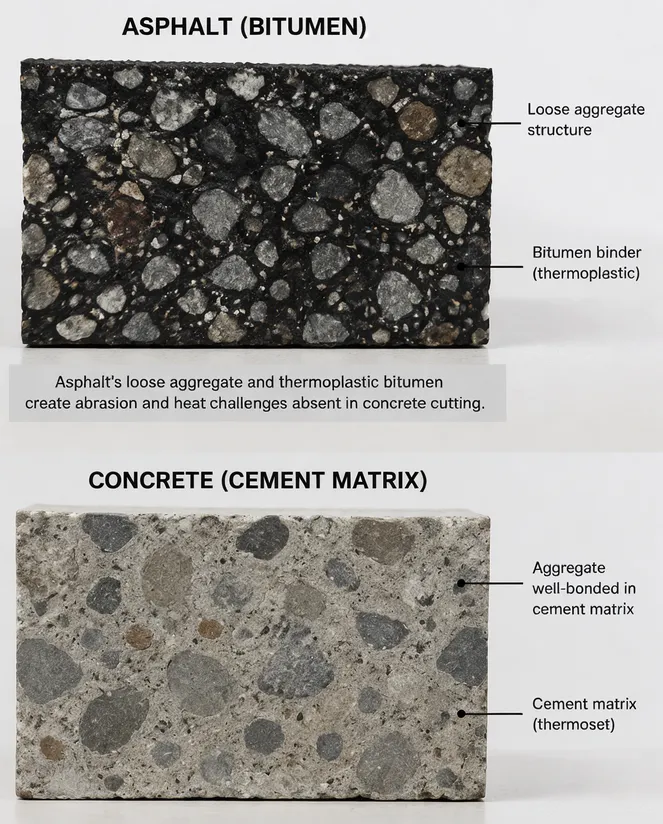
Asphalt's loose aggregate and thermoplastic bitumen create abrasion and heat challenges absent in concrete cutting.
Technical Specifications for Asphalt Diamond Blades
Specifications shown are industry-standard values for this product type. Actual specifications may vary by diameter and configuration. Contact us for detailed product data sheets.
| Parameter | Typical Values |
|---|---|
| Diameter range | 300, 350, 400, 450, 500, 600, 700, 800, 900 mm |
| Segment height | 10–15 mm (standard); up to 20 mm on heavy-duty versions |
| Segment width | 3.2–4.8 mm |
| Core thickness | 2.8–4.0 mm |
| Arbor bore | 25.4 mm (1″), 50 mm (custom bore available) |
| Segment type | Wide gullet, drop-segment, or turbo-segmented |
| Welding method | Laser welding (standard); high-frequency welding for wet-only |
| Bond type | Soft-to-medium iron-cobalt matrix, formulated for high-abrasion |
| Diamond grit | 30/35, 35/40 mesh (coarser grit for aggressive removal) |
| Operating speed | 25–50 m/s (varies by diameter) |
| Cooling method | Wet preferred; semi-dry and dry supported (laser-welded) |
| Certifications | ISO 9001:2015, CE, MPA |
Comparing Quotes Between Manufacturers?
The segment width and gullet depth are where asphalt blades diverge most from concrete blades. Wider segments with deeper gullets let the melted bitumen and aggregate slurry clear instead of packing into the cut face. If you're comparing quotes between manufacturers, check these dimensions — a "cheap" blade with narrow segments designed for concrete will underperform catastrophically in asphalt.
Bond Formula: Why Asphalt Demands a Different Matrix
We've shipped asphalt cutting blades to road contractors in Southeast Asia, the Middle East, and South America for over fifteen years. The single most common failure we see from buyers switching to us: they were using concrete-formula blades on asphalt, and the segments weren't wearing fast enough to expose fresh diamonds. The blade glazes — looks intact but stops cutting. The contractor blames the blade. The distributor takes the return.
The fix is straightforward but requires formula-level control. Asphalt's extreme abrasiveness means the bond matrix needs to erode faster than you'd want for concrete. We use an iron-cobalt soft bond with controlled porosity — the porous structure helps with heat dissipation and allows the matrix to shed cleanly, keeping diamond exposure consistent from the first cut to the last millimeter of segment. We adjust diamond concentration and grit size based on the specific aggregate in your market's road base.
Regional Formula Adaptation: Southeast Asian road surfaces tend to use harder basalt aggregate versus the softer limestone common in Middle Eastern roads — the same formula doesn't optimize for both. We calibrate diamond concentration and grit size for your specific market's road base aggregate.
For you as a distributor or contractor buyer, this means fewer warranty claims from blade glazing, longer effective cutting life per blade, and a product your field crews won't complain about by lunchtime. We maintain formula records for repeat orders, so your year-two blades perform identically to your year-one trial.
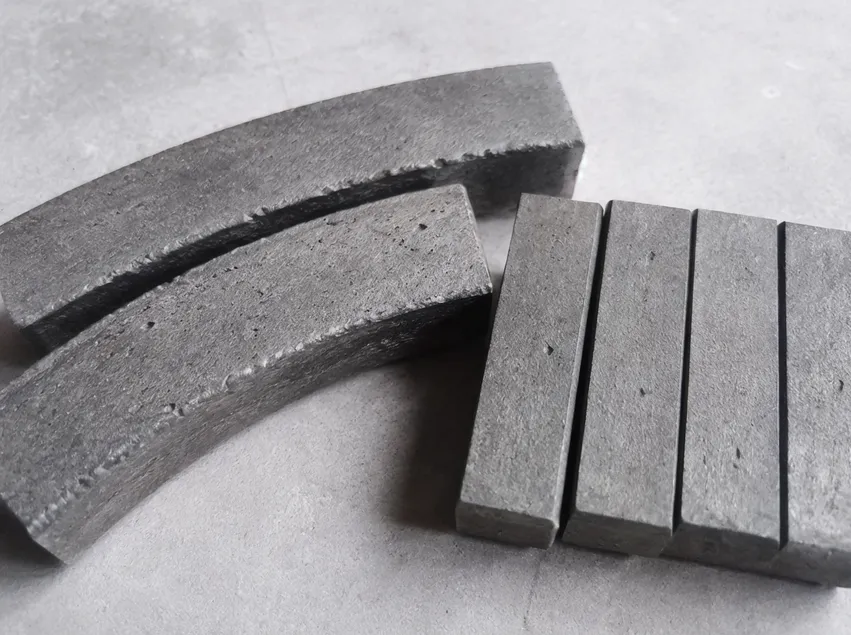
Road Construction and Utility Work — Where Asphalt Blades Move Volume
Municipal Road Maintenance and Repair
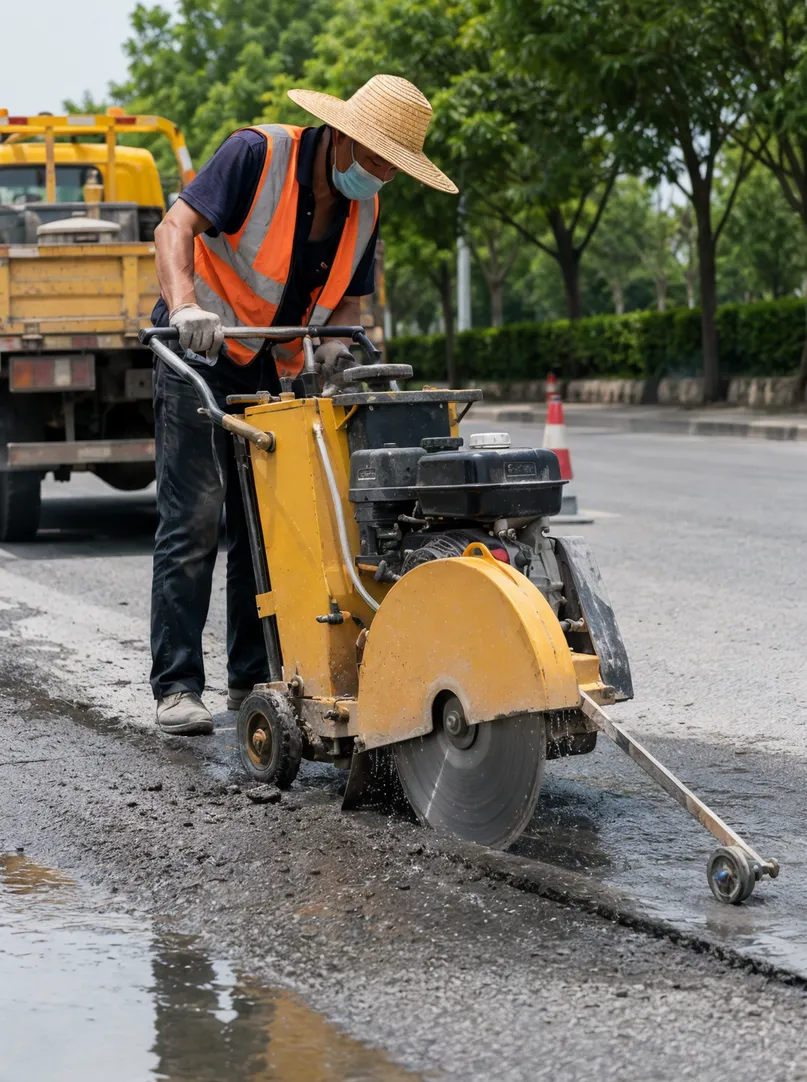
This is the recurring revenue segment. Every city and municipality repairs roads year-round — patching potholes, cutting trenches for utility access, milling damaged sections for overlay. Walk-behind road saws consuming 300–500 mm blades are the standard tool. Crews run through blades at a predictable rate, and whoever supplies their blades gets reorders every month during construction season.
Typical order patterns: 50–200 blades per municipal contractor per season in temperate climates; year-round in tropical markets.
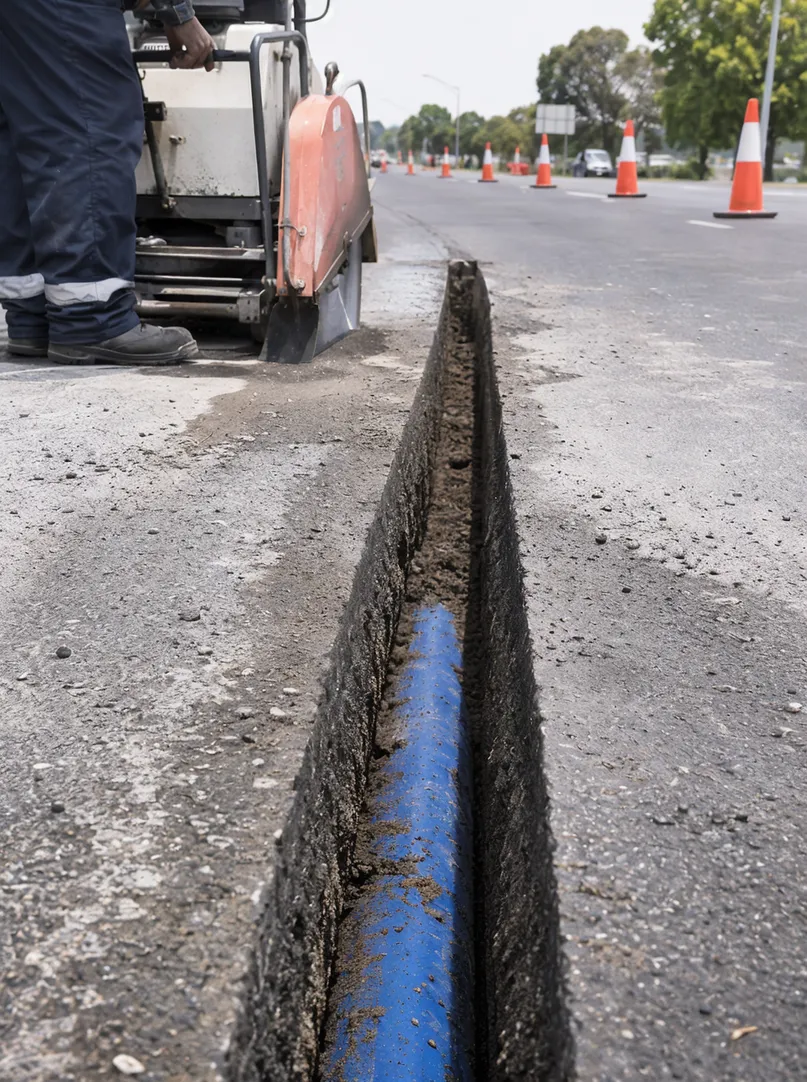
Utility Trench Cutting (Water, Gas, Telecom)
Underground utility installation and repair requires precise pavement cuts — clean edges, controlled depth, minimum surface damage to adjacent road. Floor saws and hand-guided road saws use 350–500 mm asphalt blades for this work. Utility contractors often operate on tight schedules (road closure permits are time-limited), so a blade that maintains consistent cutting speed throughout its life directly reduces their labor-per-meter cost.
Field-proven result: We've had utility contractors switch to our blades specifically because they could finish one more trench per shift — that's a margin argument, not just a product argument.
Highway and Airport Runway Joint Cutting
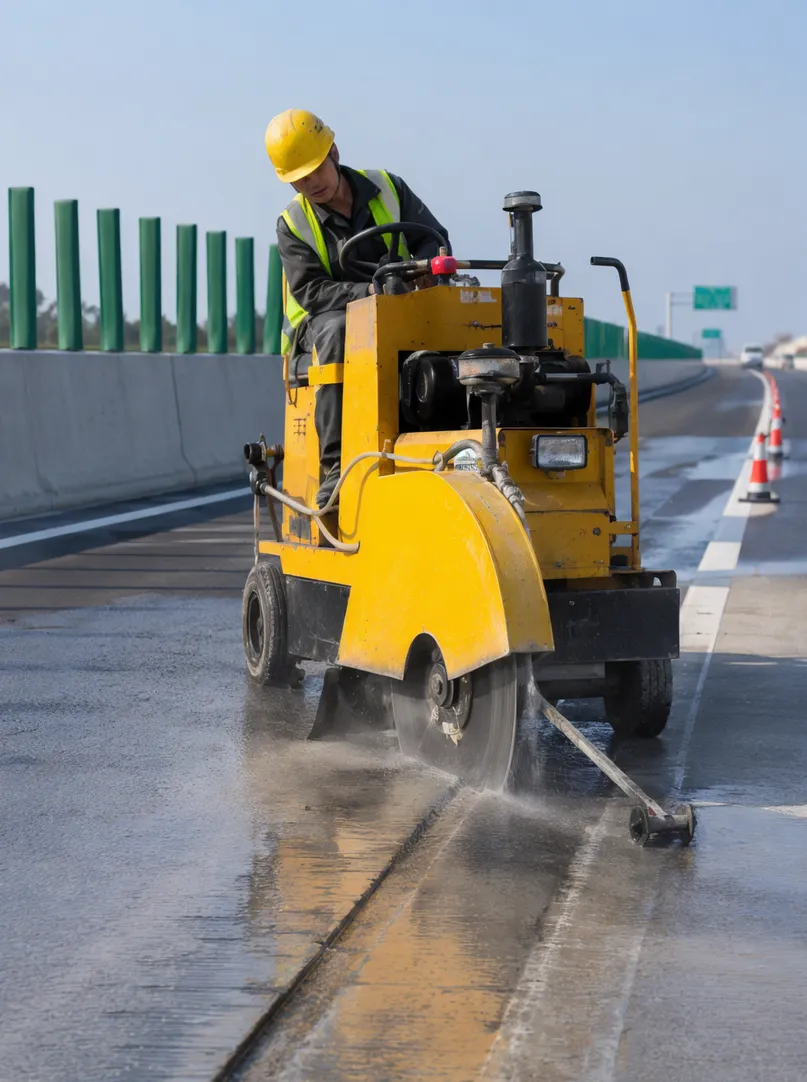
Large-diameter blades (600–900 mm) on ride-on road saws for cutting expansion joints, isolation joints, and repair boundaries in highway pavement and airport runways. These projects are government-funded, high-volume, and specification-driven.
If your business bids on infrastructure supply contracts, stocking the right diameters with certified quality documentation (MPA, CE) puts you ahead of competitors who can't provide compliance paperwork at bid time.
Demolition and Site Preparation
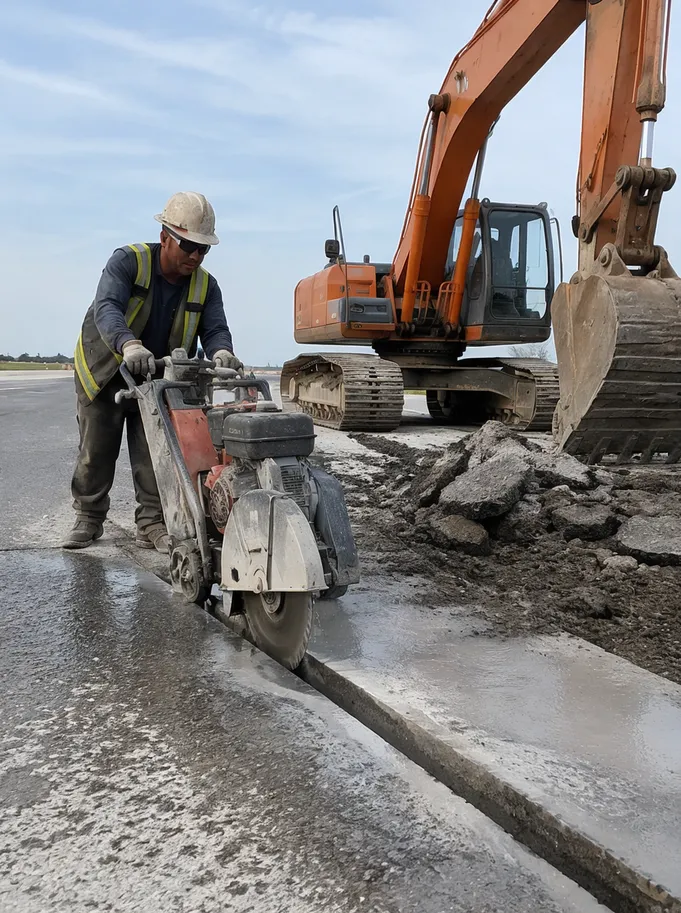
Before new construction starts, old asphalt surfaces need cutting and removal. Demolition contractors use road saws and wall saws to section pavement for excavator removal. Speed matters more than cut quality here — the material is being removed, not preserved.
Heavy-duty variant: We offer taller segments (15–20 mm) for this application, extending blade life on high-volume demolition where operators push feed rates aggressively.
Tell us which segments you serve — we'll recommend the diameter and specification mix.
Get Application GuidanceSegment Design and Welding: Engineering for Thermal Abuse
Asphalt road cutting is hard on weld joints. Road saws frequently cut semi-dry (limited water or recycled slurry water), the bitumen creates thermal insulation that traps heat at the cutting face, and operators often make interrupted cuts — starting and stopping repeatedly across a repair zone. Each thermal cycle stresses the segment-to-core bond.
Laser Welding — Our Standard
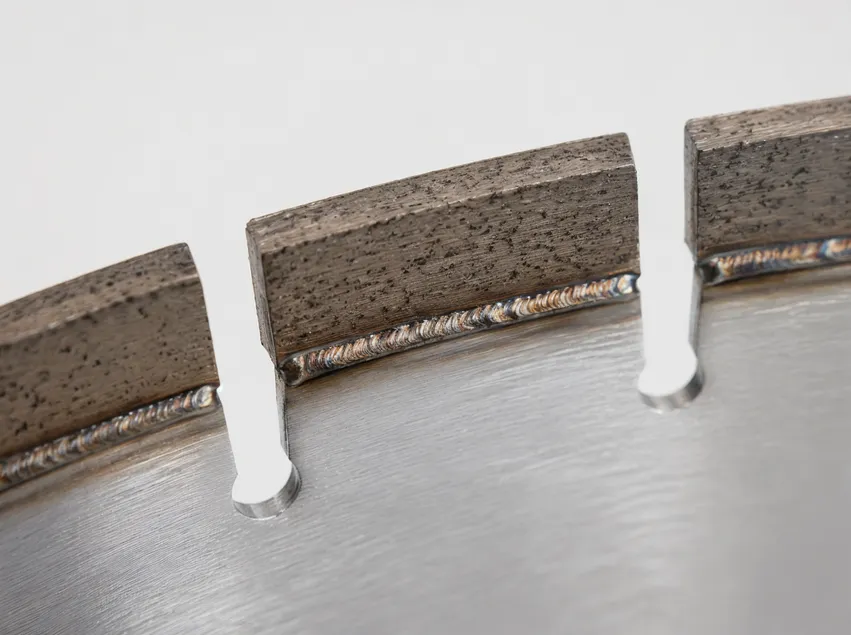
We laser-weld our asphalt blades as standard. Laser welding creates a metallurgical fusion bond between segment and core that withstands repeated thermal cycling without crack propagation — unlike high-frequency welded joints that rely on a brazing alloy with a lower thermal fatigue threshold.
For wet-only applications at lower RPM (indoor floor sawing on asphalt-covered warehouse floors, for instance), we offer HF-welded versions at a lower price point. But for outdoor road cutting where thermal conditions are unpredictable, laser welding is the recommendation we stand behind.
Drop-Segment Geometry
Our segments use a drop-segment geometry with wide gullets — wider than what you'd see on a concrete blade of the same diameter. The gullets serve dual purpose: clearing the sticky bitumen-aggregate slurry from the kerf and providing airflow cooling to the segment face.
We cold-press these segments at lower compaction density than our concrete segments (intentional — the added porosity accelerates matrix wear to match asphalt's abrasiveness). Every batch gets density measurement and hardness testing; if segment density exceeds our threshold, the bond is too hard for asphalt and that batch gets reclassified or scrapped.
Laser Welded (Standard)
- Metallurgical fusion bond — no brazing alloy layer
- Withstands repeated thermal cycling without crack propagation
- Recommended for all semi-dry and outdoor road cutting
- Safe for interrupted cut patterns and thermal shock
HF Welded (Budget Option)
- Brazing alloy bond — lower thermal fatigue threshold
- Suitable for wet-only, low-RPM applications
- Indoor floor sawing on asphalt-covered warehouse floors
- Lower price point for controlled thermal environments
Customization Scope for Asphalt Cutting Blades
| Customization Dimension | Available Options |
|---|---|
| Diameter | 300–900 mm (standard); custom diameters on request |
| Arbor Bore | 25.4 mm, 50 mm, or custom |
| Segment Height | 10 mm, 12 mm, 15 mm, 20 mm |
| Bond Hardness | Soft, Medium-soft, Medium |
| Diamond Concentration | Standard, High (for extended life applications) |
| Diamond Grit Size | 30/35, 35/40, 40/50 mesh |
| Welding Type | Laser (standard), HF (wet-only budget option) |
| Segment Geometry | Standard gullet, Drop-segment, Turbo-segmented |
| Packaging | CLSEG brand, Private label (your brand), or Unbranded |
| Color Coding | Standard or custom core paint color |
What Cannot Be Customized
- No asphalt blades below 300 mm diameter — road saws don't use them
- No blades above 900 mm — that's gang saw-scale equipment that doesn't cut asphalt
- No continuous rim for asphalt — gullets are essential for slurry clearance
Formula Adjustment Turnaround
Typically 2–3 weeks including sample production and test cutting.
If you're entering a new regional market and aren't sure which aggregate type dominates your local roads, send us a sample of the road surface material or even a photo — we can usually identify the aggregate and recommend the appropriate bond configuration.
Need a custom specification or private-label pricing?
Share your requirements and we'll scope a solution within 48 hours.
Asphalt Blades vs. Concrete Blades — Helping Your Customers Choose Correctly
The Most Common Purchasing Error
The most common purchasing error we see from distributors new to infrastructure blades: stocking "concrete/asphalt" combo blades and selling them as universal. These compromise on everything — the bond is too hard for pure asphalt work and too soft for reinforced concrete. Your customer gets mediocre performance on both materials and blames the blade.
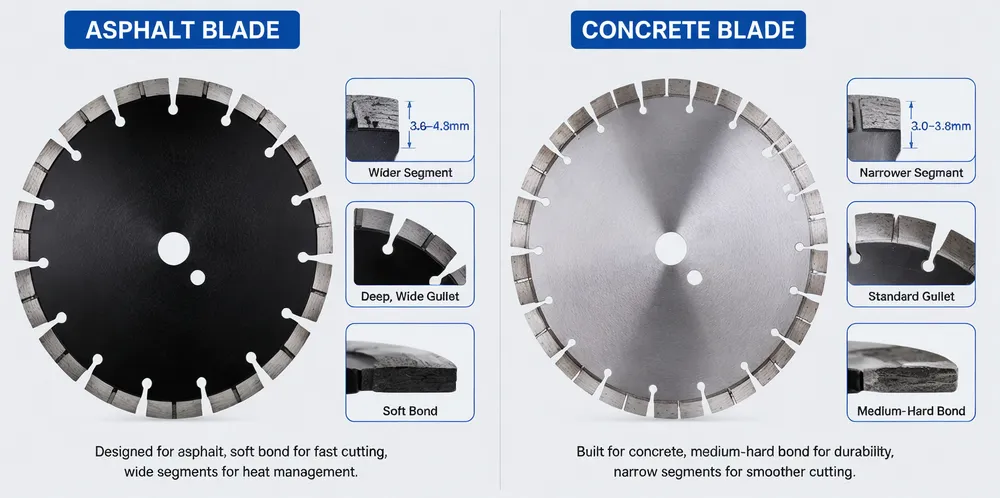
| Factor | Asphalt Blade | Concrete Blade | "Universal" Blade |
|---|---|---|---|
| Bond Hardness | Soft (erodes quickly to expose diamonds) | Medium-hard (resists abrasion from aggregate) | Medium (compromises both) |
| Segment Width | 3.6–4.8 mm (wider for heat management) | 3.0–3.6 mm (narrower for precision) | 3.2–3.6 mm |
| Gullet Design | Deep, wide (slurry clearance) | Standard depth | Standard depth |
| Thermal Tolerance | High (designed for semi-dry) | Moderate (assumes water cooling) | Moderate |
| Best Application | Pure asphalt, road base, bituminous materials | Cured/green concrete, reinforced concrete | Light-duty mixed surfaces |
| Life in Asphalt | 100% rated life | 30–50% rated life (premature glazing or segment loss) | 60–70% rated life |
Stock Recommendation
If your customers cut both materials regularly, stock both dedicated blades — the per-meter cutting cost is lower than using a universal blade on either material. Universal blades have a place for occasional crossover cuts, but they're not the profit center.
Need Help Choosing?
Need a recommendation for your specific product mix? Tell us what your customers cut and we'll map the right blade assortment to your market.
Tell us what your customers cutLooking for concrete-specific blades with medium-hard bond and standard gullet geometry? See our dedicated concrete blade range with formulas designed for reinforced and green concrete.
Packaging, Container Loading, and Logistics for Asphalt Blade Orders
Individual Blade Packaging
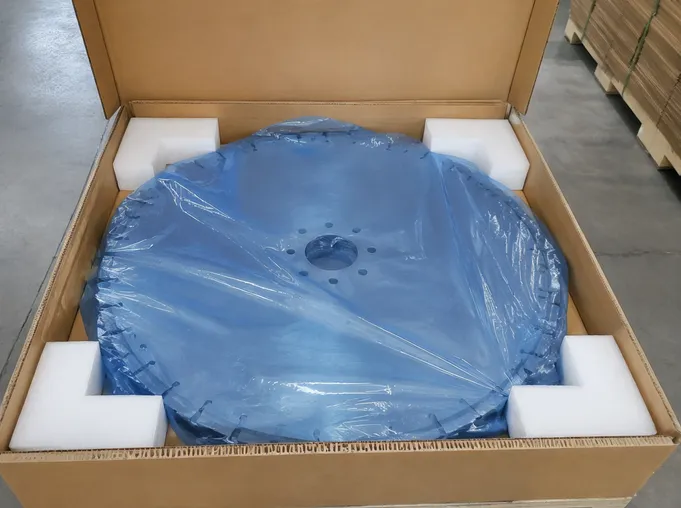
Each blade ships in a VCI (vapor corrosion inhibitor) sleeve with a reinforced cardboard box. Foam edge protectors prevent segment tip damage during transit. Blades above 600 mm use wooden crate packaging with moisture barriers for ocean freight.
Container Loading Estimates
Approximate quantities; varies by diameter and packaging configuration.
| Diameter | Pieces per 20GP | Pieces per 40HQ |
|---|---|---|
| 300–400 mm | 3,000–4,500 | 6,500–9,000 |
| 450–500 mm | 1,800–2,500 | 4,000–5,500 |
| 600–700 mm | 800–1,200 | 1,800–2,500 |
| 800–900 mm | 400–600 | 900–1,300 |
We optimize crate and carton dimensions to maximize container fill rate and can provide a loading diagram with your quote. For mixed-diameter orders (which is typical — most infrastructure distributors order a range of sizes), we arrange loading to distribute weight evenly and prevent shift during transit.
Lead Time
- Standard formulas: 25–35 days from order confirmation
- Repeat orders: Ship faster — we maintain your formula parameters and production records
- Custom formula (first order): Add 2–3 weeks for sampling and approval
Documentation Included
- Commercial Invoice
- Packing List
- Certificate of Origin
- MPA/CE Certificates
- Fumigation Certificate (wooden crates)
We coordinate with your freight forwarder or arrange FOB/CIF through our logistics partners.
Frequently Asked Questions
Practical answers for distributors and procurement teams sourcing asphalt cutting blades at volume.
What diamond blade diameter do I need for a standard road saw?
Most walk-behind road saws accept 350–500 mm blades. The typical cutting depth for utility trench work is 100–150 mm, which a 400 mm blade handles comfortably. Ride-on saws for highway joint cutting use 600–900 mm.
Match blade diameter to your saw's maximum capacity minus about 50 mm — running a blade at maximum capacity reduces stability and shortens life.
If you're unsure which sizes your customers' machines require, send us the saw model numbers and we'll cross-reference the compatibility.
How many linear meters does an asphalt cutting blade last?
It depends on aggregate hardness, cutting depth, and whether you're running wet or semi-dry. As a general range: a quality 400 mm asphalt blade with 12 mm segment height cuts 800–1,500 linear meters at 100 mm depth in standard asphalt pavement.
Hard basalt aggregate reduces life toward the lower end; softer limestone aggregate extends it.
We can provide more specific estimates once we know your aggregate type — or if you send us a competitor blade you're currently using as a benchmark, we'll quote a direct performance comparison.
Can I use an asphalt blade to cut concrete patches in road repair?
Yes, briefly and with trade-offs. When cutting through asphalt overlay into a concrete base (common in road repair), the asphalt blade works but the soft bond wears faster in the concrete layer than a dedicated concrete blade would.
For occasional crossover — a few centimeters of concrete below the asphalt — the blade handles it fine. For full-depth concrete cuts, switch to a concrete blade.
Stocking both avoids premature wear and keeps your per-meter cost accurate for each material.
Laser-welded or high-frequency welded for road cutting applications?
Laser-welded, almost always. Road saws run semi-dry frequently (water supply runs low, operators cut through water-line refill delays, ambient heat evaporates coolant fast). HF-welded joints crack under thermal cycling because the brazing alloy fatigues. Laser joints are fused metal-to-metal and tolerate the temperature swings.
The only exception: if your blades are exclusively used indoors on wet-cut floor saws where water supply is guaranteed and RPM is lower — then HF-welded saves you cost per unit.
What is the minimum order quantity for asphalt cutting blades?
50 pieces per specification for standard diameters and stock formulas. Private-label orders with custom packaging start at 100 pieces per spec.
Sample orders of 5–10 pieces available at production pricing for market testing.
For mixed-diameter orders (multiple sizes in one shipment), the MOQ applies per individual specification — a typical starter order might be 50 pieces each of 350 mm, 400 mm, and 500 mm.
How does aggregate type affect blade selection?
The aggregate embedded in asphalt is what actually wears the blade — the bitumen is soft. Hard aggregates (basalt, quartzite, river gravel) accelerate abrasion and shorten blade life; they need slightly harder bonds than you'd use for soft-aggregate roads.
Soft aggregates (limestone, recycite from crushed old asphalt) are less abrasive, allowing softer bonds and higher diamond concentrations for extended life.
If you serve multiple regions with different road compositions, we can set up 2–3 formula variants in your account so you order the right blade for each market.
Sibling Products Under Diamond Saw Blades
Your infrastructure customers may also need these complementary blade categories. Build a complete road-work inventory from a single source.
Concrete Saw Blades
For green concrete, cured concrete, and reinforced concrete. Harder bond, narrower segments. Pair with asphalt blades for full road-work coverage.
Large Concrete Saw Blades
600 mm+ for walk-behind saws, wall saws, and heavy-duty floor saws on thick concrete slabs.
Dry Cut Concrete Blades
When water isn't available. Laser-welded with heat-management segment design for waterless cutting.
Laser Welded Diamond Blades
The full range of laser-welded blades across materials, for buyers building a dry-cut inventory.
Building an infrastructure blade product line? Get a recommended SKU mix covering asphalt, concrete, and reinforced concrete.
Ask for SKU RecommendationsSource Your Asphalt Cutting Blades Direct
We're an asphalt cutting blade manufacturer — not a trader repackaging someone else's product. The formula is ours, the sintering is ours, and the welding is ours. When you need an adjustment for your market's road composition, you're talking to the engineers who control the process, not a sales team relaying messages.
Send Us Your Requirements
Provide the following details, and we'll come back within 48 hours with a specific recommendation, FOB pricing, and sample availability:
- The blade diameters you need
- The road saw models your customers run
- The type of road surface in your market (or country/region — we can usually infer the aggregate type)
- Your expected monthly or quarterly volume
The more specific you are about your application, the more precisely we can match the formula.
Contact Us Directly
Or submit a detailed inquiry with your specifications
Get Factory PriceTypical response time: within 48 hours with specific recommendation and FOB pricing