

Continuous Rim Diamond Blades Chip-Free Cutting for Premium Materials
No gullets means no chipping. When your customers cut material that sells by the visible edge, the rim design is the difference between billable work and scrap.
Built for porcelain, marble, ceramic tile, and decorative stone — materials where edge quality determines value.
- OEM / Private Label Available
- Ships to 30+ Countries
- 105 mm – 500 mm Range
- Factory-Direct Pricing
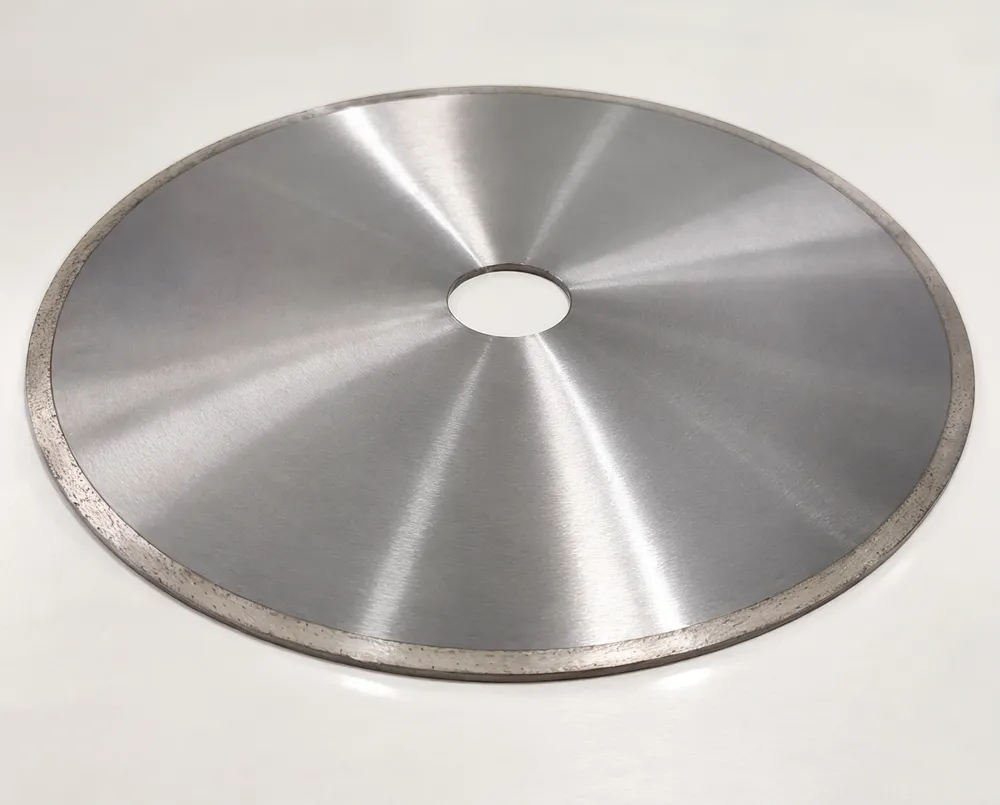
What Makes a Continuous Rim Blade Different — and Where It Earns You Money
A continuous rim diamond blade has no gullets — no gaps between segments. The cutting edge is an unbroken band of diamond-impregnated matrix running the full circumference. This geometry eliminates the impact points that create micro-chipping on brittle materials.
Your segmented blades cut faster. Your turbo blades clear debris better. But neither can deliver the edge finish your customers need on polished porcelain tile, honed marble, or decorative stone where a single visible chip means a rejected piece. That's where continuous rim blades live commercially — in applications where material cost is high enough that a clean edge saves money, not wastes time.
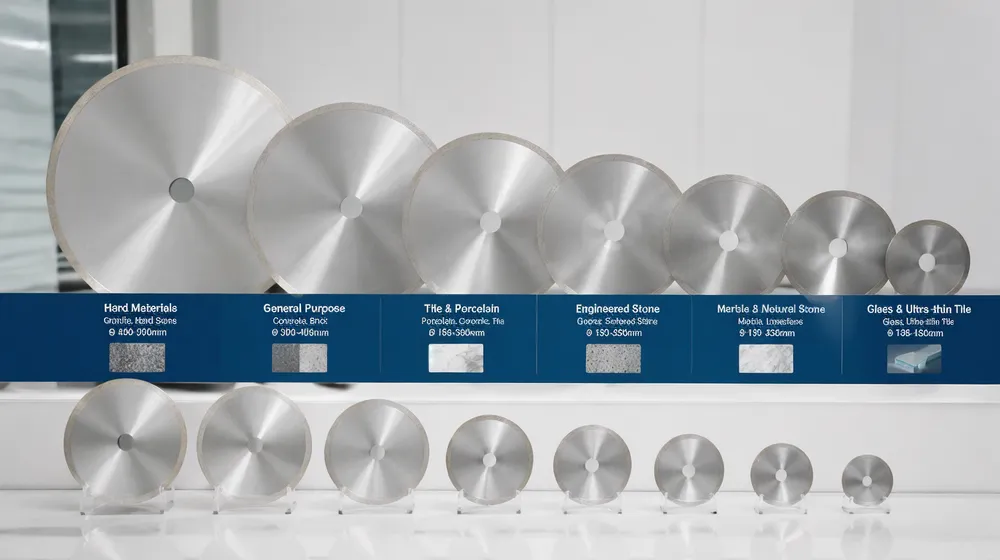
We manufacture continuous rim diamond blades from 105 mm up to 500 mm, covering angle grinders, tile wet saws, bridge saws, and table saws. The full diameter range means you stock one blade construction type across multiple machine categories — simpler SKU management for your warehouse, and one product story for your sales team to tell regardless of the end user's equipment.
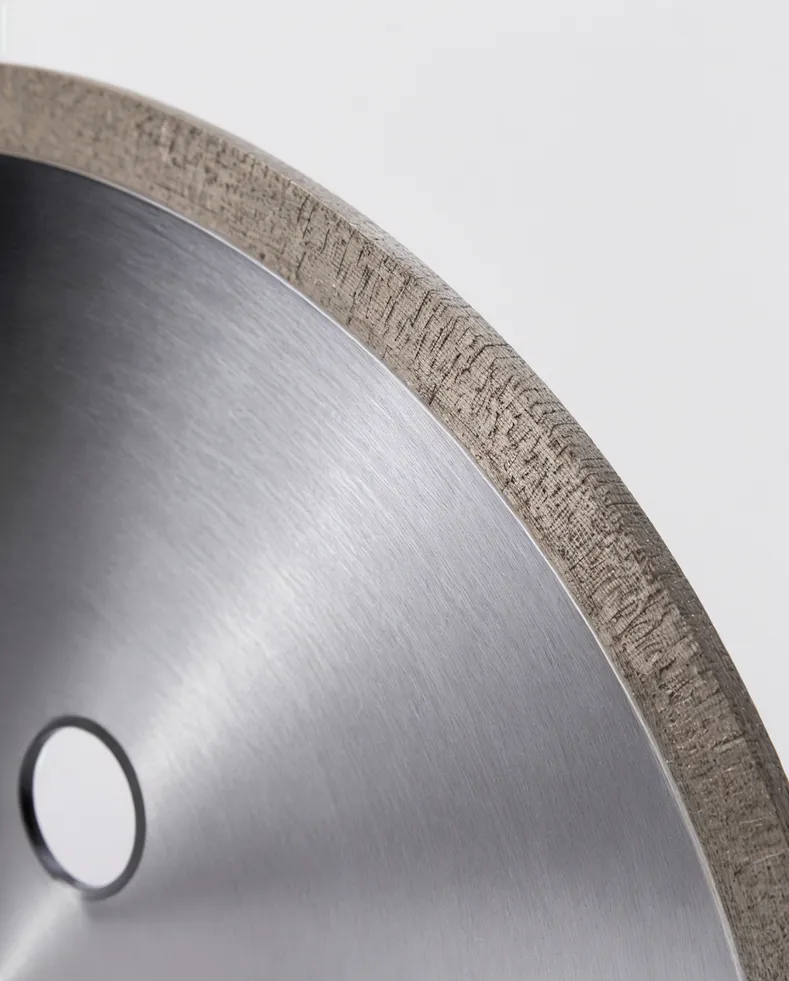
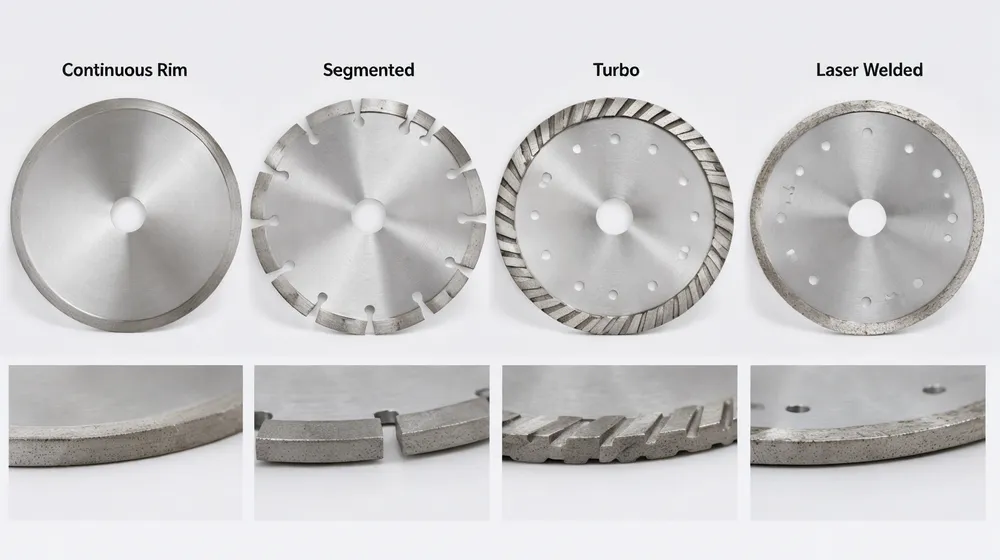
Continuous Rim
Unbroken edge band. Cleanest finish on brittle materials. Slower feed rate, but zero chip risk on polished surfaces.
Segmented
Gullets between segments for debris clearance and cooling. Faster cuts on hard materials like granite and concrete. Rougher edge.
Turbo
Serrated continuous rim. Better debris clearance than continuous. Compromise between speed and finish quality.
The Commercial Logic
Continuous rim blades live in applications where material cost is high enough that a clean edge saves money, not wastes time. A single visible chip on polished porcelain tile, honed marble, or decorative stone means a rejected piece — and rejected pieces cost your customers more than slower feed rates.
The Rim Itself: How We Sinter a Blade With No Weak Points
On a segmented blade, each segment is individually pressed, sintered, then welded onto the core. Every weld joint is a potential failure point. A continuous rim blade eliminates weld joints entirely on the cutting edge.
Cold-Press in a Ring Die
We cold-press the rim in a ring die — one continuous form, not a series of individual segment blanks. This creates the full circumference band as a single integrated piece from the start.
Extended Sintering Profile
The sintering profile is different from segmented production: longer hold time at peak temperature because the larger continuous mass needs uniform heat penetration. If the center of the rim sinters at a different density than the edges, you get uneven wear and the blade loses roundness prematurely.
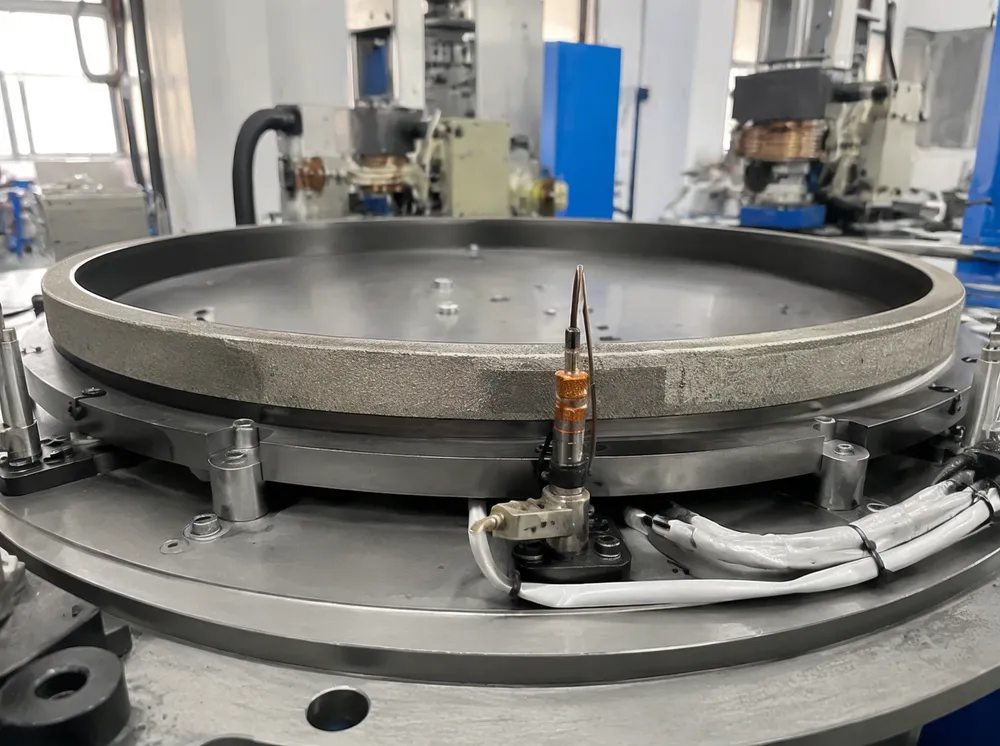
Thermocouple Monitoring
We monitor internal thermocouple readings across the rim cross-section during sintering to confirm temperature uniformity within ±5°C. We added the thermocouples after chasing a batch inconsistency in 2017 that only showed up after 30+ hours of cutting — the rim was wearing into an oval because the inner zone was slightly under-sintered.
Single-Operation Bond to Core
We sinter the full rim as a single integrated band, then braze or sinter-bond it to the steel core in one operation. No individual weld joints on the cutting edge — eliminating the most common failure mode of segmented blades.
The Payoff for You
- No segment loss risk — the continuous band cannot shed individual segments because there aren't any
- Uniform wear pattern — thermocouple-controlled sintering ensures consistent density across the full rim cross-section
- Predictable blade life across the batch — your customers get consistent results blade after blade, fewer complaints, and higher reorder rates
Technical Specifications
| Parameter | Typical Range |
|---|---|
| Diameter | 105 mm, 115 mm, 125 mm, 180 mm, 200 mm, 250 mm, 300 mm, 350 mm, 400 mm, 500 mm |
| Rim Height | 5 mm – 12 mm (varies by diameter) |
| Rim Width (Kerf) | 1.4 mm – 3.2 mm |
| Core Thickness | 0.8 mm – 2.6 mm |
| Arbor Bore | 20 mm, 22.23 mm, 25.4 mm, 50 mm (custom bore available) |
| Operating Speed | 30–50 m/s (varies by diameter) |
| Maximum RPM | 13,300 RPM (105 mm) down to 2,800 RPM (500 mm) |
| Bond Type | Cobalt-iron composite, sintered |
| Diamond Grit | 60/80, 80/100, 100/120 mesh |
| Cooling Method | Wet cutting required (water flow ≥ 3 L/min recommended) |
| Certifications | ISO 9001:2015, CE, MPA |
Specifications shown are industry-standard values for continuous rim blades. Actual specifications may vary by model and customization. Contact us for detailed product data sheets.
Why Finer Grit Matters
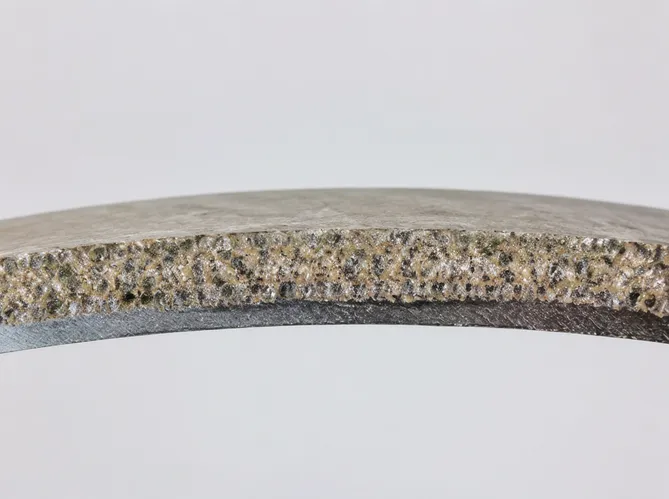
Our continuous rim blades use 60/80 to 100/120 mesh diamond grit — significantly finer than the 30/50 mesh typical on segmented blades.
- Smaller diamond crystals remove material in smaller increments
- Less impact force per crystal — fewer micro-fractures on brittle materials
- Chip-free edge on polished porcelain and marble with visible edges
Trade-off: slower feed rate vs. coarse-grit segmented blades. On materials where finish quality determines the end product's value, speed is secondary.
Need a specific diameter or arbor?
Custom configurations available across the full size range.
Request a Custom QuoteContinuous Rim Tile Blade: Your Highest-Volume SKU
The 105–200 mm range for wet tile saws is likely where most of your volume sits. Here's why this single SKU category deserves dedicated attention in your product mix.
High-Frequency Reorder Product
The tile installation market consumes blades as a disposable consumable. A tiler running a benchtop wet saw burns through a blade every 1–3 weeks depending on volume. That's 20–50 blades per year per professional installer.
Multiply by the number of tile contractors in your territory, and you're looking at a high-frequency reorder product with predictable demand.
Production Scale Advantage
We produce continuous rim tile blades in the highest volumes of any blade type in our factory — the automated sintering line runs these in batches of 5,000–10,000 pieces. At this production scale, your per-unit cost drops meaningfully, which gives you margin room to be competitive at retail or wholesale without sacrificing profit.
The KPI That Drives Reorder Loyalty
The key performance indicator your tile cutter customers use: number of square meters cut per blade. These are the numbers that determine reorder loyalty — if a blade consistently delivers 80 m² across five consecutive purchases, your customer stops comparing prices and just reorders.
Porcelain Tile (8–10 mm)
60–100 m²
per blade
Ceramic Tile
150–250 m²
per blade
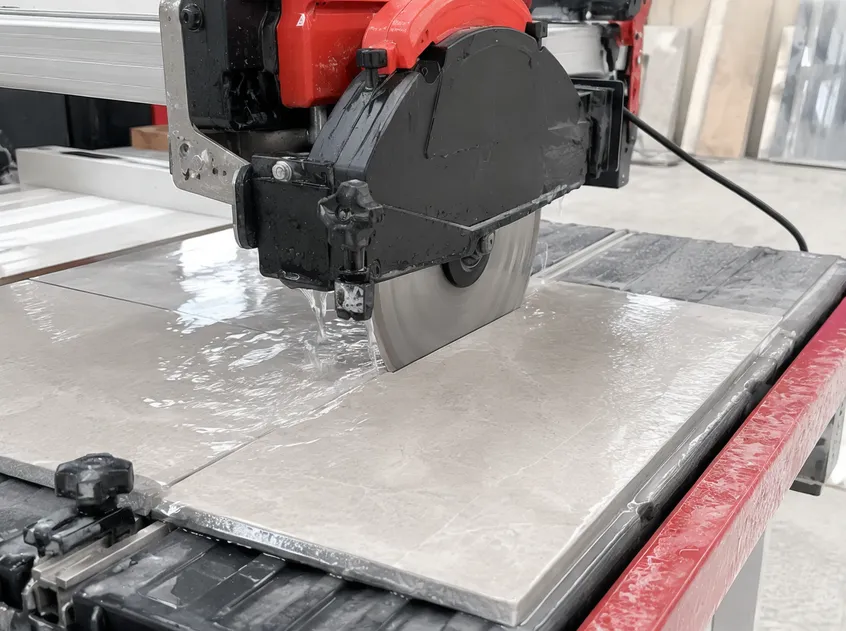
Consumption per Installer
The #1 Cause of Tile Blade Returns
Buyers expecting to use a continuous rim blade for dry cutting. These blades require water cooling. Without water, the rim overheats, the bond weakens, and the blade glazes or warps within minutes.
If your customers ask about dry cutting, point them to laser-welded diamond blades instead.
Where Continuous Rim Blades Sell — Market Segments Worth Stocking For
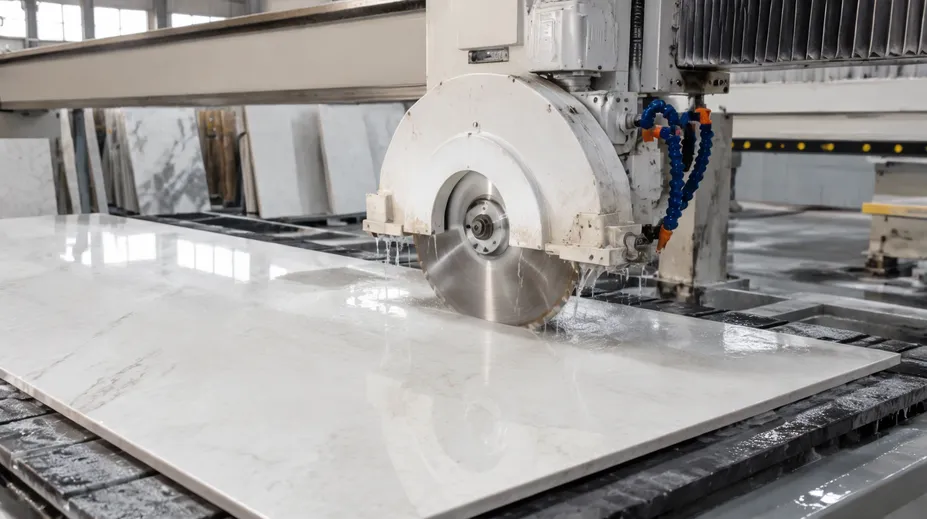
Porcelain and Ceramic Tile Fabrication
Large-format porcelain slabs (1200×2400 mm panels for countertops and wall cladding) are the fastest-growing segment in stone fabrication. These slabs are thin (6–12 mm), britle, and intolerant of vibration — making continuous rim blades the only practical cutting solution. Tile contractors and slab fabricators consume blades at high rates due to the abrasive nature of porcelain body compositions.
- Wet tile saws (tabletop and rail-guided bridge saws)
- Miter cuts for waterfall edges and panel joins
- High blade turnover — recurring revenue for distributors
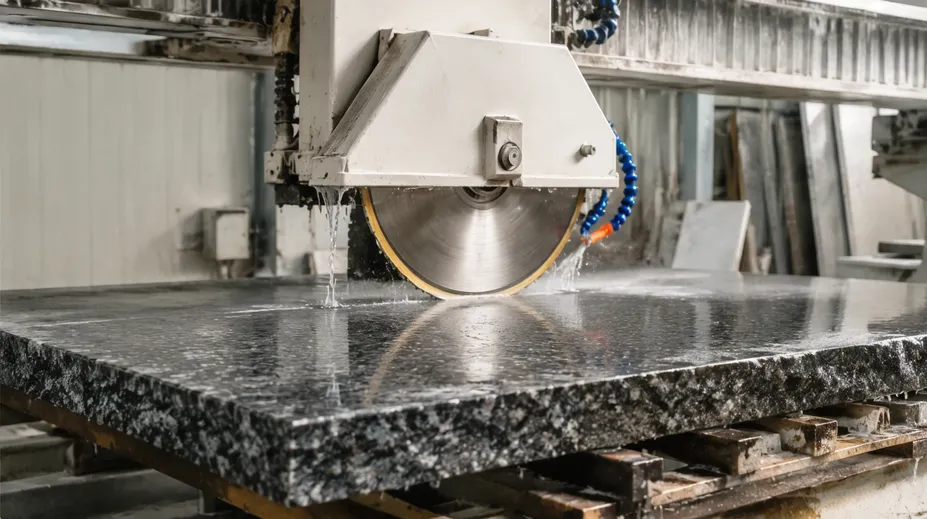
Natural Stone Countertop Shops
Granite, marble, and quartzite fabrication shops demand chip-free sink cutouts, edge profiles, and seam cuts. Continuous rim blades deliver the finish quality that eliminates secondary polishing steps — saving labor cost on every slab processed.
- Bridge saws and CNC machines (14″–20″ blades)
- Premium blades justify premium pricing to this segment
- Shops typically stock multiple diameters and bond types
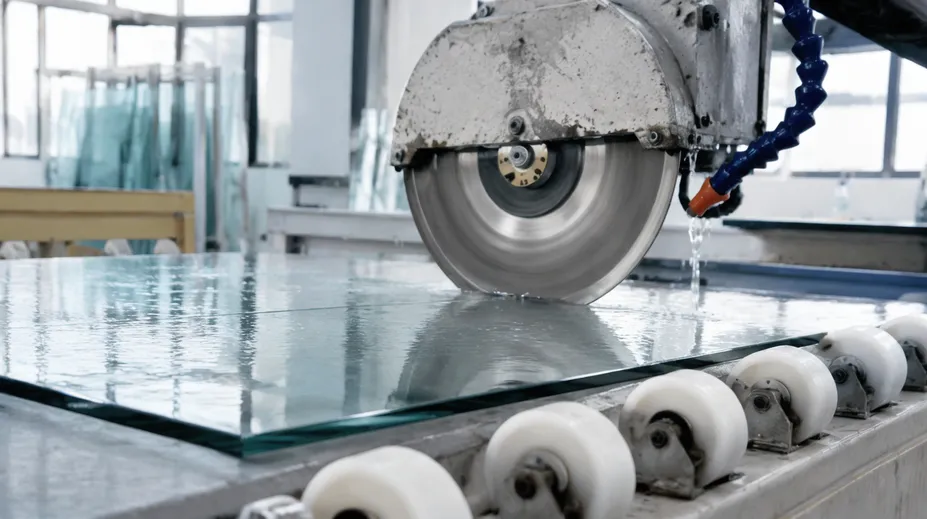
Glass and Mirror Processing
Architectural glass, shower enclosures, and decorative mirror panels require fracture-free cutting. The uninterrupted contact of a continuous rim blade distributes cutting force evenly — critical when working with materials that shatter under point-load stress.
- Requires finest grit (mesh 200+) and thin kerf designs
- Wet cutting mandatory — no dry glass cutting
- Growing demand from smart-glass and solar panel sectors
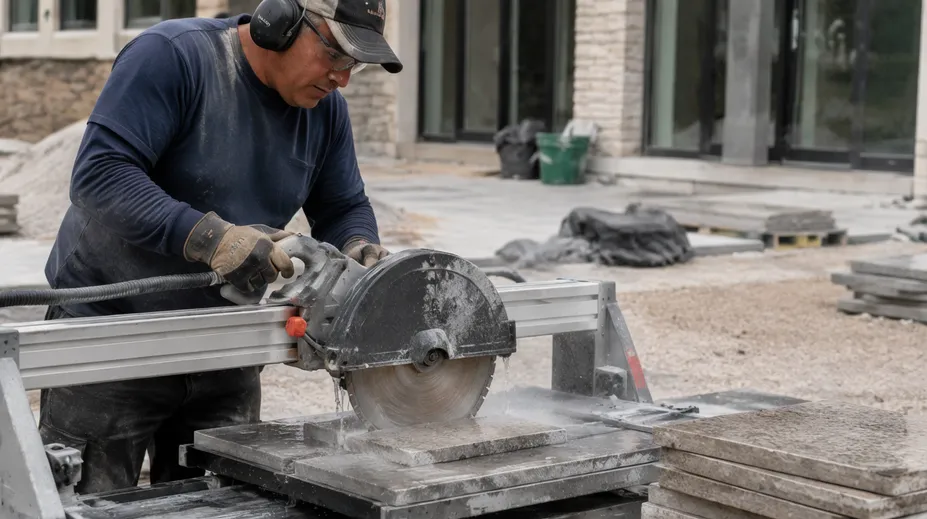
Masonry and Hardscape Contractors
Paver installations, stone veneer cladding, and decorative masonry projects require precision cuts where visible edges matter. Contractors choose continuous rim blades when chipping would mean recutting expensive natural stone or engineered pavers.
- 4.5″–7″ blades for handheld wet saws dominate this segment
- Jobsite durability and water management are key buying factors
- Seasonal demand peaks align with construction cycles
Stocking Strategy for Distributors
The four segments above account for over 80% of continuous rim blade demand in most markets. A well-curated inventory covering tile fabrication (high volume, 4.5″–14″), countertop shops (premium, 14″–20″), glass processing (specialty thin-kerf), and masonry (jobsite-rated 4.5″–7″) positions your catalog to capture the full buying spectrum without dead stock risk.
How Continuous Rim Blades Are Made — Manufacturing That Determines Margin
Understanding production methods helps you evaluate supplier quality claims and identify where cost savings are real versus where they signal compromised performance.
Steel Core Production
High-carbon steel (65Mn or 50Mn2V) is laser-cut or stamped into disc blanks, then heat-treated to achieve the hardness (HRC 38–44) needed to resist deflection at operating speeds. Core flatness is ground to within 0.05 mm tolerance — any warping translates directly to cut deviation.
Quality indicator: Ask suppliers for core material grade and flatness tolerance specs. Budget blades often use recycled steel with inconsistent hardness.
Diamond Segment Formulation
Synthetic diamond crystals (selected by mesh size, shape, and toughness index) are blended with metal powder matrices — cobalt, bronze, iron, or tungsten carbide depending on the target material. The bond hardness must match material abrasiveness: soft bonds for hard, non-abrasive materials; hard bonds for soft, abrasive ones.
Quality indicator: Diamond concentration is measured in "ct/segment." Premium blades use 20–25 ct concentration; economy grades drop to 12–15 ct with filler particles.
Sintering and Bonding to Core
The diamond-metal powder mixture is cold-pressed into a continuous ring mold, then sintered at 700–950°C under high pressure (hot-press or vacuum sintering). The sintered rim is then bonded to the steel core via laser welding, silver brazing, or — in budget lines — mechanical crimping.
Quality indicator: Laser-welded joints withstand higher RPM and lateral stress. Brazed joints are adequate for wet-only use. Crimped bonds are a cost signal — avoid for professional-grade inventory.
Rim-to-Core Bonding Methods — Impact on Price and Performance
| Bonding Method | Max RPM Rating | Wet / Dry Use | Cost Impact | Best For |
|---|---|---|---|---|
| Laser Welding | Highest (safe for dry) | Wet and Dry | +15–25% | Professional & contractor grades |
| Silver Brazing | Medium | Wet Only | Baseline | Shop-based wet saws |
| Mechanical Crimping | Lowest | Wet Only (low RPM) | −20–30% | DIY / light-duty only |
Post-Production Quality Control
Reputable manufacturers perform dynamic balancing, runout measurement, and tensioning checks on every blade. Ask potential suppliers whether they test 100% of production or rely on batch sampling — this single question separates professional-grade factories from commodity producers.
Technical Specs That Drive Purchasing Decisions
These are the parameters your customers evaluate when choosing between suppliers. Understanding each spec helps you match blades to applications — and justify premium pricing where it matters.
Blade Diameter
Determines maximum depth of cut and machine compatibility. Common continuous rim sizes range from 4″ (105 mm) for angle grinders to 20″ (500 mm) for bridge saws.
Stock priority: 4.5″, 7″, 10″, 14″ cover ~85% of demand across all segments.
Arbor Size
The center bore must match the saw spindle exactly. Mismatched arbors cause vibration and unsafe runout. Standard sizes: 7/8″–5/8″ (22.23 mm), 1″ (25.4 mm), 20 mm (European), 50 mm (bridge saws).
Tip: Offering adapter bushings as accessories increases per-order value.
Rim Height (Segment Depth)
Directly determines blade lifespan. Standard rim heights: 7 mm (economy), 10 mm (professional), 12–15 mm (premium/industrial). Every additional mm of rim height adds approximately 15–20% more cutting life.
Margin note: Higher rim = higher cost but significantly better cost-per-cut value for buyers.
Kerf Width
The thickness of the cut. Standard kerf (2.0–2.8 mm) provides stability and straight cuts. Thin kerf (1.2–1.6 mm) reduces material waste and motor load — critical for low-powered tile saws and expensive materials like marble slabs.
Application match: Thin kerf for tile saws ≤1.5 HP; standard kerf for bridge saws ≥3 HP.
Diamond Grit Size
Mesh 30/40 (coarse) cuts fast but rougher. Mesh 60/80 (medium) balances speed and finish. Mesh 120/200+ (fine) delivers mirror-smooth cuts for glass and polished stone. Most continuous rim blades use mesh 60/80 as a versatile default.
Buyer concern: Glass cutters specifically ask for fine grit — stock accordingly.
Maximum Operating Speed (RPM)
Rated in RPM or surface feet per minute (SFPM). Exceeding rated speed risks segment detachment. Smaller blades tolerate higher RPM (13,000+ for 4″); larger blades require lower RPM (1,800–3,500 for 14″+). Always matched to machine specifications.
Safety critical: Ensure RPM ratings are clearly printed on packaging and blade body.
Quick-Reference: Common Continuous Rim Blade Specifications
Standard configurations available for OEM and private-label orders
| Diameter | Arbor | Rim Height | Kerf Width | Max RPM | Primary Use |
|---|---|---|---|---|---|
| 4″ (105 mm) | 7/8″ | 7 mm | 1.4 mm | 13,500 | Angle grinder tile cuts |
| 4.5″ (115 mm) | 7/8″–5/8″ | 8 mm | 1.6 mm | 12,200 | Handheld wet saws |
| 7″ (180 mm) | 7/8″–5/8″ | 10 mm | 1.8 mm | 8,500 | Tabletop tile saws |
| 10″ (250 mm) | 5/8″ or 1″ | 10 mm | 2.2 mm | 5,800 | |
| 14″ (350 mm) | 1″ or 50 mm | 12 mm | 2.6 mm | 3,500 | Bridge saws / masonry saws |
| 20″ (500 mm) | 50 mm | 15 mm | 3.0 mm | 1,800 | Industrial bridge saws |
Custom Specifications Available
Need non-standard diameters, arbor sizes, or rim configurations? Our engineering team works with buyers on custom blade specifications for OEM partnerships and private-label programs. Minimum order quantities apply for custom tooling.
Discuss custom specs with our teamMaterial Compatibility & Application Guide
Different materials demand different blade configurations. This guide helps you recommend the right continuous rim blade for each application — building trust with buyers and reducing returns from mismatched products.
Porcelain & Ceramic Tile
Ideal MatchThe primary application for continuous rim blades. Porcelain's hardness (Mohs 7–8) and brittleness require the chip-free cutting that only a continuous rim delivers. Ceramic is softer (Mohs 5–6) and even more chip-prone on edges.
Recommended: Fine grit (mesh 60/80), thin kerf (1.4–1.8 mm), wet cutting
Feed rate: Moderate — let the blade do the work to prevent edge chipping
Coolant: Essential for porcelain; reduces heat buildup that causes micro-fractures
Natural Stone (Marble, Limestone, Travertine)
Ideal MatchSofter natural stones (Mohs 3–5) cut easily but chip and crack if attacked aggressively. Continuous rim blades produce the smooth, polished edges that natural stone fabricators demand — especially on visible countertop and facade edges.
Recommended: Medium grit (mesh 50/60), standard kerf, wet cutting mandatory
Feed rate: Slow to moderate — prevents heat discoloration on light stones
Special note: Softer bond matrix for softer stone — allows diamond exposure without glazing
Granite & Engineered Quartz
Conditional MatchHard materials (Mohs 6–7) that generate significant heat and wear. Continuous rim blades work but cut slower than segmented blades on these materials. Best suited for finish cuts and detailed work where chip-free edges justify the speed tradeoff.
Recommended: Coarser grit (mesh 40/50), higher diamond concentration, wet cutting mandatory
Feed rate: Very slow — excessive pressure accelerates wear dramatically
Buyer guidance: Position as "finish blade" — pair with segmented blade for rough cuts
Glass & Glass Mosaic
Ideal MatchGlass is extremely brittle and fracture-prone. Only continuous rim blades with fine diamonds can cut glass cleanly. This is a growing niche as glass mosaic tile and glass backsplash installations increase in popularity.
Recommended: Very fine grit (mesh 120+), thin kerf (1.2–1.4 mm), wet cutting mandatory
Feed rate: Extremely slow — rushing causes cracking and shattering
Premium opportunity: Glass-specific blades command 2–3× margins over general-purpose blades
Materials NOT Suited for Continuous Rim Blades
Knowing what to recommend against is just as important as knowing what to recommend. Advising against misuse builds credibility and prevents costly returns.
Concrete & Masonry
Abrasive aggregates clog continuous rims quickly. Use segmented blades instead — the gullets clear debris.
Asphalt
Soft, gummy material generates extreme heat. Requires segmented blades with deep gullets for cooling.
Green Concrete (Uncured)
Highly abrasive sand content destroys continuous rim segments rapidly. Use specialized early-entry blades.
Metal / Rebar
Diamond blades are not designed for metal cutting. Impact with embedded rebar can damage segments.
Wood & Composites
Fibrous materials require toothed blades. Diamond blades burn wood and create dangerous kickback.
Thick Granite Slabs (>3 cm)
While possible wet, segmented blades are 3–4× faster for rough cutting thick hard stone slabs.
Quality Grades & Pricing Tiers
Understanding the relationship between quality inputs and market pricing helps buyers position products correctly, avoid overpaying for specifications they don't need, and identify genuine value versus marketing claims.
DIY & Light Duty
Price-sensitive retail and e-commerce
Typical Specifications
- Synthetic diamond (lower quality / recycled)
- 7 mm rim height
- Lower diamond concentration (15–20%)
- Cold-pressed or mechanical crimping
- Basic steel core (65Mn)
Market Positioning
- Home improvement stores
- Amazon / e-commerce multi-packs
- One-time project buyers
- Price-driven procurement
Expected life: 50–150 linear feet of porcelain tile
Target margin: High volume, lower per-unit margin (20–35%)
Contractor & Trade
Daily-use professional applications
Typical Specifications
- High-quality synthetic diamond (select grades)
- 10 mm rim height
- Medium-high diamond concentration (25–35%)
- Hot-pressed sintering or laser welding
- Heat-treated steel core (50Mn2V or equivalent)
Market Positioning
- Tile installation contractors
- Stone fabrication shops
- Tool distributors and dealers
- Repeat-purchase relationships
Expected life: 300–800 linear feet of porcelain tile
Target margin: Balanced volume and margin (30–50%)
Industrial & Specialty
High-volume production environments
Typical Specifications
- Premium natural or select synthetic diamond
- 12–15 mm rim height
- High diamond concentration (35–50%)
- Laser welded with multi-layer segments
- Premium alloy steel, tensioned and balanced
Market Positioning
- Stone fabrication production lines
- CNC bridge saw operations
- Tile manufacturing QC labs
- Specification-driven purchasing
Expected life: 1,000–3,000+ linear feet of porcelain tile
Target margin: Lower volume, premium margin (40–65%)
What Actually Drives Cost Differences
When evaluating supplier quotes, these are the inputs that create legitimate price differences — versus specification claims that don't translate to meaningful performance gains.
of blade cost is diamond powder
Quality, size, and concentration
is metal bond powder
Cobalt, tungsten, copper ratios
is steel core
Alloy grade and heat treatment
is manufacturing labor + QC
Welding method and testing level
Sourcing & Supplier Selection Guide
Choosing the right manufacturing partner is the single most impactful decision for importers and distributors. Here's a structured framework for evaluating suppliers and avoiding common procurement pitfalls.
Manufacturing Capability
- In-house sintering and laser welding equipment
- Diamond powder sourcing transparency (supplier names)
- Annual production capacity vs. current utilization
- R&D team and new product development history
- Tooling for custom segment profiles
Red flag: Supplier cannot show you sintering presses or welding machines during factory audit — likely a trading company reselling.
Quality Systems
- ISO 9001 certification (verified, not just claimed)
- Documented incoming material inspection process
- In-process runout and flatness testing
- Final product testing protocols (cut test records)
- Batch traceability from raw material to finished blade
Red flag: No cut-test data available, or "all blades pass" with no failure rate documentation.
Commercial Terms
- Minimum order quantities aligned with your volume
- Lead time consistency (ask for last 6 months history)
- Payment terms that protect both parties (T/T + LC)
- Clear warranty and claims resolution process
- OEM/private label packaging capabilities
Red flag: Requires 100% payment upfront with no third-party escrow or inspection option.
Communication & Service
- Dedicated English-speaking account manager
- Response time under 24 hours consistently
- Willingness to send samples before bulk orders
- Technical support for application-specific questions
- Proactive communication on delays or material changes
Red flag: Sales contact changes every order, or technical questions get generic catalog responses.
Recommended Supplier Verification Process
Initial Screening
Verify business license, export history, and production photos
Sample Order
Order 5–10 blades, test against known benchmarks in controlled conditions
Factory Audit
On-site or third-party inspection of equipment, materials, and processes
Trial Order
Place small MOQ order, evaluate consistency, packaging, and lead time accuracy
Partnership
Negotiate annual terms, establish QC protocols, and build the relationship
Geographic Sourcing Landscape
The diamond blade industry has distinct manufacturing clusters, each with different strengths and trade-offs for buyers.
China (Hebei, Fujian, Jiangxi)
- Strength: Full supply chain, competitive pricing, massive scale
- Range: Economy through professional grade
- Consideration: Quality variance between factories is high — due diligence essential
- Lead time: 25–45 days production + shipping
South Korea
- Strength: Consistent quality, strong R&D, good IP protection
- Range: Professional through premium grade
- Consideration: Higher pricing but lower variance and better technical support
- Lead time: 20–35 days production + shipping
Europe (Italy, Germany)
- Strength: Premium engineering, proprietary bond formulations
- Range: Premium and industrial/specialty
- Consideration: Highest cost but strongest brand value and certifications
- Lead time: 15–30 days production + shipping
Safety Standards & Best Practices
Diamond blades operate at high rotational speeds and create significant hazards when misused or when substandard products fail. Understanding safety requirements protects end users and reduces liability for distributors and importers.
Key Regulatory Standards
EN 13236 (European Standard)
Safety requirements for superabrasive products. Covers segment retention, maximum operating speed, and tensioning requirements. Required for CE marking.
ANSI B7.1 (North American)
Use, care, and protection of abrasive wheels. Defines speed ratings, guarding requirements, and mounting practices.
oSa (Organization for the Safety of Abrasives)
Voluntary certification demonstrating compliance with EN 13236. Increasingly required by European distributors and rental companies.
ISO 6103 / ISO 6104
Permissible unbalance and flanging standards for bonded abrasive products. Applies to quality-critical applications.
Critical Safety Factors for Buyers
Segment Retention
The #1 safety failure mode. Segments detaching at speed become projectiles. Laser welding provides highest retention strength; verify weld penetration depth exceeds 1.5mm.
Maximum Operating Speed (MOS)
Every blade must be rated for its intended equipment's RPM. A 14" blade on a high-speed saw sees different forces than on a low-speed saw. Verify MOS marking matches application.
Core Fatigue and Cracking
Steel cores develop fatigue cracks from thermal cycling and vibration. Inspect used blades regularly. Discard blades with visible cracks regardless of remaining segment life.
Arbor Fit and Mounting
Incorrect arbor size or worn flanges create runout that accelerates wear and increases failure risk. Verify bore tolerance is within ±0.1mm of equipment shaft.
Essential Operating Guidelines
These guidelines should be communicated to end users through product documentation, packaging inserts, and safety data sheets.
Speed Matching
Never exceed the blade's maximum RPM rating. Verify equipment speed before mounting. Smaller blades generally require higher RPM.
Wet vs. Dry Use
Use blades only as rated. Wet blades used dry overheat rapidly; dry blades submerged may have bond formulations that underperform wet.
Direction of Cut
Mount blade with arrow matching rotation direction. Reversed blades cut poorly and can overheat segments, weakening weld joints.
Side Pressure
Avoid lateral force on the blade during cutting. Side pressure causes core deflection, segment cracking, and increased kerf binding.
Depth of Cut
For deep cuts, use multiple passes rather than full-depth plunging. Reduces heat buildup and extends blade life significantly.
PPE Requirements
Eye protection, hearing protection, dust mask (P100 for silica), and gloves minimum. Face shield recommended for dry cutting.
Importer Liability Considerations
As the importer of record, you assume product liability in your market regardless of manufacturer origin. Ensure your supplier provides: test certificates per batch, product liability insurance documentation, material safety data sheets, and clear maximum operating speed markings on every blade. Work with a customs broker familiar with abrasive product classifications and a product liability attorney in your market.
Frequently Asked Questions
Technical and commercial questions we hear most from importers, distributors, and professional buyers evaluating diamond blade sourcing decisions.
What's the difference between laser-welded and sintered (hot-pressed) segments?
Laser welding fuses segments to the core using a focused laser beam, creating a metallurgical bond with tensile strength typically exceeding 800 MPa. Sintered (hot-pressed) segments are bonded during the same pressing operation that forms the segment itself. Both are professional-grade attachment methods. Laser welding is preferred for wet-cutting applications and larger blades (12"+) due to superior heat resistance at the joint. Hot-pressed sintering is common on smaller blades and is perfectly adequate for most applications under 12 inches.
A third method — brazing or mechanical crimping — is used on economy blades and offers the lowest retention strength, making it unsuitable for high-RPM or demanding applications.
How do I verify diamond concentration claims from suppliers?
Direct verification requires destructive testing — dissolving the bond matrix and measuring diamond content by weight. Most buyers rely on indirect methods: weigh the segment before and after a controlled cut test, compare cutting speed and life against known benchmarks, and request batch material certificates showing diamond powder purchase quantities against segment production quantities.
For critical verification, third-party testing labs (SGS, Bureau Veritas) can perform XRF analysis or acid dissolution testing on sample segments. Budget approximately $200–400 per sample for full composition analysis.
What minimum order quantities should I expect from Chinese manufacturers?
MOQs vary significantly by blade type and manufacturer scale. General guidelines:
- Small blades (4"–7"): 500–2,000 pieces per SKU
- Medium blades (10"–14"): 200–500 pieces per SKU
- Large blades (16"+): 50–200 pieces per SKU
- Custom specifications: Often 1,000+ pieces to justify tooling
Smaller factories (annual revenue under $5M) often accept lower MOQs to win new customers. Larger factories have higher minimums but better consistency. For initial orders, many suppliers will negotiate reduced MOQs (50% of standard) in exchange for a commitment to order volume within 6–12 months.
Can a single blade cut both porcelain tile and natural granite effectively?
Not optimally. Porcelain tile (Mohs 7–8, very dense, brittle) requires a softer bond matrix and finer diamond grit (50/60 mesh) to maintain exposure and prevent chipping. Natural granite (Mohs 6–7, crystalline, abrasive) works best with a harder bond and coarser diamonds (30/40 mesh) to resist rapid wear from the abrasive quartz content.
A "multi-purpose" blade compromises on both. It will cut both materials but with slower speed on porcelain and shorter life on granite compared to dedicated blades. For professional applications, always stock material-specific blades. Multi-purpose blades are acceptable only for occasional DIY use where convenience outweighs performance.
How do I calculate landed cost for diamond blade imports?
Landed cost includes multiple components beyond the FOB price:
- FOB Price: Manufacturer's price at port of origin
- Freight: Sea freight ($1,500–$4,000 per 20ft container depending on route), or air freight ($4–8/kg for urgent orders)
- Insurance: Typically 0.3–0.5% of CIF value
- Import Duty: Varies by country (e.g., US HS 8202.39 carries 2.5% duty; EU is typically 3.7%)
- Customs Brokerage: $150–$400 per shipment
- Port Handling: $200–$600 depending on port
- Inland Transport: Variable by distance to warehouse
Rule of thumb: for sea freight to North America or Europe, add 15–25% to FOB price for total landed cost. Air freight can add 30–50% but delivers in 5–7 days versus 25–40 days by sea.
What certifications should I require from a diamond blade supplier?
Essential certifications vary by target market:
- Europe (EU): EN 13236 compliance (safety requirements for superabrasives), CE marking, and oSa (Organization for the Safety of Abrasives) certification for professional-grade blades
- North America: ANSI B7.1 compliance for safety, UL listing optional but adds market credibility
- Global: ISO 9001 (quality management system) as a baseline factory certification
- Material-specific: MPA test reports (Materialprüfungsanstalt) for European distribution
Beyond certifications, request: batch-level test reports showing segment hardness (HRC), dimensional inspection results, and mechanical safety test records (burst test at 1.5x rated speed). A manufacturer unwilling to provide test documentation is a red flag regardless of price.
Why does my blade glaze over and stop cutting?
Glazing occurs when the bond matrix is too hard for the material being cut. The diamonds become dull but the bond doesn't wear away fast enough to expose fresh crystals. Common causes:
- Using a hard-bonded blade (designed for abrasive materials like asphalt) on hard, non-abrasive materials like hard-fired porcelain
- Insufficient feed pressure — the blade needs load to wear the bond
- Too high RPM for the material, causing polishing rather than cutting
Fix: Make a few cuts into abrasive material (cinder block, dressing brick, or sandstone) to strip the glazed bond layer and re-expose diamonds. For chronic glazing, switch to a softer bond specification. This is a common sourcing mistake — always match bond hardness to material abrasiveness.
How long should a professional-grade diamond blade last?
Blade life varies enormously by application, but here are professional benchmarks for properly matched blades:
- 14" general concrete (wet): 800–1,500 linear meters
- 14" reinforced concrete (wet): 300–600 linear meters
- 14" asphalt (wet): 1,500–3,000 linear meters
- 4.5" porcelain (dry): 50–150 linear meters
- 10" granite (wet): 200–500 linear meters
- Wall saw blades (36"+): 50–200 square meters
These assume optimal operating conditions. Abusive use (wrong speed, dry when rated wet, excessive side pressure) can reduce life by 50–80%. Document expected life ranges in your product specs and track field returns to identify whether failures are product- or user-caused.
Diamond Blade Glossary
Key terminology for communicating precisely with manufacturers, engineers, and technical buyers.
Arbor (Bore)
The center hole in the blade that mounts onto the equipment spindle. Common sizes: 20mm, 22.23mm, 25.4mm (1"), and 1" with adapter bushings.
Bond Matrix
The metal powder mixture (cobalt, bronze, iron, nickel, tungsten) that holds diamond crystals in place. Bond hardness must match material abrasiveness.
Concentration
The volume percentage of diamond in the segment. 100% concentration = 4.4 carats per cm³. Professional blades typically range from 20–35 concentration.
Core (Steel Body)
The precision-machined steel disc that carries the segments. Made from heat-treated steel (typically 65Mn or equivalent), tensioned for stability at operating speed.
Dry Cutting
Operating without water coolant. Requires segments designed for air cooling (deeper gullets, expansion slots). Limited to shallow cuts to manage heat buildup.
Gullet (Slot)
The gap between segments that allows cooling air/water flow and slurry evacuation. Deeper gullets improve cooling but reduce the number of segments on the blade.
Kerf
The width of the cut made by the blade, determined by segment width. Narrower kerf reduces material waste and power consumption but may reduce blade stability.
Mesh Size
The sieve size used to classify diamond crystal dimensions. Lower mesh = larger crystals (30/40 mesh ≈ 420–590μm). Higher mesh = finer crystals (50/60 mesh ≈ 250–350μm).
MOS (Maximum Operating Speed)
The highest peripheral speed (m/s) at which a blade is rated to safely operate. Determined by burst testing at 1.5x rated speed per EN 13236.
Segment
The cutting portion of the blade containing diamonds suspended in bond matrix. Attached to the core by laser welding, sintering, brazing, or mechanical means.
Segment Height
The radial thickness of the segment from tip to weld point. Determines total cutting life — taller segments last longer but cost more due to increased diamond content.
Tensioning
Controlled stress applied during core manufacturing (via hammer rolling or heat treatment) that ensures the blade runs flat and true at its rated operating speed.
Turbo Rim
A continuous rim with serrated (wave-shaped) edges that improves cooling and debris clearance versus a plain continuous rim, while maintaining chip-free cutting.
Undercut Protection
A narrowing of the core beneath the segment that prevents the steel body from contacting the cut material. Protects against core erosion in abrasive applications.
Wet Cutting
Operating with continuous water supply to the cut zone. Provides cooling, lubricates the cut, suppresses dust, and extends blade life by 3–5x versus dry cutting.
Ready to Source Diamond Blades with Confidence?
Whether you're evaluating your first supplier or optimizing an established supply chain, our technical team can help you navigate specifications, quality verification, and market positioning.
No minimum order for sample requests. Technical data sheets available for all products.
Customization: What You Can Specify, What's Fixed
Fully Customizable
-
Diameter: any size from 100 mm to 500 mm in 5 mm increments. Tooling for standard diameters exists; non-standard diameters require a minimum 500-piece order.
-
Arbor bore: any standard or custom size.
-
Rim height: adjustable within 4–15 mm range to match your target blade life.
-
Rim width (kerf): adjustable within 1.2–3.5 mm. Thinner kerf = less material waste, but shorter blade life.
-
Bond formula: matched to your specific material type.
-
Diamond concentration: adjustable from 20% to 50% by volume.
-
Steel core color: painted or bare, any RAL color for brand identity.
-
Packaging: private label, your brand, your design, blister pack or box.
Fixed by Design
-
Rim must be continuous — if you need gullets for debris clearance, that becomes a segmented blade or turbo blade.
-
Wet cutting only — the continuous rim cannot dissipate heat without water flow. We don't produce "dry-cut continuous rim" blades because they fail in the field and generate returns.
-
Maximum diameter 500 mm — beyond this, continuous rim blades develop stress concentrations that compromise rim integrity at operational RPM. For larger diameters, segmented construction is required.
These constraints aren't arbitrary — they reflect field failure patterns we've validated across 20+ years of production data.
MOQ by Customization Level
| Customization Level | MOQ |
|---|---|
| Stock formula, standard diameter with your packaging | 100 pcs / SKU |
| Custom formula with standard diameter | 200 pcs / SKU |
| Custom diameter (non-standard tooling required) | 500 pcs / SKU |
| Sample orders for testing | 10–20 pcs at production pricing |
Lead Time
Stock formulas: 20–30 days | Custom formula development: 30–40 days (including sample approval)
How Continuous Rim Production Differs From Our Segmented Lines
Most diamond blade factories optimize for segmented production — individual segments pressed, sintered, then welded. We run continuous rim as a dedicated production stream with different tooling and different quality checkpoints.
Ring-Die Pressing
The ring-die pressing stage requires even more precision than individual segment pressing. With a segmented blade, minor density variation within one segment is tolerable because each segment operates semi-independently. In a continuous rim, the entire circumference wears together — any density gradient creates uneven wear and the blade goes out of round.
Post-Sinter Thickness Control
After sintering, every rim gets measured for thickness uniformity at 8 points around the circumference. If variation exceeds 0.05 mm, that rim gets re-ground before bonding to the core. On segmented blades, this step doesn't exist because segment-to-segment height variation is corrected during truing after welding. On continuous rim, there's no post-weld truing that can add material back — so we control it at the source.
Silver-Alloy Brazing
The bonding process uses silver-alloy brazing under controlled atmosphere. The braze joint must withstand the full centrifugal force at rated RPM distributed across the entire rim circumference — no weld-to-weld gaps creating localized stress concentrations.
We X-ray sample joints from each production run to verify braze coverage meets our 95% minimum threshold. We set this at 95% after testing showed that braze coverage below 90% correlates with rim separation under thermal cycling conditions.
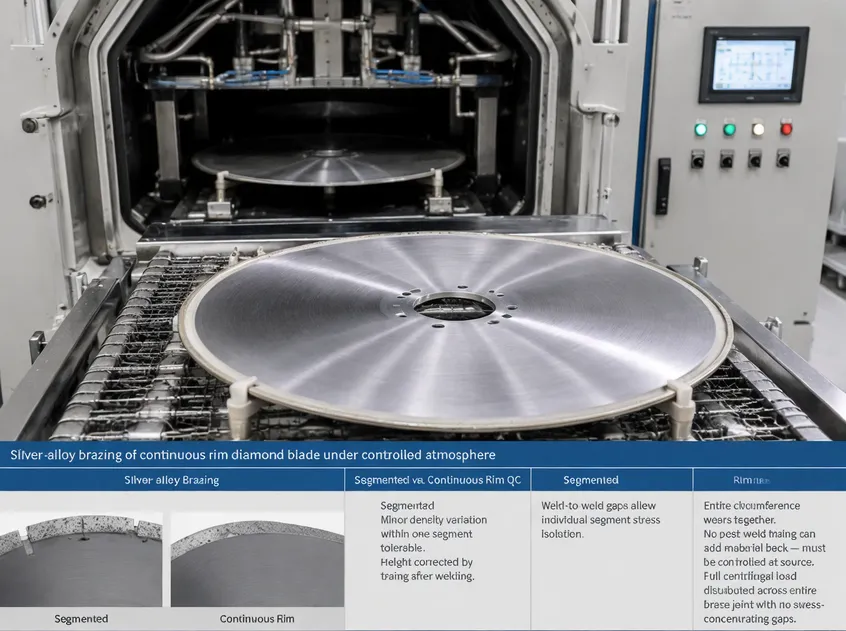
Segmented vs. Continuous Rim QC
Minor density variation within one segment tolerable. Height corrected by truing after welding.
Entire circumference wears together. No post-weld truing can add material back — must be controlled at source.
Weld-to-weld gaps allow individual segment stress isolation.
Full centrifugal load distributed across entire braze joint with no stress-concentrating gaps.
What This Means for Your Bottom Line
This manufacturing attention translates directly to your business: fewer returns, consistent performance batch to batch, and safety certification that holds up under MPA audit because the production controls are documented and traceable.
Compared to Sibling Blade Types: When to Recommend What
Your customers will ask you which blade to use. Here's how continuous rim fits against the other construction types in our range — a guide for your sales team.
| Customer Need | Recommended Blade | Why |
|---|---|---|
| Chip-free edges on porcelain, marble, tile | Continuous rim This product | No impact points = no chipping on brittle materials |
| Faster cutting on granite or hard stone | Segmented diamond blade | Gullets clear debris and allow aggressive feed rates |
| Balance of speed and finish | Turbo diamond saw blade | Continuous rim with serrated edge — faster than smooth rim, cleaner than segmented |
| Dry cutting without water | Laser welded diamond blade | Weld joints survive thermal cycling; continuous rim cannot |
| Noise reduction in indoor shops | Silent core diamond blade | Dampened core reduces noise 3–5 dB below standard |
| Maximum life on hard granite | Arix diamond blade | Arranged diamond pattern extends segment life 20–30% |
Practical Stocking Strategy
Carry continuous rim in 105–250 mm for your tile and porcelain customers, and segmented blades for everything else. As your customer base grows into marble fabrication and decorative stone, expand your continuous rim range to 300–500 mm.
Frequently Asked Questions
Common technical and commercial questions from our distributor network — answers you can share directly with your sales team and end-users.
Can I use a continuous rim diamond blade for dry cutting?
No. Continuous rim blades require water cooling during operation. The unbroken rim generates more friction heat than segmented designs (no gullets for air cooling), and without water flow, the braze joint weakens within minutes. We've seen blades warp or lose the rim entirely after 30 seconds of dry cutting in hard porcelain.
If your customers need to cut without water, stock laser-welded blades for those applications.
What's the difference between a continuous rim blade and a turbo blade?
Both have continuous cutting edges, but a turbo blade has a serrated or wave-pattern rim profile that creates small channels for debris evacuation and air cooling. This makes turbo blades faster-cutting and somewhat tolerant of limited water flow, but the serrated edge produces a slightly rougher finish than a smooth continuous rim.
For visible edges on polished porcelain or marble, continuous rim wins. For production cutting where speed matters more than edge polish, turbo is the better value.
How many square meters can one continuous rim blade cut?
Depends on the material. Typical ranges for our standard 115 mm blade:
Higher-concentration custom formulas extend these numbers — if your customers are high-volume fabricators who track cost-per-meter, we can quote a higher diamond concentration formula that extends life 30–40% at a modest price increase.
What arbor size do continuous rim blades use?
Standard production covers 20 mm, 22.23 mm, 25.4 mm, and 50 mm arbors. The 22.23 mm bore is the most common globally (fits standard angle grinders and small tile saws). European wet saws often use 25.4 mm or 30 mm.
If your market uses a non-standard arbor — common with some Italian and South American tile saw brands — we produce to match. No tooling surcharge on standard arbor variants.
What causes a continuous rim blade to chip tile?
Three common causes:
- Running the blade too fast — RPM exceeding rated maximum for the diameter
- Insufficient water flow — rim overheats and bond softens
- Wrong formula for the material — bond too hard for the tile, causing the blade to skip instead of cut smoothly
If your customers report chipping, check water flow first — it's the most common culprit we see across our distributor network. If water supply is adequate, the bond formula may need adjustment for their specific tile brand.
What is the minimum order quantity for continuous rim blades?
These MOQs apply per individual specification (diameter + arbor + formula combination) — if you're ordering multiple SKUs, the total order volume can be lower per line item.
Start With Your Material, We'll Match the Formula
Tell us what your customers cut — the tile brand, the stone type, the thickness. We'll recommend the right diameter range, bond formula, and rim specification for your market. Include your approximate monthly volume and we'll quote with volume-appropriate pricing.
Most new partners start with 2–3 continuous rim SKUs (typically 115 mm and 200 mm in their market's most popular arbor size) for testing, then expand based on customer feedback. We keep your formula on file for seamless reorders.
What to Include in Your Inquiry
- Material types your customers cut (porcelain, marble, granite, engineered stone, etc.)
- Target blade diameters and arbor sizes for your market
- Approximate monthly volume (for volume-appropriate pricing)
- Preferred rim thickness or any brand/packaging requirements
We respond with specifications and FOB pricing within 48 hours.
Explore more diamond saw blade types from CLSEG: