

Granite Saw Blades Diamond Blades Engineered for Hard, Abrasive Natural Stone
Diamond granite saw blades with bond formulas developed specifically for the hardness and abrasiveness profile of natural granite.
Granite punishes generic blades — wrong bond chemistry means glazing, premature segment loss, or slow feed rates that kill your customers' throughput. We formulate per granite type, not per diameter.
- 20+ years granite blade production
- ISO 9001, CE, SGS, MPA certified
- Formula library covering 100+ granite varieties
- Factory-direct wholesale
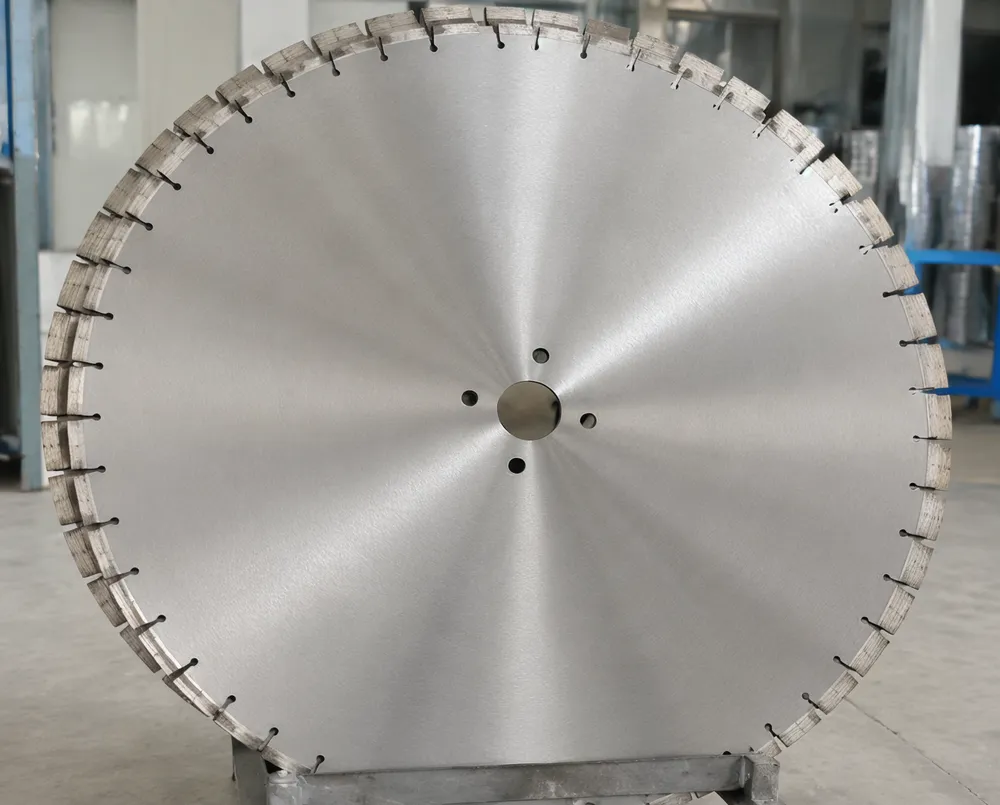
What Makes Granite Different — and Why It Demands Its Own Blade
Granite is hard. That's obvious. What's less obvious — and what determines whether your blade inventory sells well or generates complaints — is that granite hardness varies enormously by origin. Absolute Black from India sits around 6.5–7 on the Mohs scale and is relatively non-abrasive. Rosa Beta from Italy is moderately abrasive. Brazilian Giallo Fiorito is both hard and highly abrasive due to its quartz content. A single "granite saw blade" formula cannot optimize for all of these.
We manufacture diamond granite saw blades with bond formulas calibrated to where the stone actually falls on the hardness-abrasiveness matrix. Soft bonds for dense, non-abrasive granite (the diamonds need to self-sharpen because the stone won't erode the matrix naturally). Medium bonds for moderately abrasive varieties. And we carry formula variants within each tier because factors like crystal size and mica content shift cutting behavior in ways that a simple hard/soft classification misses.
This is your differentiation as a distributor: you're not selling "a granite blade" — you're selling the blade that actually performs on the granite your customer cuts every day. We've built the formula library over 20 years to make that specificity possible at wholesale volumes.
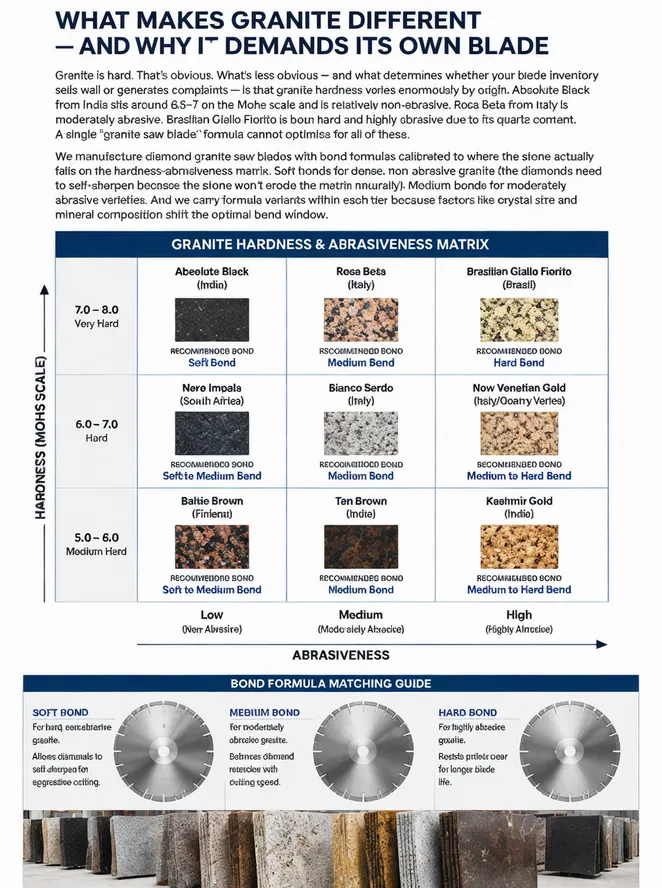
Hard, Non-Abrasive
Example: Absolute Black (India) — Mohs 6.5–7, low quartz content.
Bond requirement: Soft cobalt-based bond. The stone won't erode the matrix naturally, so diamonds must self-sharpen through controlled bond wear.
Moderately Abrasive
Example: Rosa Beta (Italy) — balanced hardness and abrasiveness.
Bond requirement: Medium bond formula balancing cutting speed against segment life. The stone provides moderate matrix erosion.
Hard & Highly Abrasive
Example: Giallo Fiorito (Brazil) — high quartz content drives extreme abrasion.
Bond requirement: Iron-cobalt composite bond resists rapid erosion while maintaining cut rate. Crystal size and mica content further tune the formula.
Need blade samples matched to your market's granite types?
Tell us the granite varieties your customers process. We'll recommend the right bond formula for each.
Granite Saw Blade Specifications
Standard production values covering our granite blade range. We adjust diameter, segment geometry, arbor bore, and bond formula to your requirements.
| Parameter | Standard Range |
|---|---|
| Diameter | 300, 350, 400, 450, 500, 600, 700, 800, 900 mm |
| Segment Height | 10 mm – 20 mm (typical: 12 mm or 15 mm) |
| Segment Width | 3.0 mm – 5.0 mm (kerf matched to slab thickness) |
| Core Thickness | 2.2 mm – 3.8 mm |
| Arbor Bore | 50 mm, 60 mm (25.4 mm for smaller diameters) |
| Segment Count | 18–54 segments (diameter dependent) |
| Diamond Grit | 30/40, 40/50 mesh (coarser for harder granite, finer for softer) |
| Diamond Concentration | 20%–35% (higher = faster cut, shorter life) |
| Bond Type | Cobalt-based soft bond (hard granite); Iron-cobalt composite (abrasive granite) |
| Welding | High-frequency welding (standard); Laser welding (dry/high-RPM use) |
| Operating Speed | 25–50 m/s linear (diameter and machine dependent) |
| Cooling | Wet cutting (standard); Dry cutting available for laser-welded blades ≤400 mm |
| Machine Compatibility | Bridge saws, block cutters, multi-blade gang saws, CNC profilers |
Custom Specifications
Every parameter above is adjustable. If your customers run non-standard equipment, cut unusual thicknesses, or process granite varieties not covered by our standard formulas, we develop custom specs at no additional engineering charge for orders meeting MOQ. Send us your machine model and target stone — we'll spec the blade.
Segment Technology for Granite Cutting
The segment is where performance lives or dies. Here's how we engineer segments specifically for granite's demands — and why generic segments underperform on this material.
Diamond Selection
Granite's hardness demands synthetic diamonds with high thermal stability and controlled friability. We use diamonds rated 55–65 on the Toughness Index for hard granite (they fracture to expose fresh edges) and 65–75 TI for abrasive granite (they resist breakdown longer). The difference in segment life between correctly and incorrectly matched diamond grade is typically 30–40%.
Multi-Layer Distribution
Our segments use controlled random distribution across multiple layers rather than single-layer patterns. This ensures consistent diamond exposure as the segment wears. Each layer maintains the target concentration, so cutting speed doesn't degrade as you move deeper into the segment — a common complaint with cheaper single-layer construction.
Segment Geometry Options
Flat-top segments for general granite slab cutting. Arrow/chevron segments for faster cuts with reduced chipping on polished surfaces. Turbo segments (continuous rim with cooling slots) for small-diameter blades on bench saws. We recommend geometry based on the application, not just the stone type.
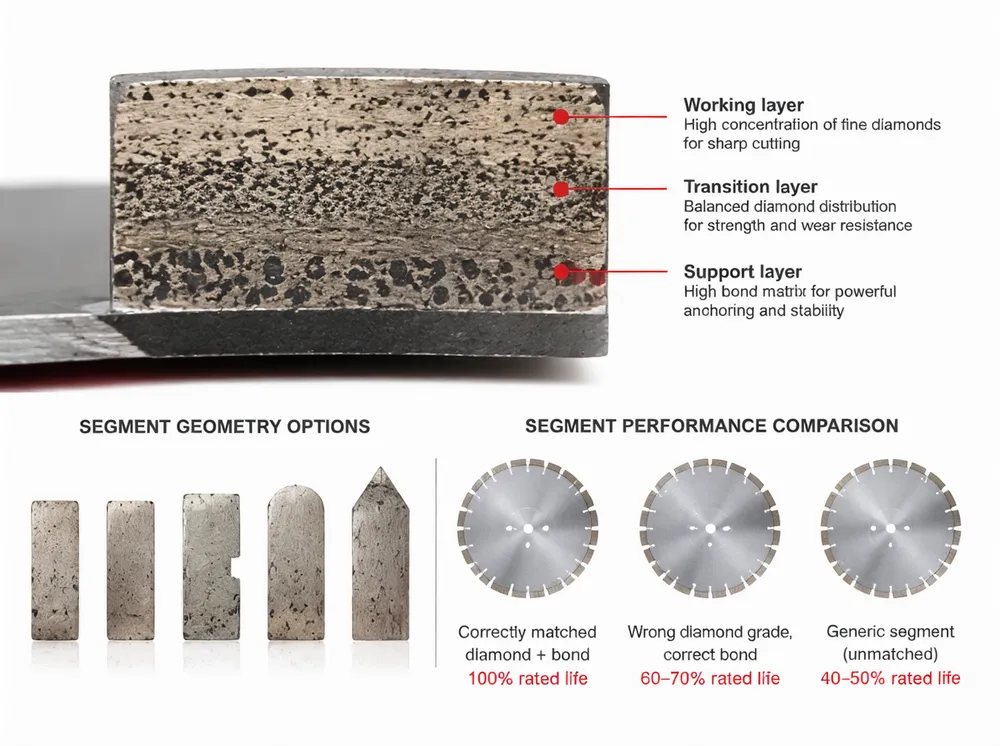
Segment Performance Comparison
Hot-Press Sintering Process
Powder Mixing
Metal powder blend (cobalt, iron, copper, tin ratios per formula) mixed with pre-screened diamond grit. Mixing time and method control distribution uniformity.
Cold Press + Hot Sinter
Cold-pressed into molds at 3–5 tons/cm², then sintered at 800–950°C under pressure. Temperature and dwell time are calibrated per bond formula — too high damages diamonds, too low leaves porosity.
Quality Verification
Hardness testing (HRC), density measurement, dimensional inspection, and destructive testing on sample segments from each batch. Segments that don't meet spec are scrapped — not reworked.
Applications & Equipment Compatibility
Different granite processing stages require different blade configurations. Here's how our blades map to common equipment in granite fabrication shops and quarries.
Bridge Saw Blades
Most common granite fabrication tool350–600 mm diameter. Used for slab cutting, countertop fabrication, and dimensional stone. Our bridge saw blades are optimized for clean, chip-free cuts on polished granite surfaces.
- Silent core option reduces noise 3–5 dB in enclosed shops
- Narrow kerf (3.2 mm) available for material savings on expensive slabs
- Compatible with Park Industries, Intermac, Breton, BACA Systems
Block Cutter Blades
Primary processing from quarry blocks600–900 mm diameter. Heavy-duty blades for cutting raw granite blocks into slabs. Tall segments (15–20 mm) maximize life between changes on continuous production runs.
- High diamond concentration (30–35%) for sustained cutting speed
- Reinforced steel core withstands lateral forces during deep cuts
- Designed for Pedrini, Simec, Gaspari Menotti block cutters
Multi-Blade / Gang Saw
High-volume slab productionMultiple blades mounted on a single arbor to cut an entire block into slabs simultaneously. Blade consistency is critical — every blade in the set must wear at the same rate.
- Matched sets with ≤0.05 mm dimensional variance between blades
- Uniform diamond distribution ensures even wear across the set
- Available in sets of 10, 20, 30, or custom quantities
Small Diameter / Bench Saw
Fabrication and site work300–400 mm diameter. For hand-held saws, bench saws, and small CNC machines. Available in both wet and dry configurations depending on use environment.
- Laser-welded segments for dry cutting safety
- Turbo rim option for faster cuts on site installations
- 25.4 mm arbor standard; pin-hole and flange options available
Equipment compatibility note: If your customers use machines not listed here, send us the machine model and spindle specifications. We've manufactured blades for most major and regional equipment brands across 40+ countries. Odds are we've already built the spec — or can develop it quickly.
Quality Assurance & Testing
Every granite saw blade ships with documented quality checks. Here's what we test, how we test it, and what happens when something doesn't pass.
Raw Material Inspection
Diamond grit screened for size consistency and crystal integrity. Metal powders tested for purity and particle size distribution. Steel cores checked for flatness (≤0.1 mm runout) and hardness.
Segment Sintering QC
Each batch: 3 segments destructively tested for diamond distribution and bond density. Hardness tested on Rockwell C scale. If batch variance exceeds 2 HRC, the entire batch is re-sintered or scrapped.
Welding Integrity
Every segment weld inspected visually and via tensile pull test (sample basis). High-frequency welds tested to ≥800 MPa shear strength. Laser welds tested to ≥1000 MPa. Failed welds → blade rejected.
Dimensional Inspection
Diameter, segment height/width, arbor bore, and total thickness measured with digital calipers and CMM. Tolerances: ±0.05 mm on critical dimensions. Out-of-spec blades are not shipped.
Dynamic Balance Test
Blades ≥400 mm are dynamically balanced to reduce vibration at operating speed. Imbalance corrected by material removal from the steel core. Target: ≤2.5 g·mm residual imbalance.
Cutting Performance Test
Sample blades from each production run are tested on actual granite under controlled conditions. We measure cutting speed (m²/hr), power draw, and segment wear rate against established benchmarks for that formula.
Certifications & Standards
OEM & Private Label Granite Blades
Most of our distributors sell under their own brand. We manufacture the blade; you own the customer relationship. Here's how private labeling works with our granite blade line.
Your Branding, Our Manufacturing
Laser-etched logos, custom color coding on segment or core, branded packaging with your company details. Minimum order: 50 blades per SKU for private label. We maintain your brand assets on file for repeatorders with zero lead time on artwork setup.
Packaging Options
Individual blade sleeves, retail-ready blister packs, bulk cartons, or custom display boxes. We can match your existing packaging spec or design new packaging to your guidelines. Barcoding and multilingual labels included at no extra charge.
Exclusivity Agreements
For volume commitments, we offer regional exclusivity on specific formulations. Your competitors won't have access to the same blade spec in your territory. NDAs and non-compete clauses available upon request.
Drop Shipping & Inventory Programs
We hold safety stock of your branded blades and ship directly to your customers or regional warehouses. Reduces your capital tied up in inventory while maintaining fast delivery to your end users.
Private Label Quick Facts
- MOQ: 50 blades per SKU for branded orders
- Artwork setup: Free after first order
- Lead time: 15–25 days (standard SKUs)
- Sample blades with your branding before bulk order
- No factory name on product or packaging
- Custom color coding per blade series
Ordering & Lead Times
From first inquiry to delivery at your warehouse. Here's what to expect at each stage and how to get the fastest turnaround.
Inquiry & Specification
Tell us the granite types, blade sizes, and quantities you need. We'll confirm specs and provide a detailed quote within 24 hours.
Timeline: 1 daySample & Approval
For new specifications or new customers, we provide test blades for field validation. You confirm performance meets requirements before bulk production begins.
Timeline: 7–10 daysProduction
Bulk manufacturing with QC checks at every stage. Production photos and progress updates available on request. Rush orders accommodated when capacity allows.
Timeline: 15–20 daysShipping & Delivery
Sea freight (25–35 days), air freight (5–7 days), or rail to Central Asia and Europe. Full export documentation, insurance, and tracking provided with every shipment.
Timeline: 5–35 daysMinimum Order Quantities & Pricing Structure
| Blade Category | MOQ (First Order) | MOQ (Reorder) | Lead Time | Volume Discount |
|---|---|---|---|---|
| Multi-Blade (1600–3500 mm) | 10 blades | 5 blades | 20–25 days | At 50+ blades |
| Single Block (2500–3500 mm) | 5 blades | 3 blades | 20–25 days | At 20+ blades |
| Bridge Saw (300–600 mm) | 50 blades | 20 blades | 15–20 days | At 200+ blades |
| Small Diameter (300–400 mm) | 100 blades | 50 blades | 15–18 days | At 500+ blades |
Payment Terms
- First order: 30% deposit, 70% before shipping (T/T)
- Established accounts: Net 30 after 3rd order
- L/C at sight accepted for orders above $20,000
- Western Union and PayPal for sample orders
Shipping & Logistics
- FOB, CIF, DDP, and DAP terms available
- Wooden crate packaging for large blades (sea freight safe)
- Consolidated shipments to reduce per-unit freight cost
- Full export documentation: CO, packing list, commercial invoice
Frequently Asked Questions
Common questions from distributors and wholesalers evaluating our granite diamond saw blades.
What granite types do your blades cut?
We manufacture blades for all commercial granite varieties — from soft granites like Bethel White and Kashmir White (Mohs 6–6.5) to extremely hard varieties like Absolute Black, Impala Black, and Baltic Brown (Mohs 7+). Each formula is optimized for a specific hardness range. Tell us which granites your customers cut most, and we'll recommend the right segment specification.
How does your blade life compare to European brands?
In controlled cutting tests, our premium-tier blades achieve 90–95% of the lifespan of top European brands at 40–60% of the cost. Our mid-tier blades match many European mid-range products directly. We're transparent about this: we provide test data and sample blades so you can verify performance on your specific granite before committing to volume.
Can you match an existing blade we're currently buying?
Yes. Send us a sample blade or detailed specifications (diameter, segment dimensions, number of segments, arbor size, and the granite types it's used on). Our engineering team will reverse-engineer the segment formula and produce test blades for comparison. This is one of our most common requests from distributors switching suppliers.
What if a blade fails prematurely in the field?
We investigate every reported failure. Send photos and usage details (machine type, RPM, feed rate, water flow, granite type). If the failure is due to a manufacturing defect, we replace the blade and ship additional units at no charge. If it's a spec mismatch, we'll adjust the formula for future orders. Our goal is zero returns — and our return rate across all distributors is below 0.3%.
Do you offer technical support for our sales team?
Yes. We provide product data sheets, cutting parameter guides, and comparison charts you can share with your customers. For key accounts, our technical team is available for direct calls to help troubleshoot cutting issues or recommend optimal operating parameters. We want your sales team to sell confidently — and that means arming them with real data.
Can I visit your factory?
Absolutely. We welcome factory visits from serious buyers. We'll arrange airport pickup, hotel recommendations, and a full production line walkthrough. You'll see raw material storage, sintering, welding, QC testing, and packaging firsthand. Most distributors who visit convert to long-term partners — seeing the operation removes any remaining doubts about quality and capability.
Ready to Source Granite Diamond Blades?
Tell us what granite types your customers cut, what blade sizes you need, and your target price point. We'll respond within 24 hours with specifications and pricing.
How Bond Formula Determines Your Blade's Margin Performance
The parent category page covers how bond chemistry works across all diamond saw blades. Here's what's specific to granite — and why it matters for your purchasing decisions.
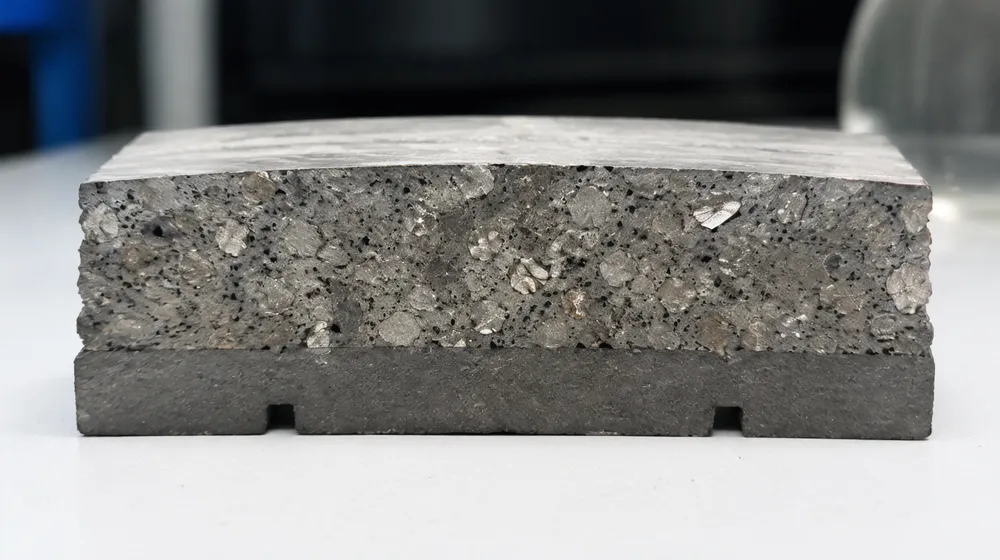
Granite's defining challenge is that it's hard but not uniformly abrasive. Most natural granite contains 20–60% quartz (highly abrasive) plus feldspar, mica, and other minerals that vary by quarry. The bond formula has to erode at a rate that continuously exposes fresh diamond cutting points — too slow and the blade glazes (diamonds go dull but can't shed), too fast and you burn through segment height in weeks.
We maintain over 30 distinct bond formulas specifically for granite applications in our library. When you tell us the granite varieties your end users cut — even if it's just the commercial name and country of origin — we match from the library or develop a new variant. This process typically takes 2–3 weeks for a new formula iteration including test-cutting on reference stone blocks.
Why This Matters Commercially
Your competitors sourcing from trading companies get a single "granite" formula. When a fabrication shop tells them "your blade glazes on our Absolute Black" or "your blade wears too fast on our Baltic Brown," they have no recourse except to switch suppliers. You can come back with an adjusted formula within a few weeks. That keeps accounts.
Field-Tested Granite Origins
We've formulated specifically for granite from these regions with proven bond parameters:
Indian Granite — Regional Variation
Indian granite alone has such variation that we maintain separate formulas for South Indian vs. North Indian quarry sources. The Mohs hardness is similar but abrasiveness differs enough to affect segment life by 20–30%.
Formula Development at a Glance
Market Segments Where Granite Saw Blades Drive Repeat Revenue
Identify where consistent reorder cycles and premium margin positioning intersect with your distribution capability.
Countertop Fabrication Shops
Highest-Frequency Reorder Segment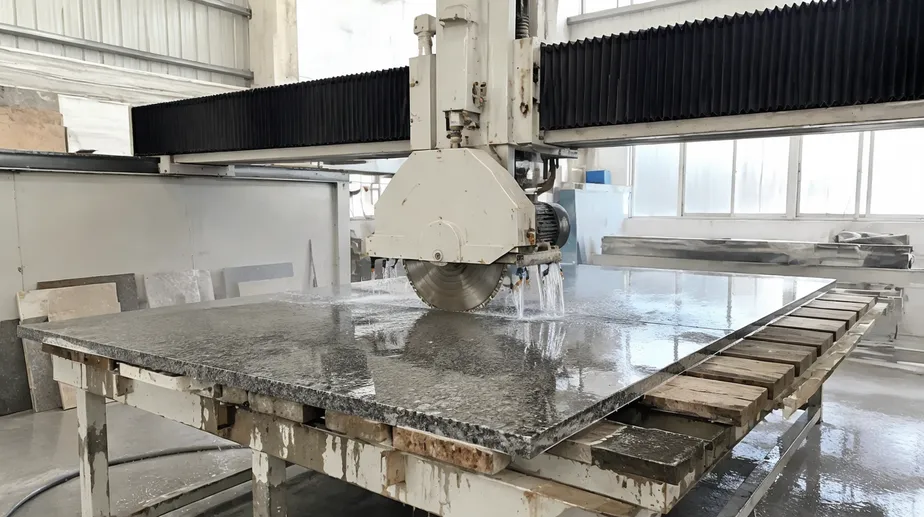
A fabrication shop running a bridge saw 8–10 hours daily on granite countertop slabs consumes 300–600 mm blades as a recurring monthly operational cost. They don't shop around once they find a blade that runs at their target feed rate without chipping edges — consistency matters more than saving $3 per blade. Typical shop accounts reorder every 30–60 days.
Your Commercial Angle
Granite countertops remain one of the highest-volume residential renovation materials in most markets. Every kitchen remodel is your blade sale. Stock 350 mm and 400 mm as your volume runners for standard bridge saws, 500 mm for industrial bridge saws, and you cover 80% of fabrication demand.
Monument and Memorial Stone Processors
Premium Pricing, Tight Tolerances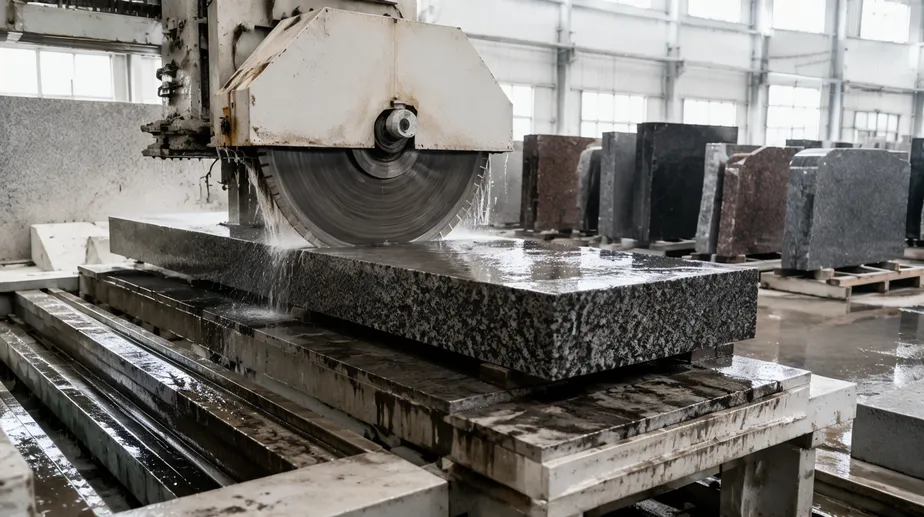
Monument fabricators cut thick granite slabs (50–200 mm) for headstones, architectural panels, and memorial installations. They run slower feed rates and need blades that produce a smooth cut surface with minimal secondary polishing. Larger diameters (600–900 mm) dominate this segment.
Your Commercial Angle
Monument work is less seasonal than construction and often government-funded (veterans' memorials, municipal projects). Fabricators in this segment order fewer blades but accept premium pricing for edge quality performance — protecting your per-unit margin.
Building Cladding and Flooring Production
High-Volume Project Orders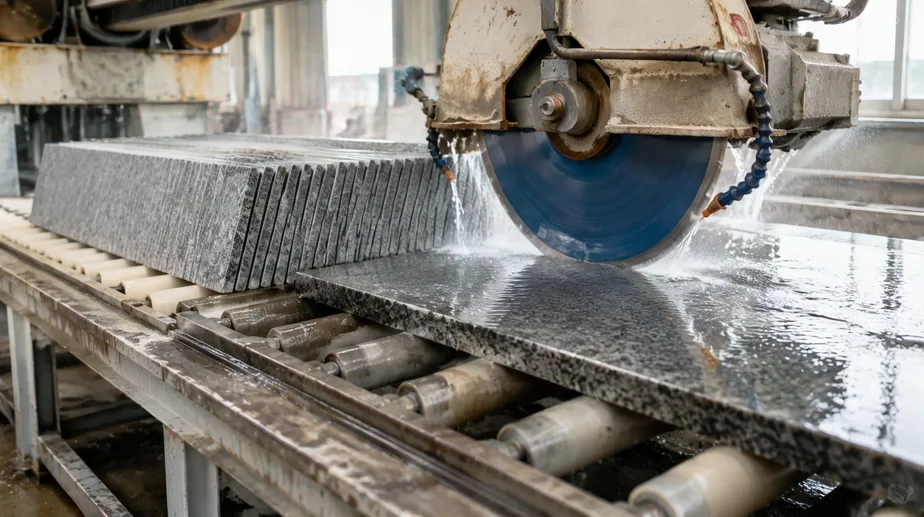
High-volume tile and panel cutting for construction projects. Granite cladding panels are cut from slabs to specific thicknesses (typically 15–30 mm), requiring blades that maintain dimensional accuracy across hundreds of cuts without deviation. Feed rate and consistent kerf width matter here because the panels need to meet tight tolerance for facade installation.
Your Commercial Angle
Cladding projects are large one-time orders — a single high-rise facade project can consume 50–200 blades over its production run. If you're supplying stone processing factories that handle construction contracts, these project-based orders are high-volume bursts you can forecast from their project pipeline.
Landscape and Paving Stone Fabrication
High-Throughput, Construction-Season Driven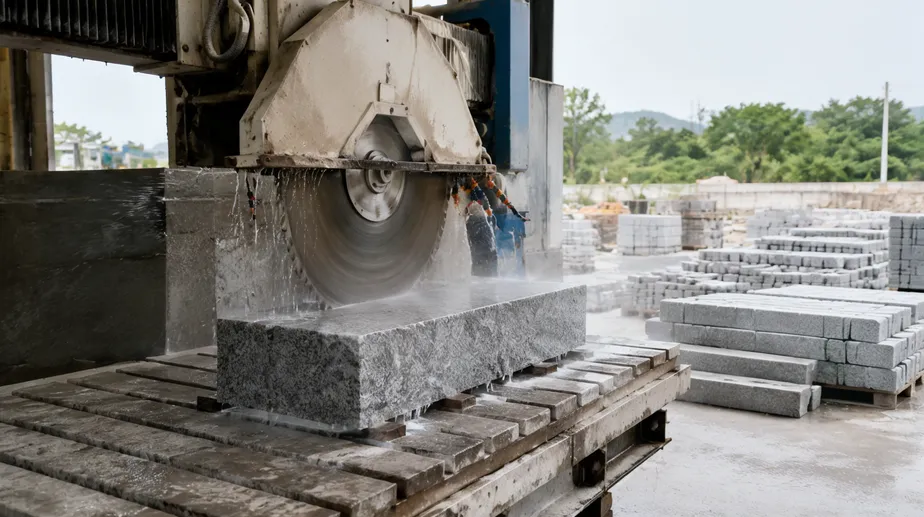
Granite pavers, curbing, and landscape features are cut in lower-precision, high-volume environments. Machines are larger (floor saws, block saws), blades are larger diameter, and the priority is throughput over surface finish. The stone types are typically lower-grade granite — harder and more abrasive than countertop material.
Your Commercial Angle
Landscape stone demand is construction-season driven in temperate markets but year-round in tropical and arid regions. Municipal street and park projects create predictable seasonal demand peaks. Stock larger-diameter blades (600–900 mm) with aggressive bond formulas for this segment.
Not sure which segment to prioritize?
Tell us your target market segment — we'll recommend a starter SKU mix.
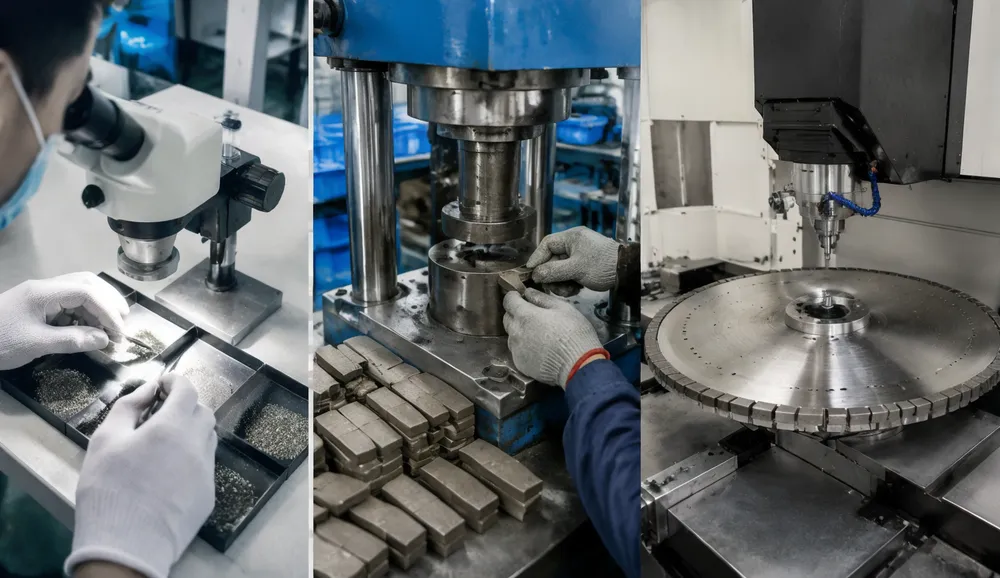
Granite-Specific Manufacturing: What We Do Differently on This Product Line
We covered the general production process on our diamond saw blades category page. Here's what's specific to our granite blade line — the production choices that separate a blade that performs on granite from a generic "stone" blade with a granite label.
Diamond Grit Selection
For granite, we use blocky-shaped synthetic diamond with high thermal stability (above 850°C). Granite generates significant heat at the cutting interface, and lower-grade diamonds fracture prematurely under thermal shock rather than wearing gradually.
We source from two qualified grit suppliers and test each incoming batch for crystal morphology — rounded or irregular crystals get rejected regardless of the supplier's certificate.
Why this matters: One bad grit batch going into 5,000 segments means 5,000 blades that wear 30% faster than spec. The incoming inspection cost is negligible compared to the field failure cost.
Cold-Press Density Control
Granite bond formulas are cobalt-heavy (soft bonds require more cobalt to achieve the right erosion rate). Cobalt powder has different flow characteristics than iron powder — it packs unevenly in the die if the press parameters aren't calibrated specifically for it.
We run granite segment pressing on dedicated press settings with modified fill-shoe velocities and compaction dwell times.
Target specification:
Segment density variation under ±2% within a batch
Density variation translates directly to uneven wear.
Post-Sinter Hardness Verification
Every granite blade batch gets segment hardness testing (HRB scale). The acceptable range for our standard hard-granite formula is HRB 85–92.
Below 85: The bond is too soft and will wear prematurely on moderately abrasive granite.
Above 92: It risks glazing on dense non-abrasive granite.
If a batch tests outside range, we adjust sintering parameters and re-run — we don't ship borderline batches and hope they perform. Your customers won't send you a lab report when the blade fails; they'll just switch to your competitor.
Core Tensioning for Granite RPM Range
Bridge saws cutting granite typically run at 2000–3500 RPM depending on blade diameter. Our CNC tensioning process stress-relieves the steel core for stability at these specific speeds.
An un-tensioned or incorrectly tensioned core develops wobble under load, widening the kerf and causing segment side-wear.
Process sequence:
Tension each blank before welding → verify flatness after final assembly
Available Configurations: Segment Types and Core Options
Not every granite cutting application needs the same blade construction. Here's what we produce across the granite saw blade range — and which configuration serves which buyer need.
Standard Segmented Granite Blades
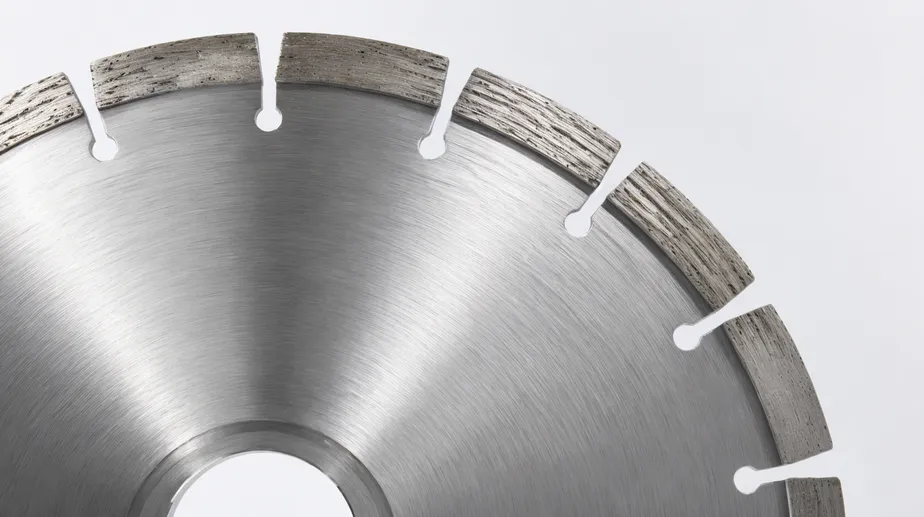
The bread-and-butter configuration. Gullet design (open slots between segments) provides effective cooling water flow and debris evacuation.
Best for general-purpose granite cutting where you need reliable performance across multiple granite types without optimizing for any single one.
Position: This is your volume SKU — the blade most fabrication shops will default to for daily production.
Silent-Core Granite Blades
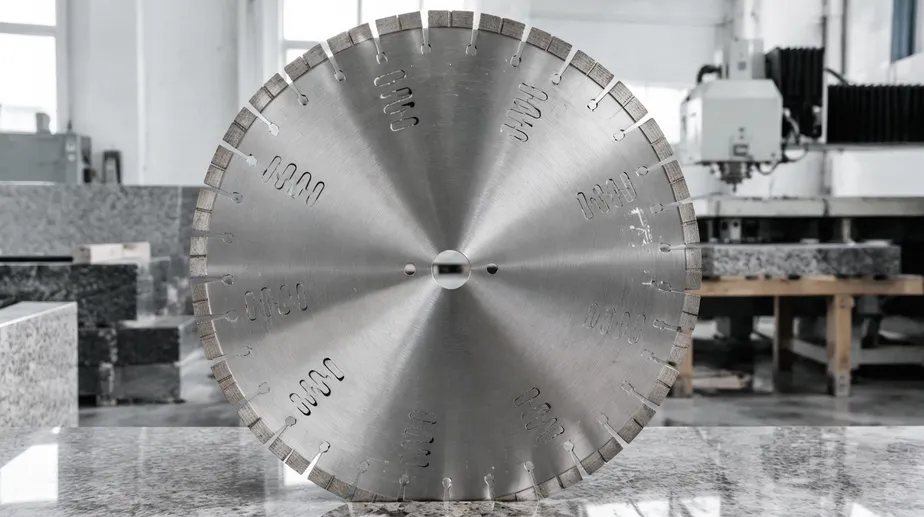
Sandwich steel construction with laser-cut vibration-dampening slots. Reduces operational noise by 3–5 dB compared to standard cores.
Required for indoor fabrication facilities subject to occupational noise regulations (increasingly common in European and North American markets). Slight price premium, but your customers in regulated environments have no alternative — they must use silent-core blades regardless of cost.
If you serve the European market, stocking silent-core options is not optional — it's a compliance requirement for an increasing number of fabrication facilities.
See dedicated silent granite saw blade pageArix-Pattern Granite Blades
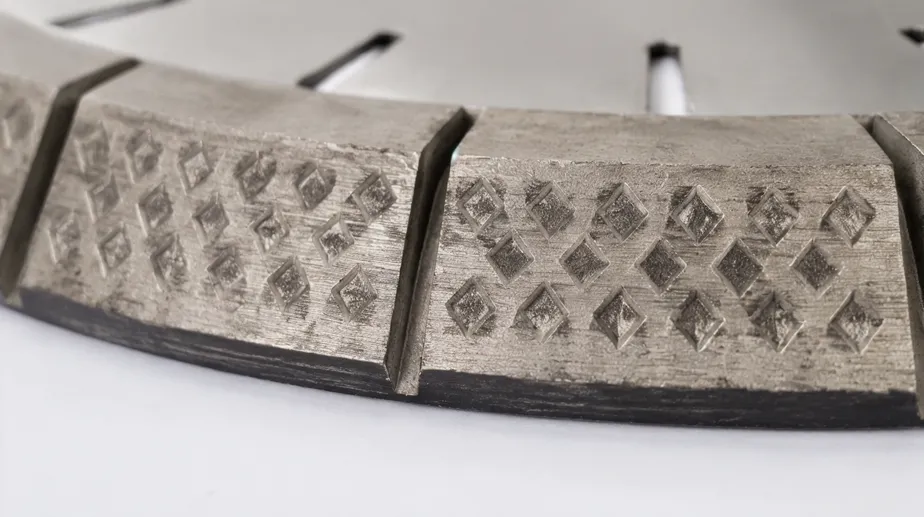
Diamonds arranged in a geometric pattern rather than random distribution. Result: more aggressive initial cutting speed and more consistent performance throughout segment life.
Price Premium
15–25%
Feed Rate Gain
20–30%
Best for fabrication shops running automated bridge saws where throughput directly translates to labor cost per slab.
For high-production environments where speed matters more than blade cost, Arix configuration is the clear recommendation.
See ARIX granite saw blade page for performance dataContinuous Rim Granite Blades
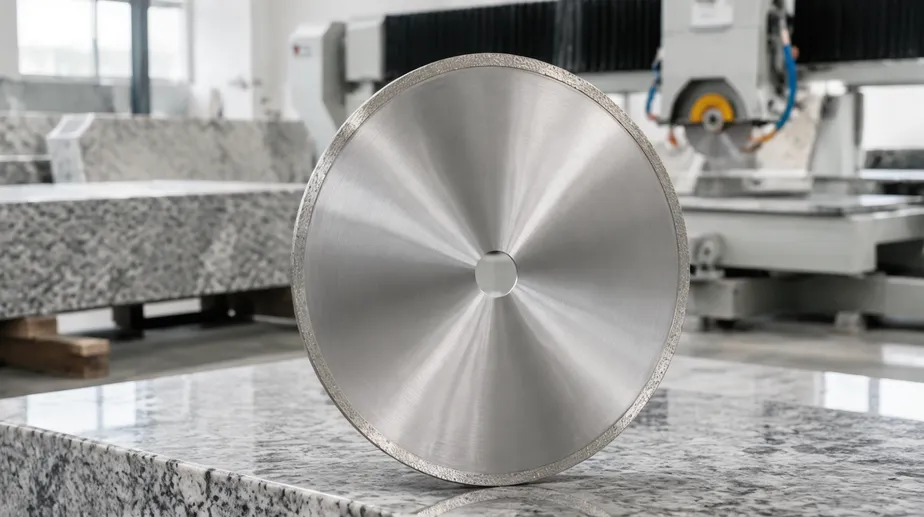
No gullets — a continuous diamond edge for the smoothest possible cut surface. Slower feed rate (no debris clearance slots), but produces edges requiring minimal polishing.
Used for decorative granite work, visible-edge applications, and precision cuts on expensive material where rework cost exceeds blade cost.
Best for: Decorative work, visible edges, precision cuts on high-value stone.
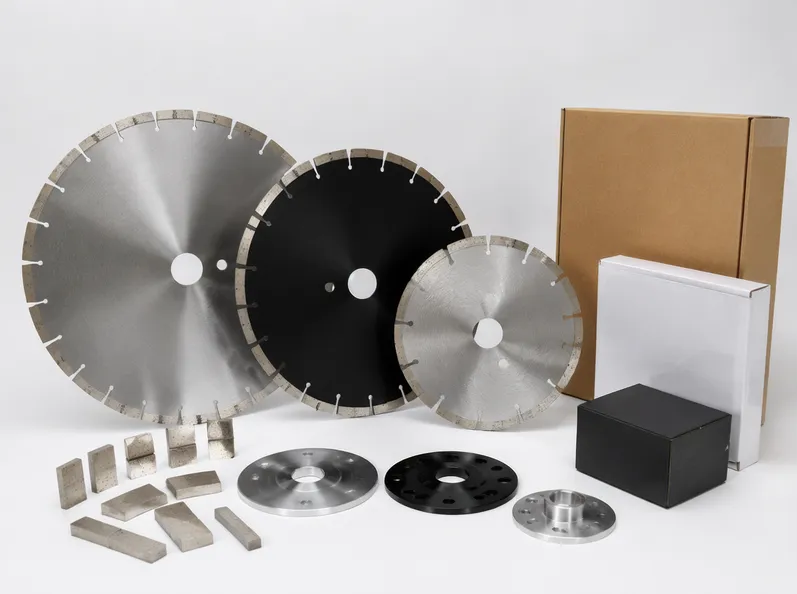
Customization Scope for Granite Saw Blades
What you can customize:
Bond Formula
Adjusted to your specific granite types. MOQ: 50 pieces per formula (we need to run a minimum batch through sintering to maintain process control).
Diameter
Any diameter from 300–900 mm. Non-standard diameters available without tooling surcharge if within ±10 mm of our standard dies.
Segment Height
10, 12, 15, or 20 mm standard. Custom heights between these possible at slightly higher MOQ (100 pieces) due to die modification.
Segment Width / Kerf
3.0–5.0 mm. Narrower kerf saves material on expensive stone slabs; wider kerf provides more stability on thicker cuts.
Arbor Bore
50 mm and 60 mm standard. 25.4 mm, custom metric, and machine-specific bores available.
Core Type
Standard steel, silent core, or color-coded cores for your product tier differentiation.
Welding Method
HF welded (standard, lower cost) or laser welded (dry-cut capable, higher thermal resistance).
Private-Label Packaging
Your brand, your color scheme, your product codes. MOQ for private-label starts at 100 pieces per SKU.
Blade Printing
Silk-screen or pad-print your logo, specs, and safety warnings directly on the core.
What Affects Lead Time
Standard specs on existing formulas
Modified formula (new bond development): add for sampling and approval before production
New diameter requiring custom dies: add for tooling
Private-label first run (artwork approval + packaging production)
Practical Limitations
- Below 300 mm diameter, these are classified as cutting discs — different production line, covered in our diamond cutting discs category.
- Above 900 mm diameter for single-blade use, you're looking at gang saw blades which have different segment geometry and core requirements.
- Formula changes below 50 pieces per spec aren't practical — sintering batch economics don't support it for either party.
We keep formula records permanently once developed. Your first order involves formula setup, but every reorder after that runs directly from your file — no re-development time or cost. Most of our long-term granite blade customers run 3–5 formulas covering their market's stone mix, and reorder quarterly.
We'll quote with formula recommendations
Packaging and Container Loading for Granite Blade Orders
Granite saw blades are heavy relative to their volume (a 500 mm blade weighs 2.5–4.5 kg depending on core thickness and segment configuration). Weight, not cubic volume, becomes the limiting factor for container loading.
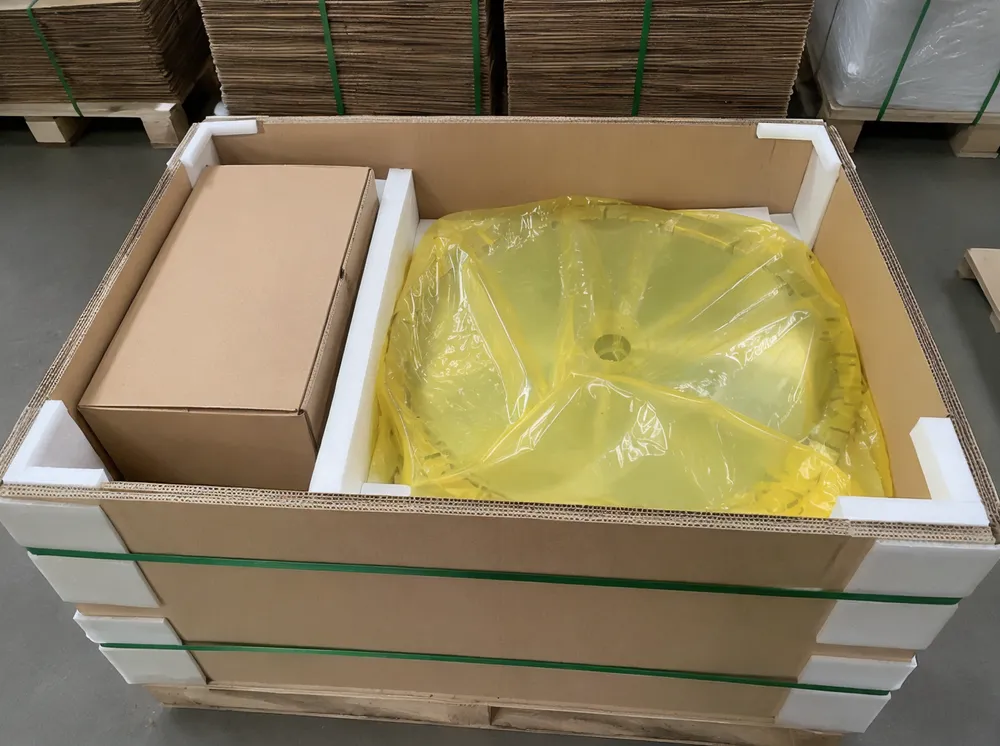
Standard Packaging
Individual VCI anti-corrosion wrap
Foam separator between blades
Color-printed inner box (customizable)
Reinforced outer carton with edge protection
Blades ship flat-stacked, diamond segments protected by molded inserts. Rigid cardboard edge guards around the full circumference eliminate segment-edge damage during transit.
Three customer complaints in 2018 about chipped segment tips on arrival taught us this lesson. Zero complaints since the packaging redesign.
Freight Consideration
Granite blades for the 300–600 mm range typically hit maximum weight before maximum volume in a 20GP container. If your total order weight approaches 20 tonnes, we'll flag it during order confirmation and recommend splitting across containers or upgrading to a 40HQ to avoid overweight surcharges at port.
Container Loading Estimates
| Blade Diameter | Approx. Pieces per 20GP | Approx. Pieces per 40HQ |
|---|---|---|
| 300–350 mm | 6,000–8,000 | 12,000–16,000 |
| 400–450 mm | 4,000–5,500 | 8,000–11,000 |
| 500–600 mm | 2,500–3,500 | 5,000–7,000 |
| 700–900 mm | 1,200–2,000 | 2,500–4,000 |
These are conservative estimates — actual loading depends on packaging configuration and whether you're mixing diameters in one container. We provide exact loading plans with your confirmed order.
Granite Saw Blade Selection: Matching Configuration to Application
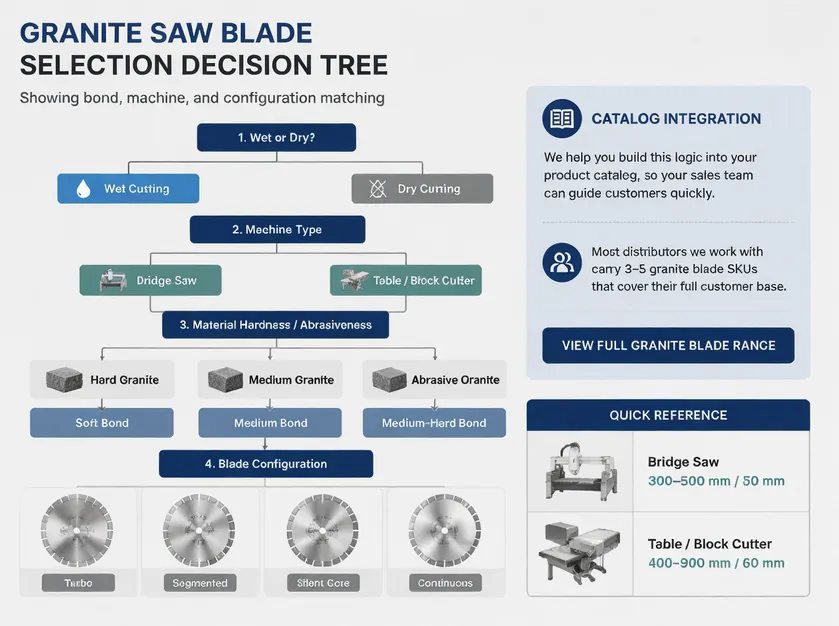
Your customer says "I need a granite blade." Here's the decision tree that gets them to the right product — and helps you avoid returns from mismatched blades.
What granite?
Hard and dense (Absolute Black, Blue Pearl, Star Galaxy) → soft bond
Moderately hard, visible quartz (Rosa Beta, Giallo Veneziano) → medium bond
Coarse-grained, highly abrasive (many Chinese and Brazilian commercial granites) → medium-hard bond with abrasion-resistant matrix
What machine?
Bridge saw (most common for countertop fabrication) → 300–500 mm diameter, 50 mm arbor
Table saw / block cutter → 400–900 mm, 60 mm arbor
The machine's spindle power determines how aggressive the segment can be — underpowered machines can't drive high-concentration segments effectively.
Speed or life?
Maximum Feed Rate
Arix segments, higher diamond concentration (30–35%), slightly shorter segment life
Maximum Life
Standard segments, moderate concentration (20–25%), longer service interval
Core type?
Standard core — most applications
Silent core — indoor facilities with noise regulations. Adds typically 8–12% to blade cost but eliminates regulatory compliance risk.
Wet or dry?
Nearly all granite fabrication is wet-cut. If your customer needs dry capability (jobsite cuts without water supply), specify laser-welded joints — HF welds fail under thermal cycling in dry conditions.
Catalog Integration
We help you build this logic into your product catalog, so your sales team can guide customers quickly. Most distributors we work with carry 3–5 granite blade SKUs that cover their full customer base.
View full granite blade rangeQuick Reference
Frequently Asked Questions
Technical answers to the questions distributors and fabricators ask most about granite saw blades.
What is the typical cutting life of a granite saw blade?
Blade life depends on three variables: granite hardness, segment height, and feed rate. As a general benchmark, a standard 400 mm blade with 12 mm segment height cutting medium-hard granite on a bridge saw delivers approximately 800–1,500 linear meters before segment exhaustion. Harder granite shortens life; softer granite extends it.
Our 15 mm segments increase total life proportionally — roughly 30–40% more linear meters for a modest cost increase. We recommend 15 mm segments for any customer running production volumes because the per-meter cutting cost drops even though the per-blade price is slightly higher.
How do I choose between high-frequency welded and laser-welded granite blades?
For standard wet-cutting on bridge saws and table saws — which covers 90%+ of granite fabrication applications — high-frequency welded blades are the correct choice. They cost less, the joint strength is fully adequate for wet-cut operating conditions, and they perform identically to laser-welded in this application.
Laser welding is necessary only when the blade will face thermal cycling: dry cutting, high-RPM hand-held saws, or applications where water supply is intermittent.
Stocking HF-welded as your standard and keeping laser-welded for specific requests optimizes your inventory cost without sacrificing coverage.
Can one granite saw blade handle multiple granite types?
A medium-bond "general purpose granite" formula handles a variety of granites at acceptable performance — not optimal on any single stone, but usable across a range. For distributors supplying small shops that cut mixed materials from different slabs daily, this is a practical SKU choice.
However, any customer running volume on a single granite type (which is most countertop fabricators — they buy slabs in bulk from one quarry) will see 25–40% better life and feed speed from a formula matched to that specific stone.
Our recommendation: stock general-purpose as your entry SKU, then transition high-volume customers to stone-matched formulas once you identify what they cut most.
What minimum order quantity applies to granite saw blades?
Standard diameters (300–600 mm) on existing stock formulas: 50 pieces per specification. Larger diameters (700–900 mm): 30 pieces per specification due to higher per-unit value.
Private-label orders: 100 pieces per SKU to cover packaging setup. Formula development orders (new bond for a specific granite type): 50 pieces minimum for the first production run.
We offer sample quantities of 5–10 pieces for field testing before committing to production volume — priced at production rates, not inflated "sample pricing."
What makes your granite blades different from general-purpose diamond blades sold as "suitable for granite"?
Bond chemistry. A general-purpose diamond blade uses a mid-range bond hardness designed to cut multiple materials acceptably. On hard granite specifically, that mid-range bond is typically too hard — the matrix doesn't erode fast enough, diamonds go dull, and the blade glazes.
Our granite-specific blades start from a soft bond baseline and adjust from there based on the specific granite's abrasiveness. The segment geometry (width, number of segments, gullet depth) is also optimized for granite's cutting characteristics rather than being a compromise across stone, concrete, and ceramic.
Do your granite saw blades carry MPA certification?
Yes. Our granite saw blades are produced under our MPA-certified manufacturing process, which specifically audits segment retention (the primary safety concern at operational RPM) and dimensional accuracy.
MPA certification is required for selling diamond blades in the European market through professional distribution channels. If you're importing into the EU, our MPA certification means your product is pre-qualified — no additional safety testing needed at your end.
Related Granite Blade Products Under Our Range
If this page covers your primary need but you're also building out adjacent SKUs, these targeted product lines address specific machine types, performance tiers, and compliance requirements.
Granite Bridge Saw Blades
Tuned specifically for bridge saw operating parameters. If your customers are exclusively countertop fabricators on bridge saws, this is the more targeted page.
View productARIX Granite Saw Blades
For the high-production fabricators willing to pay more per blade for measurably faster cutting and longer life.
View productSilent Granite Saw Blades
Indoor facility compliance. If you serve the European market, you need these in your catalog.
View productGranite Gang Saw Blades
Block-to-slab processing at quarry and factory scale. Different machine, different segment geometry, much larger orders per set.
View productGranite Cutter Blades
General fabrication shop blades. Overlaps with this page but positioned as the general-purpose entry SKU.
View productNeed help building a granite blade product line that covers your full market? We'll recommend the SKU mix based on your customer profile and regional stone types.
Start with Your Granite Types
The fastest path to an accurate quote: tell us what granite your customers cut. A quarry name, a commercial stone name, or even a photo of the stone — we can usually identify the mineral composition and match the right formula.
Include in your inquiry:
- Stone names or origins your market works with
- Machine types (bridge saw, table saw, block cutter)
- Blade diameters you need
- Monthly or quarterly volume estimate
- Whether you need private-label packaging
We'll respond within 48 hours with formula recommendations, a spec sheet for each SKU, and FOB pricing at your volume tier.
Direct Contact
How Most New Customers Start
Submit stone types, machine specs, and volume — the more specific your data, the more precise our first quote.
Receive formula recommendations, spec sheets, and FOB pricing at your volume tier within 48 hours.
Start with a 5–10 piece sample order on our recommended formula, test-cut on your actual stone.
Place production quantities once you've confirmed performance against your target stones.