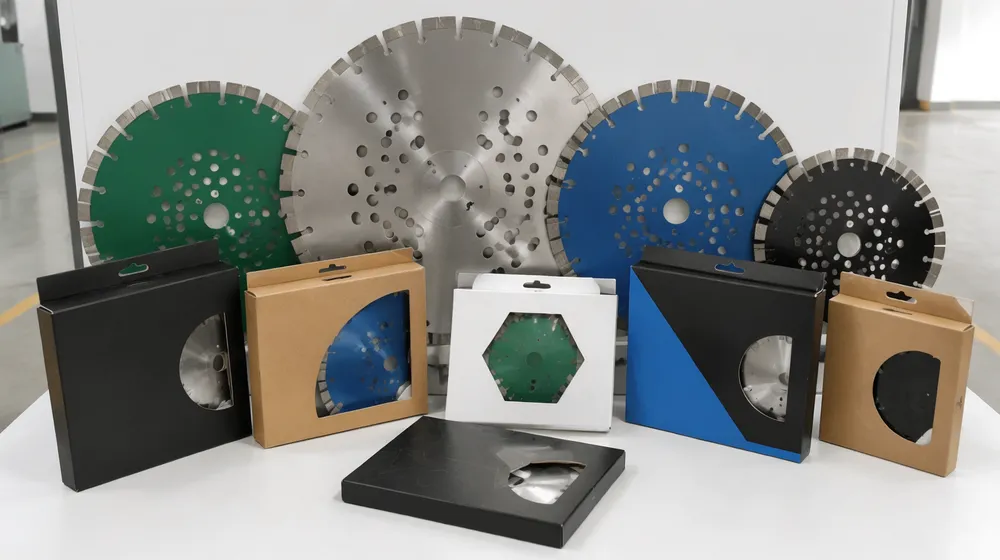
Engineered to bring your shop below occupational noise thresholds without sacrificing cut speed.
3–5 dB reduction over standard cores. Vibration-dampened slots absorb resonance at operating RPM, so your fabrication floor stays compliant and your operators stay productive through full shifts.
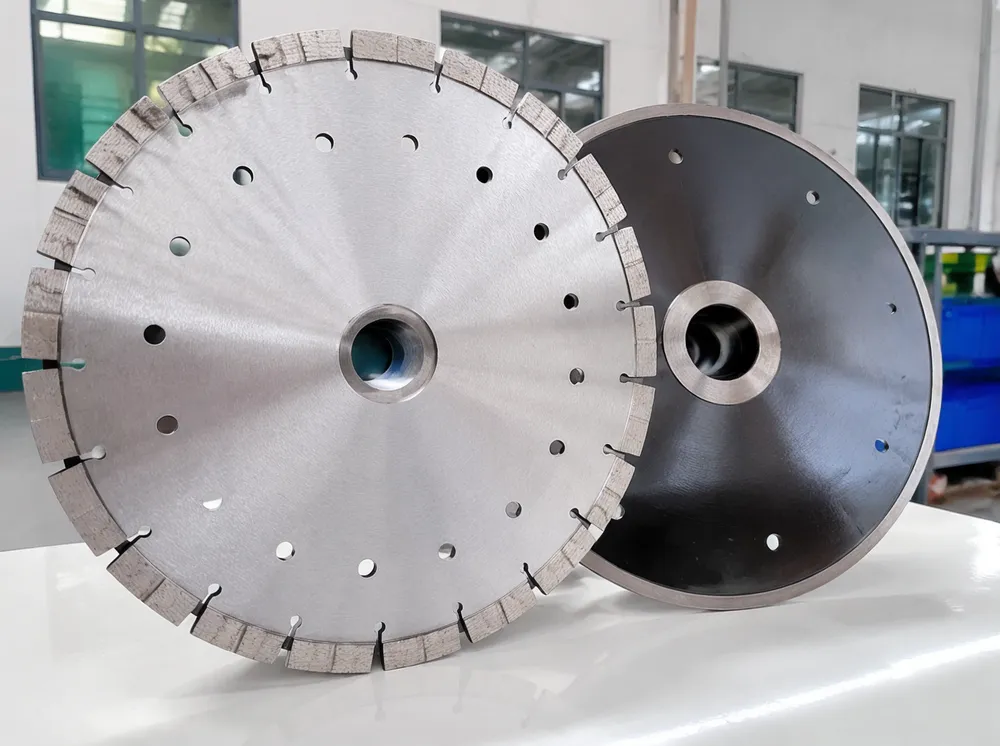
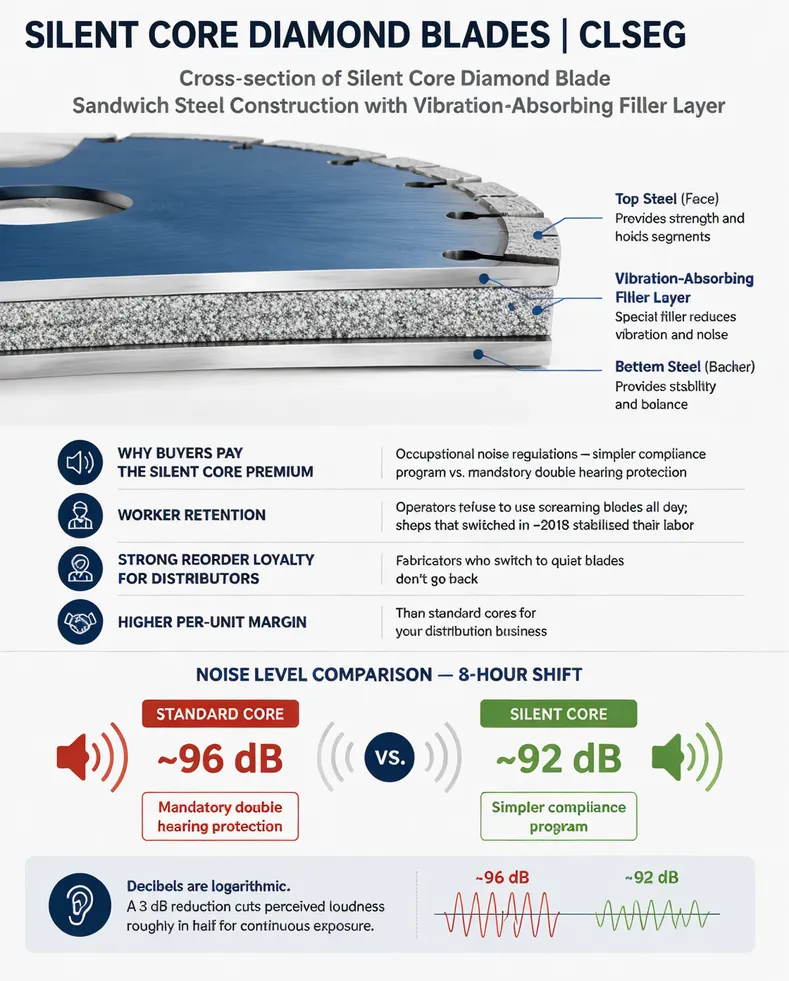
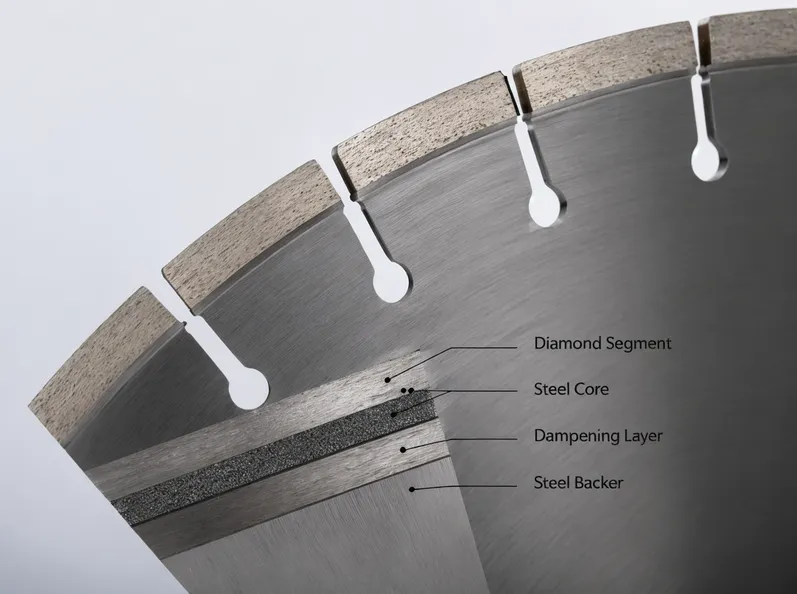
A silent core diamond blade uses a sandwich steel construction: two outer steel plates bonded to a vibration-absorbing filler layer, with laser-cut dampening slots at calculated positions around the core perimeter. When the blade reaches operating RPM, the filler material absorbs harmonic resonance that would otherwise translate into audible noise and lateral vibration.
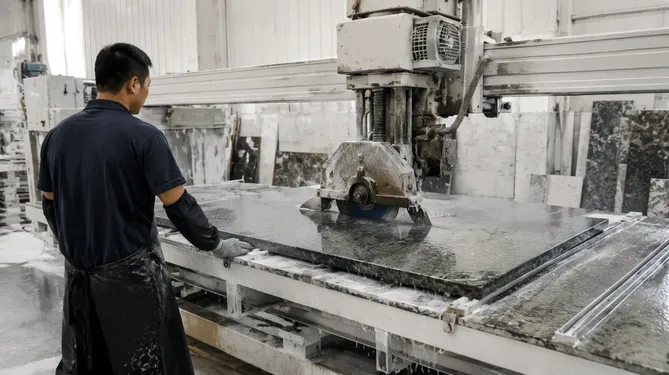
The practical result: 3–5 dB lower noise output compared to a standard single-plate steel core of the same diameter. That sounds modest on paper — until you remember that decibels are logarithmic. A 3 dB reduction cuts perceived loudness roughly in half for continuous exposure. Over an 8-hour shift in an enclosed fabrication shop, the difference between a standard blade at 96 dB and a silent core at 92 dB is the difference between mandatory double hearing protection and a simpler compliance program.
This is the blade you stock for indoor fabrication customers who face occupational noise regulations — and increasingly, for any premium stone shop where operators refuse to work with screaming blades all day. We started seeing this shift around 2018. Shops that couldn't retain workers invested in quieter tooling. The silent core premium pays for itself in labor stability.
For your distribution business, silent core blades carry higher per-unit margin than standard cores while commanding strong reorder loyalty — once a fabricator switches to quiet blades, they don't go back.
Decibels are logarithmic. A 3 dB reduction cuts perceived loudness roughly in half for continuous exposure.
We produce our silent cores in-house, which matters because core construction quality directly determines noise performance. A poorly made sandwich core — delaminated filler, inconsistent slot geometry, imbalanced plate thickness — creates vibration problems worse than a standard blade.
Two precision-cut 65Mn spring steel plates, each CNC-tensioned independently. Individual tensioning ensures both plates contribute equal dampening load — uneven tension is a common failure point in competitor silent cores.
A copper-alloy interlayer is bonded between the two steel plates under controlled pressure and temperature. Interlayer thickness is calibrated per blade diameter — larger diameters require thicker damping material to maintain consistent noise attenuation across the full operating RPM range.
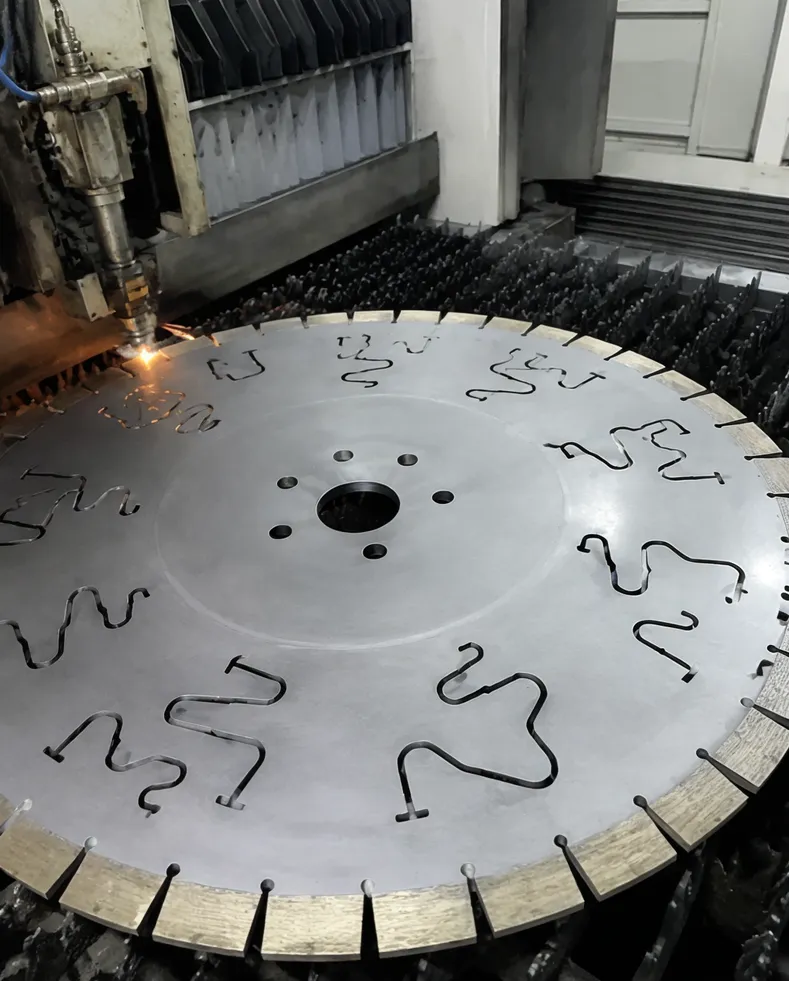
Vibration-absorption slots are laser-cut at calculated angular positions around the core perimeter. Slot geometry and count are specific to each blade diameter — not a universal template applied across the range. This is where many low-cost silent cores fail: generic slot patterns don't cancel harmonics at the correct frequencies for each blade size.
Each finished core is dynamic-balanced and checked for lateral runout before segment welding. Runout tolerance: ±0.15 mm max for diameters ≤500 mm. Cores that exceed tolerance are rejected — not reworked. A blade that passes noise specs but fails runout will vibrate laterally in the cut, which defeats the entire purpose of the silent core design.
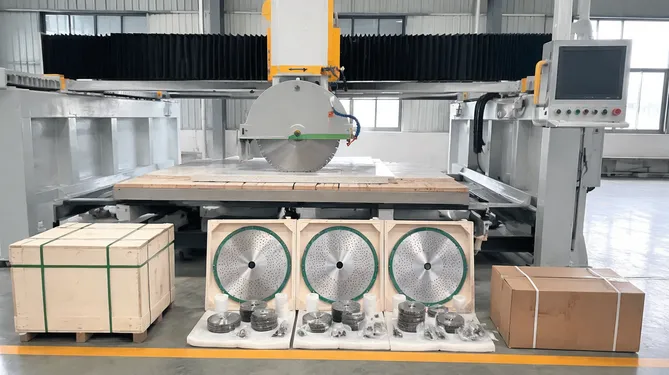
Our silent core blades are produced in diameters from 105 mm through 600 mm, covering bridge saw, angle grinder, and CNC machining center applications. Each diameter ships with segment formulations optimized for the primary material cut at that size — not a single segment compound applied across the full range.
| Diameter | Bore | Segment Type | Primary Application | Cooling |
|---|---|---|---|---|
| 105–115 mm | 22.23 mm | Turbo / Continuous | Angle grinder — granite tile, porcelain | Dry / wet |
| 180–230 mm | 22.23 mm | Segmented / Turbo-seg | Medium angle grinder — stone slab rough cuts | Dry / wet |
| 300–350 mm | 25.4 / 60 mm | Premium segmented | Bridge saw — granite, quartz, marble slab | Wet only |
| 400–450 mm | 60 mm | Premium segmented — hard bond | Bridge saw — hard granite, quartzite | Wet only |
| 500–600 mm | 60 mm | Heavy-duty segmented | Large bridge saw / CNC — slabs, blocks | Wet only |
Primary driver of silent core adoption. Enclosed space amplifies blade noise; regulatory pressure is highest. Bridge saw blades 300–450 mm are the volume SKU for this segment.
Quartz is abrasive and generates significant vibration on standard cores. Silent core reduces chatter on Silestone, Caesarstone, and similar engineered surfaces, improving edge quality and reducing micro-chipping.
Ultra-compact surfaces like Dekton and Neolith require vibration-free cutting to avoid surface fracture. Silent core angle grinder blades 105–230 mm are specified by installers working with these materials.
Standard production values for the silent core line. Exact parameters vary by diameter and formula — contact us for detailed product data sheets matched to your machine and stone type.
| Parameter | Specification |
|---|---|
| Diameter range | 250 mm – 600 mm (standard) 650 mm – 900 mm (available on request) |
| Core construction | Sandwich steel (dual 65Mn plates + copper-alloy damping interlayer) |
| Core thickness | 2.2 mm – 3.8 mm (varies by diameter) |
| Segment height | 10 mm – 15 mm (standard) 8 mm and 20 mm available |
| Segment width | 2.8 mm – 4.2 mm |
| Arbor bore | 25.4 mm, 50 mm, 60 mm Custom bore available |
| Noise reduction | 3–5 dB below equivalent standard-core blade |
| Dampening slots | Laser-cut, asymmetric pattern optimized per diameter |
| Welding method | High-frequency welding (standard) Laser welding (for high-RPM specs) |
| Operating speed | 25–45 m/s (varies by diameter) |
| Compatible machines | Bridge saws, table saws, CNC stone centers, mitre saws |
| Applicable materials | Granite, marble, engineered quartz, sintered stone, ceramic |
| Certifications |
ISO 9001:2015
CE
SGS
MPA
|
Diameter Coverage Note
The 250–600 mm range covers 90% of indoor fabrication demand. Silent cores above 600 mm — typically for large CNC bridge saws processing big slabs — are produced on order with a slightly higher MOQ.
Three buyer profiles drive the majority of silent core blade demand. Understanding their order patterns and purchase logic helps you build a stocking position and a pitch that closes quickly.
Your primary market. Any countertop fabrication shop operating bridge saws or CNC saws indoors is a candidate. European and North American shops face OSHA or EU noise directive requirements — typically 85 dB TWA exposure limits — and indoor stone cutting with standard blades routinely exceeds that threshold. Silent core blades bring measured noise at the operator position below compliance thresholds for most granite and marble work, letting your customers avoid engineering controls, administrative limits, or expensive acoustic enclosures.
Order Pattern
Fabrication shops consuming 2–8 blades per month on primary saws, with reorders on a 30–60 day cycle depending on stone volume and material hardness. Once adopted, retention is high — the noise difference is immediately obvious to every operator in the shop.
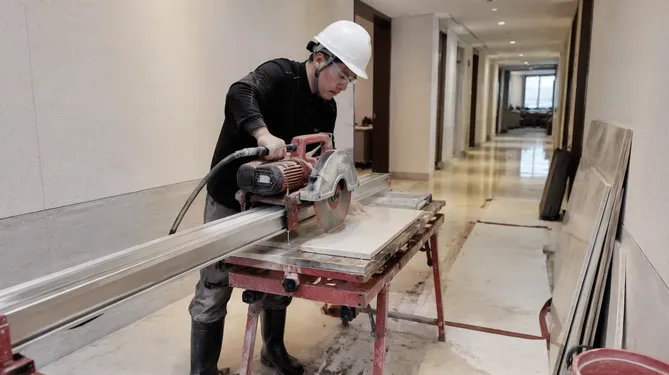
Installers doing on-site cutting in occupied buildings — hotel lobbies, residential kitchens during renovation, commercial offices — need blades that don't generate complaints from adjacent spaces. Standard blades on a portable rail saw in a hotel corridor create noise levels that shut down surrounding areas. Silent core blades on a wet-cut rail saw reduce the disruption radius enough to keep adjacent rooms operational.
Order Pattern
Contractors purchasing 5–20 blades per project, specified by project managers who learned from noise complaints on previous jobs. Premium pricing is accepted without negotiation because the alternative is lost working hours.
Bridge saw and CNC stone center manufacturers increasingly bundle low-noise blades as part of their machine package — both as a selling point and to ensure their machines meet advertised noise specifications during buyer demonstrations. If you supply fabrication equipment to dealers, silent core blades become a bundled accessory that moves automatically with each machine sale.
Order Pattern
Equipment OEMs purchasing matched blade sets (typically 2–3 blades per machine sold) as ongoing accessory stock.
Tell us which market segment you're targeting
We'll recommend the right diameter and formula combination for your stocking position.
The segment formula follows the same stone-matching logic as our standard range. Hard bond for abrasive materials, soft bond for hard non-abrasive stone, diamond concentration matched to the expected feed rate and cut frequency. The silent core changes the steel structure — not the cutting chemistry.
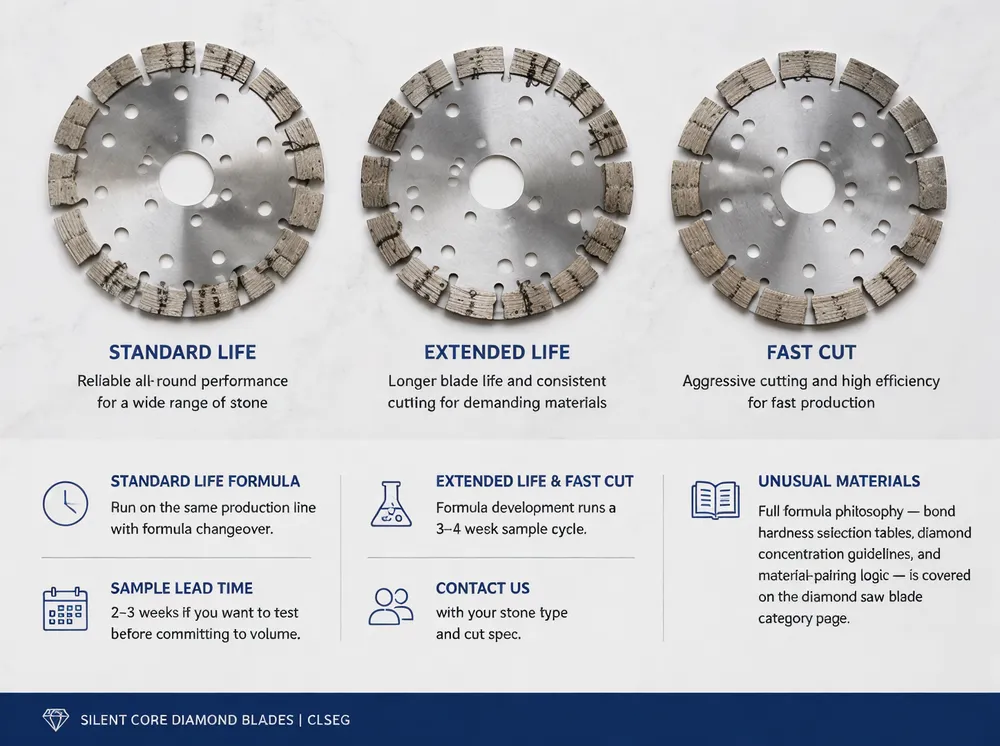
Most silent core demand concentrates on granite and engineered quartz fabrication — the hardest, noisiest materials to cut indoors. We've refined three formula tiers specifically for silent core granite blades, each targeting a distinct shop profile and production model.
Mid-range diamond concentration (standard synthetic grit, 40/50 mesh), balanced for shops cutting mixed granite varieties at moderate feed rates. Covers 70% of fabrication demand — your bread-and-butter reorder SKU.
Higher diamond concentration with a more wear-resistant bond matrix, for shops running CNC automated saws where blade changes interrupt production cycles. Costs more per unit, but your customer's cost-per-cut drops because they change blades less frequently.
Aggressive diamond exposure, softer bond, optimized for shops prioritizing throughput over blade longevity. Fabricators running high-volume countertop production prefer faster feed rates and accept shorter blade life as the trade-off.
Full formula philosophy — bond hardness selection tables, diamond concentration guidelines, and material-pairing logic — is covered on the diamond saw blade category page.
OEM and ODM are standard workflow here — not a special-request process. The table below defines every configurable dimension, the available options, and the hard constraints on each. Use it as your spec checklist before sending a customization brief.
| Customization Dimension | Available Options | Limitations |
|---|---|---|
| Diameter | Any size 250–900 mm in 10 mm increments | Below 250 mm: damping interlayer ineffective at that radius. Above 900 mm: contact us for feasibility. |
| Arbor Bore | 25.4 mm, 50 mm, 60 mm standard; custom bores to machine spec | Non-standard bores require MOQ 50+ pieces per size. |
| Segment Formula | Granite, marble, engineered quartz, multi-material, concrete | Formula development for unusual materials: 3–4 week sample cycle. |
| Segment Height | 8 mm, 10 mm, 12 mm, 15 mm, 20 mm | Heights below 8 mm not available on sandwich cores (welding clearance). |
| Core Slot Pattern | Standard optimized pattern per diameter | Custom slot patterns: engineering review required, MOQ 200+ pieces. |
| Private Label | Your brand on blade body, segment printing, custom box packaging | MOQ 100+ pieces for private-label runs. |
| Core Color Coding | Standard silver, or custom paint/anodize to brand color | Custom colors: MOQ 200+ pieces. |
Not a special request — it's how we operate.
If you're building a branded silent blade line for your market, send us your brand guidelines and target specs. We'll mock up packaging and deliver branded samples within the standard sample timeline.
Diameter range is 250–900 mm in 10 mm increments. Requests outside 900 mm require a feasibility review — contact us with your machine model, target diameter, and expected cut frequency.
Your customers will ask: "Do I need the silent version or is the regular blade fine?" Here's how we think about it — and how you can guide the conversation to move both SKUs.
| Decision Factor | Standard Core | Silent Core |
|---|---|---|
| Operating environment | Outdoor, open-air, or well-isolated indoor | Enclosed indoor shops, on-site in occupied buildings |
| Noise regulation pressure | None or easily managed with PPE | Approaching or exceeding 85 dB TWA limits |
| Operator comfort priority | Not a retention factor | Operators cite noise as a fatigue/attrition driver |
| Cut quality sensitivity | Standard tolerance acceptable | Premium stone where micro-vibration affects edge finish |
| Price sensitivity | Primary purchase driver | Performance and compliance outweigh per-unit cost |
| Typical margin for distributor | Standard category margin | 15–25% higher margin per unit |
Standard blades as your commodity volume, silent core blades as your premium upsell for customers who operate indoors or cut expensive materials where vibration-free edges matter. Both move — they serve different buying motivations. You're not cannibalizing one with the other.
Silent core blades ship with the same ocean-freight-ready packaging as our standard range, with one addition: individual foam cradle inserts that prevent lateral pressure on the damping slots during transit. Slot deformation during shipping — even minor bending — can alter the dampening characteristics and introduce vibration at operating speed. We learned this early and changed our packaging accordingly.
Container diagram provided with quote
Standard diameters held in production-ready inventory
Non-standard bore, segment height, or arbor configuration
Full container quantities; confirm with your sales contact
Silent core blades are available with your logo, brand colors, and distributor contact details on carton and blade face printing. Minimum order quantities for private label are the same as our standard OEM program. Artwork templates are provided in AI and PDF formats.
Request OEM Packaging InfoMany of your customers face noise regulations they don't fully understand — and they're looking for equipment solutions rather than administrative headaches. Silent core diamond blades are the simplest intervention for a fabrication shop approaching noise limits.
Indoor bridge saw cutting granite at the operator position:
Same machine, same stone, same feed rate. May not eliminate the need for hearing protection entirely — but can bring a shop below the action threshold that triggers expensive engineering controls, audiometric testing programs, and reporting requirements.
You're not just selling a blade — you're selling regulatory simplification. That positions you as a solutions provider rather than a commodity blade vendor.
Our CE and MPA certifications confirm the blades are manufactured and safety-tested to European standards.
Concrete answers to the questions distributors ask before committing to stock — MOQ, blade life, dry cutting, RPM limits, and product line comparisons.
For market testing, we offer sample orders of 3–5 pieces at production pricing so you can put them in your customers' hands before committing to volume.
Blade life is determined by the segment formula and stone type — the silent core construction doesn't affect longevity in either direction. A silent core granite blade with the same formula as our standard granite blade delivers identical cutting life.
The silent core costs more per unit (sandwich steel construction is more expensive to produce than single-plate cores), but you're paying for noise reduction and vibration control, not extra segment life. Your margin calculation should compare against the compliance cost your customer avoids, not against standard blade lifespan.
We recommend wet cutting for most silent core applications. The damping interlayer performs optimally within a controlled temperature range — sustained dry cutting generates heat in the core body that can affect the interlayer bonding over extended runs.
Intermittent dry cuts — short plunge cuts, edge trimming. Thermal load stays within acceptable range.
Sustained continuous dry cutting runs with standard silent core construction.
If your customers need sustained dry cutting with noise reduction, laser-welded silent cores with heat-resistant bonding compound are available — ask us about this configuration specifically, as it carries a different MOQ.
Different mechanisms, different trade-offs:
Reduces noise by eliminating gullet turbulence — no air gaps between segments means less aerodynamic noise.
Reduces noise by dampening core resonance — the steel body itself vibrates less. Standard segmented rims maintain normal cutting speed.
Maximum noise reduction: Some customers combine both — silent core with a continuous rim segment arrangement. For your product line: stock segmented silent cores as the general-purpose option; offer continuous-rim silent cores as the ultra-quiet specialty SKU for customers cutting premium marble and onyx where both noise and edge quality are critical.
Follow the same maximum peripheral speed as standard blades of the same diameter. The sandwich core construction does not reduce the safe operating speed.
We recommend against running silent cores at the absolute maximum rated speed for extended periods — higher RPM increases core temperature through aerodynamic friction, and the damping interlayer has a working temperature ceiling. Handheld high-speed grinders (which exceed typical bridge saw RPM) are not the intended application for these blades. Bridge saws and CNC saws operate well within the safe range.
Yes — we supply silent core blades for both granite and marble applications. The segment formulas differ by material, so it's important to specify which stone type you're ordering for.
Harder bond matrix, higher diamond concentration. Designed for abrasive, dense stone where the blade needs to hold up under sustained cutting pressure.
Softer bond to release diamonds faster on low-abrasion stone. Optimised for clean, chip-free edges on marble, limestone, and travertine.
Stocking recommendation: If your customers work across multiple stone types, consider holding both SKUs. Marble fabricators in particular benefit from the silent core because marble workshops tend to be smaller and more acoustically reflective — noise reduction is especially noticeable in those environments.
Request samples, confirm specifications, or place a trial order. Our team responds within one business day.
Test a silent core blade on your customers' machines before committing to stock. Sample availability subject to current inventory.
Share your target diameter, arbor size, and estimated monthly volume. We'll provide unit pricing and MOQ options by return.
Not sure which specification suits your customers' applications? Our technical team can match blade configuration to stone type and machine setup.
Wholesale pricing for trade buyers. Minimum order quantities apply. Custom specifications available on request.
The fastest path to a quote on silent core diamond blades: tell us the bridge saw or CNC center your customers run, the primary stone type being cut, and your expected monthly or quarterly volume.
We'll come back with the right diameter, formula, and FOB pricing within 48 hours. Provide these details for an accurate, fast response:
The more detail you provide, the more precisely we can match the formula and quote.
If you're exploring silent core blades as a new product line for your distribution business, tell us your market and we'll recommend a starter SKU mix.
Typically 2–3 diameters covering the dominant machines in your region, with our standard granite formula as the initial offering.
Marble or engineered quartz formulas as expansion options once you've validated demand in your market.
We match your regional machine mix to the right diameter selection — no guesswork required.
Contact us directly or submit a detailed RFQ — include stone types, machine specifications, and target quantity.
Prefer a structured inquiry? Our RFQ form walks you through machine specs, stone types, and quantity fields — the faster path to a precise factory quote.
Submit RFQOther blade types in the CLSEG diamond saw blade range — for applications where silent core is not the primary requirement.