

Granite Diamond Segments Formula-Matched to Your Granite Type
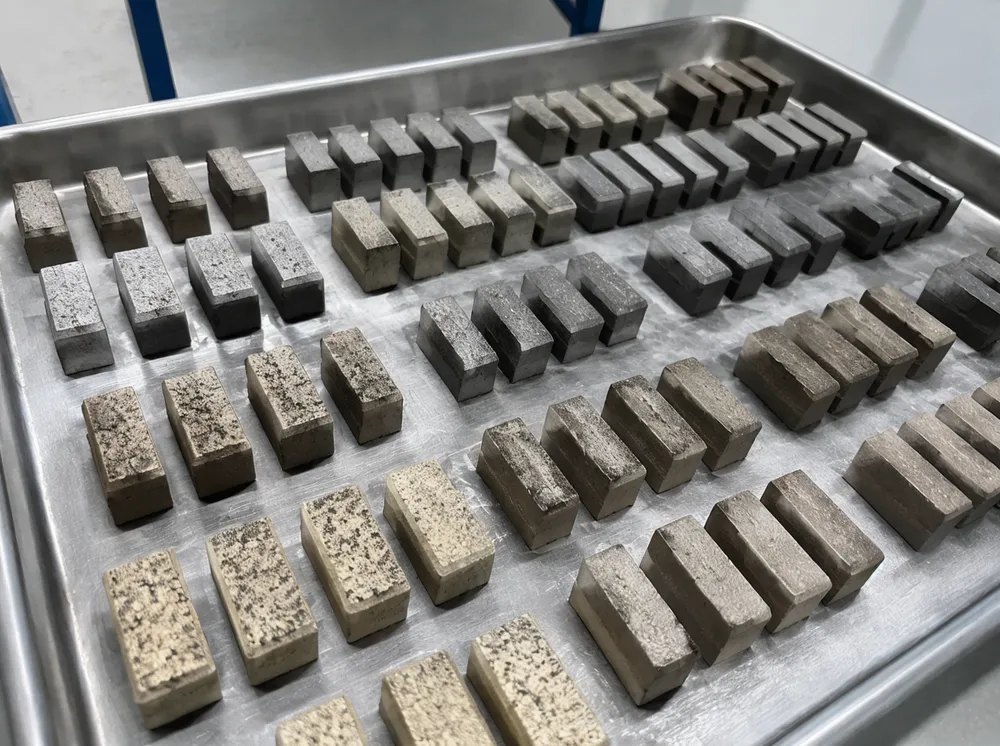
Sintered in-house with stone-specific bond formulas developed over 20 years. Whether your market cuts G603, Absolute Black, or Brazilian exotics, we match diamond concentration and bond hardness to the granite — so your blades perform, your customers reorder, and your margin holds.
- 500-piece minimum order
- Exported to 30+ countries
- ISO 9001, CE, SGS, MPA certified
- 50+ granite formula variants
Why the Segment Formula Is Your Real Competitive Advantage in Granite
Granite is not one material. It's hundreds of materials with wildly different cutting characteristics — from soft, coarse-grained G603 that eats through mild-bond segments in weeks, to dense Indian Absolute Black that glazes over a mismatched formula within the first slab. The diamond segment for granite saw blade applications must be formulated to the specific granite variety your market processes, or you'll spend more on customer complaints than you saved on per-piece cost.
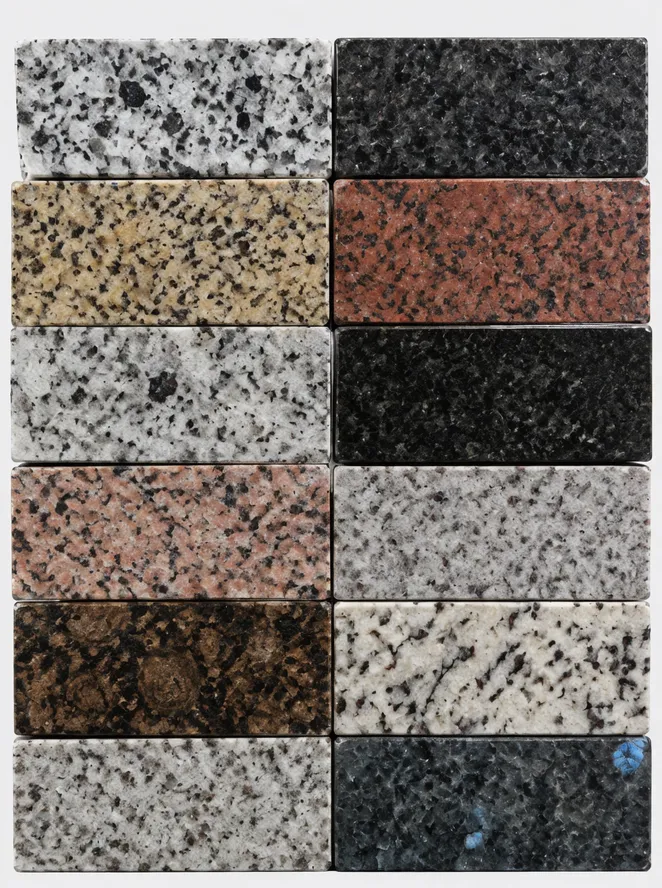
We maintain a formula library covering 50+ granite types across every major quarrying region: China (G603, G654, G682, Shanxi Black), India (Absolute Black, Tan Brown, Ruby Red, Kashmir White, tropical granites from Karnataka and Tamil Nadu), Brazil (Giallo Ornamental, Santa Cecilia, Blue Bahia, exotic Quartzite-adjacent varieties), Scandinavia (Baltic Brown, Blue Pearl, Emerald Pearl), Africa (Zimbabwe Black, African Red), and the Middle East (Saudi and Egyptian desert granites with high silica and feldspar content).
Each formula addresses the specific hardness and abrasiveness profile of the stone. When you tell us what your end customers are cutting, we don't reach for a generic "granite formula" — we pull from a library that's been refined through two decades of field feedback from buyers across 30+ countries. (We've reformulated our Indian hard-granite series three times since 2015 alone, each time based on field wear data from distributors in Jaipur and Udaipur who run tens of thousands of linear meters annually.)
China
G603, G654, G682, Shanxi Black
India
Absolute Black, Tan Brown, Ruby Red, Kashmir White, Karnataka & Tamil Nadu tropicals
Brazil
Giallo Ornamental, Santa Cecilia, Blue Bahia, Quartzite-adjacent exotics
Scandinavia
Baltic Brown, Blue Pearl, Emerald Pearl
Africa
Zimbabwe Black, African Red
Middle East
Saudi & Egyptian desert granites — high silica & feldspar content
Need a formula recommendation?
Tell us what granite types your end customers process and we'll match from our library.
Granite Segment Specifications
These aren't category ranges repeated from our diamond segments overview — they reflect the granite-specific subset we actually produce. The key differentiator is in diamond concentration and bond hardness: precisely calibrated per granite variety, not set to one "granite formula" that supposedly covers everything.
| Parameter | Specification Range |
|---|---|
| Segment height | 10 mm – 20 mm (standard: 10, 12, 15, 20 mm) |
| Segment length | 20 mm – 180 mm (matched to blade diameter) |
| Segment width (kerf) | 2.8 mm – 7.0 mm |
| Diamond grit size | 30/35 mesh – 50/60 mesh (coarser for hard granite, finer for soft) |
| Diamond concentration | 18% – 35% |
| Bond hardness | HRC 15 – HRC 30 |
| Compatible blade diameter | 350 mm – 3500 mm |
| Segment geometry | Flat-top, Arix layered, sandwich, turbo-slot, fan-shaped |
| Welding compatibility | High-frequency, laser, silver brazing |
| Application | All granite types — soft, medium, hard, abrasive, non-abrasive |
Specifications shown are standard production ranges. Exact values depend on the targetgranite variety, machine type, and cutting parameters. We provide full spec sheets with every quote — including recommended RPM ranges, feed rates, and water flow for each segment configuration.
Why diamond concentration and bond hardness are highlighted: These two parameters are where most generic suppliers cut corners. A segment rated "for granite" with 15% concentration and HRC 12 bond will underperform catastrophically on Indian Absolute Black. Our minimum concentration for hard granites starts at 25%, with bond hardness above HRC 22 — because field data from high-volume processors shows that's where lifespan and speed intersect optimally.
Segment Types & Geometry for Granite
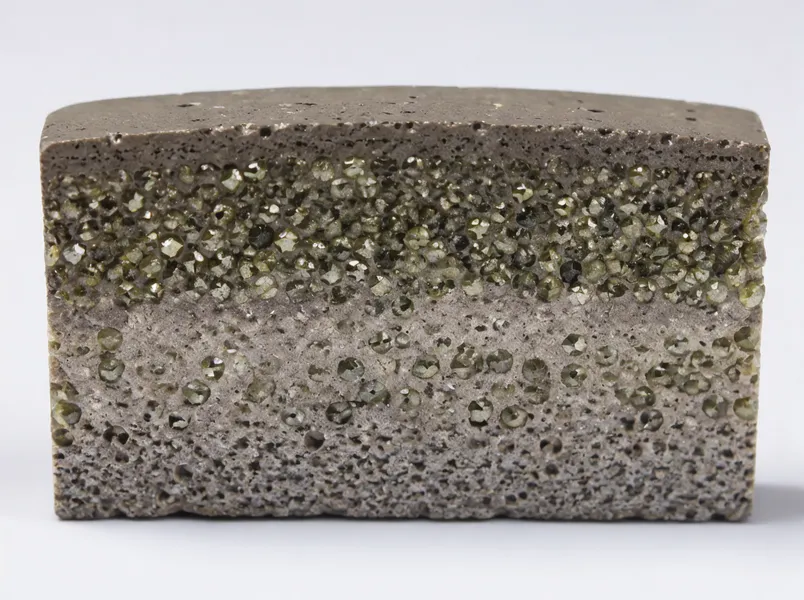
Geometry isn't cosmetic — it directly controls chip clearance, cooling efficiency, and cutting stability. We produce five primary geometries for granite, each optimized for specific machine types and cutting conditions.
Flat-Top
The workhorse. Maximum contact area for stable, predictable wear on medium-hard granites. Best for multi-blade gang saws and bridge saws running consistent depths.
Best for: G603, G654, Baltic Brown, medium-density varieties
Arix Layered
Controlled diamond placement in a grid pattern. Exposes fresh diamonds more evenly, extending lifespan 15–30% over random distribution. Premium option for high-volume processors.
Best for: Absolute Black, Shanxi Black, hard Indian granites
Sandwich (Multi-Layer)
Alternating layers of different diamond concentrations or bond hardness. The softer inner layer wears faster, creating a self-sharpening channel that improves chip evacuation.
Best for: Abrasive granites, Santa Cecilia, Giallo types
Turbo-Slot
Slots machined into the segment face create additional cooling channels and reduce drag. Ideal for dry or semi-dry cutting applications and smaller-diameter blades where heat buildup is critical.
Best for: Small blade diameters (350–600 mm), site cutting
Fan-Shaped
Curved profile matches the blade's rotation arc for smoother entry and reduced vibration. Used on large-diameter quarry blades (2000 mm+) where stability at high peripheral speeds matters most.
Best for: Quarry blades 2000–3500 mm, block cutting
Custom Geometry
If your application doesn't fit standard profiles — unusual blade diameters, proprietary machine specifications, or niche granite varieties — we design custom segment geometry from scratch. MOQ applies.
Discuss custom geometryHow to Choose the Right Geometry
Machine type: Gang saw, bridge saw, wire saw, or hand-held? This narrows geometry immediately.
Granite hardness: Harder stone benefits from Arix or sandwich; softer stone works well with flat-top.
Cooling method: Wet cutting allows denser geometries; dry/semi-dry requires turbo-slot for heat management.
Performance Metrics: What Our Granite Segments Deliver
Numbers from real production environments, not lab conditions. These ranges reflect feedback from distributors and processors across our network — measured on commercial machines running 8–12 hour shifts.
m²/segment
Cutting area lifespan (medium granite)
m/min
Linear cutting speed (bridge saw, 30mm depth)
longer lifespan
vs. generic segments (matched testing)
deviation
Cut straightness over 3m slab length
Performance by Granite Hardness Class
Expected ranges under standard production conditions (wet cutting, recommended RPM & feed)
| Granite Class | Examples | Lifespan (m²/seg) | Cutting Speed | Recommended Geometry |
|---|---|---|---|---|
| Soft Granite | G603, Kashmir White, Giallo Ornamental | 12–14 m² | 2.0–2.5 m/min | Flat-top, Turbo-slot |
| Medium Granite | G654, Tan Brown, Baltic Brown, Santa Cecilia | 9–12 m² | 1.5–2.0 m/min | Flat-top, Sandwich |
| Hard Granite | Absolute Black, Shanxi Black, Zimbabwe Black | 8–10 m² | 1.2–1.6 m/min | Arix, Sandwich |
| Very Hard / Abrasive | Blue Bahia, African Red, Quartzite-adjacent | 6–9 m² | 1.0–1.4 m/min | Arix, Custom |
* Performance varies based on machine condition, operator technique, water supply, and specific stone batch composition. Values shown are typical midpoints from distributor field reports. We provide application-specific projections with every quote.
How We Manufacture Granite Diamond Segments
Our manufacturing process is purpose-built for consistency at scale. Every segment in a batch performs identically — because when you're shipping 10,000 segments to a distributor, one underperformer reflects on your brand, not just ours.
Formula Selection & Powder Mixing
Metal bond powders (cobalt, iron, copper, nickel, tungsten carbide blends) are selected based on the target granite profile. Diamond grit — synthetic industrial grade, sourced from verified suppliers with consistent mesh sizing — is mixed in controlled ratios. Each batch is weighed to ±0.5g accuracy.
Cold Pressing
Mixed powder is loaded into graphite molds and cold-pressed to form green compacts. Press pressure is calibrated per formula — harder bonds require higher initial compaction to avoid porosity in the final segment.
Hot-Press Sintering
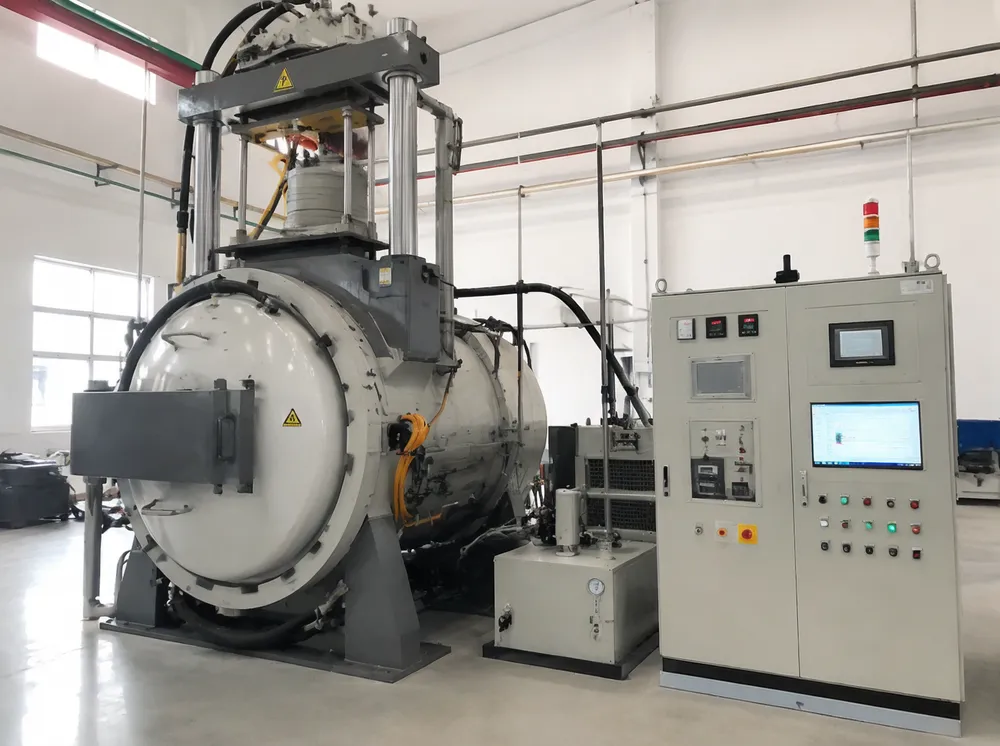
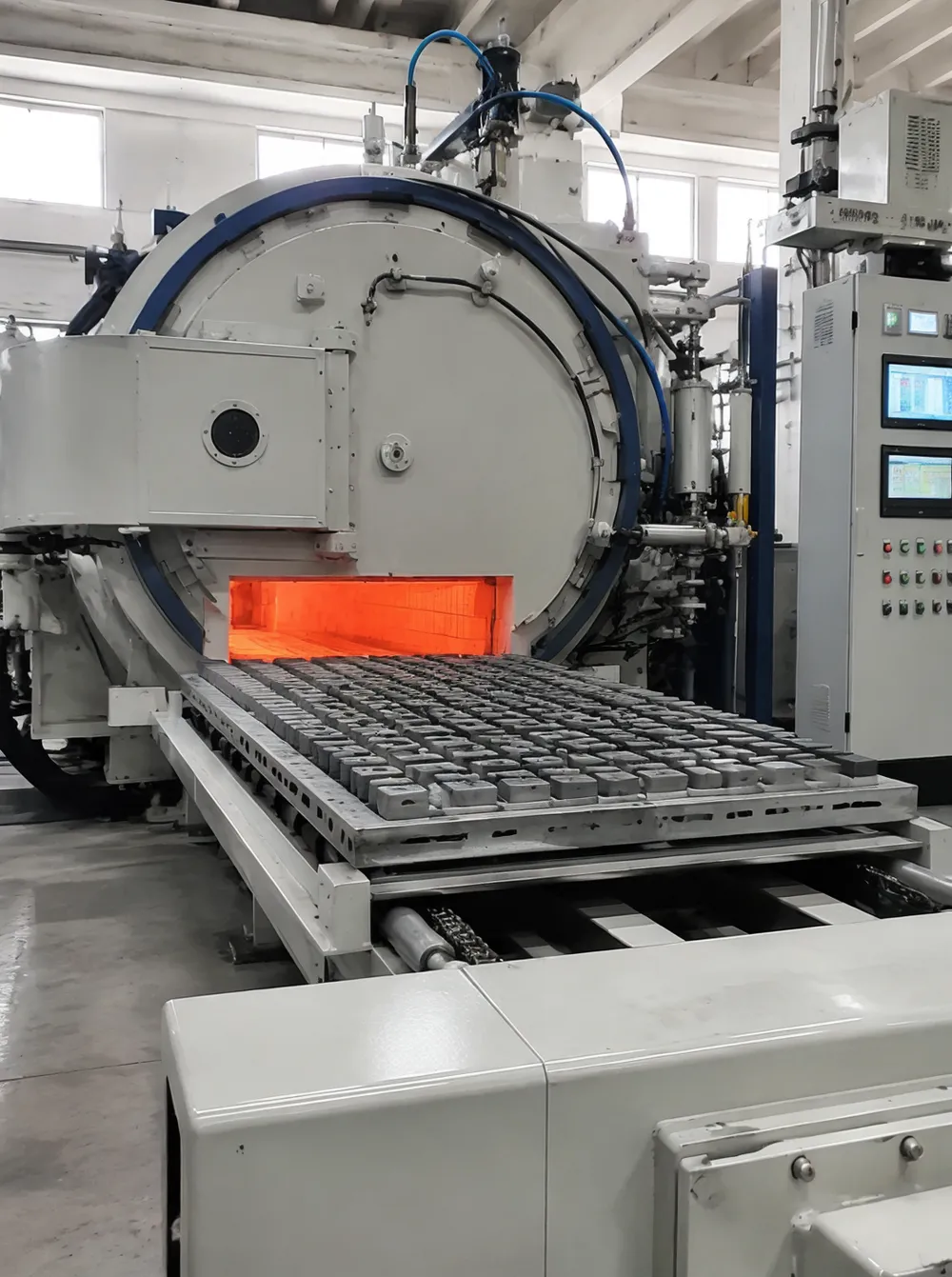
Green compacts are sintered under simultaneous heat (680–850°C) and pressure in a hot-press furnace. This is the critical step: temperature curves are programmed per formula, and dwell time determines final bond hardness and diamond retention. Our furnaces run automated profiles — no operator guesswork.
De-molding & Cleaning
Sintered segments are separated from graphite molds, sandblasted to remove residual graphite, and visually inspected for surface defects, cracks, or delamination.
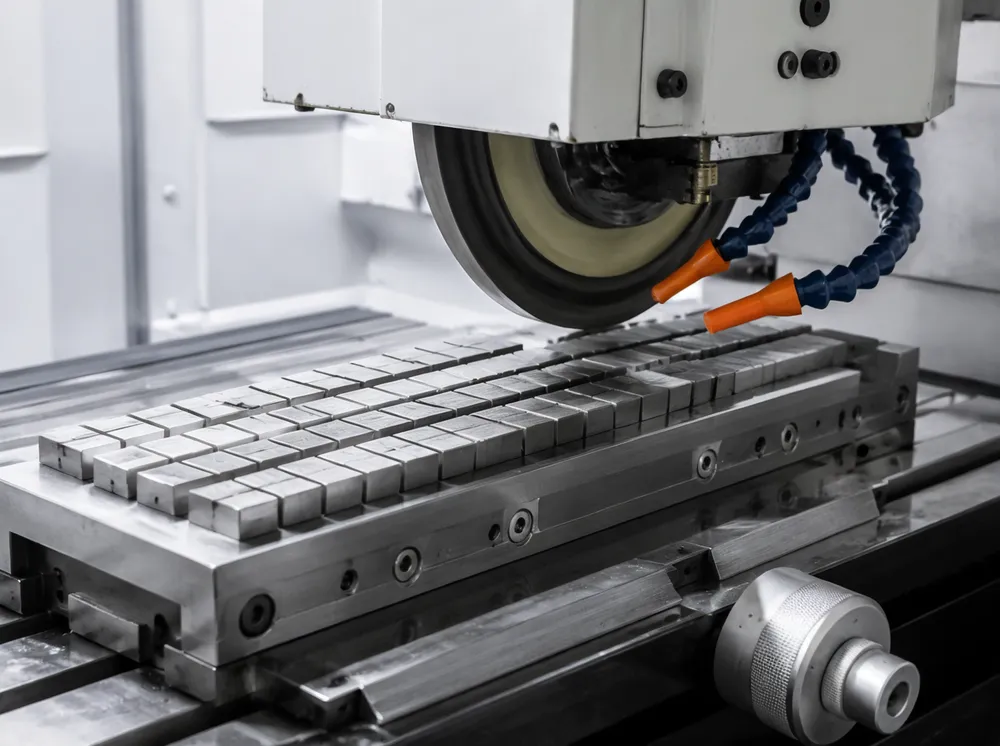
Grinding & Dimensioning
Each segment is ground to final dimensions on CNC surface grinders. Tolerances: height ±0.1mm, width ±0.05mm, length ±0.2mm. This precision ensures uniform wear across all segments on a blade and proper seating during welding.
Quality Control & Batch Testing
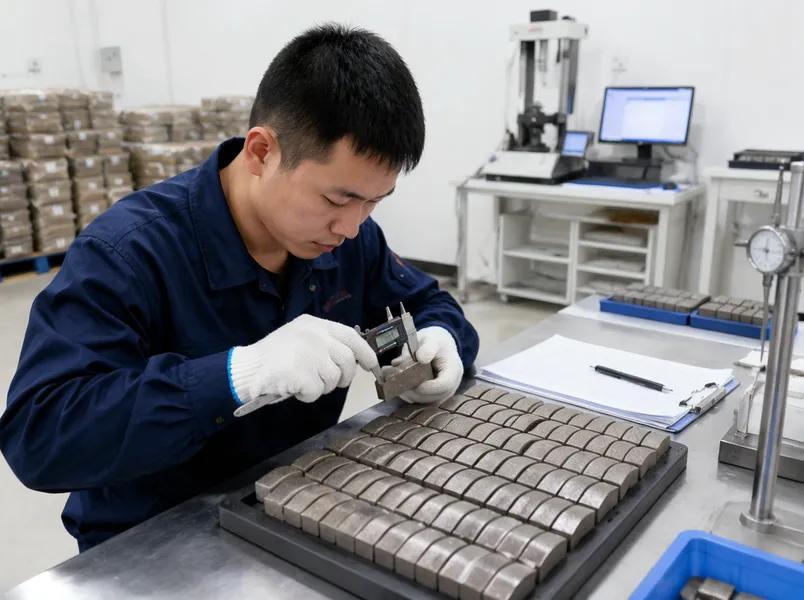
Random samples from each batch are tested: hardness (Rockwell C), density (Archimedes method), and dimensional verification. One in every 50 segments is destructively tested — cross-sectioned and examined under magnification to verify diamond distribution and bond integrity.
Width tolerance
Destructive test ratio
Sintering temperature range
Dimensional inspection
Soft-Bond vs. Hard-Bond: How We Match Segments to Your Granite Market
This is where most granite segment sourcing goes wrong, and where we spend the majority of our engineering time. The bond hardness decision controls whether your blade performs or generates complaints — and it's entirely determined by the granite your customers cut.
Hard, Non-Abrasive Granites
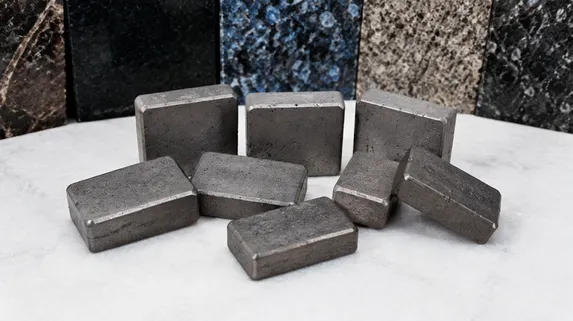
These dense, tightly crystallized granites resist cutting but don't aggressively wear the segment bond. We use soft-bond formulas with higher diamond concentration. The soft matrix erodes under cutting pressure to expose fresh diamonds continuously.
Without this rapid self-sharpening, the segment surface glazes over — the blade slows mid-slab, the operator pushes harder, and you get premature segment loss or burned steel cores.
We run lower cobalt percentages and introduce controlled porosity into the bond structure. The result: a segment that stays aggressive through the full cutting depth, maintains consistent feed rate from first slab to last, and delivers predictable life in linear meters.
For your inventory planning: that predictability means your customers reorder at consistent intervals instead of returning half-used blades.
Soft, Abrasive Granites
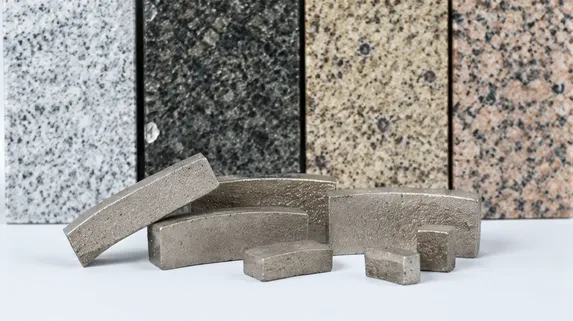
These granites are the volume play — they dominate commercial construction markets worldwide and move fast. They're relatively easy to cut, but their abrasive mineral content (biotite, feldspar with coarse grain boundaries) chews through soft bonds at an uneconomical rate.
We use hard-bond formulas with moderate diamond concentration. The harder matrix resists the abrasive action, so segment life stays commercially viable — typically 30–50% longer than a universal formula on the same stone.
Economics note: Most of our Southeast Asian and Middle Eastern buyers stock blades for G603/G654 primarily. These stones are price-sensitive markets where segment life directly determines per-cut cost for the fabrication shop — and per-cut cost determines whether your customer sticks with your blade brand or switches to a competitor next quarter.
Medium-Hard, Mixed Granites
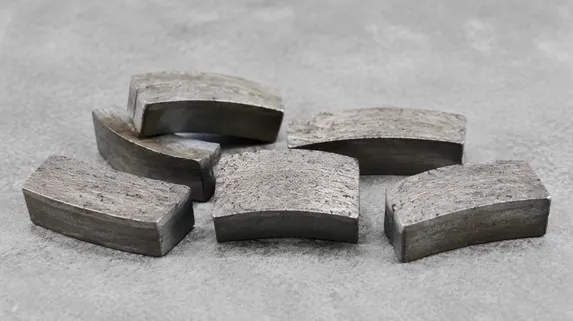
This middle ground is where formula precision yields the highest marginal return. A 5% adjustment in cobalt content or a half-step change in diamond mesh size can add 15–20% to segment cutting life.
We produce several mid-range bond variants (HRC 20–25) and typically recommend field testing 2–3 options to find the optimum for your specific stone source. Small differences in quarry location can shift the abrasiveness enough to warrant a formula tweak.
Send us your granite types — we'll recommend the bond match
Our engineers match formula to stone. Tell us what your customers cut.
Segment Geometry Options and When They Matter Commercially
Beyond bond formula, the physical geometry of the granite diamond segment affects cutting behavior, debris clearance, and segment life. We produce five standard geometries, and your choice depends on the blade application and the performance characteristics your market demands.
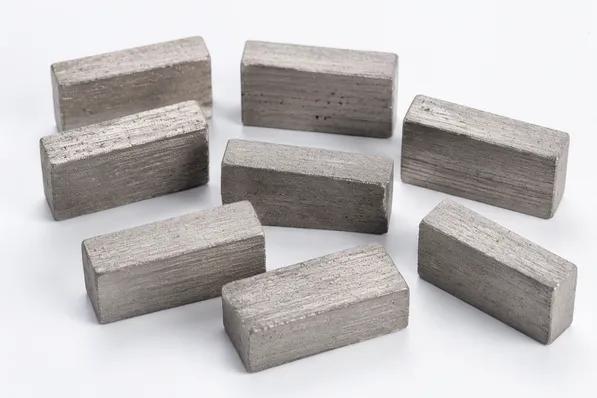
Flat-Top (Standard Rectangular)
The industry baseline. Lowest manufacturing cost per segment, simplest to weld, suitable for the majority of granite circular saw and bridge saw applications.
Best for: If you're stocking general-purpose granite blades for the construction trade, flat-top segments keep your per-blade cost competitive.

Arix Layered
Diamonds arranged in deliberate layered patterns rather than random distribution. In hard granite applications, Arix segments deliver 15–25% longer life than equivalent random-distribution segments at comparable cutting speed.
Best for: Bridge saw blades cutting dense granite slabs — the per-linear-meter cost drops because you change blades less frequently. Worth it for fabrication shop customers; overkill for general construction.
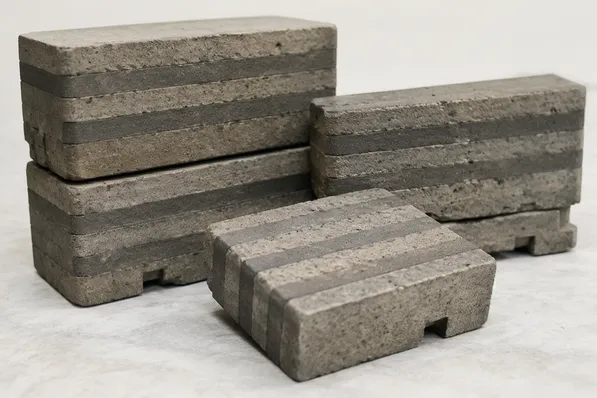
Sandwich (Multi-Layer)
Alternating layers of different diamond concentrations — typically a harder outer layer for wear resistance and a softer inner layer for aggressive cutting. Developed specifically for quarry block-cutting applications where segments face extreme cutting depths (200–400 mm per pass).
Best for: Quarry operations — this geometry balances longevity against consistent cutting speed through the full depth and reduces mid-block stalling.
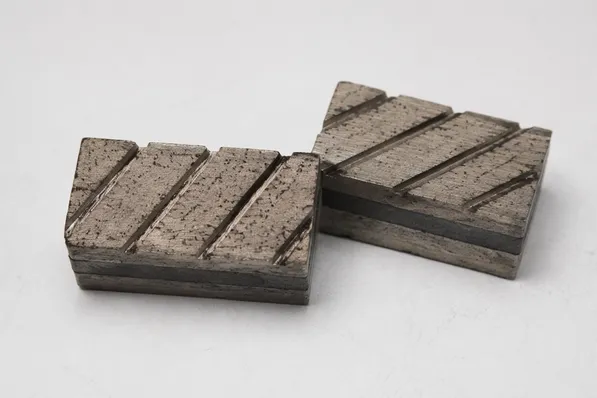
Turbo-Slot
Angled slots machined into the segment face improve debris clearance and coolant flow during cutting. Particularly effective on soft, slurry-producing granites where standard flat-top segments can clog with cutting mud, reducing efficiency.
Best for: Soft slurry-producing granites and high-RPM bridge saw applications where heat buildup is a concern.
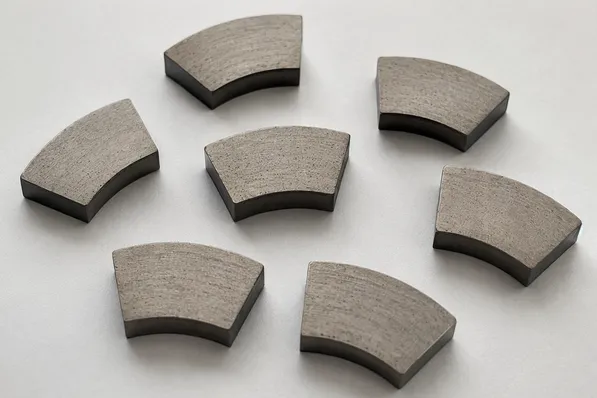
Fan-Shaped
Designed for specific blade configurations — typically multi-blade block cutters and certain gang saw adaptations. Less common in standard circular saw applications.
Best for: Non-standard segment footprints and specialized blade designs. Ask us if your blade design requires this geometry.
Manufacturing Process: From Powder to Your Warehouse
We sinter every granite diamond segment in-house — from raw powder blending through cold pressing, sintering, and final grinding. No third-party segment sourcing, no mystery about what's inside the product you're selling under your brand.
The process matters to your business because it's where batch consistency lives or dies. Here's what we control:
Powder Blending
Starts with incoming inspection. Every batch of diamond grit gets tested for particle size distribution and crystal morphology before it enters our mixing room.
We've rejected supplier shipments that passed their own QC — our particle size tolerance is ±3% tighter than industry standard because we've traced segment performance variation directly back to grit inconsistency in early production years.
Metal bond powders (cobalt, iron, copper, tin, proprietary additives) are weighed on precision scales and blended in our formulation-specific ratios.
Cold Pressing
Forms the segment blank under high tonnage in hardened steel dies. We maintain die sets for every geometry we produce — flat-top, Arix, sandwich, turbo, fan.
Die condition directly affects segment dimensional consistency, so we track press counts per die set and retire them before tolerance drift reaches 0.05 mm.
Sintering
Fully automated — programmable temperature profiles (typically 800–920°C for granite segment formulas), controlled atmosphere, and consistent pressure curves.
Each formula has a locked sintering recipe: same temperature ramp, same hold time, same cooling rate. The system logs every cycle. When you reorder in six months, we pull the identical profile.
Post-Sintering QC
- Density measurement: ±0.1 g/cm³ tolerance
- Rockwell hardness testing: ±0.5 HRC against target
Segment Base Grinding
Ensures flatness for welding. We grind every segment base to specification before packing — because an uneven base surface means inconsistent weld joints, and inconsistent welds mean segments falling off blades in the field.
Why This Step Exists
We added this grinding step in 2011 after a batch of segments shipped to a European buyer had marginal weld adhesion. The root cause was 0.08 mm base curvature from a worn die. Now every segment gets ground regardless, and that failure mode is eliminated.
Get a quote for granite segments
Include your stone type and blade diameter for formula-matched pricing.
Market Segments Where Granite Segments Drive Repeat Volume
Your granite diamond segment inventory serves distinct market channels, each with different formula requirements and ordering patterns. Understanding where the volume sits helps you stock the right formulas.
Stone Fabrication Shops
Bridge Saw & CNC Applications
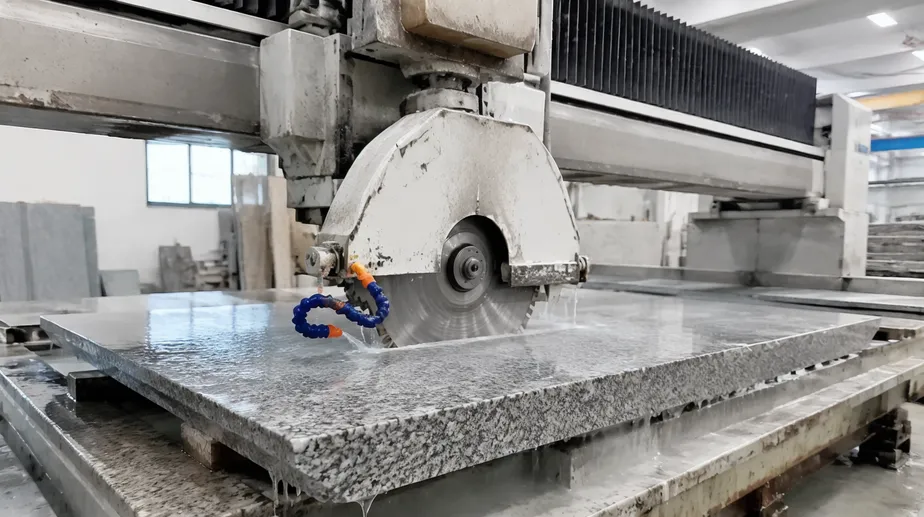
Fabrication shops consume segments steadily — they run bridge saws 8–12 hours daily cutting countertops, vanity tops, and architectural panels. Typical blade diameters: 350–500 mm.
These buyers prioritize cutting speed and surface finish quality because labor cost per slab dominates their economics. A segment that cuts 10% faster means 10% more slabs per shift.
Formula Direction
Medium-soft bond, higher diamond concentration, Arix or flat-top geometry depending on the granite mix. Fabrication shops tend to cut 3–5 granite varieties routinely, so we often supply 2–3 segment formulas per customer — one for hard exotics, one for standard commercial grades, one for engineered quartz (which requires its own formula entirely).
Ordering pattern: Monthly or bi-monthly reorders of 500–2,000 segments. High reorder frequency makes this a stable revenue channel once you've proven the formula works.
Quarry Block Cutting
Large-Diameter & Gang Saw Applications
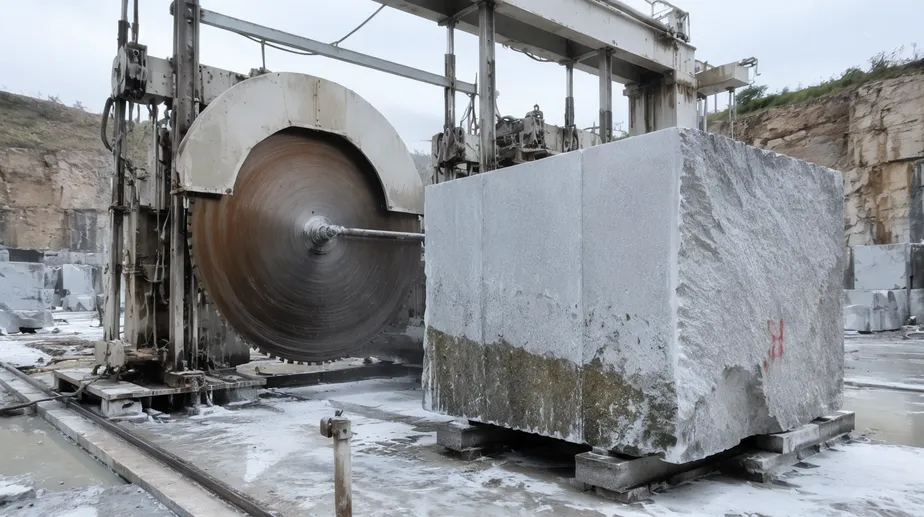
Quarries buy segments in large volumes for 1600–3500 mm blades and gang saw frames. The segment life calculation is different here — cutting depth per pass is massive (often the full block height), so segments face extreme thermal and mechanical stress.
Formula requirements shift toward higher cobalt content for heat resistance and coarser diamond grit (30/35 mesh) for aggressive material removal.
Ordering pattern: Quarterly or semi-annual bulk orders of 5,000–50,000 segments per quarry operation. Fewer customers, larger individual orders, longer sales cycles — but once you're the approved segment supplier for a quarry, switching costs keep you in place for years.
Construction Contractors
Small to Mid-Diameter Cutting
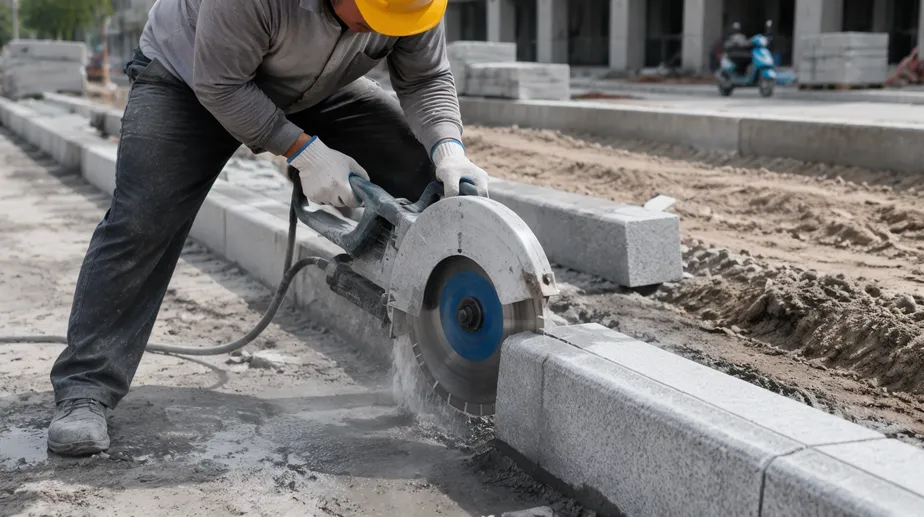
Contractors use granite segments on 350–900 mm blades for curbstone cutting, paving work, and building facade installation. They buy through tool distributors and hardware channels, not directly from segment manufacturers.
Your play here is supplying blades to the distributors who serve this trade.
Formula Direction
General-purpose hard-bond formulas that survive mixed-use conditions (granite one day, concrete the next). These buyers tolerate shorter segment life in exchange for versatility and lower per-blade cost. Volume comes from breadth of distribution, not depth per customer.
OEM Blade Manufacturers
Your Brand, Our Segments
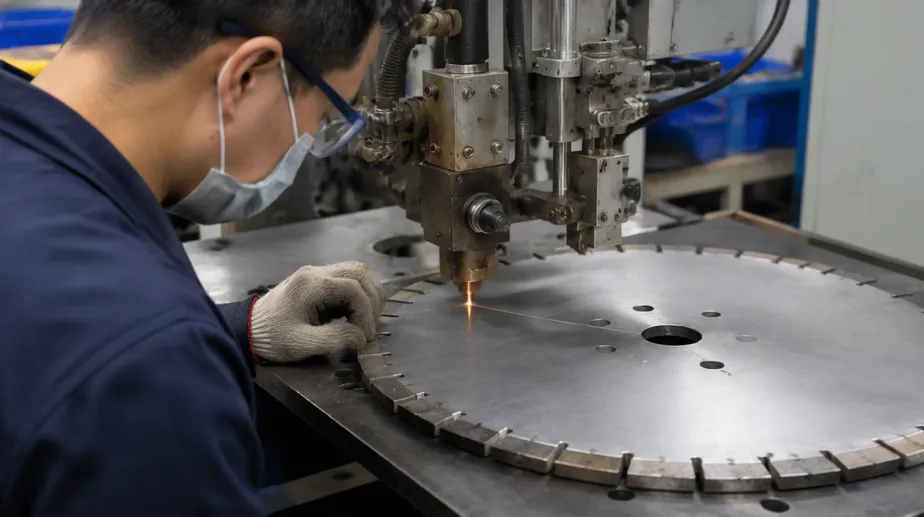
If you manufacture finished blades but don't sinter your own segments, we supply segments to your specification — welded by your team onto your steel cores, shipped under your brand.
We maintain formula confidentiality per customer: your formula stays locked to your account and doesn't ship to competitors in your market. This is a significant portion of our granite segment output — many blade brands worldwide don't control their own sintering, and formula traceability matters when you need to troubleshoot field performance.
Tell us which market segment you serve
We'll recommend the right formula and geometry for your channel.
Customization Parameters and Constraints
Every granite diamond segment order can be customized across the following dimensions. We include the practical limits so you know exactly what to specify when requesting a quote.
| Customization Dimension | Available Options | Constraints |
|---|---|---|
| Bond hardness (HRC) | 15–30, in ~2 HRC increments | Target granite type must be specified for formula matching |
| Diamond concentration | 18%–35% | Higher concentration increases cost per segment proportionally |
| Diamond grit size | 30/35 to 50/60 mesh | Coarser mesh = more aggressive; finer mesh = smoother finish |
| Segment height | 10, 12, 15, 20 mm (custom available) | Below 8 mm not recommended for granite; above 20 mm adds sintering complexity |
| Segment length | 20–180 mm | Must match blade diameter and segment count |
| Segment width (kerf) | 2.8–7.0 mm | Narrower kerf saves material waste but reduces segment rigidity |
| Geometry | Flat-top, Arix, sandwich, turbo-slot, fan-shaped | Arix and sandwich carry ~20–30% cost premium |
| Welding type compatibility | High-frequency, laser, silver brazing | Laser-compatible segments require specific base preparation |
| Packaging | Standard / private-label / custom branding | Private-label available at no additional charge above 1,000 pcs |
Minimum Order Quantities
- Standard granite formulas — 500 segments
- Custom/new formula development — 1,000 segments on first order (covers formula development and in-house validation), reorders flexible down to 500
- Sample quantities — 10–50 segments available for field testing before production commitment
Lead Time
- Standard formulas from inventory: 15–20 days
- Custom formula first order: add 2–4 weeks for development and test cutting
- Reorders on established formulas: 15–25 days
Not sure which specifications to request? Just send us the granite type, blade diameter, blade RPM, and whether it's wet or dry cutting. We'll spec it from there.
Batch Consistency Across Your Annual Volume
If you're buying 10,000 or 100,000 granite segments per year, the segments you receive in December must cut identically to the ones you received in March. Inconsistency within a single shipment is bad — inconsistency across shipments destroys your brand reputation with end customers who can't figure out why "the same blade" performs differently each time.
How We Maintain Consistency
Automated sintering with locked recipes
Temperature profiles, pressure curves, and hold times are digitally locked per formula. No operator variance between batches.
Incoming grit inspection on every batch
Diamond grit is verified for size distribution, morphology, and thermal stability before entering production.
Post-sintering density/hardness testing
Sample segments from every production run are tested for density and hardness before any shipment is cleared.
Batch Test Report — Every Shipment
Each shipment comes with a batch test report documenting:
Hardness Readings
Density Measurements
Dimensional Inspection
These records are retained and traceable — if a question arises six months later about a specific shipment, we pull the production data.
Pre-Shipment Sample Approval
For large-volume OEM relationships, we offer pre-shipment sample approval: before the full batch ships, we send you 5–10 segments from the production run for your own testing or inspection.
Your approval triggers final packing and shipment
This adds 3–5 days to lead time but eliminates any doubt about batch quality.
Frequently Asked Questions
Practical answers to the bond-matching, compatibility, and performance questions we hear most from granite segment buyers.
How do I choose between soft-bond and hard-bond granite diamond segments?
Match the bond to the granite's abrasiveness, not its "hardness" label. Hard but non-abrasive granites (Absolute Black, Blue Pearl) need soft bonds — HRC 15–20 — so the matrix self-sharpens against stone that won't naturally erode it. Soft but abrasive granites (G603, Rosa Porrino) need hard bonds — HRC 24–30 — to resist premature wear from abrasive mineral content.
If you're unsure about a specific granite, send us the stone name or a photo of the cut surface. We'll recommend a bond range based on our formula library and field data from similar stone profiles.
What causes granite segments to glaze over, and how do you prevent it?
Glazing occurs when the bond matrix is too hard relative to the granite being cut. The stone can't wear away the metal to expose fresh diamond cutting points, so the segment surface becomes smooth and the blade stops cutting.
We prevent this by matching bond hardness precisely to the stone's abrasiveness profile — not by using a "universal" formula. If you're experiencing glazing with your current segments, it's almost certainly a bond mismatch, not a blade defect.
Send us the stone type and current segment specifications — we'll recommend a reformulation.
Can you supply granite segments compatible with blades from other manufacturers?
Yes — we regularly supply replacement and OEM granite segments to buyers who weld their own blades or need segments for existing steel cores.
Provide us with:
- Segment dimensions (length × width × height)
- Blade diameter
- Segment count per blade
- Welding method
- Target granite type
We'll match the geometry and recommend an appropriate formula. If you can send a sample segment, we can also reverse-engineer the specifications and offer an equivalent or improved alternative.
What is the typical cutting life of your granite segments in linear meters?
Segment life varies significantly by granite type, blade RPM, feed rate, and cooling conditions — quoting a single number would be misleading. As a reference range:
800–1,500
m/mm — Medium-hard granite
Kashmir White, Viscount White
500–900
m/mm — Hard exotics
Dense, slow-wearing stone
1,200–2,000
m/mm — Soft construction granite
High-volume applications
We provide detailed expected-life data specific to your granite type and cutting parameters after formula selection.
What is the difference between Arix-pattern granite segments and standard flat-top?
Arix segments place diamonds in a deliberate layered pattern rather than random distribution. On hard granite (Absolute Black, Tan Brown), this delivers 15–25% longer segment life at comparable cutting speed because diamond exposure is more uniform throughout the segment's working life.
The cost premium is 20–30% per segment. For soft/medium granite in high-volume applications, the performance advantage rarely justifies the premium — flat-top segments with an optimized formula deliver better cost-per-meter economics.
We recommend Arix primarily for bridge saw applications cutting dense, expensive slabs where blade change downtime has a high cost.
What is your minimum order for granite diamond segments?
Standard catalog formulas: 500 segments minimum.
New custom formula (first order): 1,000 segments — covers formula development, test sintering, and in-house cutting validation.
Reorders on established formulas: Flexible down to 500 segments.
Sample quantities of 10–50 segments are available for field testing before production commitment — we encourage this for new buyer relationships to validate the formula on your specific stone before scaling.
Sibling Products Under Diamond Segments
If granite segments don't fully cover your product needs, we produce diamond segments across all major stone-processing applications under the same manufacturing platform.
Marble Diamond Segments
Cobalt-dominant soft bonds with controlled porosity for clean marble cuts. Different formula chemistry than granite segments; marble's low abrasiveness and tendency toward edge chipping require a distinct approach.
View marble segmentsGang Saw Diamond Segments
Engineered for continuous multi-day cutting on gang saw frames. Extreme batch uniformity (±0.5 HRC across a set) because uneven wear across a gang saw frame destroys expensive stone blocks.
View gang saw segmentsCustom Diamond Segments
For non-standard applications, unusual stone types, or proprietary geometries. Our R&D team develops custom formulas with 2–4 week turnaround to sample delivery.
View custom segmentsAll segment types share the same in-house sintering platform, raw material sourcing, and QC protocols. If you're consolidating segment supply under one manufacturer, we cover the full range.
View all diamond segment productsStart With Your Granite — We'll Handle the Formula
Send us the granite types your market is cutting, the blade diameters in use, and the performance issue you're solving (if any). We respond with a specific formula recommendation — bond hardness, diamond concentration, grit size, geometry — not a generic catalog PDF.
Formula Transparency Is Standard
If you're currently sourcing granite segments from a supplier who can't tell you the bond composition or troubleshoot when blades underperform on specific stone, you're carrying margin risk that compounds every time a customer returns a blade or switches brands.
With us, you know exactly what's in your segments and why. Full formula transparency means you can trace performance back to composition — and make informed decisions when adjusting for new granite types or market shifts.
What to Include
- Your stone type (granite variety, hardness range)
- Blade size (diameter range in use)
- Approximate annual volume
- Performance issue you're solving (if any)
We'll have a specific recommendation back to you within 48 hours.