Marble Diamond Segments Soft-Bond Formulas for Clean Cuts
Your marble blades live or die on the segment formula. Our marble-specific bonds wear at the right rate to keep diamonds sharp without over-cutting — so your customers get clean slabs and you get reorders, not complaints.
- 20+ years sintering experience
- Marble-specific formula library
- ISO 9001, CE, SGS, MPA certified
- 500-segment MOQ on standard formulas
Why Marble Demands Its Own Segment Formula
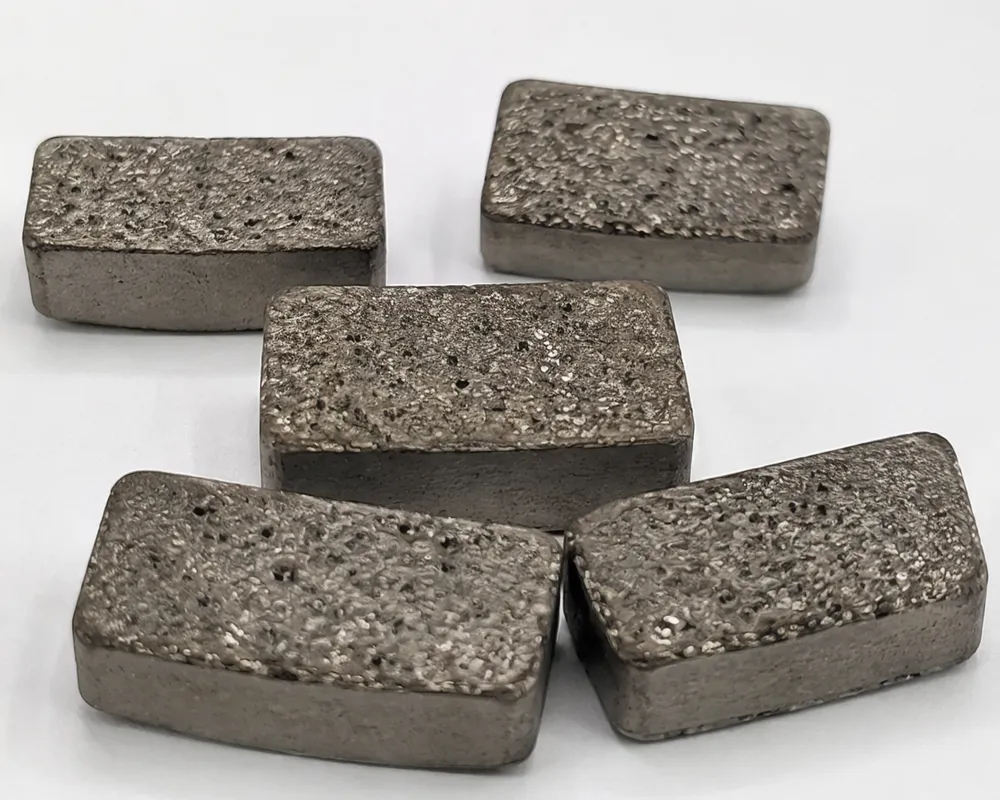
Marble is soft and relatively non-abrasive compared to granite. That combination creates a specific engineering problem: the metal bond matrix doesn't wear down naturally from abrasion the way it does when cutting granite. If you use a generic segment — or worse, a granite formula relabeled for marble — diamonds stay buried in the bond, cutting speed drops mid-slab, and your customer calls to say the blade is "dull" after 20 linear meters.
We've been making marble diamond segments since 2003, and the formula approach is fundamentally different from our granite line. Our marble segments use cobalt-dominant bonds with engineered porosity — micro-voids within the metal matrix that create controlled weakness points. The stone's cutting action breaks through these points, exposing fresh diamond layers continuously without requiring the abrasive wear that granite naturally provides. The result: consistent cutting speed from first cut to last, smooth slab surfaces that reduce downstream polishing time, and segment life that matches what you quoted your customer.
Separate Formula Libraries — Not a Compromise
We maintain separate formula libraries for marble and granite specifically because trying to serve both with a "universal" formula always compromises one or the other. A marble-optimized bond would erode too fast in granite. A granite-optimized bond glazes in marble. There's no shortcut here.
The practical difference for your business: fewer blade returns from fabrication shops complaining about slow cutting, fewer surface-finish complaints from slab buyers, and a reputation for blades that actually perform in marble — not blades that "work on everything" and excel at nothing.
Request marble segment samples for field testing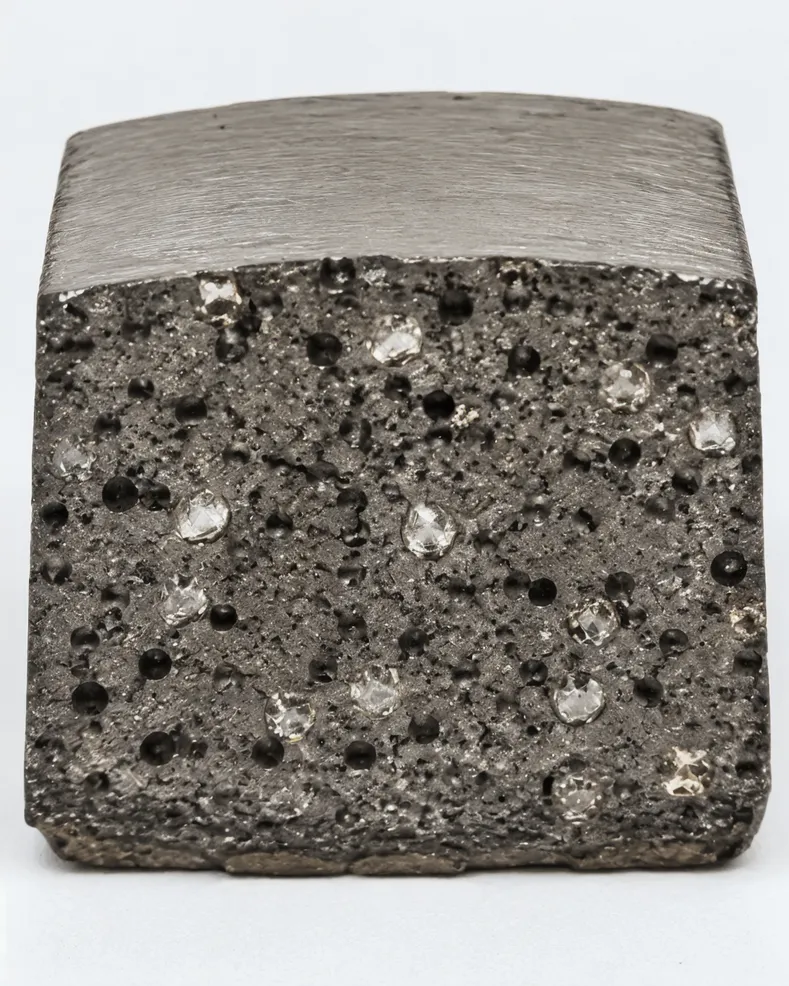
Generic or granite-formula segments glaze in marble — diamonds stay buried, cutting speed drops mid-slab, blades returned as "dull."
Cobalt-dominant bond with engineered porosity creates controlled weakness points — fresh diamonds expose continuously through normal cutting pressure alone.
Technical Specifications for Marble Diamond Segments
| Parameter | Standard Marble Segment | Premium Marble Segment (high-finish applications) |
|---|---|---|
| Segment height | 10 mm – 15 mm (typical) | 10 mm – 20 mm |
| Segment length | 24 mm – 40 mm (circular saw), up to 140 mm (gang saw) | Same range |
| Segment width (kerf) | 2.8 mm – 5.5 mm | 3.0 mm – 4.5 mm (narrower for precision work) |
| Diamond grit size | 40/50 mesh – 60/80 mesh | 50/60 mesh – 80/100 mesh (finer for surface quality) |
| Diamond concentration | 18% – 30% | 22% – 35% |
| Bond hardness | HRC 12 – HRC 22 | HRC 10 – HRC 18 (softer for consistent diamond exposure) |
| Bond composition | Cobalt-dominant with iron/tin additives | High-cobalt with increased porosity agents |
| Compatible blade diameter | 250 mm – 3500 mm | 300 mm – 900 mm (primarily bridge saw range) |
| Welding compatibility | High-frequency, laser, silver brazing | High-frequency, laser, silver brazing |
| Target stone types | White marble, Carrara, travertine, limestone, onyx | Premium marble (Calacatta, Statuario, bookmatched slabs) |
Specifications shown are industry-standard values for marble diamond segments. Actual specifications are formula-dependent and matched to your specific marble type. Contact us for a detailed specification sheet.
Bond Hardness: The Critical Variable
The bond hardness range (HRC 12–22) is notably lower than our granite segments (HRC 22–35). This is intentional — marble doesn't generate enough abrasive friction to self-dress a hard bond, so we engineer the matrix softer to ensure diamonds re-expose through normal cutting pressure alone. If you've had issues with segments glazing on marble, bond hardness is almost certainly the root cause, and it's the first thing we'd adjust for your application.
Bond Hardness Comparison
Softer bond = faster self-dressing in low-abrasion stones
Marble Segment Applications by Machine Type
Different machines impose different demands on diamond segments. Feed rate, coolant flow, blade peripheral speed, and vibration characteristics all change the equation. Here's how our marble segments are configured for each application.
Gang Saw Segments
For multi-blade block cutting. Long segments (up to 140 mm) with uniform diamond distribution to handle the slow, heavy-pressure cuts that gang saws impose on full marble blocks.
- Segment length: 100–140 mm
- Optimized for 0.5–2 m/min feed rates
- Layered diamond distribution for even wear
Bridge Saw Segments
The workhorse of slab fabrication. Segments balanced for speed and finish quality on 350–900 mm blades. Higher diamond concentration for the faster peripheral speeds bridge saws deliver.
- Segment length: 24–40 mm
- Clean edge finish for visible cuts
- Low vibration design for chip-free cutting
Block Cutter Segments
For large-diameter (1600–3500 mm) single-blade block cutters. Maximum segment height for extended life, with bond engineered for the high coolant volumes these machines use.
- Segment height: 12–20 mm
- High coolant erosion resistance
- Consistent performance through full block depth
Multi-Disc Cutter Segments
For tile and slab production lines running multiple blades simultaneously. Consistency between segments is critical — every blade on the arbor must cut at the same rate.
- Tight tolerance on segment weight (±0.5g)
- Matched sets for uniform wear across all discs
- Narrow kerf options for material savings
CNC Router Segments
Small-diameter segments for CNC profiling and shaping. Premium diamond quality and ultra-consistent bond for the precision these machines demand on countertop edges and custom profiles.
- Fine grit (80/100 mesh) for surface quality
- Blade diameter: 250–400 mm
- Minimal chipping on polished surfaces
Custom Specifications
Running a machine or marble type we haven't listed? We develop custom formulas for specific marble varieties, unusual machine configurations, or production requirements that off-the-shelf segments can't meet.
Discuss custom segment developmentMarble Types & Segment Selection
Not all marble cuts the same. Hardness, crystal structure, veining, and mineral inclusions all affect how a diamond segment performs. Here's how we match segment formulas to marble characteristics.
Soft / Pure Calcite Marble
Carrara, Thassos, Sivec, White Volakas
Mohs 3–3.5. Highly crystalline with minimal impurities. These marbles generate almost zero abrasion on the bond — the softest bond formulas are essential, or diamonds never re-expose.
Segment Approach
Softest cobalt bond (HRC 10–15), highest porosity, moderate diamond concentration. Fast self-dressing even at low feed pressures.
Medium Hardness / Dolomitic Marble
Crema Marfil, Emperador, Rosa Portugal, Botticino
Mohs 3.5–4. Contains dolomite (calcium-magnesium carbonate) which adds hardness and abrasion. Slightly more aggressive on bond wear, allowing a somewhat harder matrix.
Segment Approach
Mid-range cobalt bond (HRC 15–20), standard porosity, higher diamond concentration for extended life in production environments.
Hard Marble & Marble-Adjacent Stone
Travertine, hard limestone, onyx, serpentine ("green marble")
Mohs 3.5–5. These stones sit between marble and granite in behavior. Travertine's voids create intermittent cutting; serpentine contains silicate minerals that add abrasion.
Segment Approach
Hybrid bond (HRC 18–24), balanced porosity, shock-resistant diamond grade for travertine void impacts. Silicate-adjusted formula for serpentine.
Premium / Bookmatched Marble
Calacatta, Statuario, Paonazzo, Breccia Capraia
Often soft (Mohs 3–3.5) but with veins of different hardness minerals. The challenge isn't cutting force — it's preventing chipping and cracking along veining during fabrication of high-value slabs.
Segment Approach
Premium diamond grade (higher toughness), fine grit, soft bond with maximum porosity. Designed for the slowest, most controlled cuts where surface quality is non-negotiable.
Not sure which category your marble falls into?
Send us a sample or share the quarry origin and we'll identify the mineral composition and recommend the correct segment formula. We've cut test slabs on hundreds of marble varieties — chances are we've already developed a formula for yours.
Send marble details for formula matchingMarble Types and Formula Matching
Not all marble cuts the same. Carrara behaves differently from travertine, which behaves differently from onyx. We maintain formula variants within our marble segment library because a single "marble formula" is a compromise that underperforms on specific varieties.
Crystalline White Marbles
Carrara · Bianco Venatino · Sivec · Chinese Crystal White
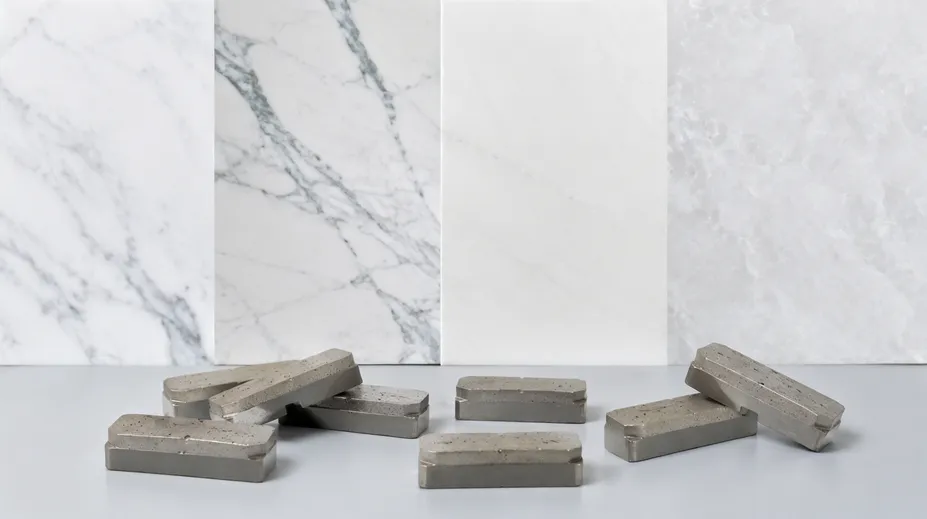
Medium-crystalline structure, moderate hardness within the marble family. Standard cobalt-dominant bond with moderate porosity works well.
These are the highest-volume marble types globally and where our baseline marble formula was originally developed and refined.
Soft, Porous Marbles & Limestones
Travertine · Jura Beige · Crema Marfil
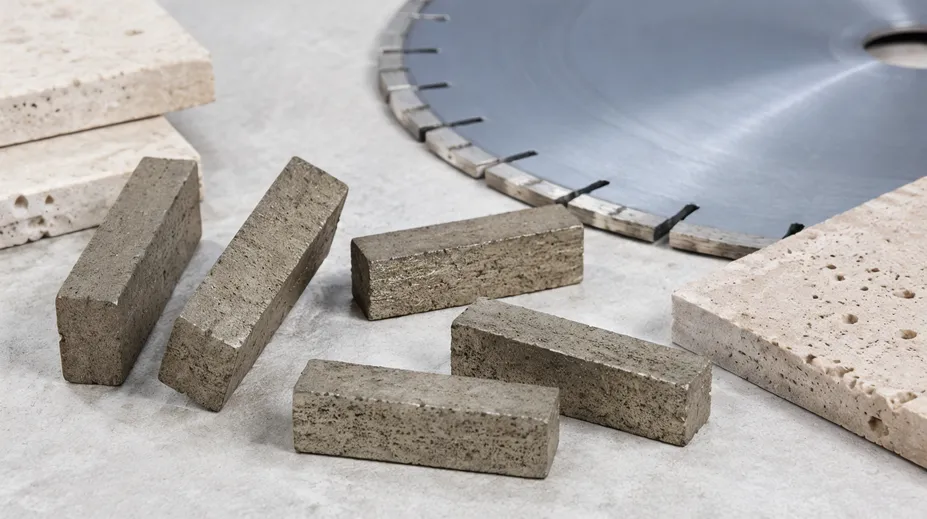
Very low hardness, often with voids and fossils that create inconsistent cutting resistance. The segment needs to handle alternating hard and soft zones without chipping at void edges.
We use a slightly harder bond here — counterintuitive, but the voids already create enough diamond exposure. Too soft a bond in travertine causes accelerated wear without proportional cutting benefit.
Dense, Compact Marbles
Nero Marquina · Emperador Dark · Greek Marbles
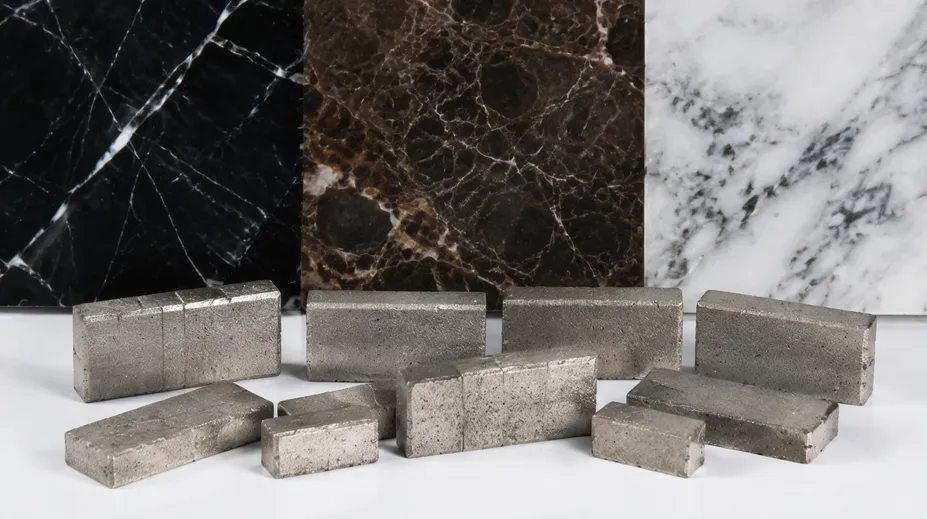
Higher density and more uniform structure than standard white marbles. Closer to the soft end of granite behavior.
These require our medium-soft bond formulas with slightly higher diamond concentration to maintain cut rate through the denser material.
Onyx & Translucent Materials
Onyx varieties · Translucent stone
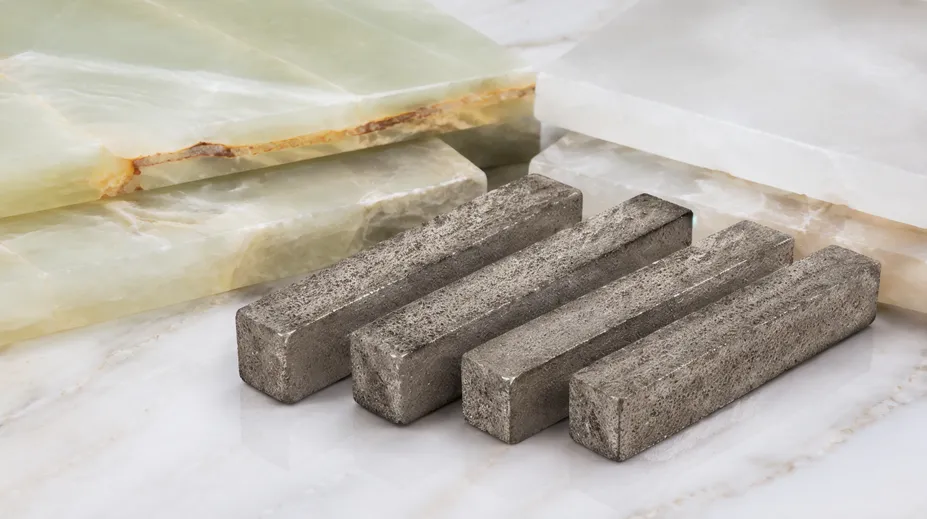
Extremely soft, brittle, prone to cracking and chipping. These need our softest bonds, finest diamond grit (60/80 or finer), and minimal segment aggressiveness.
Most of our onyx-specific segments go to buyers in the Middle East and Turkey where onyx processing is concentrated. Onyx segments are a small volume SKU for us, but if you're in that market, you know how hard it is to find segments that don't shatter the material.
How We Match Your Stone
When you inquire, tell us the marble variety names or send photos. We'll match from the library or adjust parameters if your stone is unusual.
Most buyers in the marble segment carry blades for 2–4 dominant marble types in their market — we spec a formula for each rather than forcing everything through one compromise formula.
Where Marble Segments Drive Revenue for Your Business
Fabrication Shop Supply
Blade Manufacturers & Distributors
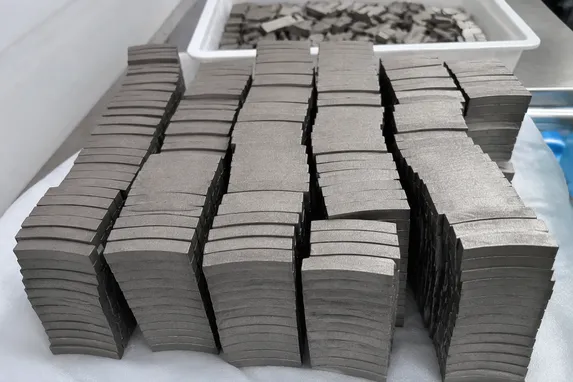
Countertop and slab fabrication shops consume marble segments at a predictable rate — they run bridge saws daily cutting marble slabs to finished dimensions.
If you manufacture or distribute marble saw blades, your segment formula directly determines whether those fabrication shops reorder from your brand or switch to a competitor after the first batch. We supply marble diamond segments to blade manufacturers across Southeast Asia, the Middle East, and Europe who weld our segments onto their own steel cores under their own brand.
Your segment is our formula; your brand carries the performance.
Block Cutting & Quarry Processing
Gang Saws & Block Cutters
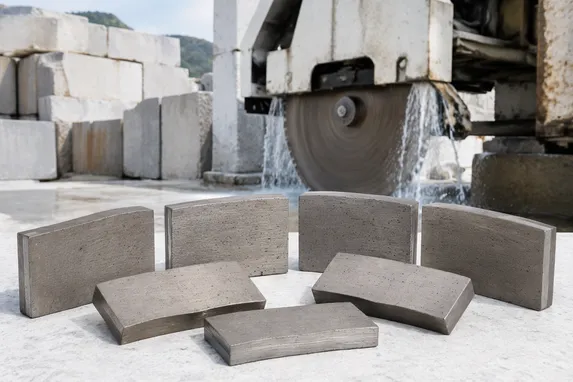
Marble quarries and block-cutting facilities use large-diameter blades (1200mm–3500mm) with gang saw frames or single-blade block cutters. These segments run under heavy coolant flow at slow feed rates for extended periods — sometimes 72 hours continuous cutting per block.
Our gang saw marble segments are sintered with enhanced thermal stability and consistent density across production lots, so every segment on a multi-blade frame wears uniformly. Uneven segment wear across a gang saw set means crooked slab cuts and wasted stone blocks — something quarry operators will not tolerate for a second order.
Gang saw marble segments are our premium tier by engineering complexity. We hold segment hardness within ±0.5 HRC across each production batch for these applications.
Replacement Segment Market
Re-tip & Aftermarket Supply
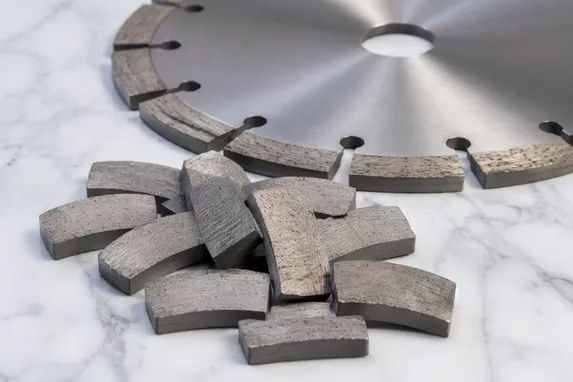
Many buyers don't manufacture complete blades — they purchase bare segments to re-tip existing steel cores or to supply as aftermarket replacement segments.
The replacement segment market is margin-rich because you're selling precision-matched consumables, not competing on blade price. We supply segments in dimensions compatible with major blade brands.
Send us the dimensions of your current segment (or ship a sample), and we'll produce a drop-in replacement at your target price point.
Tell us your marble type and blade application — we'll recommend the right formula.
Get a Formula RecommendationHow We Sinter Marble Segments Differently
The sintering process for marble segments diverges from our granite line at several points, and those differences directly affect your segment's field performance.

Lower Sintering Temperature, Longer Hold Time
Marble segment bonds use higher cobalt content and porosity-inducing agents that require a different thermal profile than high-iron granite bonds.
Extended hold times allow the porosity structure to form uniformly throughout the segment matrix. Rush the hold time and you get inconsistent porosity — some diamonds expose too fast (short life), others stay buried (glazing). We tuned these profiles over hundreds of production runs, correlating sintering parameters with field cutting data from our export markets.
Controlled Atmosphere Sintering
Cobalt-dominant bonds are sensitive to oxidation during sintering. We run marble segment batches under protective atmosphere (nitrogen/hydrogen mix) to prevent cobalt oxide formation on the segment surface.
Oxidized segments bond poorly during welding and can show premature delamination in the field. This is an extra step that lower-cost factories often skip — and it's one reason why cheap marble segments sometimes fall off the blade core after a few hundred cuts.
Post-Sintering Treatment
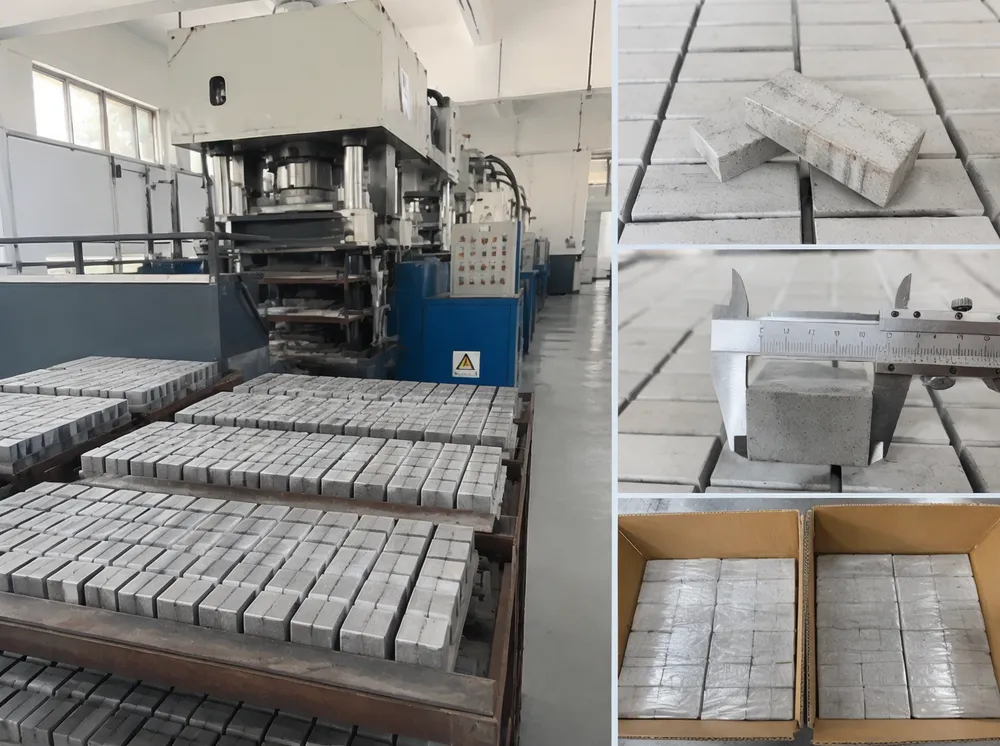
Every marble segment batch goes through base-face grinding to ensure flatness for welding. We also run hardness testing (Rockwell C) on sample segments from each sintering cycle.
Marble Hardness Tolerance
±1.0 HRCof target
Glazing Threshold
2–3 HRCpoints margin
Marble segments have a narrower acceptable hardness range than granite because the difference between "cuts well" and "glazes" in soft stone is a matter of 2–3 HRC points. There's less margin for error.
These process details translate to one outcome you care about: your marble segments perform consistently batch after batch, and your blade customers don't call you to say "the last shipment was fine but this one glazes."
Customization for Marble Diamond Segments
What You Can Customize
| Dimension | Options |
|---|---|
| Bond formula | Adjusted per marble type — hardness, porosity level, cobalt ratio |
| Diamond concentration | 18%–35% (application-dependent) |
| Diamond grit size | 30/35 mesh through 80/100 mesh |
| Segment geometry | Flat-top rectangular, sandwich layer, fan-shaped, custom profiles |
| Segment dimensions | Length 24–140 mm, width 2.8–5.5 mm, height 10–20 mm |
| Welding slot / keyhole | Standard or custom relief patterns for brazing/laser welding |
| Packaging | Neutral, CLSEG-branded, or your private label |
| Quality documentation | Standard batch report, or formatted to your template |
What Has Constraints
Below HRC 10 Bond Hardness
We don't recommend it. The segment becomes too fragile for reliable welding joints and can crack during brazing. If your application seems to need ultra-soft bond, we'll discuss alternative approaches — increased porosity with standard hardness, or finer grit selection.
Segment Height Above 20 mm
Available for large-diameter gang saw applications only. For standard circular saw segments (below 800 mm blade diameter), heights above 15 mm create instability.
Mixed-Formula Batch Orders
Each formula requires a dedicated sintering cycle. We can produce multiple formulas in one shipment, but each formula has its own MOQ — 500 segments for standard, 1,000 for first-order custom formulas.
Rush Lead Time Below 10 Days
Standard marble segments ship in 15–20 days. Custom formulas add 2–3 weeks on first order. Below 10 days is only possible for formulas we've recently run with available inventory.
Send your segment specs or current sample
We'll confirm what's feasible and quote accordingly.
Marble Segments vs. Granite Segments — Selection Guide
If you stock blades for multiple stone types, understanding where marble segments end and granite segments begin saves you from misapplication complaints.
| Factor | Marble Diamond Segment | Granite Diamond Segment |
|---|---|---|
| Bond hardness | HRC 12–22 (soft) | HRC 22–35 (medium to hard) |
| Bond type | Cobalt-dominant, engineered porosity | Iron/cobalt blend, dense matrix |
| Diamond concentration | 18%–35% | 22%–40% |
| Diamond exposure mechanism | Controlled matrix weakness (porosity) | Abrasive wear from stone |
| Ideal stone hardness | Mohs 3–4 (marble, limestone, travertine) | Mohs 6–7 (granite, quartzite) |
| Common failure mode if mismatched | Glazing (bond too hard for stone) | Excessive wear (bond too soft for abrasion) |
| Typical segment life | 15–30 m²/segment (varies by marble type) | 8–20 m²/segment (varies by granite type) |
Bond Hardness
Bond Type
Diamond Concentration
Diamond Exposure Mechanism
Ideal Stone Hardness
Common Failure Mode if Mismatched
Typical Segment Life
Separate SKUs Required
If your market cuts both marble and granite, you need separate blade SKUs with different segment formulas — not a "universal" segment. We supply many blade manufacturers with both formula lines.
OEM Supply — Your Marble Blades, Our Segment Technology
We supply marble diamond segments as OEM components to blade manufacturers and private-label brands in 30+ countries.
You Tell Us
Marble types your market cuts, blade diameters in your product line, desired performance balance (cut speed vs. segment life vs. surface finish).
We Specify
Bond formula, diamond parameters, segment geometry, and pricing based on your volume.
You Test
Sample segments (10–50 pieces) for field validation on your target marble varieties.
We Produce
Production quantities under your brand, with batch quality documentation.
Your Formula Stays Proprietary
Your formula stays locked to your account. We don't share custom formulas with other buyers in your market — your competitive edge stays proprietary. We have formulas on file that have been running for 10+ years for the same customer, with incremental refinements as their market evolves.
MOQ Structure for Marble Segments
Frequently Asked Questions
Why do marble diamond segments glaze over faster than granite segments on the same machine?
It's not about the machine — it's about the stone. Marble is softer and less abrasive, so it doesn't naturally wear down the bond matrix the way granite does. If your marble segment uses a bond designed for harder stone (or a "general-purpose" formula), the matrix stays intact, diamonds can't re-expose, and cutting speed drops progressively.
The fix is a softer bond with engineered porosity that allows diamond re-exposure through normal cutting pressure rather than relying on abrasive wear from the stone.
If you're experiencing glazing on marble, send us your current segment specs — we can diagnose whether the bond hardness is mismatched and recommend an alternative.
What diamond grit size produces the best surface finish on premium marble slabs?
For premium white marbles where surface finish matters (Calacatta, Statuario, bookmatched panels), use 60/80 mesh or finer diamond grit. Finer diamonds create smaller scoring marks on the cut face, reducing the polishing time needed downstream.
The trade-off: finer grit segments cut slower and wear slightly faster than coarser alternatives.
For standard production marble where cut speed matters more than polish-ready surfaces, 40/50 mesh is the practical sweet spot — fast cutting with acceptable surface quality. Most fabrication shops that do both rough cutting and finish work keep two blade types in rotation.
Can I use the same diamond segment for marble and limestone?
In many cases, yes — soft limestone and standard marble respond to similar bond formulas. Dense limestones like Jura Beige or Galala Beige behave almost identically to mid-hardness marbles.
However, porous limestones (travertine, coral stone) create interrupted cutting conditions that benefit from a slightly harder bond to prevent accelerated wear at void edges.
If your market mixes marble and limestone, we can usually find one formula that serves both adequately — but dedicated formulas will always outperform a compromise. Tell us the specific stone names and we'll advise whether one formula covers your range or whether two variants make commercial sense.
How many linear meters of marble can one segment cut?
Segment life depends on marble hardness, cut depth, feed rate, and coolant quality — so precise meter claims are unreliable without knowing your conditions.
Industry-typical ranges: 15–30 m² per segment on standard marble varieties (White Carrara, Crema Marfil, Sivec) using properly matched bond formulas on bridge saw applications. Softer marbles and thin cuts extend life; dense marbles and full-depth block cuts reduce it.
We provide cutting performance estimates specific to your marble type and application after reviewing your requirements — not generic claims that don't account for real-world variation.
What is your lead time for custom-formula marble segments?
First order on a new custom formula: 4–6 weeks total. That includes 2–3 weeks for formula development, test sintering, and in-house cutting validation, plus 2–3 weeks for production and shipping preparation.
Reorders on an established formula: ship in 15–20 days.
If you need standard marble segments from our existing formula library (suitable for common marble types), we can ship within 15–20 days from order confirmation. Sample quantities for field testing ship faster — typically 7–10 days.
Do your marble segments work with laser-welded blades?
Yes. We produce marble segments compatible with both high-frequency welding and laser welding.
For laser-welded applications, the segment base face requires tighter flatness tolerance and specific surface preparation — we grind to ≤0.02 mm flatness for laser-weld segments and can add a pre-tinned layer if your welding process requires it.
Specify your welding method when ordering and we'll adjust the segment finish accordingly.
Start With Your Marble Type
Tell us what marble your market is cutting, what blade sizes are in use, and what performance gap (if any) you're trying to close. We'll match from our marble formula library or develop a custom bond if your application is unusual.
If your current marble segments glaze, wear unevenly, or produce surface finishes your customers complain about — those are formula problems with formula solutions. Send us the details and we'll show you what the right bond specification looks like for your stone.