

OEM & ODM Diamond Tools Custom Manufacturing from the Formula Up
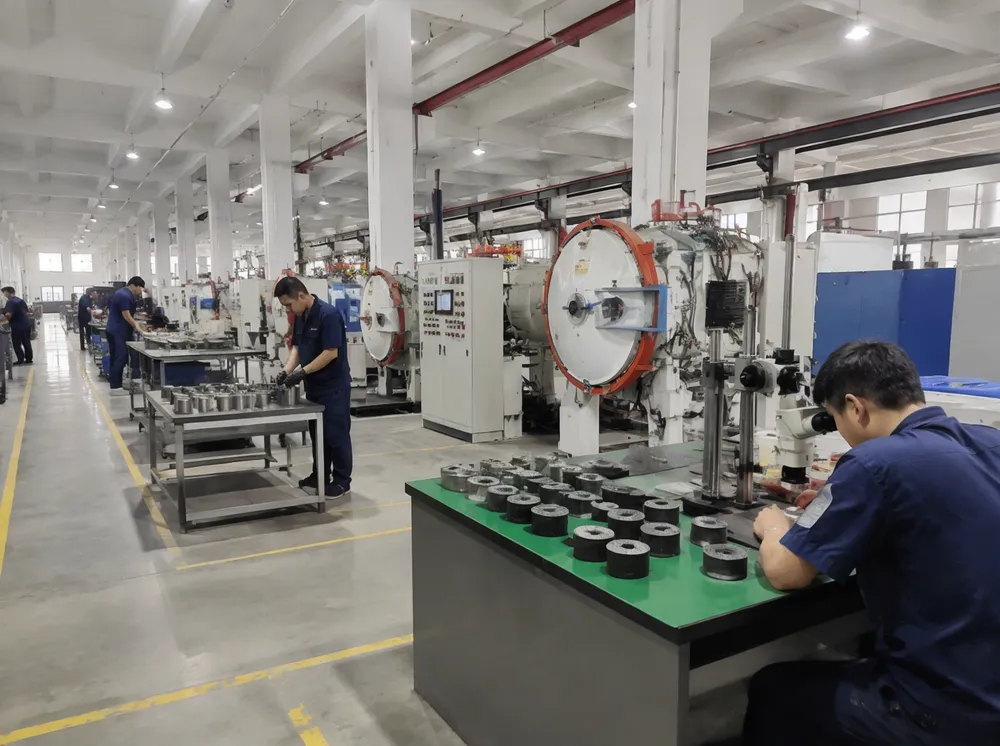
Factory-direct OEM and ODM service for diamond saw blades — every specification layer open to customization, from bond formula to private-label packaging. We don't sub out segments or buy pre-made cores. Every blade that leaves under your label was designed, sintered, welded, and QC'd in our 14,100 m² facility.
That's the difference between a customization service and a rebranding service.
- ISO 9001:2015 Certified
- CE, SGS, MPA Certified
- 60+ Proprietary Patents
- 3,000,000 Pcs Annual Capacity
What OEM and ODM Actually Mean Here
Most factories use "OEM/ODM" as a checkbox on their website. We use it to describe how most of our export business works — private-label programs and custom-spec orders make up the bulk of what we ship internationally, and the infrastructure to support that is built into our production system, not bolted on as a special-request workflow.
OEM — Your Specification, Our Manufacturing
You provide the specification, we manufacture to it. This model suits buyers who already have a proven blade formula, a specific segment geometry, or brand standards that must be matched exactly.
You send us your drawings, samples, or a written spec sheet; our engineering team reviews for manufacturability, flags any adjustments needed, and we produce to your specification. Your name goes on the blade, and your buyers see a product that performs to your brand's standard.
What this gives you:
A differentiated product your competitors can't easily copy.
ODM — Our Proven Designs, Your Brand
You choose from our existing formula and design library, apply your branding, and go to market without investing in product development. This is the faster path for distributors entering a new product category or importers who want to test a market segment before committing to custom tooling.
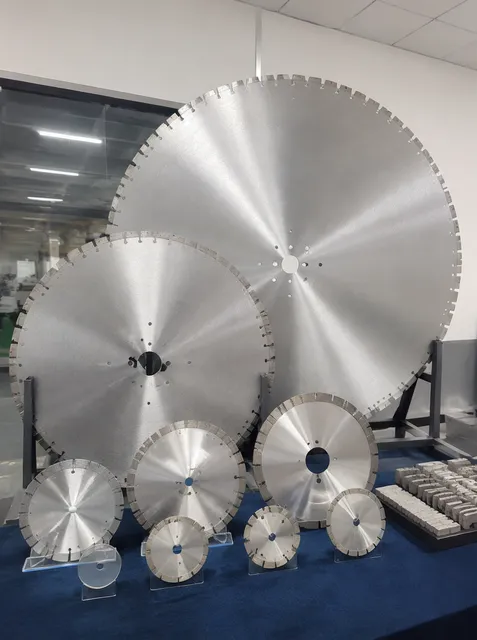
Our catalog covers the full stone-cutting range — from 105 mm angle grinder blades to 3200 mm gang saw segments — so there's very likely a proven formula that fits your target application already.
What this gives you:
Speed-to-market with validated cutting performance.
The Typical Path: ODM First, Then OEM
Most of our long-term partners started with ODM to establish the relationship and test their market, then moved into OEM as their volume grew and their customers developed specific preferences. ODM validates market fit; OEM locks in your competitive advantage.
A word on IP: your OEM formula and tooling are yours. We sign NDAs, we don't cross-sample your specs to other buyers, and your production files are not repurposed. Full details in the IP Protection section below.
What We Can Actually Customize
The credibility test for any OEM claim is specificity: not "we can do custom" but "here is exactly what the customization boundary looks like." These are ours.
Formula and Cutting Specification
This is where most OEM work happens, and it's what we're genuinely equipped to do at depth. Our R&D center holds 60+ patents covering bond formulas and segment geometries. When you need a blade tuned for Brazilian black granite, Indian sandstone, or wet-cutting engineered quartz in the European market, we adjust diamond concentration, grit size, and bond hardness (cobalt-iron ratio, additive type, sintering temperature profile) to match the stone's hardness and abrasiveness.
The result is a blade that outperforms a generic catalog product in your target application — which is what protects your margin when your buyers can compare.
Segment geometry adjustments include:
- Segment height and width
- Gullet pattern (straight, curved, turbo, segmented)
- Undercut geometry for specific machines
- Non-standard arbor configurations

Blade Dimensions and Product Range
Custom diameters are standard — we're not limited to catalog sizes. The range runs from 105 mm cutting discs for angle grinders to 3200 mm segments for quarry gang saws. Custom arbor bore sizes, custom blank thickness, custom segment count per blade — all accessible.
The only constraint is engineering feasibility: some dimension combinations affect dynamic balance or welding joint geometry, and our engineering team will flag those in the review stage rather than produce a blade that underperforms in the field.
105mm
Min Diameter
3200mm
Max Diameter
Custom
Arbor & Thickness
Private Label and Packaging
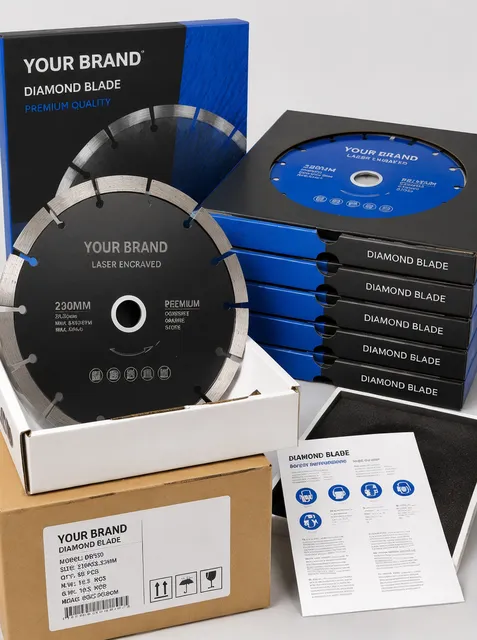
Core color matching, laser-engraved or printed branding on the blade face, custom packaging cartons, custom inner packaging inserts — we handle all of it. If you have brand guidelines with specific Pantone references for your core color, send them over.
If you need blades packaged in retail-ready boxes for your distribution channel, we design and source the packaging to your spec. We've done full retail packaging programs for distributors serving hardware chains in Europe and Southeast Asia — the economics make sense once your volume justifies a custom packaging run, which is typically above 500 units per SKU.
- Laser engraving (logo, model, specs)
- Silk-screen printing (full color)
- Custom core color coating
- Retail-ready box packaging
- Custom carton and pallet labeling
- Multi-language safety inserts
Application-Specific Engineering
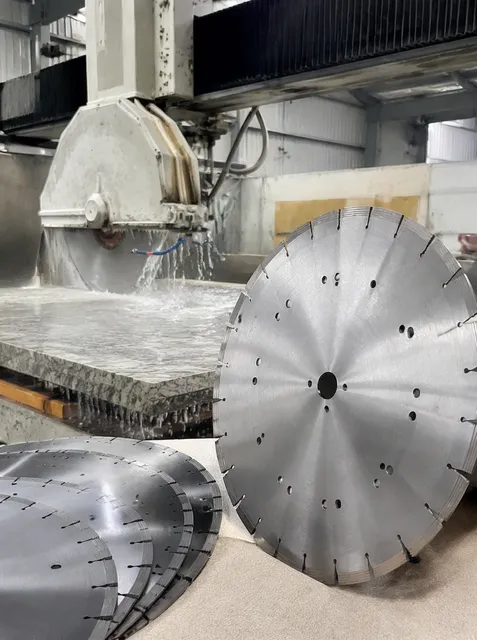
Beyond formula work, we engineer for specific machine types and operating conditions. A blade designed for a bridge saw running at 2800 RPM in a wet-cutting environment has different stress profiles than a hand-held saw blade running dry at 6500 RPM. We account for peripheral speed, cooling method, feed rate expectations, and the operator skill level typical in your market.
If you're supplying blades for a specific machine brand (Breton, Pedrini, Simec, Intermac), we can engineer to that machine's operating envelope. This is where real performance differentiation lives — not in marketing claims but in matched engineering.
Common application engineering requests:
- Blades tuned for specific stone quarry geology (hardness, abrasiveness profile)
- Machine-matched RPM and feed rate optimization
- Noise-reduction core designs for urban job sites
- Extended-life formulas for high-volume production environments
What we won't customize (and why):
We don't compromise on safety-critical parameters. Core steel grade, welding methodology, and dynamic balance tolerances follow our engineering standards regardless of cost pressure. A cheaper core or thinner weld might save $0.30 per blade, but it introduces failure risk at operating speed. We'll explain the tradeoff transparently if it comes up, but we won't ship a blade we wouldn't put our own team behind.
The Development Process: From Brief to Production
Predictability matters when you're coordinating supply chain, marketing, and customer commitments. Here's what the OEM development timeline actually looks like, with real durations — not optimistic ones.
Technical Brief & Specification Review
Week 1–2You send us your requirements — target stone type, machine specs, performance expectations, volume forecasts. Our engineering team reviews feasibility and comes back with a specification proposal, including recommended formula direction and any dimensional constraints.
Output: Agreed specification document with formula direction, dimensions, and target performance metrics.
Sample Production & Internal Testing
Week 3–5We produce sample blades using the agreed formula and geometry. Internal testing on our CNC cutting stations measures cutting speed, wear rate, and segment life against the specification targets. If the formula needs adjustment, we iterate here — not after your customers have the product.
Output: Test samples with internal performance data report. Formula locked if targets are met.
Client-Side Field Testing
Week 5–8We ship samples to you for testing in real-world conditions on your customers' machines with their stone. This step matters because lab results and field results diverge — operator habits, machine condition, water flow, feed pressure all affect performance. Your feedback drives the final formula lock.
Output: Field feedback collected. Final formula adjustment (if needed) and production approval.
Branding, Packaging & Pre-Production Setup
Week 8–10While formula is being locked, we run packaging design in parallel. Artwork proofs, color matching, packaging structure samples — all approved before production starts. Tooling for custom core colors or packaging dies is produced during this window.
Output: Approved artwork files, packaging samples confirmed, tooling ready.
First Production Run & Shipment
Week 10–14Full production run with QC checkpoints at mixing, sintering, welding, and final inspection. First batch includes additional QC sampling for your records. Shipping coordination based on your preferred incoterm (FOB Quanzhou or CIF to your port).
Output: Production-quality product delivered with QC documentation and batch traceability.
Total timeline: 10–14 weeks from brief to delivery
Repeat orders ship within 25–35 days depending on quantity and complexity.
Quality Infrastructure Behind the Product
OEM buyers need to verify quality systems, not just take performance claims at face value. Here's the infrastructure that sits behind every blade we ship under your brand.
Raw Material Verification
Every incoming batch of diamond grit, metal powder, and steel core is tested against spec before entering production. Diamond quality is verified under microscopy for crystal integrity and mesh consistency.
Sintering Process Control
Hot-press sintering with automated temperature and pressure profiling. Each segment batch is logged with time-temperature curves for traceability. Deviation triggers automatic rejection.
Dimensional Inspection
Every blade is checked for diameter tolerance, flatness, and runout. Segment height, width, and spacing verified against the production spec sheet. Out-of-tolerance blades don't ship — they get recycled.
Weld Strength Testing
High-frequency welded segments are pull-tested on every production batch to verify bond strength exceeds the safety threshold for operating speed. This is a non-negotiable safety checkpoint.
Dynamic Balance Testing
Blades above 350 mm are dynamically balanced to minimize vibration at operating speed. Unbalanced blades reduce cut quality, accelerate bearing wear, and create safety risk — so we test every one.
Batch Traceability
Every production batch is traceable from raw material lot through to final packaging. If a quality issue surfaces in the field, we can trace back to the exact production run, formula batch, and operator shift.
Certifications & Standards Compliance
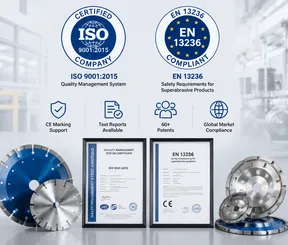
Our manufacturing facility holds ISO 9001:2015 certification. Products are manufactured to comply with EN 13236 (safety requirements for superabrasives) for the European market. We support CE marking documentation and can provide test reports formatted for your market's import requirements.
IP Protection: Your Formula Stays Yours
This is the concern every OEM buyer has and few suppliers address directly. Here's our position, stated plainly.
NDA as Standard
We sign mutual NDAs before any technical discussion begins. Your specifications, formula requirements, and market information are contractually protected from disclosure to any third party.
No Cross-Sampling
Your custom formula is not offered to other buyers. We don't take your specification and produce a "similar" product for a competitor. Each OEM formula is production-locked to your account.
Separated Production Files
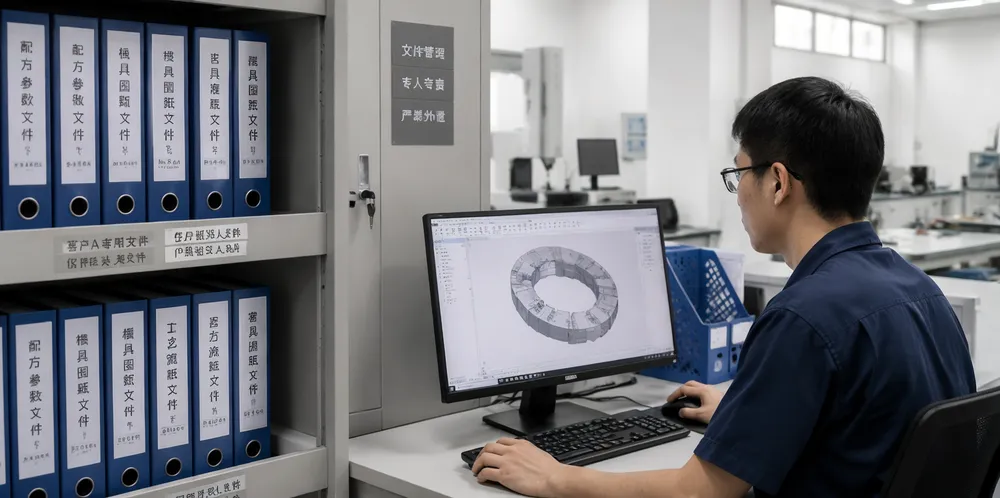
OEM production files (formulas, tooling specs, artwork) are stored in client-specific directories with access restricted to the assigned production team. We don't have a shared pool where your files sit next to your competitor's.
Tooling Ownership
Custom molds and tooling produced for your project are your property. If the relationship ends, your tooling either ships to you or is destroyed — your choice, documented in writing.
Practical note: we're a manufacturer with 30+ years of OEM relationships across 60 countries. Our business model depends on trust — one IP breach would cost us far more in lost partnerships than any short-term gain from cross-sampling. The contractual protections exist because they should, but the commercial incentive is equally strong.
MOQ and Commercial Terms
Transparent commercial terms help you model costs accurately before committing. Here's how our minimums and pricing structure work.
OEM (Your Brand)
First Order MOQ
200 pieces per SKU for standard specifications. Lower MOQs negotiable for initial trial orders with commitment to reorder volume.
Reorder MOQ
100 pieces per SKU on repeat orders. Your tooling is already set up, so the fixed-cost barrier drops significantly.
Custom Formula MOQ
500 pieces per SKU when a unique diamond/bond formula is developed specifically for your requirements. R&D cost sharing applies.
ODM (We Design, Your Brand)
Catalog Selection
100 pieces per SKU from our existing proven formulas. Pick from our range, apply your branding, and ship within 2–3 weeks.
Modified Catalog
200 pieces per SKU when you want adjustments to an existing formula — different segment height, modified bond hardness, or specific arbor configuration.
New Product Development
300 pieces per SKU for entirely new product designs. Includes full engineering, prototyping, and field testing before production commitment.
Pricing Structure
Pricing Basis
FOB Quanzhou
CIF/DDP available on request
Payment Terms
30% deposit, 70% before shipping
Net-30 available for established accounts
Volume Tiers
Quarterly volume discounts
Annual contracts receive best pricing
Tooling Costs
Amortized or upfront
Mold costs recoverable over first 3 orders
Typical Lead Times
| Order Type | Sample/Proto | First Production | Repeat Orders |
|---|---|---|---|
| ODM Catalog | 3–5 days | 15–20 days | 10–15 days |
| OEM Standard | 7–10 days | 20–25 days | 15–20 days |
| OEM Custom Formula | 14–21 days | 25–35 days | 15–20 days |
| New Product Dev | 21–30 days | 30–45 days | 15–25 days |
Lead times are from order confirmation / deposit receipt. Peak season (March–June) may add 5–7 days. Rush production available at premium for existing account holders.
Who This Service Is For
Our OEM/ODM service works best for specific buyer profiles. Here's who gets the most value from partnering with us — and who might be better served elsewhere.
Good Fit
- Tool brands building or expanding a diamond blade product line under their own brand
- Distributors who want exclusive products their competitors can't source from the same factory
- Power tool companies needing matched accessories for their equipment ecosystem
- Rental chains requiring consistent, branded consumables across multiple locations
- Industrial buyers with specific cutting applications that off-the-shelf blades don't solve well
- Companies planning to enter new geographic markets and need local-branded product
Not Ideal For
- One-time buyers looking for a single batch with no reorder intent — our value is in the ongoing partnership
- Buyers whose only criteria is lowest price — we compete on performance-per-dollar, not rock-bottom pricing
- Projects requiring fewer than 50 pieces total across all SKUs — the setup cost won't make economic sense
- Buyers who need next-week delivery on first orders — quality development takes time, and we don't cut corners on it
Not sure which category you fall into? Start a conversation. We'll give you a straight answer about whether we're the right fit — and if not, we'll tell you what to look for in a supplier that is.
Start the Conversation
No pressure, no commitment at this stage. Tell us what you're looking for and we'll respond with a candid assessment of how we can help — or whether another supplier might be a better match.
What Happens Next
- 1 We review your inquiry and respond within 24 hours with initial questions or a preliminary proposal
- 2 Technical discussion to clarify specifications, target performance, and any special requirements
- 3 Sample production and testing (usually 2–3 weeks depending on complexity)
- 4 You test, give feedback, we refine if needed — then move to production order
Direct Contact
Quick Answers
Can I visit the factory?
Yes. We host buyer visits regularly and can arrange airport pickup from Xiamen (XMN). Visits typically scheduled on weekdays.
Do you attend trade shows?
We exhibit at World of Concrete, Bauma, and China Xiamen Stone Fair annually. Happy to schedule a meeting at any upcoming show.
Can I get samples before committing?
Absolutely. Sample cost varies by product type — standard catalog samples are often free, custom formula samples are at cost.
Customization Capability Matrix
Every dimension of the blade is adjustable. This is the full scope of what we configure per OEM program — not a pick-list of pre-built options, but genuine engineering parameters you control.
| Dimension | Customizable Range | Notes |
|---|---|---|
| Blade diameter | 105 mm – 3200 mm | Custom sizes outside catalog available |
| Arbor bore | Standard and non-standard sizes | Confirm against your machine spec |
| Segment formula | Full bond and diamond spec adjustment | Application-matched, not generic |
| Segment geometry | Height, width, gullet pattern, undercut | Per cutting application |
| Steel core type | Standard, silent-core, laser-tensioned | Based on noise/flatness requirement |
| Welding method | High-frequency or laser | Based on use conditions (wet/dry, RPM) |
| Branding | Laser engraving, print, color-coded cores | Brand guideline matching available |
| Packaging | Custom carton, inner packaging, retail-ready | MOQ applies for custom packaging runs |
| Product documentation | Certificates of origin, custom labels, compliance docs | Per target market requirements |
The Collaboration Process, Step by Step
Buyers who haven't done OEM from a Chinese factory before sometimes worry about the process being opaque. Here's exactly what it looks like working with us — no ambiguity in what you need to provide, no surprise steps.
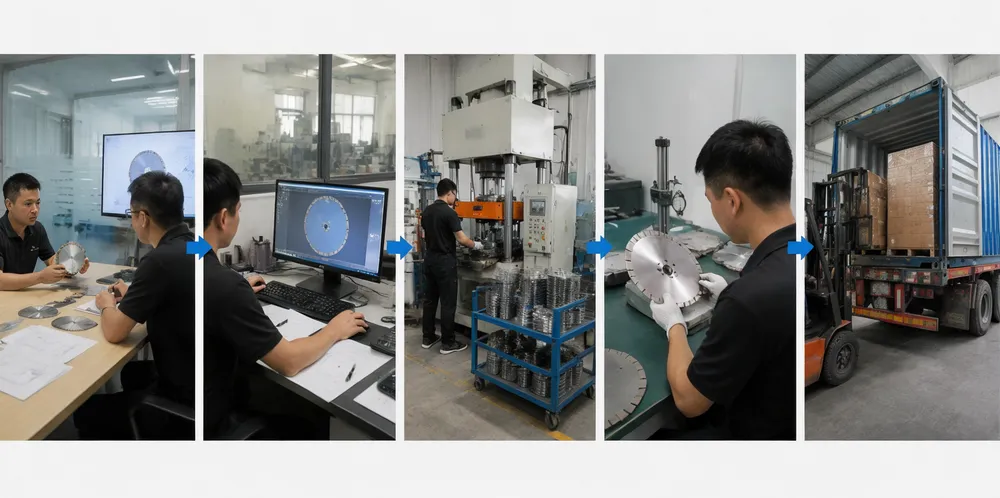
Requirements Discussion
Days 1–5Send us your target application, stone type, blade diameter range, and approximate annual volume. If you have an existing blade you want to match or improve on, send a sample or a detailed spec sheet. If you're starting fresh, describe the end market and we'll recommend a starting specification from our formula library.
We'll come back with an initial specification recommendation, a quote range, and a sample timeline. This is also when we execute the NDA if you're sharing proprietary formulas or design files.
What you provide:
- Target application and stone type
- Blade diameter range
- Approximate annual volume
- Sample blade or spec sheet (if matching existing)
Specification Confirmation and Tooling
Days 5–15For ODM orders, this step is brief — you select from existing formulas and we confirm the configuration. For OEM orders, this is where our engineering team reviews your spec for manufacturability, suggests any adjustments, and we agree on the final specification in writing.
If custom tooling is required (non-standard segment molds, custom core blanks), this is also when tooling is ordered. Tooling lead time varies by complexity — we'll quote it specifically.
Sample Production and Approval
Days 15–35We produce a physical sample run — typically 3–10 blades depending on diameter — and ship them to you for testing. Along with the samples, we send a lab report covering segment density, bond hardness test results, and dimensional verification. You test against your application and either approve the sample or come back with adjustment requests.
Most OEM programs go through one or two sample rounds before approval; complex formula development occasionally requires three.
Why the sample stage matters
The sample stage is where the real engineering conversation happens. When a buyer sends back feedback like "cuts too fast on soft limestone but burns on hard granite," our team translates that into specific adjustments — we increase bond hardness slightly and reduce diamond concentration to extend segment life on the harder material. Having this conversation directly with the people who set the sintering parameters saves weeks compared to working through a trading company.
Mass Production
Days 35–60 from order confirmationOnce samples are approved and you place the production order, we schedule your run on the appropriate production line. 8 automated lines running in parallel mean your order doesn't queue indefinitely — standard OEM programs for established products run 25–40 days from production start, depending on volume. Complex custom programs with new tooling may run 40–55 days.
We provide a production milestone update at the mid-point and a shipping readiness confirmation 5 days before completion.
Quality Inspection and Pre-Shipment
Days 55–65Full outgoing QC before your container is loaded: dimensional checks, runout measurement, visual inspection, weld joint sampling, and cutting performance spot tests. For large-diameter blades, dynamic balance testing is standard.
If you or your agent need to send a third-party inspector (SGS, BV, or your own QC firm), we schedule access with 48 hours' notice — we've had buyers send inspectors for every single shipment; it's never a problem.
Export and Delivery
Shipping coordinationWe pack for ocean freight with moisture barriers and blade-safe cushioning. We prepare export documentation: commercial invoice, packing list, certificate of origin, and any market-specific compliance documentation (CE Declaration of Conformity for EU, for example).
We coordinate with your freight forwarder or use our logistics partners. For repeat orders, documentation turnaround is typically 2–3 days from shipping confirmation.
Commercial Invoice
Packing List
Certificate of Origin
CE Declaration
Custom Labels
Freight Coordination
Ready to start the conversation?
Send your specs or describe your target application. We'll respond with a recommendation within 48 hours.
MOQ and Lead Time Reference
Use this table to scope your initial order and plan production timelines. All lead times run from order confirmation and deposit receipt.
| Order Type | Typical MOQ | Standard Lead Time |
|---|---|---|
| ODM — existing formula, standard size | 200 pieces | 20–30 days |
| ODM — existing formula, custom packaging | 500 pieces | 25–35 days |
| OEM — new spec, existing tooling range | 300 pieces | 35–50 days (incl. sample) |
| OEM — new spec, custom tooling required | 500 pieces | 50–70 days (incl. tooling + sample) |
| Large-diameter blades (≥600 mm) | 50 pieces | 30–45 days |
| Trial / sample orders | 3–10 pieces | 15–25 days |
ODM — existing formula, standard size
ODM — existing formula, custom packaging
OEM — new spec, existing tooling range
Including sample production
OEM — new spec, custom tooling required
Including tooling + sample
Large-diameter blades (≥600 mm)
Trial / sample orders
All lead times run from order confirmation and deposit receipt. Subject to production scheduling at time of order — confirm current lead time when placing your order.
Rush scheduling is available for established OEM partners with consistent volume.
Your Formula and Design Stay Yours — IP Protection
For buyers running an OEM program, IP protection is a real concern — not a checkbox item. Here is how we handle it.
NDA Before Spec Sharing
Before you send us proprietary drawings, existing product samples, or formula specifications, we execute a mutual NDA. This covers formula confidentiality, design file handling, and production exclusivity terms for your specific segment geometry.
We use a standard international NDA format that most buyers' legal teams accept without modification, or we can review your company's template.
Production File Segregation
Your custom formula parameters and segment mold specs are filed under your account and are not shared with other buyers or repurposed for other programs.
Staff who work on your production run have access to your production file; the broader team does not.
This is standard practice for factories running simultaneous OEM programs for competing brands in the same category — which we do. Keeping the files clean is a basic operational requirement.
Tooling Ownership
Custom molds produced for your program are your property. They are stored at our facility for production continuity, but they are documented as owned by you.
- You can request physical transfer of tooling at any time
- You can specify destruction if you end the program
- We do not use your molds for any other buyer's production
Exclusivity Terms
For high-volume OEM programs, we can negotiate formula exclusivity — meaning we do not sell the same bond specification and segment geometry combination under another brand.
This is negotiated on a per-program basis and tied to minimum annual volume commitments.
It's a reasonable arrangement: we get volume certainty, you get market differentiation.
Application Markets Where OEM Programs Run Well
Your buyers purchase blades to deploy in production environments, not for their own use — so the segments that matter commercially are the ones where volume is predictable and application-specific performance creates real margin opportunity.
Natural Stone Fabrication
Granite · Marble · Quartzite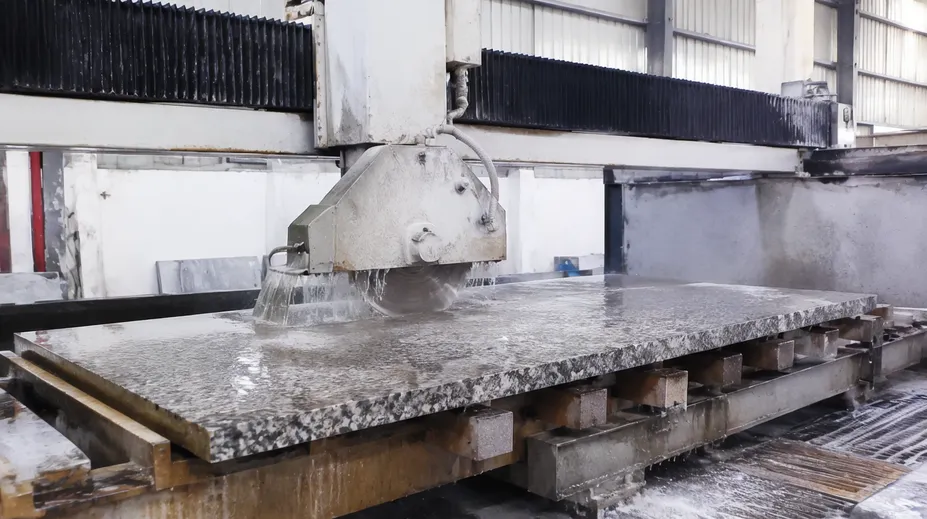
Granite, marble, and quartzite fabricators run bridge saws with predictable annual blade consumption. A blade optimized for their specific stone type reduces downtime from premature segment failure — which is the selling argument that wins you a repeat contract.
Why OEM wins here:
- Formula libraries covering major stone types from Brazil, India, Turkey, and Southeast Asia
- Application-specific optimization reduces premature segment failure
- Predictable consumption cycles enable contract-based repeat orders
Construction & Concrete
Road Saws · Floor Saws · Precast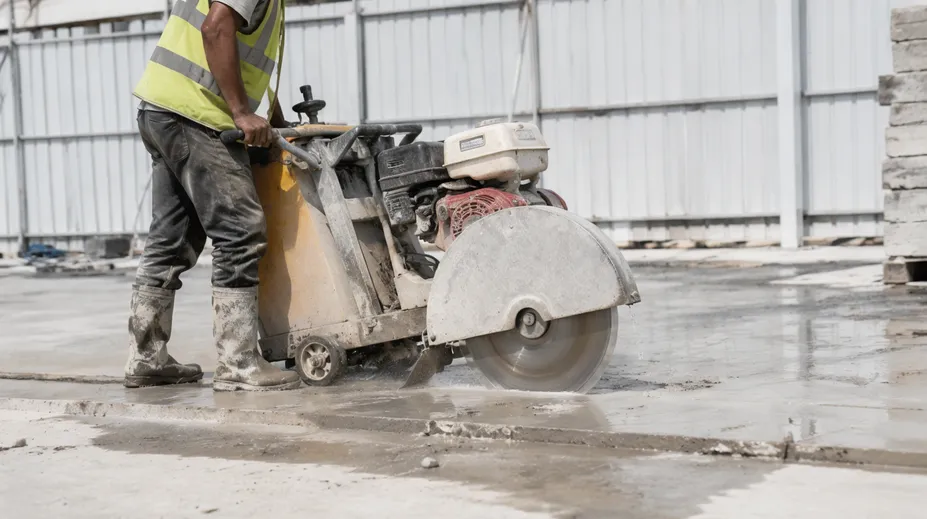
Road saw operators, floor saw contractors, and precast concrete manufacturers consume blades at high volume and are acutely sensitive to cost-per-cut. This is a high-volume OEM segment where your brand competes primarily on price-per-meter-cut, and the formula has to deliver on that metric.
Why OEM wins here:
- Formulas tuned for aggregate hardness ranges common in each regional market
- High-volume segment — price-per-meter-cut is the decisive performance metric
- Cost-sensitive buyers reward consistent, optimized supply programs
Quarry Operations
Block Cutting · Wire Saws · Large-Diameter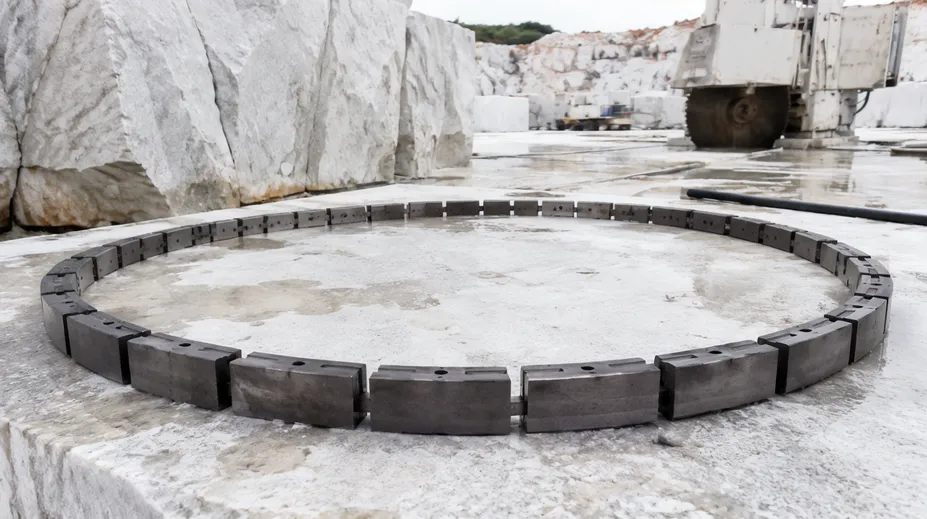
Large-diameter segment supply for block cutting and wire saws is a lower-volume but high-ticket segment. Buyers here are technically sophisticated — they know the diamond spec they need and will test against it rigorously. If you're supplying quarry operators, your brand's credibility rests entirely on technical precision.
Why OEM wins here:
- Your own engineered formula (OEM) rather than a catalog product (ODM) makes a clear commercial difference
- Technically sophisticated buyers test rigorously — formula precision is non-negotiable
- High per-unit value makes lower MOQ viable for large-diameter segments
Tile & Ceramic
All Diameters · Wet & Dry · Multi-Segment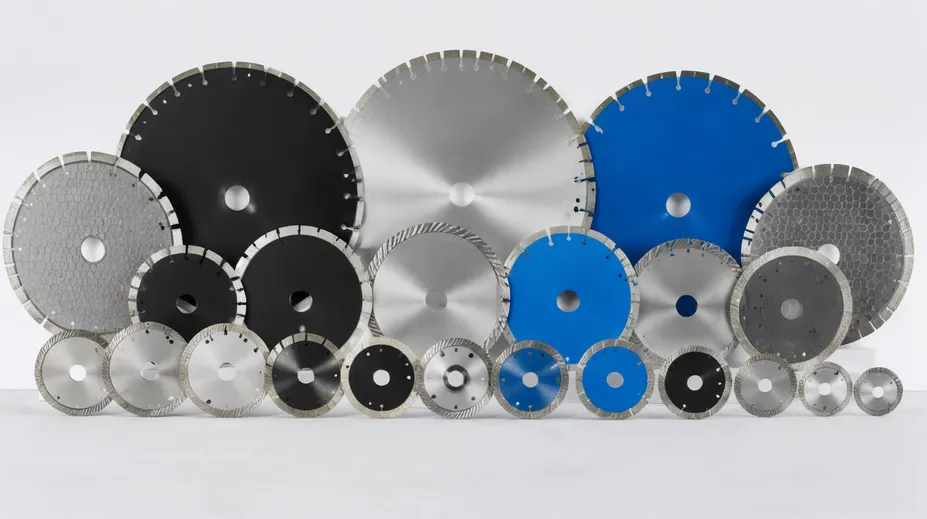
Smaller blades, higher SKU count, more commodity competition. The opportunity here is packaging and SKU range — distributors who can offer a complete tile blade program (all diameter steps, wet and dry cutting variants, multiple segment types) win shelf space over distributors who offer partial ranges.
Why OEM wins here:
- Complete tile blade program under your brand from a single sourcing relationship
- Full SKU range (all diameter steps, wet and dry variants) wins distributor shelf space
- Packaging differentiation creates brand visibility in commodity-heavy segment
FAQ
Answers to the questions we hear most from buyers evaluating private-label and custom blade programs.
What's the minimum order for a private-label program?
For existing formulas with standard dimensions, 200 pieces is our floor. If you need custom packaging, the minimum rises to 500 pieces — below that, the packaging setup cost doesn't make commercial sense for either side.
For large-diameter blades (600 mm and above), 50 pieces is workable given the per-unit value.
Can you match an existing blade we're currently sourcing?
Yes, and this is one of the most common starting points for an OEM program. Send us a sample of your current blade. Our lab will measure the segment dimensions, run composition tests to characterize the bond type and diamond grade, and we'll build a spec that matches or improves on the performance profile.
We've reverse-engineered and improved on competitor blades many times for buyers who were unhappy with their current supplier's consistency.
What file formats do you need for custom blade or packaging designs?
For blade specifications: a drawing in PDF, DWG, or DXF format covering diameter, thickness, arbor bore, segment count, and segment dimensions.
For packaging: AI, PDF, or CDR files with your logo and brand guidelines.
If you only have a concept sketch, our design team can draft production-ready files from your brief — we've done this for buyers who didn't have an in-house design team.
How do you handle quality disputes after delivery?
We document every production run's QC data and keep it on file for 12 months. If a shipment has a performance issue, send us samples from the affected batch, describe the stone type and machine settings, and we'll run parallel tests in our lab.
If the defect traces to production variance on our end, we replace or credit the affected quantity.
Most disputes resolve at the data review stage — having the original production QC records usually clarifies what happened quickly.
Can you accommodate small trial orders before committing to a full program?
Yes. 3–10 pieces is the standard sample quantity for evaluation.
If you want to run a more meaningful market trial — enough to put in the hands of a few key accounts and get real-world feedback — we can produce a commercial trial batch of 50–100 pieces on the ODM program before you commit to OEM tooling.
This is the path we'd recommend for buyers entering a new segment: test the product with your customers first, lock in the formula second.
Start Your OEM or ODM Program
The fastest way to start is to send us your target application — the stone type, the machine type, the blade size, and your approximate annual volume.
Send Us Your Target Application
If you have a current blade you want to match, a sample is more useful than a spec sheet. We'll respond with a specific configuration recommendation and a quote timeline, not a generic catalog.
- Stone type you're cutting
- Machine type and blade size
- Approximate annual volume
- Sample blade to match (if available)
If you're still mapping out your product line strategy and want a technical conversation before committing to anything, that works too. Our engineering team has helped dozens of distributors spec out their first private-label program — the conversation is useful even before you have a firm order in hand.
Contact
WhatsApp / Phone
+86 13177381650Address
Special No. 1, Diamond Industrial Park, Yanji, Ezhou City, Hubei Province, China